Problems
Filters
43 problems found
2025 Paper 2 Q9
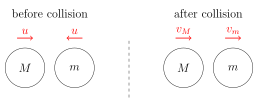
Points \(A\) and \(B\) are at the same height and a distance \(\sqrt{2}r\) apart. Two small, spherical particles of equal mass, \(P\) and \(Q\), are suspended from \(A\) and \(B\), respectively, by light inextensible strings of length \(r\). Each particle individually may move freely around and inside a circle centred at the point of suspension. The particles are projected simultaneously from points which are a distance \(r\) vertically below their points of suspension, directly towards each other and each with speed \(u\). When the particles collide, the coefficient of restitution in the collision is \(e\).
- Show that, immediately after the collision, the horizontal component of each particle's velocity has magnitude \(\frac{1}{2}ev\sqrt{2}\), where \(v^2 = u^2 - gr(2 - \sqrt{2})\) and write down the vertical component in terms of \(v\).
- Show that the strings will become taut again at a time \(t\) after the collision, where \(t\) is a non-zero root of the equation \[(r - evt)^2 + \left(-r + vt - \frac{1}{2}\sqrt{2}gt^2\right)^2 = 2r^2.\]
- Show that, in terms of the dimensionless variables \[z = \frac{vt}{r} \quad \text{and} \quad c = \frac{\sqrt{2}v^2}{rg}\] this equation becomes \[\left(\frac{z}{c}\right)^3 - 2\left(\frac{z}{c}\right)^2 + \left(\frac{2}{c} + 1 + e^2\right)\left(\frac{z}{c}\right) - \frac{2}{c}(1 + e) = 0.\]
- Show that, if this equation has three equal non-zero roots, \(e = \frac{1}{3}\) and \(v^2 = \frac{9}{2}\sqrt{2}rg\). Explain briefly why, in this case, no energy is lost when the string becomes taut.
- In the case described in (iv), the particles have speed \(U\) when they again reach the points of their motion vertically below their points of suspension. Find \(U^2\) in terms of \(r\) and \(g\).
Solution:

- Assuming the particles have mass \(m\), and speed \(v\) just before collision, then \begin{align*} \text{COE}: && \underbrace{\frac12 m u^2}_{\text{initial kinetic energy}} + \underbrace{0}_{\text{initial GPE}} &= \underbrace{\frac12m v^2}_{\text{kinetic energy just before collision}} + \underbrace{mgr\left(1-\frac1{\sqrt{2}}\right)}_{\text{GPE just before collision}} \\ \Rightarrow && v^2 &= u^2 - gr(2-\sqrt{2}) \end{align*} Therefore the particles has velocity \(\frac{\sqrt{2}}2v \binom{\pm 1}{1}\) before the collision. By symmetry, the impulse between the particles will be horizontal, so the vertical velocities will be unchanged at \(\frac{\sqrt{2}}{2}v\). By conservation of momentum (or symmetry) the particles will have equal but opposite velocities after the collision (say \(w\)) satisfying: \[ e = \frac{2w}{2\frac{\sqrt{2}}{2}v} \] ie \(w = \frac{\sqrt{2}}2 e v\) as required.
- Once the particles have rebounded, they will be projectiles whilst the strings are slack. If we consider the left-most point \(A = (0,0)\) then the particles colide at \(\left ( \frac{\sqrt{2}}{2}, -\frac{\sqrt{2}}{2} \right)\) and the position at time \(t\) after the collision (before the string goes slack) will be: \begin{align*} \mathbf{x}_t &= \frac{\sqrt{2}}{2}r\binom{1}{-1} + \frac{\sqrt{2}}{2} vt \binom{-e}{1} + \frac12 gt^2 \binom{0}{-1} \end{align*} The string will go taught when \(|\mathbf{x}_t|^2 = r^2\), ie \begin{align*} && r^2 &= \left ( \frac{\sqrt{2}}{2} r - \frac{\sqrt{2}}{2}evt \right)^2 + \left (-\frac{\sqrt{2}}{2} r + \frac{\sqrt{2}}{2}vt -\frac12 gt^2 \right)^2 \\ \Rightarrow && r^2 &= \frac12 \left (r - evt \right)^2 + \frac12 \left (-r+vt - \frac{\sqrt{2}}{2}gt^2 \right)^2 \\ \Rightarrow && 2r^2 &= \left (r - evt \right)^2 + \left (-r+vt - \frac{\sqrt{2}}{2}gt^2 \right)^2 \\ \end{align*} as required.
- Suppose \(z = \frac{vt}{r}\), \(c = \frac{\sqrt{2}v^2}{rg}\), then \begin{align*} && 2r^2 &= \left (r - evt \right)^2 + \left (-r+vt - \frac{\sqrt{2}}{2}gt^2 \right)^2 \\ \Leftrightarrow && 2 &= \left (1 - e\frac{vt}{r} \right)^2 + \left (-1 + \frac{vt}{r}- \frac{\sqrt{2}}{2} \frac{gt^2}{r} \right)^2 \\ \Leftrightarrow && 2 &= \left (1 - ez \right)^2 + \left (-1 +z- \frac{v^2t^2}{r^2} \frac{gr}{\sqrt{2}v^2}\right)^2 \\ \Leftrightarrow && 2 &= \left (1 - ez \right)^2 + \left (-1 +z- \frac{z^2}{c} \right)^2 \\ \Leftrightarrow && 2 &= 1-2ez + e^2z^2 + 1 + z^2 +\frac{z^4}{c^2} - 2z-2\frac{z^3}{c}+2\frac{z^2}{c} \\ \Leftrightarrow && 0 &= z(-2e-2) + z^2(e^2+1 + \frac{2}{c}) + z^3(-\frac{2}{c}) + z^4 \frac{1}{c^2} \\ \underbrace{\Leftrightarrow}_{z \neq 0} && 0 &= \left ( \frac{z}{c} \right)^3 - 2\left ( \frac{z}{c} \right)^2 + \left ( \frac{z}{c} \right) (1 + e^2 + \frac{2}{c} ) - \frac{2}{c}(1+e) \end{align*} as required, (where on the last step we divide by \(z/c\)).
- If a cubic has \(3\) equal, non-zero roots then it must have the form \((z-a)^3 = z^3 -3az^2 + 3a^2 z -a^3 = 0\), so \(3a = 2\), and so the expansion must be \(\left ( \frac{z}{c} \right)^3 - 2\left ( \frac{z}{c} \right)^2 + \frac{4}{3}\left ( \frac{z}{c} \right) - \frac{8}{27} = 0\) \begin{align*} && \frac{2}{c}(1+e) &= \frac{8}{27} \\ \Rightarrow && \frac{2}{c} &= \frac{8}{27} \frac{1}{1+e} \\ && 1 + e^2 + \frac{2}{c} &= \frac43 \\ \Rightarrow && e^2 + \frac{8}{27(1+e)} &= \frac{1}{3} \\ \Rightarrow && 27(1+e)e^2+8 &= 9(1+e) \\ \Rightarrow && 27e^3 + 27e^2-9e-1 &= 0 \\ \Rightarrow && (3e-1)(9e^2+12e+1) &= 0 \end{align*} The only (positive) root is \(e = \frac13\), therefore \(e = \frac13\). We must also have \begin{align*} && \frac{2}{c} \frac43 &= \frac{8}{27} \\ \Rightarrow && c &= 9 \\ \Rightarrow && \frac{\sqrt{2}v^2}{rg} &= 9 \\ \Rightarrow && v^2 &= \frac{9\sqrt{2}rg}{2} \end{align*} as required. If we consider the path of the particle acting as a projectile, iff the path is tangent to the circle then there will be exactly one solution for \(z/c\) and (importantly) it will be a repeated root. Therefore the particle rejoins the circle at a tangent and the tension is acting perpendicularly to the direction of motion (ie no energy loss).
- Since the only energy lost is lost in the collision, we can apply conservation of energy again: \begin{align*} \text{COE:} && \frac12 m U^2 &= \frac12 m \frac12v^2(1+e^2) + mgr\left (1 - \frac1{\sqrt{2}} \right) \\ \Rightarrow && U^2 &= \frac12 \frac{9 \sqrt{2}}{2}gr(1+\frac19) + gr(2 - \sqrt{2}) \\ &&&= \left (\frac{5\sqrt{2}}{2}+2 - \sqrt{2} \right)gr \\ &&&= \left (\frac{4+3\sqrt{2}}{2} \right)gr \end{align*}
2024 Paper 3 Q9
The origin \(O\) of coordinates lies on a smooth horizontal table and the \(x\)- and \(y\)-axes lie in the plane of the table. A smooth sphere \(A\) of mass \(m\) and radius \(r\) is at rest on the table with its lowest point at the origin. A second smooth sphere \(B\) has the same mass and radius and also lies on the table. Its lowest point has \(y\)-coordinate \(2r\sin\alpha\), where \(\alpha\) is an acute angle, and large positive \(x\)-coordinate. Sphere \(B\) is now projected parallel to the \(x\)-axis, with speed \(u\), so that it strikes sphere \(A\). The coefficient of restitution in this collision is \(\frac{1}{3}\).
- Show that, after the collision, sphere \(B\) moves with velocity \[\begin{pmatrix} -\frac{1}{3}u\bigl(1 + 2\sin^2\alpha\bigr) \\ \frac{2}{3}u\sin\alpha\cos\alpha \end{pmatrix}.\]
- Show further that the lowest point of sphere \(B\) crosses the \(y\)-axis at the point \((0, Y)\), where \(Y = 2r(\cos\alpha\tan\beta + \sin\alpha)\) and \[\tan\beta = \frac{2\sin\alpha\cos\alpha}{1 + 2\sin^2\alpha}.\]
- Show that, if \(h > Y + 2r\sec\beta\), sphere \(B\) will not strike sphere \(C\) in its motion after the collision with sphere \(A\).
- Show that \(Y < 2r\sec\beta\). Hence show that sphere \(B\) will not strike sphere \(C\) for any value of \(\alpha\), if \(h > \dfrac{8r}{\sqrt{3}}\).
2022 Paper 3 Q9
- Two particles \(A\) and \(B\), of masses \(m\) and \(km\) respectively, lie at rest on a smooth horizontal surface. The coefficient of restitution between the particles is \(e\), where \(0 < e < 1\). Particle \(A\) is then projected directly towards particle \(B\) with speed \(u\). Let \(v_1\) and \(v_2\) be the velocities of particles \(A\) and \(B\), respectively, after the collision, in the direction of the initial velocity of \(A\). Show that \(v_1 = \alpha u\) and \(v_2 = \beta u\), where \(\alpha = \dfrac{1 - ke}{k+1}\) and \(\beta = \dfrac{1+e}{k+1}\). Particle \(B\) strikes a vertical wall which is perpendicular to its direction of motion and a distance \(D\) from the point of collision with \(A\), and rebounds. The coefficient of restitution between particle \(B\) and the wall is also \(e\). Show that, if \(A\) and \(B\) collide for a second time at a point \(\frac{1}{2}D\) from the wall, then \[ k = \frac{1+e-e^2}{e(2e+1)}\,. \]
- Three particles \(A\), \(B\) and \(C\), of masses \(m\), \(km\) and \(k^2m\) respectively, lie at rest on a smooth horizontal surface in a straight line, with \(B\) between \(A\) and \(C\). A vertical wall is perpendicular to this line and lies on the side of \(C\) away from \(A\) and \(B\). The distance between \(B\) and \(C\) is equal to \(d\) and the distance between \(C\) and the wall is equal to \(3d\). The coefficient of restitution between each pair of particles, and between particle \(C\) and the wall, is \(e\), where \(0 < e < 1\). Particle \(A\) is then projected directly towards particle \(B\) with speed \(u\). Show that, if all three particles collide simultaneously at a point \(\frac{3}{2}d\) from the wall, then \(e = \frac{1}{2}\).
2021 Paper 3 Q9
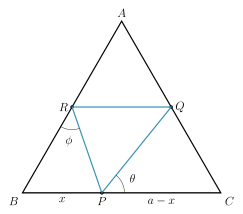
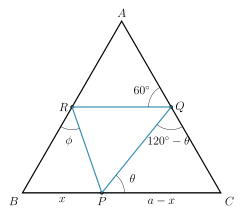
An equilateral triangle \(ABC\) has sides of length \(a\). The points \(P\), \(Q\) and \(R\) lie on the sides \(BC\), \(CA\) and \(AB\), respectively, such that the length \(BP\) is \(x\) and \(QR\) is parallel to \(CB\). Show that \[ (\sqrt{3}\cot\phi + 1)(\sqrt{3}\cot\theta + 1)x = 4(a - x), \] where \(\theta = \angle CPQ\) and \(\phi = \angle BRP\). A horizontal triangular frame with sides of length \(a\) and vertices \(A\), \(B\) and \(C\) is fixed on a smooth horizontal table. A small ball is placed at a point \(P\) inside the frame, in contact with side \(BC\) at a distance \(x\) from \(B\). It is struck so that it moves round the triangle \(PQR\) described above, bouncing off the frame at \(Q\) and then \(R\) before returning to point \(P\). The frame is smooth and the coefficient of restitution between the ball and the frame is \(e\). Show that \[ x = \frac{ae}{1 + e}. \] Show further that if the ball continues to move round \(PQR\) after returning to \(P\), then \(e = 1\).
Solution:
2019 Paper 3 Q10
Two identical smooth spheres \(P\) and \(Q\) can move on a smooth horizontal table. Initially, \(P\) moves with speed \(u\) and \(Q\) is at rest. Then \(P\) collides with \(Q\). The direction of travel of \(P\) before the collision makes an acute angle \(\alpha\) with the line joining the centres of \(P\) and \(Q\) at the moment of the collision. The coefficient of restitution between \(P\) and \(Q\) is \(e\) where \(e < 1\). As a result of the collision, \(P\) has speed \(v\) and \(Q\) has speed \(w\), and \(P\) is deflected through an angle \(\theta\).
- Show that $$u \sin \alpha = v \sin(\alpha + \theta)$$ and find an expression for \(w\) in terms of \(v\), \(\theta\) and \(\alpha\).
- Show further that $$\sin \theta = \cos(\theta + \alpha) \sin \alpha + e \sin(\theta + \alpha) \cos \alpha$$ and find an expression for \(\tan \theta\) in terms of \(\tan \alpha\) and \(e\). Find, in terms of \(e\), the maximum value of \(\tan \theta\) as \(\alpha\) varies.
Solution:
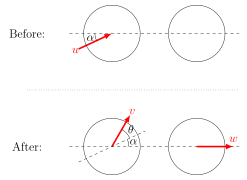
- Since the impulse is along the line of centres, the velocities are as show in the diagram. Additionally, vertical velocity is unchanged, so: \(v \sin (\theta + \alpha) = u \sin \alpha\) \begin{align*} \text{COM}(\rightarrow): && u \cos\alpha &= v \cos(\alpha + \theta) + w \\ \Rightarrow && w &= u \cos \alpha - v \cos (\alpha + \theta) \end{align*}
- Since the approach speed (horizontally) is \(u \cos \alpha\) the speed of separation is \(e u \cos \alpha\), in particular \(w - v \cos(\theta + \alpha) = e u \cos \alpha\) or \(w = v \cos (\theta + \alpha) + e u \cos \alpha\). \begin{align*} && w &= w \\ && v \cos (\theta + \alpha) + e u \cos \alpha &= u \cos \alpha - v \cos (\alpha + \theta) \\ \Rightarrow && \frac{u \sin \alpha}{\sin (\alpha + \theta)} \cos (\theta + \alpha) + e u \cos \alpha &= u \cos \alpha - \frac{u \sin \alpha}{\sin (\alpha + \theta)} \cos (\alpha + \theta) \\ \Rightarrow && \sin \alpha \cos(\theta + \alpha) + e \sin (\alpha+\theta)\cos \alpha &= \sin(\alpha+\theta) \cos \alpha - \cos(\alpha+\theta)\sin \alpha \\ &&&= \sin ((\alpha+\theta)-\alpha) \\ &&&= \sin \theta \end{align*} as required. \begin{align*} && \sin \theta &= \cos(\theta+ \alpha)\sin \alpha + e \sin (\theta + \alpha) \cos \alpha \\ &&&= \cos \theta \cos \alpha \sin \alpha - \sin \theta \sin^2 \alpha + e \sin \theta \cos ^2 \alpha + e \cos \theta \sin \alpha \cos \alpha \\ \Rightarrow && \tan \theta \sec^2 \alpha &= \tan \alpha - \tan \theta \tan^2 \alpha + e \tan \theta + e \tan \alpha \\ \Rightarrow && \tan \theta (1 + \tan^2 \alpha+\tan^2 \alpha-e) &= \tan \alpha + e \tan \alpha \\ \Rightarrow && \tan \theta &= \frac{(1+e)\tan \alpha}{1-e + 2\tan^2 \alpha} \end{align*} We seek to maximise \(y = \frac{x}{c+2x^2}\), \begin{align*} && \frac{\d y}{\d x} &= \frac{c+2x^2-4x^2}{(c+2x^2)^2} \\ &&&= \frac{c-2x^2}{(c+2x^2)^2} \end{align*} Therefore the maximum will occur at \(x = \sqrt{c/2}\), ie \(\tan \alpha = \sqrt{(1-e)/2}\) and theta will be \(\displaystyle \frac{(1+e)\sqrt{(1-e)/2}}{2(1-e)} =\frac{1}{2\sqrt{2}} \frac{1+e}{\sqrt{1-e}}\)
2018 Paper 2 Q9
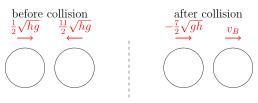
Two small beads, \(A\) and \(B\), of the same mass, are threaded onto a vertical wire on which they slide without friction, and which is fixed to the ground at \(P\). They are released simultaneously from rest, \(A\) from a height of \(8h\) above \(P\) and \(B\) from a height of \(17h\) above \(P\). When \(A\) reaches the ground for the first time, it is moving with speed \( V\). It then rebounds with coefficient of restitution \(\frac{1}{2}\) and subsequently collides with \(B\) at height \(H\) above \(P\). Show that \(H= \frac{15}8h\) and find, in terms of \(g\) and \(h\), the speeds \(u_A\) and \(u_B\) of the two beads just before the collision. When \(A\) reaches the ground for the second time, it is again moving with speed \( V\). Determine the coefficient of restitution between the two beads.
Solution: \begin{align*} && v^2 &= u^2 +2as \\ \Rightarrow && V^2 &= 2 g \cdot (8h)\\ \Rightarrow && V &=4\sqrt{hg}\\ \end{align*} When the first particle collides with the ground, the second particle is at \(9h\) traveling with speed \(V\), the first particle is at \(0\) traveling (upwards) with speed \(\tfrac12 V\). For a collision we need: \begin{align*} && \underbrace{\frac12 V t- \frac12 g t^2}_{\text{position of A}} &= \underbrace{9h - Vt - \frac12 gt^2}_{\text{position of B}} \\ \Rightarrow && \frac32Vt &= 9h \\ \Rightarrow && t &= \frac{6h}{V} \\ \\ && \underbrace{\frac12 V t- \frac12 g t^2}_{\text{position of A}} &= \frac12 V \frac{6h}{V} - \frac12 g t^2 \\ &&&= 3h - \frac12 g\frac{36h^2}{16hg} \\ &&&= 3h - \frac{9}{8}h \\ &&&= \frac{15}{8}h \end{align*} Just before the collision, \(A\) will be moving with velocity (taking upwards as positive) \begin{align*} && u_A &= \frac12 V-gt \\ &&&= 2\sqrt{hg}-g \frac{6h}{V} \\ &&&= 2\sqrt{hg} - g \frac{6h}{4\sqrt{hg}} \\ &&&= 2\sqrt{hg}-\frac32\sqrt{hg} \\ &&&= \frac12 \sqrt{hg} \end{align*} Similarly, for \(B\). \begin{align*} && u_B &= -V -gt \\ &&&= -4\sqrt{hg} - \frac32\sqrt{hg} \\ &&&= -\frac{11}{2}\sqrt{hg} \end{align*} Considering \(A\), to figure out \(v_A\). \begin{align*} && v^2 &= u^2 + 2as \\ && V^2 &= v_A^2 + 2g\frac{15}{8}h \\ && 16hg &= v_A^2 + \frac{15}{4}gh \\ \Rightarrow && v_A^2 &= \frac{49}{4}gh \\ \Rightarrow && v_A &= -\frac{7}{2}\sqrt{gh} \end{align*}
2018 Paper 3 Q9
A particle \(P\) of mass \(m\) is projected with speed \(u_0\) along a smooth horizontal floor directly towards a wall. It collides with a particle \(Q\) of mass \(km\) which is moving directly away from the wall with speed \(v_0\). In the subsequent motion, \(Q\) collides alternately with the wall and with \(P\). The coefficient of restitution between \(Q\) and \(P\) is \(e\), and the coefficient of restitution between \(Q\) and the wall is 1. Let \(u_n\) and \(v_n\) be the velocities of \(P\) and \(Q\), respectively, towards the wall after the \(n\)th collision between \(P\) and \(Q\).
- Show that, for \(n\ge2\), \[ (1+k)u_{n} - (1-k)(1+e)u_{n-1} + e(1+k)u_{n-2} =0\,. \tag{\(*\)} \]
- You are now given that \(e=\frac12\) and \(k = \frac1{34}\), and that the solution of \((*)\) is of the form \[ \phantom{(n\ge0)} u_n= A\left( \tfrac 7{10}\right)^n + B\left( \tfrac 5{7 }\right)^n \ \ \ \ \ \ (n\ge0) \,, \] where \(A\) and \(B\) are independent of \(n\). Find expressions for \(A\) and \(B\) in terms of \(u_0\) and \(v_0\). Show that, if \(0 < 6u_0 < v_0\), then \(u_n\) will be negative for large \(n\).
Solution:
- Just before collision \(n-1\): Velocity of \(P\) is \(u_{n-2}\) Velocity of \(Q\) is \(-v_{n-2}\) \begin{align*} COM: && mu_{n-2}+km(-v_{n-2}) &= mu_{n-1}+kmv_{n-1} \\ \Rightarrow && u_{n-2}-kv_{n-2} &= u_{n-1}+kv_{n-1} \\ NEL: && v_{n-1}-u_{n-1} &= -e((-v_{n-2})-u_{n-2}) \\ \Rightarrow && v_{n-1}-u_{n-1} &= e(v_{n-2}+u_{n-2}) \end{align*} \begin{align*} &&kv_{n-1} &= u_{n-2} - kv_{n-2}-u_{n-1} \\ &&kv_{n-1}&= ku_{n-1}+kev_{n-2}+keu_{n-2} \\ \Rightarrow && kv_{n-2}(1+e) &= u_{n-2}(1-ke)-u_{n-1}(1+k) \\ \Rightarrow && kv_{n-1}(1+e) &= u_{n-1}(1-ke)-u_{n}(1+k) \\ && k(1+e)v_{n-1}-k(1+e)u_{n-1} &= k(1+e)e(v_{n-2}+u_{n-2}) \\ \Rightarrow && u_{n-1}(1-ke)-u_{n}(1+k)-k(1+e)u_{n-1} &= e(u_{n-2}(1-ke)-u_{n-1}(1+k))+k(1+e)eu_{n-2} \\ \Rightarrow && 0 &= (1+k)u_n + ((ke-1)+k(1+e)-e(1+k))u_{n-1} \\ &&& \quad \quad + (e(1-ke)+k(1+e)e)u_{n-2} \\ \Rightarrow && 0 &= (1+k)u_n- (1-k)(1+e)u_{n-1} +e(1+k)u_{n-2} \end{align*}
- \(u_0 = A + B\) \begin{align*} &&& \begin{cases}u_0 - kv_0 &= kv_1 + u_1 \\ \frac12 (u_0+v_0) &= v_1 - u_1 \\ \end{cases} \\ \Rightarrow && (1+k)u_1 &= u_0 - kv_0 - \frac{k}{2}(u_0 + v_0) \\ \Rightarrow && u_1 &= \frac{1}{k+1} \l u_0 (1-\frac{k}{2}) - \frac32 k v_0 \r \\ &&&= \frac{67}{70} u_0 - \frac{3}{70} v_0 \end{align*} Therefore \(A+B = u_0, \frac{49A+50B}{70} = \frac{67}{70} u_0 - \frac{3}{70} v_0\) \begin{align*} && A+B &= u_0 \\ && 49A+50B &= 67u_0 - 3v_0 \\ \Rightarrow && 50u_0 - A &= 67u_0 - 3v_0 \\ \Rightarrow && A &= -17u_0 + 3v_0 \\ && B &= 18u_0 - 3v_0 \end{align*} If \(0 < 6u_0 < v_0\), then \(B < 0\) and as \(n \to \infty\) we will find that \(\l \frac57 \r^n\) dominates \(\l \frac7{10} \r^n\) and so our velocity will be negative and the particle will change direction
2017 Paper 1 Q10
Particles \(P_1\), \(P_2\), \(\ldots\) are at rest on the \(x\)-axis, and the \(x\)-coordinate of \(P_n\) is \(n\). The mass of \(P_n\) is \(\lambda^nm\). Particle \(P\), of mass \(m\), is projected from the origin at speed \(u\) towards \(P_1\). A series of collisions takes place, and the coefficient of restitution at each collision is \(e\), where \(0 < e <1\). The speed of \(P_n\) immediately after its first collision is \(u_n\) and the speed of \(P_n\) immediately after its second collision is \(v_n\). No external forces act on the particles.
- Show that \(u_1=\dfrac{1+e}{1+\lambda}\, u\) and find expressions for \(u_n\) and \(v_n\) in terms of \(e\), \(\lambda\), \(u\) and \(n\).
- Show that, if \(e > \lambda\), then each particle (except \(P\)) is involved in exactly two collisions.
- Describe what happens if \(e=\lambda\) and show that, in this case, the fraction of the initial kinetic energy lost approaches \(e\) as the number of collisions increases.
- Describe what happens if \(\lambda e=1\). What fraction of the initial kinetic energy is \mbox{eventually} lost in this case?
Solution:
- \begin{align*} \text{COM}: && mu &= mv + \lambda m u_1 \\ \Rightarrow && u &= v + \lambda u_1 \tag{1} \\ \text{NEL}: && e &= \frac{u_1-v}{u} \\ \Rightarrow && eu &= u_1 - v \tag{2} \\ (1)+(2) && (1+e)u &= (1+\lambda) u_1 \\ \Rightarrow && u_1 &= \frac{1+e}{1+\lambda}u \\ && v &= u_1 - eu \\ &&&= \frac{1+e - (1+\lambda)e}{1+\lambda} u \\ &&&= \frac{1-\lambda e}{1+\lambda}u \end{align*} Note that subsequent (first (and second)) are the same as these, therefore: \begin{align*} u_n &= \left ( \frac{1+e}{1+\lambda} \right)^n u \\ v_n &= \frac{1-\lambda e}{1+\lambda } u_n \\ &= \frac{1-\lambda e}{1+\lambda } \left ( \frac{1+e}{1+\lambda} \right)^n u \end{align*}

- If \(e > \lambda\) then \((1-\lambda e) > 1-e^2 > 0\) and \begin{align*} \frac{v_{n+1}}{v_n} &= \frac{1+e}{1+\lambda} > 1 \end{align*} So the particles are moving away from each other - hence no more collisions.
- If \(e = \lambda\) then \(u_n = u\) and \(v_n = (1-\lambda)u\) so all the particles end up moving at the same speed. \begin{align*} \text{initial k.e.} &= \frac12 m u^2 \\ \text{final k.e.} &= \frac12 m((1-e)u)^2 + \sum_{n = 1}^{\infty} \frac12 \lambda^n m ((1-e)u)^2 \\ &= \frac12mu^2(1-e)^2 \left ( \sum_{n=0}^{\infty} e^n \right) \tag{\(e = \lambda\)} \\ &= \frac12 mu^2(1-e)^2 \frac{1}{1-e} \\ &= \frac12m u^2 (1-e) \\ \text{change in k.e.} &= \frac12 m u^2 - \frac12m u^2 (1-e) \\ &= e\frac12m u^2 \end{align*} Ie the total energy lost approaches a fraction of \(e\).
- If \(\lambda e = 1\), after the second collision the particle will be stationary. ie \begin{align*} \text{initial k.e.} &= \frac12 m u^2 \\ \text{k.e. after }n\text{ collisions} &= \frac12 \lambda^n m \left (\left ( \frac{1+e}{1+\lambda} \right)^n u \right)^2\\ &= \frac12 \lambda^n m \left ( \frac{1+\frac1{\lambda}}{1+\lambda} \right)^{2n} u&2\\ &= \frac12 \lambda^n m \left ( \frac{1+\frac1{\lambda}}{1+\lambda} \right)^{2n} u\\ &= \frac12 \lambda^n m \left ( \frac{1}{\lambda} \right)^{2n} u\\ &= \frac12 m \lambda^{-n} u\\ &\to 0 \end{align*} Eventually we lose all the kinetic energy.
2016 Paper 1 Q10
Four particles \(A\), \(B\), \(C\) and \(D\) are initially at rest on a smooth horizontal table. They lie equally spaced a small distance apart, in the order \(ABCD\), in a straight line. Their masses are \(\lambda m\), \(m\), \(m\) and \(m\), respectively, where \(\lambda>1\). Particles \(A\) and \(D\) are simultaneously projected, both at speed \(u\), so that they collide with \(B\) and \(C\) (respectively). In the following collision between \(B\) and \(C\), particle \(B\) is brought to rest. The coefficient of restitution in each collision is \(e\).
- Show that \(e = \dfrac {\lambda-1}{3\lambda+1}\) and deduce that \(e < \frac 13\,\).
- Given also that \(C\) and \(D\) move towards each other with the same speed, find the value of \(\lambda\) and of \(e\).
Solution:


- \begin{align*} \text{NEL}: && w_C &= e(v_B - v_C) \\ \text{COM}: && mv_B+ mv_C &= m w_C \\ \Rightarrow && w_C &= v_B + v_C\\ \Rightarrow && e(v_B - v_C) &= (v_B + v_C) \\ \Rightarrow && (1-e)v_B &= -(1+e)v_C \\ \Rightarrow && (1-e) \frac{\lambda(1+ e)}{1+\lambda} &= (1+e) \frac{1+e}{2} \\ \Rightarrow && 2\lambda - 2\lambda e &= 1+\lambda + e + \lambda e \\ \Rightarrow && (3\lambda +1)e &= \lambda - 1 \\ \Rightarrow && e &= \frac{\lambda -1}{3\lambda + 1} \\ &&&< \frac{\lambda - 1 + \frac{4}{3}}{3\lambda + 1} \\ &&& = \frac13 \end{align*}

- Since they move towards each other at the same speed \(w_C = - v_D\) \begin{align*} && w_C &= - v_D \\ \Rightarrow && v_B + v_C &= -(v_C+eu) \\ \Rightarrow && -eu &= v_B +2v_C \\ &&&= \frac{\lambda(1+ e)}{1+\lambda} u -(1+e)u \\ \Rightarrow && 1 &= \frac{\lambda(1+e)}{1+\lambda} \\ \Rightarrow && 1+\lambda &= \lambda \left ( 1 + \frac{\lambda -1}{3\lambda+1} \right) \\ &&&= \lambda \frac{4\lambda}{3\lambda +1} \\ \Rightarrow && 1+4\lambda + 3\lambda^2 &= 4\lambda^2 \\ \Rightarrow && 0 &= \lambda^2 - 4\lambda - 1 \\ \Rightarrow && \lambda &= \frac{4 \pm \sqrt{20}}{2} \\ &&&= 2\pm \sqrt{5} \\ \Rightarrow && \lambda &= 2 + \sqrt{5} \\ && e &= \frac{1+\sqrt{5}}{7+3\sqrt{5}} \\ &&&=\sqrt{5}-2 \end{align*}
2014 Paper 1 Q10
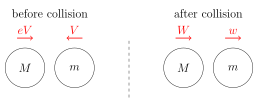
- A uniform spherical ball of mass \(M\) and radius \(R\) is released from rest with its centre a distance \(H+R\) above horizontal ground. The coefficient of restitution between the ball and the ground is \(e\). Show that, after bouncing, the centre of the ball reaches a height \(R+He^2\) above the ground.
- A second uniform spherical ball, of mass \(m\) and radius \(r\), is now released from rest together with the first ball (whose centre is again a distance \(H+R\) above the ground when it is released). The two balls are initially one on top of the other, with the second ball (of mass \(m\)) above the first. The two balls separate slightly during their fall, with their centres remaining in the same vertical line, so that they collide immediately after the first ball has bounced on the ground. The coefficient of restitution between the balls is also \(e\). The centre of the second ball attains a height \(h\) above the ground. Given that \(R=0.2\), \(r=0.05\), \(H=1.8\), \(h=4.5\) and \(e=\frac23\), determine the value of \(M/m\).
Solution:
- The story for first ball (before it collides with the second ball) will be exactly the same, ie it rebounds with speed \(eV\).
For the second ball, it will also have fallen a distance \(H\) and will be travelling with the same speed \(V\). Their speed of approach therefore will be \((1+e)V\), and the speed of separating therefore must be \(e(1+e)V\)
Given the centre of the second ball reaches a height of \(h\) (from a position of height) \(2R+r\), we must have:
\begin{align*}
&& v^2 &= u^2 + 2as \\
&& 0 &= w^2 - 2g(h - 2R-r) \\
\Rightarrow && w^2 &= 2g(h-2R-r)
\end{align*}
Taking upwards to be positive, then we have:
\begin{align*} \text{COM}: && MeV + m(-V) &= M(w-e(1+e)V) + mw \\ \Rightarrow && V(Me-m)+e(1+e)MV &= w(M+m) \\ \Rightarrow && w &= \frac{2Me+e^2M-m}{M+m} V \\ \Rightarrow && w^2 &= \left ( \frac{M/m(2e+e^2)-1}{M/m+1}\right)^2 V^2 \\ \Rightarrow && 2g(h-2R-r) &= \left ( \frac{M/m(2e+e^2)-1}{M/m+1}\right)^2 2gH \\ \Rightarrow && \left ( \frac{M/m(2e+e^2)-1}{M/m+1}\right)^2 &= \frac{h-2R-r}{H} \\ &&&= \frac{4.5-0.4-0.05}{1.8} \\ &&&= \frac{9}{4} \\ \Rightarrow && \frac{M/m(\frac43+\frac49)-1}{M/m+1} &= \frac32 \\ \Rightarrow && \frac{16}9M/m-1 &= \frac32 M/m+\frac32 \\ \Rightarrow && \frac{5}{18}M/m &= \frac{5}{2} \\ \Rightarrow && M/m &= 9 \end{align*}
2013 Paper 1 Q10
Two parallel vertical barriers are fixed a distance \(d\) apart on horizontal ice. A small ice hockey puck moves on the ice backwards and forwards between the barriers, in the direction perpendicular to the barriers, colliding with each in turn. The coefficient of friction between the puck and the ice is \(\mu\) and the coefficient of restitution between the puck and each of the barriers is \(r\). The puck starts at one of the barriers, moving with speed \(v\) towards the other barrier. Show that \[ v_{i+1}^2 - r^2 v_i^2 = - 2 r^2 \mu gd\, \] where \(v_i\) is the speed of the puck just after its \(i\)th collision. The puck comes to rest against one of the barriers after traversing the gap between them \(n\) times. In the case \(r\ne1\), express \(n\) in terms of \(r\) and \(k\), where \(k= \dfrac{v^2}{2\mu g d}\,\). If \(r=\e^{-1}\) (where \(\e\) is the base of natural logarithms) show that \[ n = \tfrac12 \ln\big(1+k(\e^2-1)\big)\,. \] Give an expression for \(n\) in the case \(r=1\).
Solution: \begin{align*} \text{W.E.P.}: && \text{change in energy} &= \text{work done on particle} \\ \Rightarrow && \underbrace{\frac12mv^2}_{\text{speed before hitting barrier}} - \underbrace{\frac12mu^2}_{\text{speed leaving first barrier}} &= \underbrace{\left( -\mu mg \right)}_{F} \cdot \underbrace{d}_{d} \\ \Rightarrow && v^2 &= v_i^2-2\mu gd \end{align*} Newton's experimental law tells us that the speed leaving the barrier will be \(r\) times the speed approaching, ie \begin{align*} && v_{i+1} &= rv \\ \Rightarrow && v_{i+1}^2 &= r^2 v^2 \\ &&&= r^2v_i^2 - 2r^2\mu gd \\ \Rightarrow && v_{i+1}^2 - r^2v_i^2 &= - 2r^2\mu gd \end{align*} It must be the case that after \(n+1\) collisions the speed is zero, ie \(v_{n+1}^2 = 0\). Not that we can consider \(w_i = \frac{v_i^2}{2\mu gd}\) and we have the recurrence: \begin{align*} && w_{i+1} &=r^2w_i -r^2 \\ \end{align*} Looking at this we have a linear recurrence with a constant term, so let's try \(w_i = C\), then \begin{align*} && C &= r^2 C - r^2 \\ \Rightarrow && C &= \frac{-r^2}{1-r^2} \\ \end{align*} So \(w_i = Ar^{2i} - \frac{r^2}{1-r^2}\). \(w_0 = k \Rightarrow A = k+\frac{r^2}{1-r^2}\) Therefore \(w_n = \left (k+\frac{r^2}{1-r^2} \right)r^{2n} - \frac{r^2}{1-r^2}\) Suppose \(w_n = 0\) then, \begin{align*} && 0 &= \left (k+\frac{r^2}{1-r^2} \right)r^{2n} - \frac{r^2}{1-r^2} \\ \Rightarrow && r^{2n} &= \frac{r^2}{1-r^2} \frac{1}{k+\frac{r^2}{1-r^2}} \\ &&&= \frac{r^2}{k(1-r^2)+r^2} \\ \Rightarrow && 2n \ln r &= 2\ln r - \ln[k(1-r^2)+r^2] \\ \Rightarrow && n &= 1 - \frac1{2\ln r} \ln[k(1-r^2)+r^2)] \end{align*} If \(r = e^{-1}\) then \(\ln r = -1\) \begin{align*} && n &= 1 + \frac12 \ln [k(1-e^{-2}) + e^{-2}] \\ &&&= 1 + \frac12 \ln [e^{-2}(k(e^2-1)+1)] \\ &&&= 1 + \frac12 \ln e^{-2} + \frac12 \ln [1+k(e^2-1)] \\ &&&= \frac12 \ln [1+k(e^2-1)] \end{align*} If \(r = 1\) the recurrence becomes: \(w_{i+1} = w_i - 1\), so \(w_i = k-n\), so we have \(k\) collisions.
2013 Paper 2 Q11
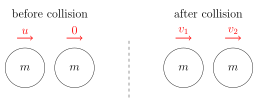
Three identical particles lie, not touching one another, in a straight line on a smooth horizontal surface. One particle is projected with speed \(u\) directly towards the other two which are at rest. The coefficient of restitution in all collisions is \(e\), where \(0 < e < 1\,\).
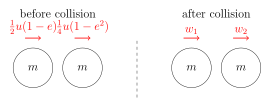
- Show that, after the second collision, the speeds of the particles are \(\frac12u(1-e)\), \(\frac14u (1-e^2)\) and \(\frac14u(1+e)^2\). Deduce that there will be a third collision whatever the value of \(e\).
- Show that there will be a fourth collision if and only if \(e\) is less than a particular value which you should determine.
Solution:
- First Collision:
By NEL, \(v_2 = v_1 + eu\), so \begin{align*} \text{COM}: && mu &= mv_1 + m(v_1 + eu) \\ \Rightarrow && 2mv_1 &= mu(1-e) \\ \Rightarrow && v_1 &= \frac12 u(1-e) \\ && v_2 &= \frac12 u(1-e) + eu \\ &&&= \frac12 u(1+e) \end{align*} The second collision is identical to the first except replacing \(u\) with \(\frac12u(1+e)\), therefore after that collision: \begin{align*} && \text{first particle} &= \frac12 u(1-e) \\ && \text{second particle} &= \frac12 \left (\frac12 u(1+e) \right)(1-e) \\ &&&= \frac14 u(1-e^2) \\ && \text{third particle} &= \frac12 \left (\frac12 u(1+e) \right)(1+e) \\ &&&= \frac14 u(1+e)^2 \end{align*} After all these collisions, all particles are moving in the same direction (since they all have positive velocity), but the first particle is now travelling faster than the second particle (as \(\frac12(1-e) < 1\)). Therefore they will collide again.
- The third collision:
The speed of approach will be \(\frac12u(1-e) - \frac14u(1-e^2) = \frac14u(1-e)(2 - (1+e)) = \frac14 u(1-e)^2\), therefore by NEL, \(w_2 = w_1 + \frac14ue(1-e)^2\) \begin{align*} \text{COM}: && m\frac12u(1-e) + m \frac14u(1-e^2) &= mw_1 + m\left (w_1 + \frac14ue(1-e)^2 \right) \\ \Rightarrow && \frac14u(1-e)(2+(1+e)) &= 2w_1 + \frac14ue(1-e)^2 \\ \Rightarrow && 2w_1 &= \frac14u(1-e)(3+e)-\frac14ue(1-e)^2 \\ &&&= \frac14u(1-e)(3+e-e(1-e)) \\ &&&= \frac14u(1-e)(3+e^2) \\ \Rightarrow && w_1 &= \frac18 u(1-e)(3+e^2) \\ && w_2 &= \frac18 u(1-e)(3+e^2) + \frac14ue(1-e)^2 \\ &&&= \frac18u(1-e)(3+e^2+2e(1-e)) \\ &&&= \frac18u(1-e)(3+2e-e^2) \\ &&&= \frac18u(1-e)(1+e)(3-e) \\ \end{align*} A fourth collision is possible, iff \begin{align*} && \frac18u(1-e)(1+e)(3-e)&> \frac14 u(1+e)^2 \\ \Leftrightarrow && (1-e)(3-e)&> 2 (1+e) \\ \Leftrightarrow &&3-4e-e^2&> 2+2e \\ \Leftrightarrow &&1-5e-e^2&>0 \\ \Leftrightarrow && e &< 3-\sqrt{2} \end{align*}
2013 Paper 3 Q10
A uniform rod \(AB\) has mass \(M\) and length \(2a\). The point \(P\) lies on the rod a distance \(a-x\) from~\(A\). Show that the moment of inertia of the rod about an axis through \(P\) and perpendicular to the rod is \[ \tfrac13 M(a^2 +3x^2)\,. \] The rod is free to rotate, in a horizontal plane, about a fixed vertical axis through \(P\). Initially the rod is at rest. The end \(B\) is struck by a particle of mass \(m\) moving horizontally with speed \(u\) in a direction perpendicular to the rod. The coefficient of restitution between the rod and the particle is \(e\). Show that the angular velocity of the rod immediately after impact is \[ \frac{3mu(1+e)(a+x)}{M(a^2+3x^2) +3m(a+x)^2}\,. \] In the case \(m=2M\), find the value of \(x\) for which the angular velocity is greatest and show that this angular velocity is \(u(1+e)/a\,\).
2011 Paper 2 Q9
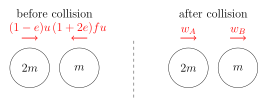
Two particles, \(A\) of mass \(2m\) and \(B\) of mass \(m\), are moving towards each other in a straight line on a smooth horizontal plane, with speeds \(2u\) and \(u\) respectively. They collide directly. Given that the coefficient of restitution between the particles is \(e\), where \(0 < e \le 1\), determine the speeds of the particles after the collision. After the collision, \(B\) collides directly with a smooth vertical wall, rebounding and then colliding directly with \(A\) for a second time. The coefficient of restitution between \(B\) and the wall is \(f\), where \(0 < f \le 1\). Show that the velocity of \(B\) after its second collision with \(A\) is \[ \tfrac23 (1-e^2)u - \tfrac13(1-4e^2)fu \] towards the wall and that \(B\) moves towards (not away from) the wall for all values of \(e\) and \(f\).
Solution:

2010 Paper 1 Q11
Two particles of masses \(m\) and \(M\), with \(M>m\), lie in a smooth circular groove on a horizontal plane. The coefficient of restitution between the particles is \(e\). The particles are initially projected round the groove with the same speed \(u\) but in opposite directions. Find the speeds of the particles after they collide for the first time and show that they will both change direction if \(2em> M-m\). After a further \(2n\) collisions, the speed of the particle of mass \(m\) is \(v\) and the speed of the particle of mass \(M\) is \(V\). Given that at each collision both particles change their directions of motion, explain why \[ mv-MV = u(M-m), \] and find \(v\) and \(V\) in terms of \(m\), \(M\), \(e\), \(u\) and \(n\).
Solution: All the forces in the circular groove will be perpendicular to the direction of motion. Therefore the particles will continue moving with constant speed at all times (aside from collisions). We can consider the collisions to occur as if along a tangent, (since they will be travelling perfectly perpendicular at the collisions).