2011 Paper 2 Q9
Year: 2011
Paper: 2
Question Number: 9
Course: UFM Mechanics
Section: Momentum and Collisions 1
Problem
Solution

Examiner's report
— 2011 STEP 2, Question 9There were just under 1000 entries for paper II this year, almost exactly the same number as last year. After the relatively easy time candidates experienced on last year's paper, this year's questions had been toughened up significantly, with particular attention made to ensure that candidates had to be prepared to invest more thought at the start of each question – last year saw far too many attempts from the weaker brethren at little more than the first part of up to ten questions, when the idea is that they should devote 25-40 minutes on four to six complete questions in order to present work of a substantial nature. It was also the intention to toughen up the final "quarter" of questions, so that a complete, or nearly-complete, conclusion to any question represented a significant (and, hopefully, satisfying) mathematical achievement. Although such matters are always best assessed with the benefit of hindsight, our efforts in these areas seem to have proved entirely successful, with the vast majority of candidates concentrating their efforts on four to six questions, as planned. Moreover, marks really did have to be earned: only around 20 candidates managed to gain or exceed a score of 100, and only a third of the entry managed to hit the half-way mark of 60. As in previous years, the pure maths questions provided the bulk of candidates' work, with relatively few efforts to be found at the applied ones. Questions 1 and 2 were attempted by almost all candidates; 3 and 4 by around three-quarters of them; 6, 7 and 9 by around half; the remaining questions were less popular, and some received almost no "hits". Overall, the highest scoring questions (averaging over half-marks) were 1, 2 and 9, along with 13 (very few attempts, but those who braved it scored very well). This at least is indicative that candidates are being careful in exercising some degree of thought when choosing (at least the first four) 'good' questions for themselves, although finding six successful questions then turned out to be a key discriminating factor of candidates' abilities from the examining team's perspective. Each of questions 4-8, 11 & 12 were rather poorly scored on, with average scores of only 5.5 to 6.6.
Rating Information
Difficulty Rating: 1600.0
Difficulty Comparisons: 0
Banger Rating: 1484.0
Banger Comparisons: 1
Show LaTeX source
Problem source
Two particles, $A$ of mass $2m$ and $B$ of mass $m$, are moving towards each other in a straight line on a smooth horizontal plane, with speeds $2u$ and $u$ respectively. They collide directly. Given that the coefficient of restitution between the particles is $e$, where $0 < e \le 1$, determine the speeds of the particles after the collision. After the collision, $B$ collides directly with a smooth vertical wall, rebounding and then colliding directly with $A$ for a second time. The coefficient of restitution between $B$ and the wall is $f$, where $0 < f \le 1$.
Show that the velocity of $B$ after its second collision with $A$ is
\[
\tfrac23 (1-e^2)u - \tfrac13(1-4e^2)fu
\]
towards the wall and that $B$ moves towards (not away from) the wall for all values of $e$ and $f$.
Solution source
\begin{center}
    \begin{tikzpicture}[scale=0.7]
        \def\h{2.75};
        \def\arrowheight{1.5};
        \def\arrowwidth{0.4};
        \def\massa{$2m$};
        \def\massb{$m$};
        \def\velocityua{$2u$};
        \def\velocityub{$u$};
        \def\velocityva{$v_A$};
        \def\velocityvb{$v_B$};


        \draw (0,0) circle (1);
        \draw (2.5,0) circle (1);

        \draw (8,0) circle (1);
        \draw (10.5,0) circle (1);


        \node at (1.25, \h) {before collision};
        \node at (9.25, \h) {after collision};

        \draw[dashed] (5.25,-\arrowheight) -- (5.25, \arrowheight);

            \node at (0,0) {\massa};
            \draw[->, thick, red] (-\arrowwidth, \arrowheight) -- (\arrowwidth, \arrowheight);
            \node[above, red] at (0, \arrowheight) {\velocityua};
            \node at (2.5,0) {\massb};
            \draw[<-, thick, red] (2.5-\arrowwidth, \arrowheight) -- (2.5+\arrowwidth, \arrowheight);  \node[above, red] at (2.5, \arrowheight) {\velocityub};
            \node at (8,0) {\massa};
            \draw[->, thick, red] (8-\arrowwidth, \arrowheight) -- (8+\arrowwidth, \arrowheight);
            \node[red,above] at (8, \arrowheight) {\velocityva};
            \node at (10.5,0 ) {\massb};
            \draw[->, thick, red] (10.5-\arrowwidth, \arrowheight) -- (10.5+\arrowwidth, \arrowheight);
            \node[red,above] at (10.5, \arrowheight) {\velocityvb};
    \end{tikzpicture}
\end{center}

Since the coefficient of restitution is $e$ and the speed of approach is $3u$, $v_B = v_A + 3eu$,

\begin{align*}
\text{COM}: && 2m\cdot2u + m \cdot (-u) &= 2m v_A + m(v_A + 3eu) \\
\Rightarrow && 3u &= 3v_A + 3eu \\
\Rightarrow && v_A &= (1-e)u \\
\Rightarrow && v_B &= (1+2e)u
\end{align*}

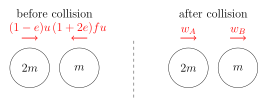
After rebounding from the wall, the velocity of $B$ will be $-fv_B$.

So for the second collision (between the particles) we will have:

\begin{center}
    \begin{tikzpicture}[scale=0.7]
        \def\h{2.75};
        \def\arrowheight{1.5};
        \def\arrowwidth{0.4};
        \def\massa{$2m$};
        \def\massb{$m$};
        \def\velocityua{$(1-e)u$};
        \def\velocityub{$(1+2e)fu$};
        \def\velocityva{$w_A$};
        \def\velocityvb{$w_B$};


        \draw (0,0) circle (1);
        \draw (2.5,0) circle (1);

        \draw (8,0) circle (1);
        \draw (10.5,0) circle (1);


        \node at (1.25, \h) {before collision};
        \node at (9.25, \h) {after collision};

        \draw[dashed] (5.25,-\arrowheight) -- (5.25, \arrowheight);

            \node at (0,0) {\massa};
            \draw[->, thick, red] (-\arrowwidth, \arrowheight) -- (\arrowwidth, \arrowheight);
            \node[above, red] at (0, \arrowheight) {\velocityua};
            \node at (2.5,0) {\massb};
            \draw[<-, thick, red] (2.5-\arrowwidth, \arrowheight) -- (2.5+\arrowwidth, \arrowheight);  \node[above, red] at (2.5, \arrowheight) {\velocityub};
            \node at (8,0) {\massa};
            \draw[->, thick, red] (8-\arrowwidth, \arrowheight) -- (8+\arrowwidth, \arrowheight);
            \node[red,above] at (8, \arrowheight) {\velocityva};
            \node at (10.5,0 ) {\massb};
            \draw[->, thick, red] (10.5-\arrowwidth, \arrowheight) -- (10.5+\arrowwidth, \arrowheight);
            \node[red,above] at (10.5, \arrowheight) {\velocityvb};
    \end{tikzpicture}
\end{center}

\begin{align*}
\text{NEL}: && w_B - w_A &= e((1-e)u+(1+2e)fu) \\
\Rightarrow && w_B - w_A &= (1-e+f+2ef)eu \tag{1} \\
\text{COM}: && 2m w_A + w_B  &= 2m(1-e)u -m(1+2e)fu \\
\Rightarrow && 2w_A + w_B &= (2-2e -f-2ef)u \tag{2} \\
(2) + 2\times(1): && 3w_B &= (2-2e -f-2ef)u  +2(1-e+f+2ef)eu \\
&&&= (2-2e-f-2ef)u+(2e-2e^2+2ef+4e^2f)u \\
&&&= (2-2e^2-f+4e^2f)u \\
&&&= 2(1-e^2)-f(1-4e^2)u \\
\Rightarrow && w_B &= \frac23 (1-e^2)u-\frac13(1-4e^2)fu
\end{align*}

Since we've always taken towards the wall as positive, the question is whether or not this is positive for all values of $e$ and $f$.  The first term is clearly positive, so in order to have a chance of being negative, we must have that $1-4e^2 > 0$ and $f$ is as large as possible, so wlog $f = 1$.

\begin{align*}
2-2e^2-1+4e^2 = 1+2e^2 > 0
\end{align*}


\end{align*}
Almost half of all candidates attempted this question, and scores averaged over 12/20. In the majority of cases, the first two parts of the question proved relatively straightforward conceptually, although there was the usual collection of errors introduced because of a lack of care with signs/directions. It was only the final part of the question that proved to be of any great difficulty: most candidates realised that they had to show that the given expression for B's velocity was always positive, but a lot of their efforts foundered on the lack of appreciation that the term 1 − 4e² could be positive or negative.