2013 Paper 2 Q11
Year: 2013
Paper: 2
Question Number: 11
Course: UFM Mechanics
Section: Momentum and Collisions 1
Problem
- Show that, after the second collision, the speeds of the particles are \(\frac12u(1-e)\), \(\frac14u (1-e^2)\) and \(\frac14u(1+e)^2\). Deduce that there will be a third collision whatever the value of \(e\).
- Show that there will be a fourth collision if and only if \(e\) is less than a particular value which you should determine.
Solution
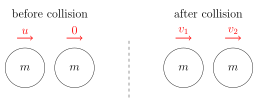
- First Collision:
By NEL, \(v_2 = v_1 + eu\), so \begin{align*} \text{COM}: && mu &= mv_1 + m(v_1 + eu) \\ \Rightarrow && 2mv_1 &= mu(1-e) \\ \Rightarrow && v_1 &= \frac12 u(1-e) \\ && v_2 &= \frac12 u(1-e) + eu \\ &&&= \frac12 u(1+e) \end{align*} The second collision is identical to the first except replacing \(u\) with \(\frac12u(1+e)\), therefore after that collision: \begin{align*} && \text{first particle} &= \frac12 u(1-e) \\ && \text{second particle} &= \frac12 \left (\frac12 u(1+e) \right)(1-e) \\ &&&= \frac14 u(1-e^2) \\ && \text{third particle} &= \frac12 \left (\frac12 u(1+e) \right)(1+e) \\ &&&= \frac14 u(1+e)^2 \end{align*} After all these collisions, all particles are moving in the same direction (since they all have positive velocity), but the first particle is now travelling faster than the second particle (as \(\frac12(1-e) < 1\)). Therefore they will collide again.
- The third collision:
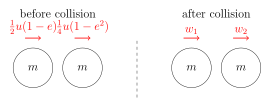
The speed of approach will be \(\frac12u(1-e) - \frac14u(1-e^2) = \frac14u(1-e)(2 - (1+e)) = \frac14 u(1-e)^2\), therefore by NEL, \(w_2 = w_1 + \frac14ue(1-e)^2\) \begin{align*} \text{COM}: && m\frac12u(1-e) + m \frac14u(1-e^2) &= mw_1 + m\left (w_1 + \frac14ue(1-e)^2 \right) \\ \Rightarrow && \frac14u(1-e)(2+(1+e)) &= 2w_1 + \frac14ue(1-e)^2 \\ \Rightarrow && 2w_1 &= \frac14u(1-e)(3+e)-\frac14ue(1-e)^2 \\ &&&= \frac14u(1-e)(3+e-e(1-e)) \\ &&&= \frac14u(1-e)(3+e^2) \\ \Rightarrow && w_1 &= \frac18 u(1-e)(3+e^2) \\ && w_2 &= \frac18 u(1-e)(3+e^2) + \frac14ue(1-e)^2 \\ &&&= \frac18u(1-e)(3+e^2+2e(1-e)) \\ &&&= \frac18u(1-e)(3+2e-e^2) \\ &&&= \frac18u(1-e)(1+e)(3-e) \\ \end{align*} A fourth collision is possible, iff \begin{align*} && \frac18u(1-e)(1+e)(3-e)&> \frac14 u(1+e)^2 \\ \Leftrightarrow && (1-e)(3-e)&> 2 (1+e) \\ \Leftrightarrow &&3-4e-e^2&> 2+2e \\ \Leftrightarrow &&1-5e-e^2&>0 \\ \Leftrightarrow && e &< 3-\sqrt{2} \end{align*}
Examiner's report
— 2013 STEP 2, Question 11All questions were attempted by a significant number of candidates, with questions 1 to 3 and 7 the most popular. The Pure questions were more popular than both the Mechanics and the Probability and Statistics questions, with only question 8 receiving a particularly low number of attempts within the Pure questions and only question 11 receiving a particularly high number of attempts.
Rating Information
Difficulty Rating: 1600.0
Difficulty Comparisons: 0
Banger Rating: 1500.0
Banger Comparisons: 0
Show LaTeX source
Problem source
Three identical particles lie, not touching one another, in a straight line on a smooth horizontal surface. One particle is projected with speed $u$ directly towards the other two which are at rest. The coefficient of restitution in all collisions is $e$, where $0 < e < 1\,$.
\begin{questionparts}
\item Show that, after the second collision, the speeds of the particles are $\frac12u(1-e)$, $\frac14u (1-e^2)$ and $\frac14u(1+e)^2$.  Deduce that there will be a third collision whatever the value of $e$.
\item Show that there will be a fourth collision if and only if  $e$ is less than a particular value which you should determine.
\end{questionparts}
Solution source
\begin{questionparts}
\item
First Collision:

\begin{center}
    \begin{tikzpicture}[scale=0.7]
        \def\h{2.75};
        \def\arrowheight{1.5};
        \def\arrowwidth{0.4};
        \def\massa{$m$};
        \def\massb{$m$};
        \def\velocityua{$u$};
        \def\velocityub{$0$};
        \def\velocityva{$v_1$};
        \def\velocityvb{$v_2$};


        \draw (0,0) circle (1);
        \draw (2.5,0) circle (1);

        \draw (8,0) circle (1);
        \draw (10.5,0) circle (1);


        \node at (1.25, \h) {before collision};
        \node at (9.25, \h) {after collision};

        \draw[dashed] (5.25,-\arrowheight) -- (5.25, \arrowheight);

            \node at (0,0) {\massa};
            \draw[->, thick, red] (-\arrowwidth, \arrowheight) -- (\arrowwidth, \arrowheight);
            \node[above, red] at (0, \arrowheight) {\velocityua};
            \node at (2.5,0) {\massb};
            \draw[->, thick, red] (2.5-\arrowwidth, \arrowheight) -- (2.5+\arrowwidth, \arrowheight);  \node[above, red] at (2.5, \arrowheight) {\velocityub};
            \node at (8,0) {\massa};
            \draw[->, thick, red] (8-\arrowwidth, \arrowheight) -- (8+\arrowwidth, \arrowheight);
            \node[red,above] at (8, \arrowheight) {\velocityva};
            \node at (10.5,0 ) {\massb};
            \draw[->, thick, red] (10.5-\arrowwidth, \arrowheight) -- (10.5+\arrowwidth, \arrowheight);
            \node[red,above] at (10.5, \arrowheight) {\velocityvb};
    \end{tikzpicture}
\end{center}

By NEL, $v_2 = v_1 + eu$, so

\begin{align*}
\text{COM}: && mu &= mv_1 + m(v_1 + eu) \\
\Rightarrow && 2mv_1 &= mu(1-e) \\
\Rightarrow && v_1 &= \frac12 u(1-e) \\
&& v_2 &=  \frac12 u(1-e) + eu \\
&&&= \frac12 u(1+e)
\end{align*}

The second collision is identical to the first except replacing $u$ with $\frac12u(1+e)$, therefore after that collision:

\begin{align*}
&& \text{first particle} &= \frac12 u(1-e) \\
&& \text{second particle} &= \frac12 \left (\frac12 u(1+e) \right)(1-e) \\
&&&= \frac14 u(1-e^2) \\
&& \text{third particle} &= \frac12 \left (\frac12 u(1+e) \right)(1+e) \\
&&&= \frac14 u(1+e)^2
\end{align*}

After all these collisions, all particles are moving in the same direction (since they all have positive velocity), but the first particle is now travelling faster than the second particle (as $\frac12(1-e) < 1$). Therefore they will collide again.

\item The third collision:

\begin{center}
    \begin{tikzpicture}[scale=0.7]
        \def\h{2.75};
        \def\arrowheight{1.5};
        \def\arrowwidth{0.4};
        \def\massa{$m$};
        \def\massb{$m$};
        \def\velocityua{$\frac12 u(1-e)$};
        \def\velocityub{$\frac14u(1-e^2)$};
        \def\velocityva{$w_1$};
        \def\velocityvb{$w_2$};


        \draw (0,0) circle (1);
        \draw (2.5,0) circle (1);

        \draw (8,0) circle (1);
        \draw (10.5,0) circle (1);


        \node at (1.25, \h) {before collision};
        \node at (9.25, \h) {after collision};

        \draw[dashed] (5.25,-\arrowheight) -- (5.25, \arrowheight);

            \node at (0,0) {\massa};
            \draw[->, thick, red] (-\arrowwidth, \arrowheight) -- (\arrowwidth, \arrowheight);
            \node[above, red] at (0, \arrowheight) {\velocityua};
            \node at (2.5,0) {\massb};
            \draw[->, thick, red] (2.5-\arrowwidth, \arrowheight) -- (2.5+\arrowwidth, \arrowheight);  \node[above, red] at (2.5, \arrowheight) {\velocityub};
            \node at (8,0) {\massa};
            \draw[->, thick, red] (8-\arrowwidth, \arrowheight) -- (8+\arrowwidth, \arrowheight);
            \node[red,above] at (8, \arrowheight) {\velocityva};
            \node at (10.5,0 ) {\massb};
            \draw[->, thick, red] (10.5-\arrowwidth, \arrowheight) -- (10.5+\arrowwidth, \arrowheight);
            \node[red,above] at (10.5, \arrowheight) {\velocityvb};
    \end{tikzpicture}
\end{center}

The speed of approach will be $\frac12u(1-e) - \frac14u(1-e^2) = \frac14u(1-e)(2 - (1+e)) = \frac14 u(1-e)^2$, therefore by NEL, $w_2 = w_1 + \frac14ue(1-e)^2$

\begin{align*}
\text{COM}: && m\frac12u(1-e)  + m \frac14u(1-e^2) &= mw_1 + m\left (w_1 + \frac14ue(1-e)^2 \right) \\
\Rightarrow && \frac14u(1-e)(2+(1+e)) &= 2w_1 + \frac14ue(1-e)^2 \\
\Rightarrow && 2w_1 &= \frac14u(1-e)(3+e)-\frac14ue(1-e)^2 \\
&&&= \frac14u(1-e)(3+e-e(1-e)) \\
&&&= \frac14u(1-e)(3+e^2) \\
\Rightarrow && w_1 &= \frac18 u(1-e)(3+e^2) \\
&& w_2 &=  \frac18 u(1-e)(3+e^2) + \frac14ue(1-e)^2 \\
&&&= \frac18u(1-e)(3+e^2+2e(1-e)) \\
&&&= \frac18u(1-e)(3+2e-e^2) \\
&&&= \frac18u(1-e)(1+e)(3-e) \\
\end{align*}

A fourth collision is possible, iff
\begin{align*}
&& \frac18u(1-e)(1+e)(3-e)&> \frac14 u(1+e)^2 \\
\Leftrightarrow && (1-e)(3-e)&> 2 (1+e) \\
\Leftrightarrow &&3-4e-e^2&> 2+2e \\
\Leftrightarrow &&1-5e-e^2&>0 \\
\Leftrightarrow && e &< 3-\sqrt{2}


\end{align*}

\end{questionparts}
This was the most popular of the Mechanics questions and also the most successfully answered question on the paper with candidates scoring on average three quarters of the marks. Candidates appeared to be very comfortable with the concepts of conservation of momentum and the law of restitution and were able to progress through the series of calculations required without too much difficulty. There were some errors in the algebra, but the majority of candidates were able to work through accurately to the end of the question.