2019 Paper 3 Q10
Year: 2019
Paper: 3
Question Number: 10
Course: UFM Mechanics
Section: Momentum and Collisions 2
Problem
- Show that $$u \sin \alpha = v \sin(\alpha + \theta)$$ and find an expression for \(w\) in terms of \(v\), \(\theta\) and \(\alpha\).
- Show further that $$\sin \theta = \cos(\theta + \alpha) \sin \alpha + e \sin(\theta + \alpha) \cos \alpha$$ and find an expression for \(\tan \theta\) in terms of \(\tan \alpha\) and \(e\). Find, in terms of \(e\), the maximum value of \(\tan \theta\) as \(\alpha\) varies.
Solution
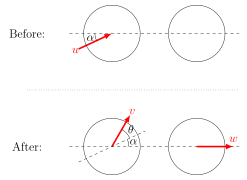
- Since the impulse is along the line of centres, the velocities are as show in the diagram. Additionally, vertical velocity is unchanged, so: \(v \sin (\theta + \alpha) = u \sin \alpha\) \begin{align*} \text{COM}(\rightarrow): && u \cos\alpha &= v \cos(\alpha + \theta) + w \\ \Rightarrow && w &= u \cos \alpha - v \cos (\alpha + \theta) \end{align*}
- Since the approach speed (horizontally) is \(u \cos \alpha\) the speed of separation is \(e u \cos \alpha\), in particular \(w - v \cos(\theta + \alpha) = e u \cos \alpha\) or \(w = v \cos (\theta + \alpha) + e u \cos \alpha\). \begin{align*} && w &= w \\ && v \cos (\theta + \alpha) + e u \cos \alpha &= u \cos \alpha - v \cos (\alpha + \theta) \\ \Rightarrow && \frac{u \sin \alpha}{\sin (\alpha + \theta)} \cos (\theta + \alpha) + e u \cos \alpha &= u \cos \alpha - \frac{u \sin \alpha}{\sin (\alpha + \theta)} \cos (\alpha + \theta) \\ \Rightarrow && \sin \alpha \cos(\theta + \alpha) + e \sin (\alpha+\theta)\cos \alpha &= \sin(\alpha+\theta) \cos \alpha - \cos(\alpha+\theta)\sin \alpha \\ &&&= \sin ((\alpha+\theta)-\alpha) \\ &&&= \sin \theta \end{align*} as required. \begin{align*} && \sin \theta &= \cos(\theta+ \alpha)\sin \alpha + e \sin (\theta + \alpha) \cos \alpha \\ &&&= \cos \theta \cos \alpha \sin \alpha - \sin \theta \sin^2 \alpha + e \sin \theta \cos ^2 \alpha + e \cos \theta \sin \alpha \cos \alpha \\ \Rightarrow && \tan \theta \sec^2 \alpha &= \tan \alpha - \tan \theta \tan^2 \alpha + e \tan \theta + e \tan \alpha \\ \Rightarrow && \tan \theta (1 + \tan^2 \alpha+\tan^2 \alpha-e) &= \tan \alpha + e \tan \alpha \\ \Rightarrow && \tan \theta &= \frac{(1+e)\tan \alpha}{1-e + 2\tan^2 \alpha} \end{align*} We seek to maximise \(y = \frac{x}{c+2x^2}\), \begin{align*} && \frac{\d y}{\d x} &= \frac{c+2x^2-4x^2}{(c+2x^2)^2} \\ &&&= \frac{c-2x^2}{(c+2x^2)^2} \end{align*} Therefore the maximum will occur at \(x = \sqrt{c/2}\), ie \(\tan \alpha = \sqrt{(1-e)/2}\) and theta will be \(\displaystyle \frac{(1+e)\sqrt{(1-e)/2}}{2(1-e)} =\frac{1}{2\sqrt{2}} \frac{1+e}{\sqrt{1-e}}\)
Examiner's report
— 2019 STEP 3, Question 10There was a significant rise in the total entry this year with an increase of nearly 8.5% on 2018. One question was attempted by over 90%, two others were very popular, and three further questions were attempted by 60% or more. No question was generally avoided and even the least popular attracted more than 10% of the candidates. 88% restricted themselves to attempting no more than 7 questions, and only a handful, but not the very best, scored strongly attempting more than 7 questions.
Rating Information
Difficulty Rating: 1500.0
Difficulty Comparisons: 0
Banger Rating: 1500.0
Banger Comparisons: 0
Show LaTeX source
Problem source
Two identical smooth spheres $P$ and $Q$ can move on a smooth horizontal table. Initially, $P$ moves with speed $u$ and $Q$ is at rest. Then $P$ collides with $Q$. The direction of travel of $P$ before the collision makes an acute angle $\alpha$ with the line joining the centres of $P$ and $Q$ at the moment of the collision. The coefficient of restitution between $P$ and $Q$ is $e$ where $e < 1$.
As a result of the collision, $P$ has speed $v$ and $Q$ has speed $w$, and $P$ is deflected through an angle $\theta$.
\begin{questionparts}
\item Show that
$$u \sin \alpha = v \sin(\alpha + \theta)$$
and find an expression for $w$ in terms of $v$, $\theta$ and $\alpha$.
\item Show further that
$$\sin \theta = \cos(\theta + \alpha) \sin \alpha + e \sin(\theta + \alpha) \cos \alpha$$
and find an expression for $\tan \theta$ in terms of $\tan \alpha$ and $e$.
Find, in terms of $e$, the maximum value of $\tan \theta$ as $\alpha$ varies.
\end{questionparts}
Solution source
\begin{center}
    \begin{tikzpicture}[scale=1]


        \def\beforeheight{0};
        \def\afterheight{-4};

        \def\textx{-1};
        \def\circleonex{2};
        \def\circler{1};
        \def\circletwox{5};
        \def\endscaling{1.5};

        \def\circleoneangle{25};
        \def\circletwoangle{-30};

        \def\circleoneafterangle{60};

        \def\velocityscale{1.3};

        \def\circleonevelocity{$u$};
        \def\circletwovelocity{$u_B$};

        \def\circletwoafterxvel{$w$};
        \def\circleoneaftervel{$v$};

        \node at (\textx,\beforeheight) {Before:};
        \node at (\textx,\afterheight) {After:};

        \draw[dotted] (\textx, {0.5*(\beforeheight+\afterheight)}) -- ({\circletwox+\endscaling*\circler}, {0.5*(\beforeheight+\afterheight)});

        \draw[dashed] ({\circleonex - \endscaling*\circler},\beforeheight) -- ({\circletwox+\endscaling*\circler}, \beforeheight);
        \draw[dashed] ({\circleonex - \endscaling*\circler},\afterheight) -- ({\circletwox+\endscaling*\circler}, \afterheight);

        \coordinate (TRowEnd) at (\textx, \beforeheight);
        \coordinate (TRowFEnd) at (100, \beforeheight);
        \coordinate (BRowEnd) at (\textx, \afterheight);
        \coordinate (BRowFEnd) at (100, \afterheight);
        \coordinate (CToneCentre) at (\circleonex, \beforeheight);
        \coordinate (CTtwoCentre) at (\circletwox, \beforeheight);
        \coordinate (CBoneCentre) at (\circleonex, \afterheight);
        \coordinate (CBtwoCentre) at (\circletwox, \afterheight);
        \coordinate (CToneVel) at ({\velocityscale*\circler*cos(180+\circleoneangle)+\circleonex},{\velocityscale*\circler*sin(180+\circleoneangle)+\beforeheight});
        \coordinate (CTtwoVel) at ({\velocityscale*\circler*cos(\circletwoangle)+\circletwox},{\velocityscale*\circler*sin(\circletwoangle)+\beforeheight});

        \coordinate (CBoneVel) at ({\velocityscale*\circler*cos(\circleoneafterangle)+\circleonex},{\velocityscale*\circler*sin(\circleoneafterangle)+\afterheight});
        \coordinate (CBoneOVel) at ({\velocityscale*\circler*cos(\circleoneangle)+\circleonex},{\velocityscale*\circler*sin(\circleoneangle)+\afterheight});

        \draw[-latex, ultra thick, red] (CToneVel) -- (CToneCentre);
        \pic [draw, angle radius=0.6cm, angle eccentricity=1.3, "$\alpha$"] {angle = TRowEnd--CToneCentre--CToneVel};
        \node[red] at ($(CToneCentre)!1.1!(CToneVel)$) {\circleonevelocity};

        % \draw[-latex, ultra thick, red] (CTtwoVel) -- (CTtwoCentre);
        % \node[red] at ($(CTtwoCentre)!1.1!(CTtwoVel)$) {\circleonevelocity};

        \draw (CToneCentre) circle (\circler);
        \draw (CTtwoCentre) circle (\circler);
        \draw (CBoneCentre) circle (\circler);
        \draw (CBtwoCentre) circle (\circler);

        \draw[-latex, ultra thick, red] (CBoneCentre) -- (CBoneVel);
        \node[red] at ($(CBoneCentre)!1.1!(CBoneVel)$) {\circleoneaftervel};
        \draw[dashed] ($(CBoneCentre)!-1!(CBoneOVel)$) -- (CBoneOVel);
        \pic [draw, angle radius=0.6cm, angle eccentricity=1.3, "$\alpha$"] {angle = BRowFEnd--CBoneCentre--CBoneOVel};
        \pic [draw, angle radius=0.7cm, angle eccentricity=1.3, "$\theta$"] {angle = CBoneOVel--CBoneCentre--CBoneVel};

        % \draw[-latex, ultra thick, red]  (CBoneCentre) -- ++ ({\velocityscale*\circler}, 0) node[above] {$v_{Ax}$};
        % \draw[-latex, ultra thick, red]  (CBoneCentre) -- ++ (0,{\velocityscale*\circler}) node[above] {$v_{Ay}$};
        \draw[-latex, ultra thick, red]  (CBtwoCentre) -- ++ ({\velocityscale*\circler}, 0) node[above] {\circletwoafterxvel};
        % \draw[-latex, ultra thick, red]  (CBtwoCentre) -- ++ (0,{\velocityscale*\circler})node[above] {$v_{By}$};


    \end{tikzpicture}
\end{center}

\begin{questionparts}
\item Since the impulse is along the line of centres, the velocities are as show in the diagram. Additionally, vertical velocity is unchanged, so:

$v \sin (\theta + \alpha) = u \sin \alpha$


\begin{align*}
\text{COM}(\rightarrow): && u \cos\alpha &= v \cos(\alpha + \theta) + w \\
\Rightarrow && w &= u \cos \alpha - v \cos (\alpha + \theta)
\end{align*}

\item
Since the approach speed (horizontally) is $u \cos \alpha$ the speed of separation is $e u \cos \alpha$, in particular $w - v \cos(\theta + \alpha) = e u \cos \alpha$ or $w = v \cos (\theta + \alpha) + e u \cos \alpha$.

\begin{align*}
&& w &= w \\
&& v \cos (\theta + \alpha) + e u \cos \alpha &= u \cos \alpha - v \cos (\alpha + \theta) \\
\Rightarrow && \frac{u \sin \alpha}{\sin (\alpha + \theta)} \cos (\theta + \alpha) + e u \cos \alpha &= u \cos \alpha - \frac{u \sin \alpha}{\sin (\alpha + \theta)} \cos (\alpha + \theta) \\
\Rightarrow && \sin \alpha \cos(\theta + \alpha) + e \sin (\alpha+\theta)\cos \alpha &= \sin(\alpha+\theta) \cos \alpha - \cos(\alpha+\theta)\sin \alpha \\
&&&= \sin ((\alpha+\theta)-\alpha) \\
&&&= \sin \theta
\end{align*}
as required.

\begin{align*}
&& \sin \theta &= \cos(\theta+ \alpha)\sin \alpha + e \sin (\theta + \alpha) \cos \alpha \\
&&&= \cos \theta \cos \alpha \sin \alpha - \sin \theta \sin^2 \alpha  + e \sin \theta \cos ^2 \alpha + e \cos \theta \sin \alpha \cos \alpha \\
\Rightarrow && \tan \theta \sec^2 \alpha &= \tan \alpha - \tan \theta \tan^2 \alpha + e \tan \theta + e \tan \alpha  \\
\Rightarrow && \tan \theta (1 + \tan^2 \alpha+\tan^2 \alpha-e) &= \tan \alpha + e \tan \alpha \\
\Rightarrow && \tan \theta &= \frac{(1+e)\tan \alpha}{1-e + 2\tan^2 \alpha}
\end{align*}


We seek to maximise $y = \frac{x}{c+2x^2}$,
\begin{align*}
&& \frac{\d y}{\d x} &= \frac{c+2x^2-4x^2}{(c+2x^2)^2} \\
&&&= \frac{c-2x^2}{(c+2x^2)^2}
\end{align*}

Therefore the maximum will occur at $x = \sqrt{c/2}$, ie $\tan \alpha = \sqrt{(1-e)/2}$ and theta will be $\displaystyle \frac{(1+e)\sqrt{(1-e)/2}}{2(1-e)} =\frac{1}{2\sqrt{2}} \frac{1+e}{\sqrt{1-e}}$
\end{questionparts}
Comfortably the most popular applied question on the paper with two fifths of candidates trying it, it was also one of the most successfully attempted on the whole paper with an average score just shy of half marks. A significant number of candidates struggled to set up the problem correctly, but those that did generally obtained the first result of (i). Then common mistakes were using Newton's Law of Impact in this part and failure to express w in terms of the specified variables. In part (ii), most candidates correctly applied Newton's Law of Impact, but depending on their expression for w in (i) had varying levels of success obtaining the required expression. A lot of candidates did manage to gain most marks in the final part even if they had struggled earlier. Alongside trigonometric and algebraic mistakes, a common mistake was failing to express tan θ in terms of tan α, as against other trigonometric ratios, and e. The commonest approach for the final result was to use differentiation, although a few candidates successfully used the AM‐GM inequality. However, fewer than a handful of candidates justified the value being a global as against local maximum.