2010 Paper 1 Q11
Year: 2010
Paper: 1
Question Number: 11
Course: UFM Mechanics
Section: Momentum and Collisions 2
Problem
Solution
Examiner's report
— 2010 STEP 1, Question 11There were significantly more candidates attempting this paper than last year (just over 1000), and the scores were much higher than last year (presumably due to the easier first question): fewer than 2% of candidates scored less than 20 marks overall, and the median mark was 61. The pure questions were the most popular as usual, though there was much more variation than in some previous years: questions 1, 3, 4 and 6 were the most popular, while question 7 (on vectors) was intensely unpopular. About half of all candidates attempted at least one mechanics question, and 15% attempted at least one probability question. The marks were unsurprising: the pure questions generally gained the better marks, while the mechanics and probability questions generally had poorer marks. A sizeable number of candidates ignored the advice on the front cover and attempted more than six questions, with a fifth of candidates trying eight or more questions. A good number of those extra attempts were little more than failed starts, but suggest that some candidates are not very effective at question-picking. This is an important skill to develop during STEP preparation. Nevertheless, the good marks and the paucity of candidates who attempted the questions in numerical order does suggest that the majority are being wise in their choices. Because of the abortive starts, I have often restricted my attention below to those attempts which counted as one of the six highest-scoring answers, and referred to these as "significant attempts". The majority of candidates did begin with question 1 (presumably as it appeared to be the easiest), but some spent far longer on it than was wise. Some attempts ran to over eight pages in length, especially when they had made an algebraic slip early on, and used time which could have been far better spent tackling another question. It is important to balance the desire to finish the question with an appreciation of when to stop and move on. Many candidates realised that for some questions, it was possible to attempt a later part without a complete (or any) solution to an earlier part. An awareness of this could have helped some of the weaker students to gain vital marks when they were stuck; it is generally better to do more of one question than to start another question, in particular if one has already attempted six questions. It is also fine to write "continued later" at the end of a partial attempt and then to continue the answer later in the answer booklet. As usual, though, some candidates ignored explicit instructions to use the previous work, such as "Hence", or "Deduce". They will get no credit if they do not do what they are asked to! (Of course, "Hence, or otherwise, show . . ." gives them the freedom to use any method of their choosing; often the "hence" will be the easiest, but in Question 5 this year, the "otherwise" approach was very popular.) On some questions, some candidates tried to work forwards from the given question and backwards from the answer, hoping that they would meet somewhere in the middle. While this worked on occasion, it often required fudging. It is wise to remember that STEP questions do require a greater facility with mathematics and algebraic manipulation than the A-level examinations, as well as a depth of understanding which goes beyond that expected in a typical sixth-form classroom.
Rating Information
Difficulty Rating: 1500.0
Difficulty Comparisons: 0
Banger Rating: 1484.1
Banger Comparisons: 1
Show LaTeX source
Problem source
Two particles  of masses $m$ and $M$, with $M>m$, lie in a smooth circular groove on a horizontal plane. The coefficient of restitution between the particles is $e$. The particles are initially projected round the groove with the same speed $u$ but in opposite directions. Find the speeds of the particles after they collide for the first time and show that they will both change direction if $2em> M-m$.
After a further $2n$ collisions, the speed of the particle of mass $m$ is $v$ and the speed of the particle of mass $M$ is $V$. Given that at each collision both particles change their directions of motion, explain why
\[
mv-MV  = u(M-m),
\]
and find $v$ and $V$ in terms of $m$, $M$, $e$, $u$ and $n$.
Solution source
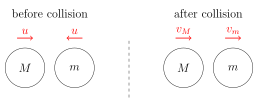
All the forces in the circular groove will be perpendicular to the direction of motion. Therefore the particles will continue moving with constant speed at all times (aside from collisions). We can consider the collisions to occur as if along a tangent, (since they will be travelling perfectly perpendicular at the collisions).

\begin{center}
    \begin{tikzpicture}[scale=0.7]
        \def\h{2.75};
        \def\arrowheight{1.5};
        \def\arrowwidth{0.4};
        \def\massa{$M$};
        \def\massb{$m$};
        \def\velocityua{$u$};
        \def\velocityub{$u$};
        \def\velocityva{$v_M$};
        \def\velocityvb{$v_m$};


        \draw (0,0) circle (1);
        \draw (2.5,0) circle (1);

        \draw (8,0) circle (1);
        \draw (10.5,0) circle (1);


        \node at (1.25, \h) {before collision};
        \node at (9.25, \h) {after collision};

        \draw[dashed] (5.25,-\arrowheight) -- (5.25, \arrowheight);

            \node at (0,0) {\massa};
            \draw[->, thick, red] (-\arrowwidth, \arrowheight) -- (\arrowwidth, \arrowheight);
            \node[above, red] at (0, \arrowheight) {\velocityua};
            \node at (2.5,0) {\massb};
            \draw[<-, thick, red] (2.5-\arrowwidth, \arrowheight) -- (2.5+\arrowwidth, \arrowheight);  \node[above, red] at (2.5, \arrowheight) {\velocityub};
            \node at (8,0) {\massa};
            \draw[->, thick, red] (8-\arrowwidth, \arrowheight) -- (8+\arrowwidth, \arrowheight);
            \node[red,above] at (8, \arrowheight) {\velocityva};
            \node at (10.5,0 ) {\massb};
            \draw[->, thick, red] (10.5-\arrowwidth, \arrowheight) -- (10.5+\arrowwidth, \arrowheight);
            \node[red,above] at (10.5, \arrowheight) {\velocityvb};
    \end{tikzpicture}
\end{center}

The speed of approach at the first collision will be $2u$. Therefore $v_m = v_M + 2eu$

\begin{align*}
\text{COM}: && Mu + m (-u) &= Mv_M + m(v_M + 2eu) \\
\Rightarrow && u(M-m - 2em) &= (M+m)v_M \\
\Rightarrow && v_M &= \left ( \frac{M-m-2em}{M+m} \right) u \\
&& v_m &= \left ( \frac{M-m-2em}{M+m} \right) u + 2eu \\
&&&= \left ( \frac{M-m+2eM}{M+m} \right) u
\end{align*}

Both particles will reverse direction if $v_M < 0$ , ie $M-m-2em < 0 \Rightarrow 2em > M-m$

Since at each collision the velocity of the particles reverses, they must still be travelling in opposite directions, and so by conservation of momentum $mv - MV = u(M-m)$. After each collision, the speed of approach (ie $V+v$) reduces by a factor of $e$, therefore $V+v = 2ue^{2n}$

\begin{align*}
&& mv - M V &= u (M-m) \\
&& v + V &= 2u e^{2n} \\
\Rightarrow && (m+M)v &= u(M-m) + M2ue^{2n} \\
\Rightarrow && v &= \frac{u(M-m) + 2ue^{2n}M}{M+m} \\
\Rightarrow && (m+M)V &= 2ume^{2n} - u(M-m) \\
\Rightarrow && V &= \frac{2um e^{2n} - u(M-m)}{M+m}
\end{align*}
This was the least popular of the mechanics questions, yet the best-answered. Nonetheless, the very standard start of the question proved to be a major stumbling-block for many candidates, with over a third unable to write down a pair of correct equations for the collision. The reason for this was very simple: about half of candidates failed to draw a diagram; this led to them trying to keep the directions in their heads, with the predictable consequence that most had inconsistent signs in their equations of momentum and restitution. It was almost impossible to make any significant further progress in such cases. (It also made the examiners' lives significantly harder, but they were not penalised for this!) The majority of those who did write down two correct equations were generally able to solve them and reach correct expressions for the velocities of the two particles after the collision. (Although the question had asked for the speeds rather than the velocities, full marks were awarded for just determining the velocities.) Many candidates who reached this point only found the conditions for one of the two particles to change direction (deducing the 2em > M − m required), but did not give an adequate (or any) explanation for why the lighter particle also changed direction. A common problem in this first half was that candidates again misread their own writing, confusing M and m. In the second half, some candidates similarly confused V and v. There were few candidates who attempted the second half of the question. Almost no candidates gave a convincing explanation for the given equation (making little or no reference to the circular track or the change of direction at every collision). Those who understood what was going on (whether or not they explained it well) and went on to try to determine v and V were frequently careless in their counting of collisions, ending up with expressions involving e^(2n) rather than e^(2n+1).