2021 Paper 3 Q9
Year: 2021
Paper: 3
Question Number: 9
Course: UFM Mechanics
Section: Momentum and Collisions 2
Problem
Solution
Examiner's report
— 2021 STEP 3, Question 9The total entry was a marginal increase from that of 2019, that of 2020 having been artificially reduced. Comfortably more than 90% attempted one of the questions, four others were very popular, and a sixth was attempted by 70%. Every question was attempted by at least 10% of the candidature. 85% of candidates attempted no more than 7 questions, though very nearly all the candidates made genuine attempts on at most six questions (the extra attempts being at times no more than labelling a page or writing only the first line or two). Generally, candidates should be aware that when asked to "Show that" they must provide enough working to fully substantiate their working, and that they should follow the instructions in a question, so if it says "Hence", they should be using the previous work in the question in order to complete the next part. Likewise, candidates should be careful when dividing or multiplying, that things are positive, or at other times non-zero.
Rating Information
Difficulty Rating: 1500.0
Difficulty Comparisons: 0
Banger Rating: 1500.0
Banger Comparisons: 0
Show LaTeX source
Problem source
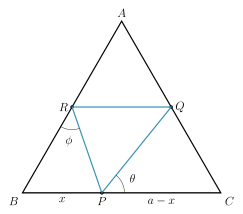
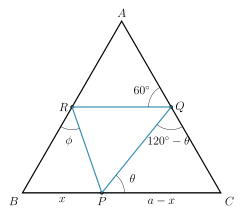
An equilateral triangle $ABC$ has sides of length $a$. The points $P$, $Q$ and $R$ lie on the sides $BC$, $CA$ and $AB$, respectively, such that the length $BP$ is $x$ and $QR$ is parallel to $CB$. Show that
\[
    (\sqrt{3}\cot\phi + 1)(\sqrt{3}\cot\theta + 1)x = 4(a - x),
\]
where $\theta = \angle CPQ$ and $\phi = \angle BRP$.

A horizontal triangular frame with sides of length $a$ and vertices $A$, $B$ and $C$ is fixed on a smooth horizontal table. A small ball is placed at a point $P$ inside the frame, in contact with side $BC$ at a distance $x$ from $B$. It is struck so that it moves round the triangle $PQR$ described above, bouncing off the frame at $Q$ and then $R$ before returning to point $P$. The frame is smooth and the coefficient of restitution between the ball and the frame is $e$.

Show that
\[
    x = \frac{ae}{1 + e}.
\]

Show further that if the ball continues to move round $PQR$ after returning to $P$, then $e = 1$.
Solution source
\begin{center}
    \begin{tikzpicture}
        \tikzset{
            axis/.style={thick, draw=black!80, -{Stealth[scale=1.2]}},
            grid/.style={thin, dashed, gray!30},
            curveA/.style={very thick, color=cyan!70!black, smooth},
            curveB/.style={very thick, color=orange!90!black, smooth},
            curveC/.style={very thick, color=green!90!black, smooth},
            curveBlack/.style={very thick, color=black, smooth},
            dot/.style={circle, fill=black, inner sep=1.2pt},
            labelbox/.style={fill=white, inner sep=2pt, rounded corners=2pt} % Protects text from lines
        }

        \def\a{3.5};
        \coordinate (B) at ({-\a}, 0);
        \coordinate (C) at ({\a}, 0);
        \coordinate (A) at (0, {sqrt(3)*\a});
        \coordinate (P) at ($(B)!0.4!(C)$);
        \coordinate (Q) at ($(A)!0.5!(C)$);
        \coordinate (R) at ($(A)!0.5!(B)$);
        \draw[curveBlack] (A) -- (B) -- (C) -- cycle;
        \node[above] at (A) {$A$};
        \node[below left] at (B) {$B$};
        \node[below right] at (C) {$C$};
        \filldraw (P) circle (1.5pt) node[below] {$P$};
        \filldraw (Q) circle (1.5pt) node[right] {$Q$};
        \filldraw (R) circle (1.5pt) node[left] {$R$};

        \draw[curveA] (P) -- (Q) -- (R) -- cycle;
        \draw (B) -- (P) node[pos=0.5, below] {$x$};
        \draw (C) -- (P) node[pos=0.5, below] {$a-x$};

        \pic [draw, angle radius=.8cm, angle eccentricity=1.5, "$\theta$"] {angle = C--P--Q};
        \pic [draw, angle radius=.8cm, angle eccentricity=1.5, "$\phi$"] {angle = B--R--P};
    \end{tikzpicture}
\end{center}

\begin{align*}
    && \frac{x}{\sin \phi} &= \frac{PR}{\sin 60^{\circ}} \\
    && \frac{a-x}{\sin (120^{\circ}-\theta)} &= \frac{QP}{\sin 60^{\circ}} \\
    && \frac{PR}{\sin \theta} &= \frac{QP}{\sin(120^{\circ}-\phi)} \\
    \\
    \Rightarrow && PR &= \frac{\sqrt3}2 \frac{x}{\sin \phi} \\
    && QP &= \frac{\sqrt3}2 \frac{a-x}{\sin(120^{\circ}-\theta)} \\
    \Rightarrow && \frac{\sqrt3}2 \frac{x}{\sin \phi} \frac{1}{\sin \theta} &= \frac{\sqrt3}2 \frac{a-x}{\sin(120^{\circ}-\theta)} \frac{1}{\sin(120^{\circ}-\phi)} \\
    \Rightarrow && a-x &= \frac{(\frac{\sqrt3}2 \cos \phi + \frac12 \sin \phi)(\frac{\sqrt3}2 \cos \theta + \frac12 \sin \theta)}{\sin \phi \sin \theta} x \\
    \Rightarrow && 4(a-x) &= (\sqrt3 \cot \phi + 1)(\sqrt 3 \cot \theta + 1) x
\end{align*}

\begin{center}
    \begin{tikzpicture}
        \tikzset{
            axis/.style={thick, draw=black!80, -{Stealth[scale=1.2]}},
            grid/.style={thin, dashed, gray!30},
            curveA/.style={very thick, color=cyan!70!black, smooth},
            curveB/.style={very thick, color=orange!90!black, smooth},
            curveC/.style={very thick, color=green!90!black, smooth},
            curveBlack/.style={very thick, color=black, smooth},
            dot/.style={circle, fill=black, inner sep=1.2pt},
            labelbox/.style={fill=white, inner sep=2pt, rounded corners=2pt} % Protects text from lines
        }

        \def\a{3.5};
        \coordinate (B) at ({-\a}, 0);
        \coordinate (C) at ({\a}, 0);
        \coordinate (A) at (0, {sqrt(3)*\a});
        \coordinate (P) at ($(B)!0.4!(C)$);
        \coordinate (Q) at ($(A)!0.5!(C)$);
        \coordinate (R) at ($(A)!0.5!(B)$);
        \draw[curveBlack] (A) -- (B) -- (C) -- cycle;
        \node[above] at (A) {$A$};
        \node[below left] at (B) {$B$};
        \node[below right] at (C) {$C$};
        \filldraw (P) circle (1.5pt) node[below] {$P$};
        \filldraw (Q) circle (1.5pt) node[right] {$Q$};
        \filldraw (R) circle (1.5pt) node[left] {$R$};

        \draw[curveA] (P) -- (Q) -- (R) -- cycle;
        \draw (B) -- (P) node[pos=0.5, below] {$x$};
        \draw (C) -- (P) node[pos=0.5, below] {$a-x$};

        \pic [draw, angle radius=.8cm, angle eccentricity=1.5, "$\theta$"] {angle = C--P--Q};
        \pic [draw, angle radius=.8cm, angle eccentricity=1.5, "$\phi$"] {angle = B--R--P};
        \pic [draw, angle radius=.8cm, angle eccentricity=1.5, "$120^{\circ}-\theta$"] {angle = P--Q--C};
        % \pic [draw, angle radius=.8cm, angle eccentricity=1.5, "$\theta$"] {angle = R--Q--P};
        \pic [draw, angle radius=.8cm, angle eccentricity=1.5, "$60^{\circ}$"] {angle = A--Q--R};
    \end{tikzpicture}
\end{center}

Notice that $e = \frac{\tan 60^{\circ}}{\tan (120^{\circ}-\theta)} = \frac{\tan \phi}{\tan 60^{\circ}}$ or

\begin{align*}
&& \tan \phi &= \sqrt 3 e \\
&& \frac{\sqrt3}{e} &= \tan(120^{\circ} - \theta) \\
&&&= \frac{-\sqrt3 - \tan \theta}{1 - \sqrt3 \tan \theta} \\
&&&= \frac{\sqrt3 \cot \theta +1}{\sqrt3-\cot \theta} \\
\Rightarrow && \sqrt3(-e-1)\cot \theta &= e-3 \\
\Rightarrow && \cot\theta &= \frac{3-e}{\sqrt{3}(1+e)} \\
\\
\Rightarrow && 4(a-x) &=  (\sqrt3 \cot \phi + 1)(\sqrt 3 \cot \theta + 1) x \\
&&&= \left (\sqrt3 \frac{1}{\sqrt3 e} + 1 \right) \left (\sqrt 3\frac{3-e}{\sqrt{3}(1+e)}+1  \right) x \\
&&&= \frac{1+e}{e}\frac{3-e+1+e}{1+e} x \\
\Rightarrow && (a-x) &= \frac{1}{e}x \\
\Rightarrow && a &= \frac{1+e}{e}x \\
\Rightarrow && x &= \frac{ae}{1+e}
\end{align*}

The ball will continue to move around $PQR$ if $e \tan(120^{\circ} - \phi) = \tan \theta$ ie
\begin{align*}
    && e \frac{-\sqrt3-\tan \phi}{1-\sqrt3 \tan \phi} &= \tan \theta \\
    \Rightarrow && e \frac{\sqrt3 + \sqrt3 e}{3e-1} &= \frac{\sqrt3(1+e)}{3-e} \\
    \Rightarrow && \frac{e}{3e-1} &= \frac{1}{3-e} \tag{$e \neq -1$} \\
    \Rightarrow && 3e-e^2 &= 3e-1 \\
    \Rightarrow && e^2 &= 1 \\
    \Rightarrow && e &= 1
\end{align*}
Just over a fifth attempted this but it had the dubious distinction of being the least successful question with a mean score a little over 4/20. There were a number of alternative methods used for the first result, and those that were successful usually applied the sine rule or dropped perpendiculars. However, some candidates drew a triangle with angles found and wrote down sine or cosine rules with no indication of how they were to be combined thus earning very little credit. Candidates who understood the concept of restitution were usually able to complete the second part of the question without any problems. Many candidates failed on the last part of the question by trying to give verbose intuition-based arguments instead of finding a third restitution equation.