2018 Paper 2 Q9
Year: 2018
Paper: 2
Question Number: 9
Course: UFM Mechanics
Section: Momentum and Collisions 1
Problem
Solution
Examiner's report
— 2018 STEP 2, Question 9The pure questions were again the most popular of the paper, with only two of those questions being attempted by fewer than half of the candidates (none of the other questions was attempted by more than half of the candidates). Good responses were seen to all of the questions, but in many cases, explanations lacked sufficient detail to be awarded full marks. Candidates should ensure that they are demonstrating that the results that they are attempting to apply are valid in the cases being considered. In several of the questions, later parts involve finding solutions to situations that are similar to earlier parts of the question. In general candidates struggled to recognise these similarities and therefore spent a lot of time repeating work that had already been done, rather than simply observing what the result must be.
Rating Information
Difficulty Rating: 1600.0
Difficulty Comparisons: 0
Banger Rating: 1485.5
Banger Comparisons: 1
Show LaTeX source
Problem source
Two small beads, $A$ and $B$, of the same mass, are threaded onto a vertical wire on which they slide without friction, and which is fixed to the ground at $P$.
They are released simultaneously from rest, $A$ from a height of $8h$ above $P$ and $B$ from a height of $17h$ above $P$.
When $A$ reaches the ground for the first time, it is moving with speed $ V$. It then rebounds with coefficient of restitution $\frac{1}{2}$ and subsequently collides with $B$ at height $H$ above $P$.
Show that $H= \frac{15}8h$ and find, in terms of $g$ and $h$, the speeds $u_A$ and  $u_B$ of the two beads just before the collision.

When $A$ reaches the ground for the second time,  it is again moving  with speed $ V$. Determine the coefficient of restitution between the two beads.
Solution source
\begin{align*}
&& v^2 &= u^2 +2as \\
\Rightarrow && V^2 &= 2 g \cdot (8h)\\
\Rightarrow && V &=4\sqrt{hg}\\
\end{align*}

When the first particle collides with the ground, the second particle is at $9h$ traveling with speed $V$, the first particle is at $0$ traveling (upwards) with speed $\tfrac12 V$.

For a collision we need:

\begin{align*}
&& \underbrace{\frac12 V t- \frac12 g t^2}_{\text{position of A}} &= \underbrace{9h - Vt -
\frac12 gt^2}_{\text{position of B}} \\
\Rightarrow && \frac32Vt &= 9h \\
\Rightarrow && t &= \frac{6h}{V} \\
\\
&& \underbrace{\frac12 V t- \frac12 g t^2}_{\text{position of A}} &= \frac12 V \frac{6h}{V}  - \frac12 g t^2 \\
&&&= 3h - \frac12 g\frac{36h^2}{16hg} \\
&&&= 3h - \frac{9}{8}h \\
&&&= \frac{15}{8}h
\end{align*}

Just before the collision, $A$ will be moving with velocity (taking upwards as positive)

\begin{align*}
&& u_A &= \frac12 V-gt \\
&&&= 2\sqrt{hg}-g \frac{6h}{V} \\
&&&= 2\sqrt{hg} - g \frac{6h}{4\sqrt{hg}} \\
&&&= 2\sqrt{hg}-\frac32\sqrt{hg} \\
&&&= \frac12 \sqrt{hg}
\end{align*}

Similarly, for $B$.

\begin{align*}
&& u_B &= -V -gt \\
&&&= -4\sqrt{hg} - \frac32\sqrt{hg} \\
&&&= -\frac{11}{2}\sqrt{hg}
\end{align*}


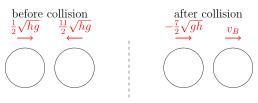
Considering $A$, to figure out $v_A$.

\begin{align*}
&& v^2 &= u^2 + 2as \\
&& V^2 &= v_A^2 + 2g\frac{15}{8}h \\
&& 16hg &= v_A^2 + \frac{15}{4}gh \\
\Rightarrow && v_A^2 &= \frac{49}{4}gh \\
\Rightarrow && v_A &= -\frac{7}{2}\sqrt{gh}
\end{align*}

\begin{center}
    \begin{tikzpicture}[scale=0.7]
        \def\h{2.75};
        \def\arrowheight{1.5};
        \def\arrowwidth{0.4};
        \def\massa{$$};
        \def\massb{$$};
        \def\velocityua{$\frac12\sqrt{hg}$};
        \def\velocityub{$\frac{11}{2}\sqrt{hg}$};
        \def\velocityva{$-\frac72\sqrt{gh}$};
        \def\velocityvb{$v_B$};


        \draw (0,0) circle (1);
        \draw (2.5,0) circle (1);

        \draw (8,0) circle (1);
        \draw (10.5,0) circle (1);


        \node at (1.25, \h) {before collision};
        \node at (9.25, \h) {after collision};

        \draw[dashed] (5.25,-\arrowheight) -- (5.25, \arrowheight);

            \node at (0,0) {\massa};
            \draw[->, thick, red] (-\arrowwidth, \arrowheight) -- (\arrowwidth, \arrowheight);
            \node[above, red] at (0, \arrowheight) {\velocityua};
            \node at (2.5,0) {\massb};
            \draw[<-, thick, red] (2.5-\arrowwidth, \arrowheight) -- (2.5+\arrowwidth, \arrowheight);  \node[above, red] at (2.5, \arrowheight) {\velocityub};
            \node at (8,0) {\massa};
            \draw[->, thick, red] (8-\arrowwidth, \arrowheight) -- (8+\arrowwidth, \arrowheight);
            \node[red,above] at (8, \arrowheight) {\velocityva};
            \node at (10.5,0 ) {\massb};
            \draw[->, thick, red] (10.5-\arrowwidth, \arrowheight) -- (10.5+\arrowwidth, \arrowheight);
            \node[red,above] at (10.5, \arrowheight) {\velocityvb};
    \end{tikzpicture}
\end{center}


To keep things clean, lets use units of $\sqrt{hg}$ so we don't need to focus on that for now:

\begin{align*}
\text{COM}: && \frac12 - \frac{11}{2} &= -\frac{7}{2}+v_B \\
\Rightarrow && v_B& =-\frac{3}{2} \\
\text{NEL}: && e &= \frac{2}{6} = \frac13
\end{align*}
This was the most popular of the mechanics questions, with almost half of the candidates attempting it. Many candidates were able to apply the required sequence of calculations and secured good marks on this question, although in some cases some steps were omitted which limited the amount of success that could be achieved on the question. In the final part of the question weaker candidates struggled to get the signs of the velocities correct and therefore were unable to reach the correct coefficient of restitution between the two particles.