Problems
Filters
218 problems found
2014 Paper 1 Q8
Let \(L_a\) denote the line joining the points \((a,0)\) and \((0, 1-a)\), where \(0< a < 1\). The line \(L_b\) is defined similarly.
- Determine the point of intersection of \(L_a\) and \(L_b\), where \(a\ne b\).
- Show that this point of intersection, in the limit as \(b\to a\), lies on the curve \(C\) given by \[ y=(1-\sqrt x)^2\, \ \ \ \ (0< x < 1)\,. \]
- Show that every tangent to \(C\) is of the form \(L_a\) for some \(a\).
Solution:
- \(L_a : \frac{y}{x-a} = \frac{1-a-0}{0-a} = \frac{a-1}{a} \Rightarrow ay+(1-a)x = a(1-a)\) \begin{align*} && ay + (1-a)x &= a(1-a) \\ && by + (1-b)x &= b(1-b) \\ \Rightarrow && aby + b(1-a)x &= ba(1-a) \\ && aby + a(1-b)x &= ab(1-b) \\ \Rightarrow && (b-a)x &= ab(b-a) \\ \Rightarrow && x &= ab \\ && y &= \frac{a-1}{a} \cdot a(b-1) \\ &&&= (1-a)(1-b) \end{align*}
- As \(a \to b\), \(x \to a^2, y \to 1-2a+a^2 =(1-a)^2 = (1-\sqrt{x})^2\)
- \(\frac{\d y}{\d x} = 2(1-\sqrt{x})\cdot \left (-\tfrac12 \frac{1}{\sqrt{x}} \right) = 1 - \frac{1}{\sqrt{x}}\). Therefore the tangent when \(x = c^2, y = (1-c)^2\) is \begin{align*} && \frac{y-(1-c)^2}{x-c^2} &= 1 - \frac{1}{c} \\ \Rightarrow && cy + (1-c)x &= c(c-1)+c(1-c)^2 \\ &&&= c(1-c) \end{align*} Which is an equation of the form \(L_c\)
2014 Paper 2 Q3
- Show, geometrically or otherwise, that the shortest distance between the origin and the line \(y= mx+c\), where \(c\ge0\), is \(c(m^2+1)^{-\frac12}\).
- The curve \(C\) lies in the \(x\)-\(y\) plane. Let the line \(L\) be tangent to \(C\) at a point \(P\) on \(C\), and let \(a\) be the shortest distance between the origin and \(L\). The curve \(C\) has the property that the distance \(a\) is the same for all points \(P\) on \(C\). Let \(P\) be the point on \(C\) with coordinates \((x,y(x))\). Given that the tangent to \(C\) at \(P\) is not vertical, show that \begin{equation} (y-xy')^2 = a^2\big (1+(y')^2 \big) \,. \tag{\(*\)} \end{equation} By first differentiating \((*)\) with respect to \(x\), show that either \(y= mx \pm a(1+m^2)^{\frac12}\) for some \(m\) or \(x^2+y^2 =a^2\).
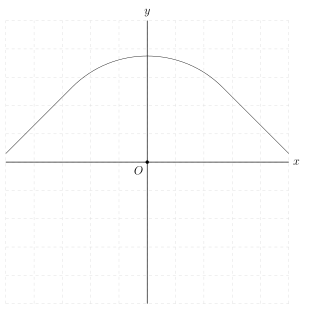
- Now suppose that \(C\) (as defined above) is a continuous curve for \(-\infty < x < \infty\), consisting of the arc of a circle and two straight lines. Sketch an example of such a curve which has a non-vertical tangent at each point.
Solution:
- \(\,\)
Note that we have a right angled triangle, with the sides in a ratio of \(m\). So if our target length is \(x\) we have \(x^2 + (mx)^2 = c^2\) and so \(x = c(m^2+1)^{-\frac12}\)
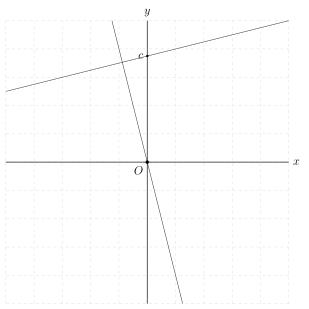
- The distance from the origin to \(L\) is \(a = c(m^2+1)^{-\frac12}\) so \begin{align*} && a^2(m^2+1) &= c^2 \\ && \frac{c-y(x)}{0-x} &= y' \\ \Rightarrow && c-y &= -xy' \\ \Rightarrow && a^2((y')^2+1) &= (y-xy')^2 \\ \\ && 2a^2y'y'' &= 2(y-xy')(y'-xy''-y') \\ &&&= 2(xy'-y)xy'' \\ \Rightarrow && y'' &= 0 \\ \text{ or } && 2a^2y' &= 2(xy'-y)x \end{align*} If \(y'' = 0\) then \(y = mx + c\) and the result follows immediately. \begin{align*} && 0 &= (a^2-x^2)y' + yx \\ \Rightarrow &&\frac1{y} y' &= -\frac{x}{a^2-x^2} \\ \Rightarrow && \ln y &= \frac12\ln (a^2-x^2) + K \\ \Rightarrow && y^2 &= M(a^2-x^2) \\ \Rightarrow && x^2 + y^2 &= a^2 \end{align*} Where in the last step we know the tangents from an ellipse are not all equidistant to the origin.
2014 Paper 2 Q6
By simplifying \(\sin(r+\frac12)x - \sin(r-\frac12)x\) or otherwise show that, for \(\sin\frac12 x \ne0\), \[ \cos x + \cos 2x +\cdots + \cos nx = \frac{\sin(n+\frac12)x - \sin\frac12 x}{2\sin\frac12x}\,. \] The functions \(S_n\), for \(n=1, 2, \dots\), are defined by \[ S_n(x) = \sum_{r=1}^n \frac 1 r \sin rx \qquad (0\le x \le \pi). \]
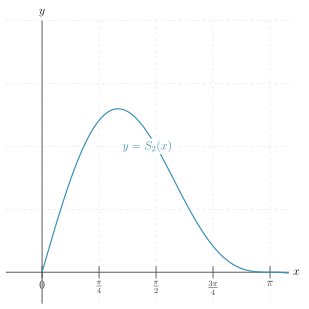
- Find the stationary points of \(S_2(x)\) for \(0\le x\le\pi\), and sketch this function.
- Show that if \(S_n(x)\) has a stationary point at \(x=x_0\), where \(0< x_0 < \pi\), then \[ \sin nx_0 = (1-\cos nx_0) \tan\tfrac12 x_0 \] and hence that \(S_n(x_0) \ge S_{n-1}(x_0)\). Deduce that if \(S_{n-1}(x) > 0\) for all \(x\) in the interval \(0 < x < \pi\), then \(S_{n}(x) > 0\) for all \(x\) in this interval.
- Prove that \(S_n(x)\ge0\) for \(n\ge1\) and \(0\le x\le\pi\).
Solution: \begin{align*} && \sin(r + \tfrac12)x - \sin(r - \tfrac12) x &= \sin rx \cos \tfrac12x + \cos r x\sin\tfrac12x - \sin r x \cos \tfrac12 x + \cos rx \sin \tfrac12 x \\ &&&= 2\cos r x \sin\tfrac12 x \\ \\ && S &= \cos x + \cos 2x + \cdots + \cos n x \\ && 2\sin \tfrac12 x S &= \sin(1 + \tfrac12)x - \sin \tfrac12 x + \\ &&&\quad+ \sin(2+\tfrac12)x - \sin(2- \tfrac12)x + \\ &&&\quad+ \sin(3+\tfrac12)x - \sin(3 - \tfrac12)x + \\ &&& \quad + \cdots + \\ &&&\quad + \sin(n+\tfrac12)x - \sin(n-\tfrac12)x \\ &&&=\sin(n+\tfrac12)x - \sin\tfrac12 x \\ \Rightarrow && S &= \frac{\sin(n+\tfrac12)x - \sin\tfrac12 x}{2 \sin \tfrac12 x} \end{align*}
- \(\,\) \begin{align*}
&& S_2(x) &= \sin x + \tfrac12 \sin 2 x \\
&& S'_2(x) &= \cos x + \cos 2x \\
&&&= \cos x + 2\cos^2 x - 1 \\
&&&= (2\cos x -1)(\cos x + 1) \\
\end{align*}
Therefore the turning points are \(\cos x= \frac12 \Rightarrow x = \frac{\pi}{3}\) and \(\cos x = -1 \Rightarrow x = \pi\)
- Suppose \(S_n(x)\) has a stationary point at \(x_0\), then $$ therefore \begin{align*} &&0 &= S_n'(x_0) \\ &&&= \cos x_0 + \cos 2x_0 + \cdots + \cos n x_0 \\ &&&= \frac{\sin(n+\tfrac12)x_0 - \sin \tfrac12x_0}{2 \sin \tfrac12 x_0} \\ \Rightarrow &&\sin\tfrac12 x_0&= \sin nx_0 \cos \tfrac12 x_0 + \cos nx_0 \sin \tfrac12x_0 \\ \Rightarrow && \sin nx_0 &= (1-\cos nx_0)\tan \tfrac12 x_0 \end{align*} Therefore \(S_n(x_0) -S_{n-1}(x_0) = \tfrac1n \sin n x_0 = \tfrac1n \underbrace{(1-\cos nx_0)}_{\geq 0}\underbrace{\tan\tfrac12 x_0}_{\geq 0} \geq 0\). Therefore if \(S_{n-1}(x) > 0\) for all \(x\) on \(0 < x < \pi\) then since \(S_n(x) > S_{n-1}(x)\) at the turning points and since they agree at the end points, it must be larger at all points inbetween.
- Notice that \(S_1(x) = \sin x \geq 0\) for all \(x \in [0,1]\) and by our previous argument we can show \(S_n > S_{n-1}\) inside the interval and equal on the boundary we must have \(S_n(x) \geq 0\) for \(x \in [0, \pi]\)
2014 Paper 2 Q7
- The function \(\f\) is defined by \(\f(x)= |x-a| + |x-b| \), where \(a < b\). Sketch the graph of \(\f(x)\), giving the gradient in each of the regions \(x < a\), \(a < x < b\) and \(x > b\). Sketch on the same diagram the graph of \(\g(x)\), where \(\g(x)= |2x-a-b|\). What shape is the quadrilateral with vertices \((a,0)\), \((b,0)\), \((b,\f(b))\) and \((a, \f(a))\)?
- Show graphically that the equation \[ |x-a| + |x-b| = |x-c|\,, \] where \(a < b\), has \(0\), \(1\) or \(2\) solutions, stating the relationship of \(c\) to \(a\) and \(b\) in each case.
- For the equation \[ |x-a| + |x-b| = |x-c|+|x-d|\,, \] where \(a < b\), \(c < d\) and \(d-c < b-a\), determine the number of solutions in the various cases that arise, stating the relationship between \(a\), \(b\), \(c\) and \(d\) in each case.
Solution:
- \(\,\)
\((a,0)\), \((b,0)\), \((b,\f(b))\) and \((a, \f(a))\) forms a rectangle.

- There are no solutions if \(a < c < b\):
There is one solution if \(a=c\) or \(a = b\)
 And there are two solution if \(c \not \in [a,b]\)
 There is exactly one solution unless....
 ... there are infinitely many solutions when the gradients line up perfectly, ie when \(a+b=c+d\)

2014 Paper 2 Q10
A particle is projected from a point \(O\) on horizontal ground with initial speed \(u\) and at an angle of \(\theta\) above the ground. The motion takes place in the \(x\)-\(y\) plane, where the \(x\)-axis is horizontal, the \(y\)-axis is vertical and the origin is \(O\). Obtain the Cartesian equation of the particle's trajectory in terms of \(u\), \(g\) and~\(\lambda\), where \(\lambda=\tan\theta\). Now consider the trajectories for different values of \(\theta\) with \(u\)~fixed. Show that for a given value of~\(x\), the coordinate~\(y\) can take all values up to a maximum value,~\(Y\), which you should determine as a function of \(x\), \(u\) and~\(g\). Sketch a graph of \(Y\) against \(x\) and indicate on your graph the set of points that can be reached by a particle projected from \(O\) with speed \(u\). Hence find the furthest distance from \(O\) that can be achieved by such a projectile.
2014 Paper 2 Q12
The lifetime of a fly (measured in hours) is given by the continuous random variable \(T\) with probability density function \(f(t)\) and cumulative distribution function \(F(t)\). The hazard function, \(h(t)\), is defined, for \(F(t) < 1\), by \[ h(t) = \frac{f(t)}{1-F(t)}\,. \]
- Given that the fly lives to at least time \(t\), show that the probability of its dying within the following \(\delta t\) is approximately \(h (t) \, \delta t\) for small values of \(\delta t\).
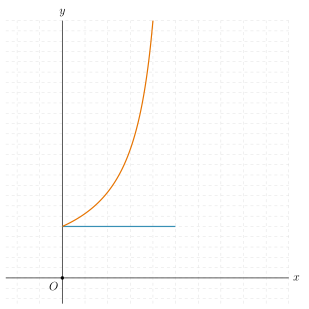
- Find the hazard function in the case \(F(t) = t/a\) for \(0< t < a\). Sketch \(f(t)\) and \(h(t)\) in this case.
- The random variable \(T\) is distributed on the interval \(t > a\), where \(a>0\), and its hazard function is \(t^{-1}\). Determine the probability density function for \(T\).
- Show that \(h(t)\) is constant for \(t > b\) and zero otherwise if and only if \(f(t) =ke^{-k(t-b)}\) for \(t > b\), where \(k\) is a positive constant.
- The random variable \(T\) is distributed on the interval \(t > 0\) and its hazard function is given by \[ h(t) = \left(\frac{\lambda}{\theta^\lambda}\right)t^{\lambda-1}\,, \] where \(\lambda\) and \(\theta\) are positive constants. Find the probability density function for \(T\).
Solution:
- \(\,\) \begin{align*} && \mathbb{P}(T > t + \delta t | T > t) &= \frac{\mathbb{P}(T < t + \delta t)}{\mathbb{P}(T > t )} \\ &&&= \frac{\int_t^{t+\delta t} f(s) \d s}{1-F(t)} \\ &&&\approx \frac{f(t)\delta t}{1-F(t)} \\ &&&= h(t) \delta t \end{align*}
- If \(F(t) = t/a\) then \(f(t) = 1/a\) and \(h(t) = \frac{1/a}{1-t/a} = \frac{1}{a-t}\)
- \(\,\) \begin{align*} && \frac{F'}{1-F} &= \frac{1}{t} \\ \Rightarrow && -\ln (1-F) &= \ln t + C\\ \Rightarrow && 1-F &= \frac{A}{t} \\ && F &= 1 - \frac{A}{t} \\ F(a) = 0: && F &= 1 - \frac{a}{t} \\ && f(t) &= \frac{a}{t^2} \end{align*}
- (\(\Rightarrow\)) \begin{align*} && \frac{F'}{1-F} &= k \\ \Rightarrow && -\ln(1-F) &= kt+C \\ \Rightarrow && 1-F &= Ae^{-kt} \\ F(b) = 0: && 1 &= Ae^{-kb} \\ \Rightarrow && 1-F &= e^{-k(t-b)}\\ \Rightarrow && f &= ke^{-k(t-b)} \\ \end{align*} (\(\Leftarrow\)) \(f(t) = ke^{-k(t-b)} \Rightarrow F(t) = 1-e^{-k(t-b)}\) and the result is clear.
- \(\,\) \begin{align*} && \frac{F'}{1-F} &= \left ( \frac{\lambda}{\theta^{\lambda}} \right) t^{\lambda-1} \\ \Rightarrow && -\ln(1-F) &= \left ( \frac{t}{\theta} \right)^{\lambda} +C\\ \Rightarrow && F &= 1-A\exp \left (- \left ( \frac{t}{\theta} \right)^{\lambda} \right) \\ F(0) = 0: && 0 &= 1-A \\ \Rightarrow && F &= 1 - \exp \left (- \left ( \frac{t}{\theta} \right)^{\lambda} \right) \\ \Rightarrow && f &= \lambda t^{\lambda -1} \theta^{-\lambda} \exp \left (- \left ( \frac{t}{\theta} \right)^{\lambda} \right) \end{align*}
2013 Paper 1 Q2
In this question, \(\lfloor x \rfloor\) denotes the greatest integer that is less than or equal to \(x\), so that \(\lfloor 2.9 \rfloor = 2 = \lfloor 2.0 \rfloor\) and \(\lfloor -1.5 \rfloor = -2\). The function \(\f\) is defined, for \(x\ne0\), by \(\f(x) = \dfrac{\lfloor x \rfloor}{x}\,\).
- Sketch the graph of \(y=\f(x)\) for \(-3\le x \le 3\) (with \(x\ne0\)).
- By considering the line \(y= \frac7{12}\) on your graph, or otherwise, solve the equation \(\f(x) = \frac7 {12}\,\). Solve also the equations \(\f(x) =\frac{17}{24}\) and \(\f(x) = \frac{4 }{3 }\,\).
- Find the largest root of the equation \(\f(x) =\frac9{10}\,\).
Solution:

- Notice that there are no solutions when \(x < 0\) since \(f(x) \geq 1\) in that region. Suppose \(x = n + \epsilon, 0 < \epsilon < 1\), then \(f(x) = \frac{n}{n+\epsilon}\), ie \(12n = 7n + 7 \epsilon \Rightarrow 5 n = 7\epsilon \Rightarrow \epsilon = \frac{5}{7}n \Rightarrow n < \frac75\), so \(n = 1 ,\epsilon = \frac57, x = \frac{12}5\). \begin{align*} && \frac{17}{24} &= f(x) \\ \Rightarrow && 17n + 17 \epsilon &= 24 n \\ \Rightarrow && 17 \epsilon &= 7 n \\ \Rightarrow && n &< \frac{17}{7} \\ \Rightarrow && n &= 1, 2 \\ \Rightarrow && x &= \frac{24}{17}, \frac{48}{17} \end{align*}. For \(f(x) = \frac{4}{3}\) we notice that \(x < 0\), so let \(x = -n +\epsilon\), ie \begin{align*} && \frac43 &= f(x) \\ \Rightarrow && \frac43 &= \frac{-n}{-n+\epsilon} \\ \Rightarrow && 4\epsilon &= n \\ \Rightarrow && n &= 1,2,3 \\ \Rightarrow && x &= -\frac{5}{4}, -\frac{3}{2}, -\frac{9}{4} \end{align*}
- \begin{align*} && \frac9{10} &= f(x) \\ \Rightarrow && 9n + 9 \epsilon &= 10 n \\ \Rightarrow && 9 \epsilon &= n \\ \Rightarrow && n < 9 \end{align} So largest will be when \(n = 8, \epsilon = \frac{8}{9}\), ie \(\frac{80}{9}\)
2013 Paper 1 Q5
The point \(P\) has coordinates \((x,y)\) which satisfy \[ x^2+y^2 + kxy +3x +y =0\,. \]
- Sketch the locus of \(P\) in the case \(k=0\), giving the points of intersection with the coordinate axes.
- By factorising \(3x^2 +3y^2 +10xy\), or otherwise, sketch the locus of \(P\) in the case \(k=\frac{10}{3}\,\), giving the points of intersection with the coordinate axes.
- In the case \(k=2\), let \(Q\) be the point obtained by rotating \(P\) clockwise about the origin by an angle~\(\theta\), so that the coordinates \((X,Y)\) of \(Q\) are given by \[ X=x\cos\theta +y\sin\theta\,, \ \ \ \ Y= -x\sin\theta + y\cos\theta\,. \] Show that, for \(\theta =45^\circ\), the locus of \(Q\) is \( \sqrt2 Y= (\sqrt2 X+1 )^2 - 1 .\) Hence, or otherwise, sketch the locus of \(P\) in the case \(k=2\), giving the equation of the line of symmetry.
Solution:
- \(k = 0\), we have \(x^2 + y^2 + 3x + y = 0\), ie \((x+\tfrac32)^2+(y+\tfrac12)^2 = \frac{10}{4}\).

- \(3x^2 + 3y^2 +10xy = (3x+y)(x+3y)\) so \(x^2 + y^2 + \tfrac{10}3xy + 3x+y = (3x+y)(\frac{x+3y}{3}+1) = 0\) so we have the line pair \(3x +y =0\), \(x+3y + 3 = 0\)

- If \(k = 2\) then \((x+y)^2 + (x+y)+2x = 0\). If \(\theta = 45^\circ\) then \( X = \frac1{\sqrt{2}}(x+y), Y = \frac{1}{\sqrt{2}}(y-x)\), ie \(x+y = \sqrt{2}X\) and \(x = \frac{1}{\sqrt2}(X-Y)\), so our equation is:
\begin{align*}
0 &= 2X^2 + \sqrt{2}X + \sqrt{2}(X-Y) \\
&= (\sqrt{2}X + 1)^2 - 1 - \sqrt{2} Y
\end{align*}
which would be a parabola with line of symmetry \(X = -\frac{1}{\sqrt{2}}\).
However, we are actually looking at that parabola rotated by \(45^\circ\) anticlockwise.

2013 Paper 1 Q8
- The functions \(\mathrm{a, b, c}\) and \(\mathrm{d}\) are defined by
- \({\rm a}(x) =x^2 \ \ \ \ (-\infty < x < \infty),\)
- \({\rm b}(x) = \ln x \ \ \ \ (x > 0),\)
- \({\rm c}(x) =2x \ \ \ \ (-\infty < x < \infty),\)
- \({\rm d}(x)= \sqrt x \ \ \ \ (x\ge0) \,.\)
- The functions \(\mathrm{f}\) and \(\mathrm{g}\) are defined by
- \(\f(x)= \sqrt{x^2-1\,} \ \ \ \ (\vert x \vert \ge 1),\)
- \(\g(x) = \sqrt{x^2+1\,} \ \ \ \ (-\infty < x < \infty).\)
- Sketch the graphs of the functions \(\h\) and \({\rm k}\) defined by
- \(\h(x) = x+\sqrt{x^2-1\,}\, \ \ \ \ ( x \ge1)\),
- \({\rm k}(x) = x-\sqrt{x^2-1\,}\, \ \ \ \ (\vert x\vert \ge1),\)
Solution:
- \begin{align*} cb(x) &= c(b(x)) \\ &= 2 \ln x \quad (x > 0) \\ ab(x) &= (b(x))^2 \\ &= (\ln x)^2 \quad (x > 0) \\ da(x) &= \sqrt{a(x)} \\ &= \sqrt{x^2} \\ &= |x| \quad (-\infty < x < \infty) \\ ad(x) &= (d(x))^2 \\ &= (\sqrt{x})^2 \\ &= x \quad (x \geq 0) \end{align*} The domains are specified above. The ranges are \(\mathbb{R}, \mathbb{R}_{\geq 0}, \mathbb{R}_{\geq 0}, \mathbb{R}_{\geq 0}\) respectively.
- \begin{align*} fg(x) &= \sqrt{g(x)^2-1} \quad (|g(x)| \geq 1) \\ &= \sqrt{x^2+1-1} \\ &= |x| \end{align*} So \(fg: \mathbb{R} \to \mathbb{R}_{\geq 0}\). \begin{align*} gf(x) &= \sqrt{f(x)^2 + 1} \\ &= \sqrt{\left ( \sqrt{x^2-1} \right)^2+1} \quad (|x| \geq 1) \\ &= |x| \end{align*} So \(gf: \mathbb{R}_{\geq 0} \to \mathbb{R}_{\geq 0}\)


2013 Paper 2 Q1
- Find the value of \(m\) for which the line \(y = mx\) touches the curve \(y = \ln x\,\). If instead the line intersects the curve when \(x = a\) and \(x = b\), where \(a < b\), show that \(a^b = b^a\). Show by means of a sketch that \(a < \e < b\).
- The line \(y=mx+c\), where \(c>0\), intersects the curve \(y=\ln x\) when \(x=p\) and \(x=q\), where \(p < q\). Show by means of a sketch, or otherwise, that \(p^q > q^p\).
- Show by means of a sketch that the straight line through the points \((p, \ln p)\) and \((q, \ln q)\), where \(\e\le p < q\,\), intersects the \(y\)-axis at a positive value of \(y\). Which is greater, \(\pi^\e\) or \(\e^\pi\)?
- Show, using a sketch or otherwise, that if \(0 < p < q\) and \(\dfrac{\ln q - \ln p}{q-p} = \e^{-1}\), then \(q^p > p^q\).
Solution: \begin{questionparts} \item The tangent to \(y = \ln x\) is \begin{align*} && \frac{y - \ln x_1}{x - x_1} &= \frac{1}{x_1} \\ \Rightarrow && \frac{x_1y -x_1 \ln x_1}{ x- x_1} &= 1 \\ \Rightarrow && x_1 y - x_1 \ln x_1 &= x - x_1 \end{align*} So to run through the origin, we need \(\ln x_1 = 1 \Rightarrow x_1 = e\) so the line will be \(y = \frac1{e} x\) If \(ma = \ln a \Rightarrow m = \frac{\ln a}{a} = \frac{\ln b}{b} \Rightarrow b \ln a = a \ln b \Rightarrow a^b = b^a\). \item
2013 Paper 2 Q3
- Given that the cubic equation \(x^3+3ax^2 + 3bx +c=0\) has three distinct real roots and \(c<0\), show with the help of sketches that either exactly one of the roots is positive or all three of the roots are positive.
- Given that the equation \(x^3 +3ax^2+3bx+c=0\) has three distinct real positive roots show that \begin{equation*} a^2>b>0, \ \ \ \ a<0, \ \ \ \ c<0\,. \tag{\(*\)} \end{equation*} [Hint: Consider the turning points.]
- Given that the equation \(x^3 +3ax^2+3bx+c=0\) has three distinct real roots and that \begin{equation*} ab<0, \ \ \ \ c>0\,, \end{equation*} determine, with the help of sketches, the signs of the roots.
- Show by means of an explicit example (giving values for \(a\), \(b\) and \(c\)) that it is possible for the conditions (\(*\)) to be satisfied even though the corresponding cubic equation has only one real root.
Solution:
- First notice that this cubic has leading first term \(1\) and three real roots, so it must have the shape:
With the \(x\)-axis running somewhere between the dashed lines. Since \(c < 0\), the \(y\)-axis must meet the curve below the \(x\)-axis, ie somewhere on the blue section of this curve:
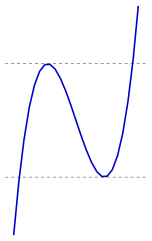 Therefore there will be either \(1\) (if it meets it in the \(\cup\) area) or \(3\) (if it meets it on the far left) positive roots.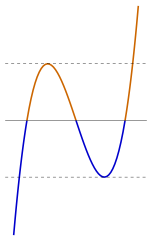
- First notice that if \(c > 0\) we cannot have three positive real roots since the function would need to pass \(0\) between \(0\) and \(-\infty\). Secondly, notice both turning points must be larger than zero, ie \begin{align*} && 0 &= 3x^2 + 6ax + 3b \\ \Leftrightarrow && 0 &= (x+a)^2 + b - a^2 \end{align*} has both roots larger than zero, (and it needs to have two roots, so \(a^2 > b\) and \(-a > 0\), ie \(a < 0\). If \(b < 0\), then just looking at \(x^2+2ax+b\) we can see that it is \(<0\) at \(0\) and one of the roots will be negative, therefore \(c < 0\), \(a^2 > b > 0\) and \(a < 0\)
- Since \(c > 0\) we can see that at least one root is negative.
ie the \(y\)-axis passes through an orange section of this curve. What now matters is where the larger turning point is. Considering \(x^2 + 2ax + b\), we notice that \(ab < 0\) means that \((x-\alpha)(x-\beta)\) we must have \((\alpha + \beta)\alpha \beta > 0\) which isn't possible if both roots are negative. Therefore the \(y\)-axis passes through the orange \(\cap\) and there are \(2\) positive real roots.
- If we take \(a = 1, b = -1, c = 1\) then we have \(x^3 + 3x^2-3x+1\). This has turning points when \(x^2+2x-1 = 0\), ie \(x = -1 \pm \sqrt{2}\) Notice that \begin{align*} && y(-1\pm \sqrt2) &= (-1 \pm \sqrt{2})^3 + 3(-1 \pm \sqrt{2})^2-3(-1 \pm \sqrt{2}) + 1 \\ &&&= (-1\pm \sqrt{2}) \cdot (3 \mp 2\sqrt2) + 3(3 \mp \sqrt2) -3(-1\pm \sqrt2) + 1 \\ &&&= (-7 \pm 5 \sqrt2) + (9 \mp 3\sqrt2) +(3 \mp 3\sqrt2) + 1 \\ &&&= 24 \mp 16\sqrt2 = 8(3 \mp 2 \sqrt2) >0 \end{align*} ie both turning points are above zero and hence only one real root
2013 Paper 2 Q4
The line passing through the point \((a,0)\) with gradient \(b\) intersects the circle of unit radius centred at the origin at \(P\) and \(Q\), and \(M\) is the midpoint of the chord \(PQ\). Find the coordinates of \(M\) in terms of \(a\) and \(b\).
- Suppose \(b\) is fixed and positive. As \(a\) varies, \(M\) traces out a curve (the locus of \(M\)). Show that \(x=- by\) on this curve. Given that \(a\) varies with \(-1\le a \le 1\), show that the locus is a line segment of length \(2b/(1+b^2)^\frac12\). Give a sketch showing the locus and the unit circle.
- Find the locus of \(M\) in the following cases, giving in each case its cartesian equation, describing it geometrically and sketching it in relation to the unit circle:
- \(a\) is fixed with \(0 < a < 1\), and \(b\) varies with \(-\infty < b < \infty\);
- \(ab=1\), and \(b\) varies with \(0< b\le1\).
Solution: \begin{align*} && y &= bx-ba \\ && 1 &= x^2 + y^2 \\ \Rightarrow && 1 &= x^2 + b^2(x-a)^2 \\ \Rightarrow && 0 &= (1+b^2)x^2-2ab^2x+b^2a^2-1 \end{align*} This will have roots which sum to \(\frac{2ab^2}{1+b^2}\), therefore \(M = \left ( \frac{ab^2}{1+b^2}, \frac{ab^3}{1+b^2}-ba \right)=\left ( \frac{ab^2}{1+b^2}, \frac{-ba}{1+b^2} \right)\)
- Since \(b\) is fixed so is \(\frac{b}{1+b^2} = t\) and all the points are \((bta, -ta)\), ie \(x = -by\). If \(a \in [-1,1]\) we are ranging on the points \((bt, -t)\) to \((-bt, t)\) which is a distance of \begin{align*}
&& d &= \sqrt{(bt+bt)^2+(-2t)^2} \\
&&&= \sqrt{4(b^2+1)t^2} \\
&&&=2 \sqrt{(b^2+1)\frac{b^2}{(b^2+1)^2}} \\
&&&= \frac{2b}{\sqrt{b^2+1}}
\end{align*}

- If \(a\) is fixed we have \(\left ( \frac{ab^2}{1+b^2}, -\frac{ba}{1+b^2} \right)\)
\begin{align*}
&& \frac{x}{y} &= - b \\
\Rightarrow && y &= \frac{a\frac{x}{y}}{1 + \frac{x^2}{y^2}} \\
\Rightarrow && y^2 \left ( 1 + \frac{x^2}{y^2} \right) &= ax \\
\Rightarrow && x^2-ax + y^2 &= 0 \\
\Rightarrow && \left (x - \frac{a}{2} \right)^2 + y^2 &= \frac{a^2}{4}
\end{align*}
Therefore we will end up with a circle centre \((\tfrac{a}{2}, 0)\) going through the origin.

- If \(ab = 1\), we have \(\left ( \frac{b}{1+b^2}, -\frac{1}{1+b^2} \right)\)
\begin{align*}
&& \frac{x}{y} &= -b \\
\Rightarrow && y &= -\frac{1}{1+\frac{x^2}{y^2}} \\
\Rightarrow && y + \frac{x^2}{y} &= - 1 \\
\Rightarrow && y^2 +y+ x^2 &= 0 \\
\Rightarrow && \left ( y + \frac12 \right)^2 + x^2 &= \frac14
\end{align*}

- If \(a\) is fixed we have \(\left ( \frac{ab^2}{1+b^2}, -\frac{ba}{1+b^2} \right)\)
\begin{align*}
&& \frac{x}{y} &= - b \\
\Rightarrow && y &= \frac{a\frac{x}{y}}{1 + \frac{x^2}{y^2}} \\
\Rightarrow && y^2 \left ( 1 + \frac{x^2}{y^2} \right) &= ax \\
\Rightarrow && x^2-ax + y^2 &= 0 \\
\Rightarrow && \left (x - \frac{a}{2} \right)^2 + y^2 &= \frac{a^2}{4}
\end{align*}
Therefore we will end up with a circle centre \((\tfrac{a}{2}, 0)\) going through the origin.
2013 Paper 2 Q5
- A function \(\f(x)\) satisfies \(\f(x) = \f(1-x)\) for all \(x\). Show, by differentiating with respect to \(x\), that \(\f'(\frac12) =0\,\). If, in addition, \(\f(x) = \f(\frac1x)\) for all (non-zero) \(x\), show that \(\f'(-1)=0\) and that \(\f'(2)=0\).
- The function \(\f\) is defined, for \(x\ne0\) and \(x\ne1\), by \[ \f(x) = \frac {(x^2-x+1)^3}{(x^2-x)^2} \,. \] Show that \(\f(x)= \f(\frac 1 x)\) and \(\f(x) = \f(1-x)\). Given that it has exactly three stationary points, sketch the curve \(y=\f(x)\).
- Hence, or otherwise, find all the roots of the equation \(\f(x) = \dfrac {27} 4\,\) and state the ranges of values of \(x\) for which \(\f(x) > \dfrac{27} 4\,\). Find also all the roots of the equation \(\f(x) = \dfrac{343}{36}\,\) and state the ranges of values of \(x\) for which \(\f(x) > \dfrac{343}{36}\).
Solution:
- \(\,\) \begin{align*} && f(x) &= f(1-x) \\ \Rightarrow && f'(x) &= -f'(1-x) \\ \Rightarrow && f'(\tfrac12) &= -f'(\tfrac12) \\ \Rightarrow && f'(\tfrac12) &= 0 \\ \\ && f(x) &= f(\tfrac1x) \\ \Rightarrow && f'(x) &= f'(\tfrac1x) \cdot \frac{-1}{x^2} \\ \Rightarrow && f'(-1) &= -f'(-1) \\ \Rightarrow && f'(-1) &= 0 \\ \\ && f'(2) &= -\frac{1}{4}f'(\tfrac12) \\ &&&= 0 \end{align*}
- Suppose \begin{align*}
&& f(x) &= \frac{(x^2-x+1)^3}{(x^2-x)^2} \\
&& f(1/x) &= \frac{(x^{-2}-x^{-1}+1)^3}{(x^{-2}-x^{-1})^2} \\
&&&= \frac{(1-x+x^2)^3/x^6}{((x-x^2)^2/x^6} \\
&&&= f(x) \\
\\
&& f(1-x) &= \frac{((1-x)^2-(1-x)+1)^3}{((1-x)^2-(1-x))^2} \\
&&&= \frac{(1-x+x^2)^3}{(x^2-x)^2} = f(x)
\end{align*}
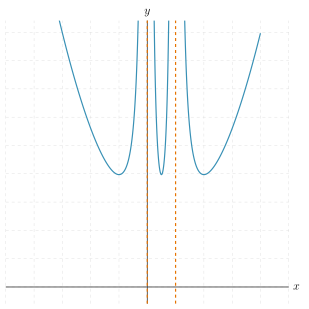
- Clearly \(x = -1\) is a root of \(f(x) = \frac{27}{4}\), so we must also have \(x=2\) and \(x = \frac12\), therefore \(f(x) > \frac{27}{4}\) if \(x \in \mathbb{R} \setminus \{-1, 2, \tfrac12, 0, 1 \}\). Clearly \(x = 3\) and \(x = -2\) are solutions so we also have: \(\frac13, -\frac12, \frac32, \frac23\) and these must be all solutions so we must have: \(f(x) > \frac{343}{36} \Leftrightarrow x \in (-\infty, -2) \cup (-\frac12, 0) \cup (0, \frac13) \cup (\frac23, 1) \cup (1, \frac32) \cup (3, \infty)\)
2013 Paper 2 Q8
The function \(\f\) satisfies \(\f(x)>0\) for \(x\ge0\) and is strictly decreasing (which means that \(\f(b)<\f(a)\) for \(b>a\)).
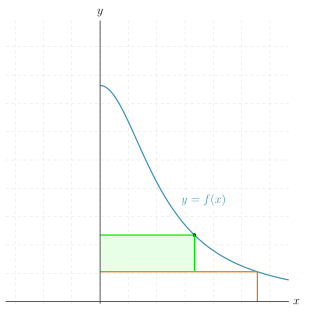
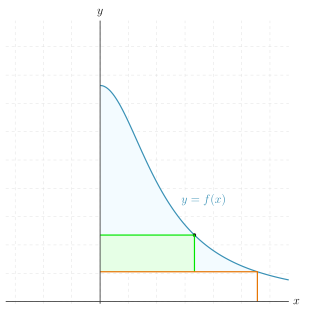
- For \(t\ge0\), let \(A_0(t)\) be the area of the largest rectangle with sides parallel to the coordinate axes that can fit in the region bounded by the curve \(y=\f(x)\), the \(y\)-axis and the line \(y=\f(t)\). Show that \(A_0(t)\) can be written in the form \[ A_0(t) =x_0\left( \f(x_0) -\f(t)\right), \] where \(x_0\) satisfies \(x_0 \f'(x_0) +\f(x_0) = \f(t)\,\).
- The function g is defined, for \(t> 0\), by \[ \g(t) =\frac 1t \int_0^t \f(x) \d x\,. \] Show that \(t \g'(t) = \f(t) -\g(t)\,\). Making use of a sketch show that, for \(t>0\), \[ \int_0^t \left( \f(x) - \f(t)\right) \d x > A_0(t) \] and deduce that \(-t^2 \g'(t)> A_0(t)\).
- In the case \(\f(x)= \dfrac 1 {1+x}\,\), use the above to establish the inequality \[ \ln \sqrt{1+t} > 1 - \frac 1 {\sqrt{1+t}} \,, \] for \(t>0\).
Solution:
- First, not that the point must be ony the curve:
Since otherwise it's pretty clear we could make the area of the rectangle larger by moving the point onto the curve. Therefore \(A = x(f(x)-f(t))\). To maximise this we need \(xf'(x) + f(x)-f(t) = 0\), ie \(x_0f'(x_0) + f(x_0) = f(t)\)
- Suppose \(\displaystyle \g(t) =\frac 1t \int_0^t \f(x) \d x\) then
\begin{align*}
&& \g(t) &=\frac 1t \int_0^t \f(x) \d x\\
\Rightarrow && tg(t) &= \int_0^t \f(x) \d x \\
\Rightarrow && tg'(t) +g(t) &= f(t) \\
\Rightarrow && tg'(t) &= f(t) - g(t)
\end{align*}
Clearly the blue area + green area is larger than the green area. So \(\displaystyle \int_0^t (f(x) - f(t))\d x > A_0(t)\). Notice that \(f(t) = \frac1{t} \int_0^t f(t) \d x \) so \(-t^2g'(t) = \int_0^t f(x) \d x > A_0(t)\)
- Not that if \(f(x) = \dfrac{1}{1+x}\), the \(f'(x) = -\frac{1}{(1+x)^2}\) and so \begin{align*} && -\frac{x_0}{(1+x_0)^2} + \frac{1}{1+x_0} &= \frac{1}{1+t} \\ && \frac{1}{(1+x_0)^2} &= \frac{1}{1+t} \\ \Rightarrow && x_0 &= \sqrt{1+t} - 1 \\ && A_0(t) &= (\sqrt{1+t} - 1) \left ( \frac{1}{\sqrt{1+t}} - \frac{1}{t+1} \right) \\ &&&= 1 - \frac{1}{\sqrt{1+t}} - \frac{1}{\sqrt{1+t}} + \frac{1}{1+t} \\ &&&= \frac{2+t}{1+t} - \frac{2}{\sqrt{1+t}} \\ && g(t) &= \frac{1}{t} \int_0^t \frac{1}{1+x} \d x \\ &&&= \frac{\ln(1+t)}{t} \\ \Rightarrow && g'(t) &= \frac{\frac{t}{1+t} - \ln(1+t)}{t^2} \\ \Rightarrow && -t^2g(t) &= \ln(1+t) - \frac{t}{1+t} \\ \Rightarrow && \ln(1+t) - \frac{t}{1+t} &> \frac{2+t}{1+t} - \frac{2}{\sqrt{1+t}} \\ \Rightarrow && \ln \sqrt{1+t} & > 1 - \frac{1}{\sqrt{1+t}} \end{align*}
2012 Paper 1 Q2
- Sketch the curve \(y= x^4-6x^2+9\) giving the coordinates of the stationary points. Let \(n\) be the number of distinct real values of \(x\) for which
\[
x^4-6x^2 +b=0.
\]
State the values of \(b\), if any, for which
- \(n=0\,\);
- \(n=1\,\);
- \(n=2\,\);
- \(n=3\,\);
- \(n=4\,\).
- For which values of \(a\) does the curve \(y= x^4-6x^2 +ax +b\) have a point at which both \(\dfrac{\d y}{\d x}=0\) and \(\dfrac{\d^2y}{\d x^2}=0\,\)? For these values of \(a\), find the number of distinct real values of \(x\) for which \(\vphantom{\dfrac{A}{B}}\) \[ x^4-6x^2 +ax +b=0\,, \] in the different cases that arise according to the value of \(b\).
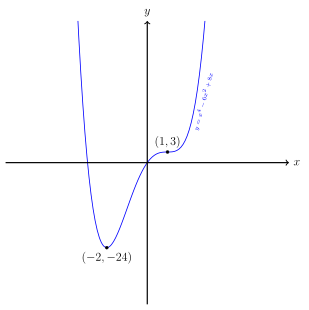
- Sketch the curve \(y= x^4-6x^2 +ax\) in the case \(a>8\,\).
Solution:
- \(\,\)

- \(n = 0\) if \(b > 9\)
- \(n = 1\) is not possible, since by symmetry if \(x\) is a root, so is \(-x\), and \(0\) can never be the only root.
- \(n = 2\) if \(b < 0\) or \(b = 9\)
- \(n = 3\) if \(b = 0\)
- \(n = 4\) if \(0 < b < 9\)
- \(\,\) \begin{align*}
&& y' &= 4x^3-12x+a \\
&& y'' &= 12x^2-12 \\
\Rightarrow && x &= \pm 1 \\
\Rightarrow && 0 &= 4(\pm 1) - 12 (\pm 1) + a \\
&&&= a \mp 8 \\
\Rightarrow && a &= \pm 8
\end{align*}
When \(a = 8\), we have \(y = x^4-6x^2+8x\) and
\begin{align*}
&&y' &= 4x^3-12x+8 \\
&&&= 4(x^3-3x+2) \\
&&&= 4(x-1)^2(x+2) \\
\Rightarrow && y(1) &= 3\\
&& y(-2) &= -24
\end{align*}
Therefore there are no solutions if \(b > 24\), one solution if \(b = 24\) and two solutions otherwise. Similarly, if \(a = -8\), we have \(y = x^4 - 6x^2-8x\) \begin{align*} && y' &= 4x^3-12x-8 \\ &&&= 4(x^3-3x-2) \\ &&&= 4(x-2)(x+1)^2 \end{align*} So we have stationary points at \(x = 2\) and \(x = -1\) (which is also a inflection point) and at \(x = 2\) \(y = -24\), so we have the same story: there are no solutions if \(b > 24\), one solution if \(b = 24\) and two solutions otherwise.
- \(\,\)
