2012 Paper 1 Q2
Year: 2012
Paper: 1
Question Number: 2
Course: LFM Pure and Mechanics
Section: Differentiation from first principles
Difficulty: 1484.0
Banger: 1484.0
curve sketching
stationary points
quartic
polynomial roots
inflection point
differentiation
number of real roots
optimisation
Problem
- Sketch the curve \(y= x^4-6x^2+9\) giving the coordinates of the stationary points. Let \(n\) be the number of distinct real values of \(x\) for which
\[
x^4-6x^2 +b=0.
\]
State the values of \(b\), if any, for which
- \(n=0\,\);
- \(n=1\,\);
- \(n=2\,\);
- \(n=3\,\);
- \(n=4\,\).
- For which values of \(a\) does the curve \(y= x^4-6x^2 +ax +b\) have a point at which both \(\dfrac{\d y}{\d x}=0\) and \(\dfrac{\d^2y}{\d x^2}=0\,\)? For these values of \(a\), find the number of distinct real values of \(x\) for which \(\vphantom{\dfrac{A}{B}}\) \[ x^4-6x^2 +ax +b=0\,, \] in the different cases that arise according to the value of \(b\).
- Sketch the curve \(y= x^4-6x^2 +ax\) in the case \(a>8\,\).
Solution
- \(\,\)

- \(n = 0\) if \(b > 9\)
- \(n = 1\) is not possible, since by symmetry if \(x\) is a root, so is \(-x\), and \(0\) can never be the only root.
- \(n = 2\) if \(b < 0\) or \(b = 9\)
- \(n = 3\) if \(b = 0\)
- \(n = 4\) if \(0 < b < 9\)
- \(\,\) \begin{align*}
&& y' &= 4x^3-12x+a \\
&& y'' &= 12x^2-12 \\
\Rightarrow && x &= \pm 1 \\
\Rightarrow && 0 &= 4(\pm 1) - 12 (\pm 1) + a \\
&&&= a \mp 8 \\
\Rightarrow && a &= \pm 8
\end{align*}
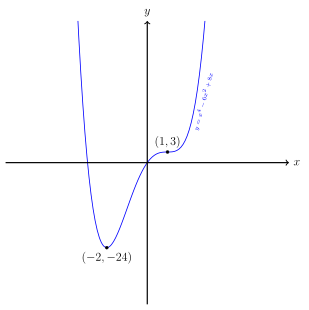
When \(a = 8\), we have \(y = x^4-6x^2+8x\) and
\begin{align*}
&&y' &= 4x^3-12x+8 \\
&&&= 4(x^3-3x+2) \\
&&&= 4(x-1)^2(x+2) \\
\Rightarrow && y(1) &= 3\\
&& y(-2) &= -24
\end{align*}
Therefore there are no solutions if \(b > 24\), one solution if \(b = 24\) and two solutions otherwise. Similarly, if \(a = -8\), we have \(y = x^4 - 6x^2-8x\) \begin{align*} && y' &= 4x^3-12x-8 \\ &&&= 4(x^3-3x-2) \\ &&&= 4(x-2)(x+1)^2 \end{align*} So we have stationary points at \(x = 2\) and \(x = -1\) (which is also a inflection point) and at \(x = 2\) \(y = -24\), so we have the same story: there are no solutions if \(b > 24\), one solution if \(b = 24\) and two solutions otherwise.
- \(\,\)

Examiner's report
— 2012 STEP 1, Question 2
Above Average
Described as 'popular'; varying levels of success, no numerical anchor
Source: Cambridge STEP 2012 Examiner's Report
· 2012-full.pdf
Rating Information
Difficulty Rating: 1484.0
Difficulty Comparisons: 1
Banger Rating: 1484.0
Banger Comparisons: 1
Show LaTeX source
Problem source
\begin{questionparts}
\item
Sketch the curve $y= x^4-6x^2+9$ giving the coordinates of the stationary points. Let $n$ be the number of distinct real values of $x$ for which
\[
x^4-6x^2 +b=0.
\]
State the values of $b$, if any, for which
\begin{enumerate}
\item $n=0\,$;
\item $n=1\,$;
\item $n=2\,$;
\item $n=3\,$;
\item $n=4\,$.
\end{enumerate}
\item
For which values of $a$ does the curve $y= x^4-6x^2 +ax +b$ have a point at which both $\dfrac{\d y}{\d x}=0$ and $\dfrac{\d^2y}{\d x^2}=0\,$? For these values of $a$, find the number of distinct real values of $x$ for which $\vphantom{\dfrac{A}{B}}$
\[
x^4-6x^2 +ax +b=0\,,
\]
 in the different cases that arise according to the value of $b$.
\item Sketch the curve $y= x^4-6x^2 +ax$ in the case $a>8\,$.
\end{questionparts}
Solution source
\begin{questionparts}
    \item $\,$
    \begin{center}
        \begin{tikzpicture}
        \def\functionf(#1){(#1)^4-6*((#1)^2)+9};
        \def\xl{-7};
        \def\xu{7};
        \def\yl{-2};
        \def\yu{20};

        % Calculate scaling factors to make the plot square
        \pgfmathsetmacro{\xrange}{\xu-\xl}
        \pgfmathsetmacro{\yrange}{\yu-\yl}
        \pgfmathsetmacro{\xscale}{10/\xrange}
        \pgfmathsetmacro{\yscale}{10/\yrange}

        % Define the styles for the axes and grid
        \tikzset{
            axis/.style={very thick, ->},
            grid/.style={thin, gray!30},
            x=\xscale cm,
            y=\yscale cm
        }

        % Define the bounding region with clip
        \begin{scope}
            % You can modify these values to change your plotting region
            \clip (\xl,\yl) rectangle (\xu,\yu);

            % Draw a grid (optional)
            % \draw[grid] (-5,-3) grid (5,3);

            \draw[thick, blue, smooth, domain=-5:5, samples=100]
                plot (\x, {\functionf(\x)});

            \node[blue, below, rotate=85] at (2.4, {\functionf(2.4)}) {\tiny $y = x^4-6x^2+9$};

            \filldraw ({sqrt(3)},0) circle (1.5pt) node[below] {$\sqrt{3}$};
            \filldraw ({-sqrt(3)},0) circle (1.5pt) node[below] {$-\sqrt{3}$};
            \filldraw (0,9) circle (1.5pt) node[above right] {$9$};
        \end{scope}

        % Set up axes
        \draw[axis] (\xl,0) -- (\xu,0) node[right] {$x$};
        \draw[axis] (0,\yl) -- (0,\yu) node[above] {$y$};

        \end{tikzpicture}
    \end{center}

    \begin{enumerate}
        \item $n = 0$ if $b > 9$
        \item $n = 1$ is not possible, since by symmetry if $x$ is a root, so is $-x$, and $0$ can never be the only root.
        \item $n = 2$ if $b < 0$ or $b = 9$
        \item $n = 3$ if $b = 0$
        \item $n = 4$ if $0 < b < 9$
    \end{enumerate}

    \item $\,$ \begin{align*}
        && y' &= 4x^3-12x+a \\
        && y'' &= 12x^2-12 \\
        \Rightarrow && x &= \pm 1 \\
        \Rightarrow && 0 &= 4(\pm 1) - 12 (\pm 1) + a \\
        &&&= a \mp 8 \\
        \Rightarrow && a &= \pm 8
    \end{align*}

    When $a = 8$, we have $y = x^4-6x^2+8x$ and
    \begin{align*}
        &&y' &= 4x^3-12x+8 \\
        &&&= 4(x^3-3x+2) \\
        &&&= 4(x-1)^2(x+2) \\
        \Rightarrow && y(1) &= 3\\
        && y(-2) &= -24
    \end{align*}


    \begin{center}
        \begin{tikzpicture}
        \def\a{8};
        \def\functionf(#1){(#1)^4-6*((#1)^2)+\a*(#1)};
        \def\xl{-7};
        \def\xu{7};
        \def\yl{-40};
        \def\yu{40};

        % Calculate scaling factors to make the plot square
        \pgfmathsetmacro{\xrange}{\xu-\xl}
        \pgfmathsetmacro{\yrange}{\yu-\yl}
        \pgfmathsetmacro{\xscale}{10/\xrange}
        \pgfmathsetmacro{\yscale}{10/\yrange}

        % Define the styles for the axes and grid
        \tikzset{
            axis/.style={very thick, ->},
            grid/.style={thin, gray!30},
            x=\xscale cm,
            y=\yscale cm
        }

        % Define the bounding region with clip
        \begin{scope}
            % You can modify these values to change your plotting region
            \clip (\xl,\yl) rectangle (\xu,\yu);

            % Draw a grid (optional)
            % \draw[grid] (-5,-3) grid (5,3);

            \draw[thick, blue, smooth, domain=-5:5, samples=100]
                plot (\x, {\functionf(\x)});

            \node[blue, below, rotate=75] at (2.4, {\functionf(2.4)}) {\tiny $y = x^4-6x^2+8x$};

            \filldraw ({1},3) circle (1.5pt) node[above] {$(1,3)$};
            \filldraw ({-2},{\functionf(-2)}) circle (1.5pt) node[below] {$(-2,-24)$};
            % \filldraw ({-sqrt(3)},0) circle (1.5pt) node[below] {$-\sqrt{3}$};
            % \filldraw (0,9) circle (1.5pt) node[above right] {$9$};

            % \draw[red, dashed] (\xl, {\a*\xl-9}) -- (\xu, {\a*\xu-9}) node[pos = 0.35, below, sloped] {\tiny $y = ax-9$};
        \end{scope}

        % Set up axes
        \draw[axis] (\xl,0) -- (\xu,0) node[right] {$x$};
        \draw[axis] (0,\yl) -- (0,\yu) node[above] {$y$};

        \end{tikzpicture}
    \end{center}

    Therefore there are no solutions if $b > 24$, one solution if $b = 24$ and two solutions otherwise.

    Similarly, if $a = -8$, we have $y = x^4 - 6x^2-8x$

    \begin{align*}
        && y' &= 4x^3-12x-8 \\
        &&&= 4(x^3-3x-2) \\
        &&&= 4(x-2)(x+1)^2
    \end{align*}

    So we have stationary points at $x = 2$ and $x = -1$ (which is also a inflection point) and at $x = 2$ $y = -24$, so we have the same story: there are no solutions if $b > 24$, one solution if $b = 24$ and two solutions otherwise.


    \item $\,$ \begin{center}
        \begin{tikzpicture}
        \def\a{8.25};
        \def\functionf(#1){(#1)^4-6*((#1)^2)+\a*(#1)};
        \def\xl{-7};
        \def\xu{7};
        \def\yl{-40};
        \def\yu{40};

        % Calculate scaling factors to make the plot square
        \pgfmathsetmacro{\xrange}{\xu-\xl}
        \pgfmathsetmacro{\yrange}{\yu-\yl}
        \pgfmathsetmacro{\xscale}{10/\xrange}
        \pgfmathsetmacro{\yscale}{10/\yrange}

        % Define the styles for the axes and grid
        \tikzset{
            axis/.style={very thick, ->},
            grid/.style={thin, gray!30},
            x=\xscale cm,
            y=\yscale cm
        }

        % Define the bounding region with clip
        \begin{scope}
            % You can modify these values to change your plotting region
            \clip (\xl,\yl) rectangle (\xu,\yu);

            % Draw a grid (optional)
            % \draw[grid] (-5,-3) grid (5,3);

            \draw[thick, blue, smooth, domain=-5:5, samples=100]
                plot (\x, {\functionf(\x)});

            \node[blue, below, rotate=75] at (2.4, {\functionf(2.4)}) {\tiny $y = x^4-6x^2+ax$};

            \filldraw ({1},{\functionf(1)}) circle (1.5pt) node[above] {\tiny $(1, y(1))$};
            % \filldraw ({-sqrt(3)},0) circle (1.5pt) node[below] {$-\sqrt{3}$};
            % \filldraw (0,9) circle (1.5pt) node[above right] {$9$};

            \draw[red, dashed] (\xl, {\a*\xl-9}) -- (\xu, {\a*\xu-9}) node[pos = 0.35, below, sloped] {\tiny $y = ax-9$};
        \end{scope}

        % Set up axes
        \draw[axis] (\xl,0) -- (\xu,0) node[right] {$x$};
        \draw[axis] (0,\yl) -- (0,\yu) node[above] {$y$};

        \end{tikzpicture}
    \end{center}

\end{questionparts}
This was again a popular question with candidates achieving varying levels of success. The first part of the question was generally well attempted, although a number of candidates who identified that the equation could be rewritten as assumed that this would result in a sharp change of gradient at the points of intersection with the x‐axis (as would be seen in the graph of ). Some candidates attempted to regard the equation as a quadratic in to identify the number of roots for different cases, but this did not sufficiently distinguish between the different cases in the solutions provided. A better method is to consider the intersections of two graphs as the value of is varied. Another common mistake was to give just part of the solution set in the case or to assume that it is not possible for there to be three solutions. In the second part of the question most candidates correctly found the two possible values of , but often just chose one of the values to work with for the next part. Graphically, the difference between the two cases is a reflection in the y‐axis and, since the intersections with a horizontal line are being found, the sets of values of will be the same in both cases. This was not explained in choices that decided to explore just one of the two cases.