2014 Paper 2 Q3
Year: 2014
Paper: 2
Question Number: 3
Course: LFM Pure
Section: Implicit equations and differentiation
Problem
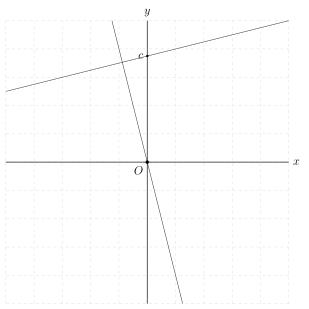
- Show, geometrically or otherwise, that the shortest distance between the origin and the line \(y= mx+c\), where \(c\ge0\), is \(c(m^2+1)^{-\frac12}\).
- The curve \(C\) lies in the \(x\)-\(y\) plane. Let the line \(L\) be tangent to \(C\) at a point \(P\) on \(C\), and let \(a\) be the shortest distance between the origin and \(L\). The curve \(C\) has the property that the distance \(a\) is the same for all points \(P\) on \(C\). Let \(P\) be the point on \(C\) with coordinates \((x,y(x))\). Given that the tangent to \(C\) at \(P\) is not vertical, show that \begin{equation} (y-xy')^2 = a^2\big (1+(y')^2 \big) \,. \tag{\(*\)} \end{equation} By first differentiating \((*)\) with respect to \(x\), show that either \(y= mx \pm a(1+m^2)^{\frac12}\) for some \(m\) or \(x^2+y^2 =a^2\).
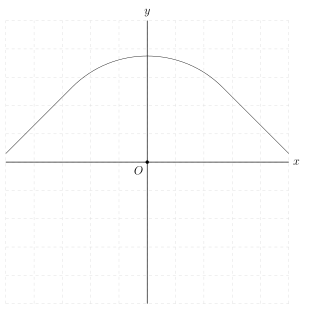
- Now suppose that \(C\) (as defined above) is a continuous curve for \(-\infty < x < \infty\), consisting of the arc of a circle and two straight lines. Sketch an example of such a curve which has a non-vertical tangent at each point.
Solution
- \(\,\)
Note that we have a right angled triangle, with the sides in a ratio of \(m\). So if our target length is \(x\) we have \(x^2 + (mx)^2 = c^2\) and so \(x = c(m^2+1)^{-\frac12}\)
- The distance from the origin to \(L\) is \(a = c(m^2+1)^{-\frac12}\) so \begin{align*} && a^2(m^2+1) &= c^2 \\ && \frac{c-y(x)}{0-x} &= y' \\ \Rightarrow && c-y &= -xy' \\ \Rightarrow && a^2((y')^2+1) &= (y-xy')^2 \\ \\ && 2a^2y'y'' &= 2(y-xy')(y'-xy''-y') \\ &&&= 2(xy'-y)xy'' \\ \Rightarrow && y'' &= 0 \\ \text{ or } && 2a^2y' &= 2(xy'-y)x \end{align*} If \(y'' = 0\) then \(y = mx + c\) and the result follows immediately. \begin{align*} && 0 &= (a^2-x^2)y' + yx \\ \Rightarrow &&\frac1{y} y' &= -\frac{x}{a^2-x^2} \\ \Rightarrow && \ln y &= \frac12\ln (a^2-x^2) + K \\ \Rightarrow && y^2 &= M(a^2-x^2) \\ \Rightarrow && x^2 + y^2 &= a^2 \end{align*} Where in the last step we know the tangents from an ellipse are not all equidistant to the origin.
Examiner's report
— 2014 STEP 2, Question 3There were good solutions presented to all of the questions, although there was generally less success in those questions that required explanations of results or the use of diagrams and graphs to reach the solution. Algebraic manipulation was generally well done by many of the candidates although a range of common errors such as confusing differentiation and integration and simple arithmetic slips were evident. Candidates should also be advised to use the methods that are asked for in questions unless it is clear that other methods will be accepted (such as by the use of the phrase "or otherwise").
Rating Information
Difficulty Rating: 1600.0
Difficulty Comparisons: 0
Banger Rating: 1516.0
Banger Comparisons: 1
Show LaTeX source
Problem source
\begin{questionparts}
\item Show, geometrically or otherwise, that the shortest distance between the origin and the line $y= mx+c$, where $c\ge0$,  is $c(m^2+1)^{-\frac12}$.
\item  The curve $C$ lies in the $x$-$y$ plane. Let the line $L$ be tangent  to $C$ at a point $P$ on $C$, and let $a$ be the shortest distance between the origin and $L$.  The curve $C$ has the property that the distance $a$ is the same for all points $P$ on $C$.
 Let $P$ be the point on $C$ with coordinates $(x,y(x))$. Given that the tangent to $C$ at $P$ is not vertical, show that
    \begin{equation}
  (y-xy')^2 =  a^2\big (1+(y')^2 \big)
\,.
  \tag{$*$}
    \end{equation}
 By first differentiating $(*)$ with respect to $x$,
show that either $y= mx \pm a(1+m^2)^{\frac12}$ for some $m$
or $x^2+y^2 =a^2$.
\item  Now suppose that $C$ (as defined above) is a continuous curve for $-\infty < x < \infty$,  consisting of the arc of a circle and two straight lines. Sketch an example of such a curve which has a non-vertical tangent at each point.
  \end{questionparts}
Solution source
\begin{questionparts}
\item $\,$
\begin{center}
    \begin{tikzpicture}
    \def\functionf(#1){1/((#1)*(#1))};
    \def\xl{-1};
    \def\xu{1};
    \def\yl{-1};
    \def\yu{1};

    % Calculate scaling factors to make the plot square
    \pgfmathsetmacro{\xrange}{\xu-\xl}
    \pgfmathsetmacro{\yrange}{\yu-\yl}
    \pgfmathsetmacro{\xscale}{10/\xrange}
    \pgfmathsetmacro{\yscale}{10/\yrange}

    % Define the reusable styles to keep code clean
    \tikzset{
        x=\xscale cm, y=\yscale cm,
        axis/.style={thick, draw=black!80, -{Stealth[scale=1.2]}},
        grid/.style={thin, dashed, gray!30},
        curveA/.style={very thick, color=cyan!70!black, smooth},
        curveB/.style={very thick, color=orange!90!black, smooth},
        curveC/.style={very thick, color=red!90!black, smooth},
        dot/.style={circle, fill=black, inner sep=1.2pt},
        labelbox/.style={fill=white, inner sep=2pt, rounded corners=2pt} % Protects text from lines
    }

    % Draw background grid
    \draw[grid] (\xl,\yl) grid[step=.2] (\xu,\yu);

    % Set up axes
    \draw[axis] (\xl,0) -- (\xu,0) node[right, black] {$x$};
    \draw[axis] (0,\yl) -- (0,\yu) node[above, black] {$y$};

    % Define the bounding region with clip
    \begin{scope}
        \clip (\xl,\yl) rectangle (\xu,\yu);
        \filldraw (0,0) circle (1.5pt) node[below left] {$O$};
        \filldraw (0,{(5*(-1)+7*2)/12}) circle (1pt) node[left] {$c$};
        \draw (-7, -1) -- (5, 2);
        \draw (-5, 20) -- (5, -20);
    \end{scope}


    \end{tikzpicture}
\end{center}

Note that we have a right angled triangle, with the sides in a ratio of $m$. So if our target length is $x$ we have $x^2 + (mx)^2 = c^2$ and so $x = c(m^2+1)^{-\frac12}$


\item The distance from the origin to $L$ is $a = c(m^2+1)^{-\frac12}$ so
\begin{align*}
&& a^2(m^2+1) &= c^2 \\
&& \frac{c-y(x)}{0-x} &= y' \\
\Rightarrow && c-y &= -xy' \\
\Rightarrow && a^2((y')^2+1) &= (y-xy')^2 \\
\\
&& 2a^2y'y'' &= 2(y-xy')(y'-xy''-y') \\
&&&= 2(xy'-y)xy'' \\
\Rightarrow && y'' &= 0 \\
\text{ or } && 2a^2y' &= 2(xy'-y)x
\end{align*}

If $y'' = 0$ then $y = mx + c$ and the result follows immediately.

\begin{align*}
&& 0 &= (a^2-x^2)y' + yx \\
\Rightarrow &&\frac1{y} y' &= -\frac{x}{a^2-x^2} \\
\Rightarrow && \ln y &= \frac12\ln (a^2-x^2) + K \\
\Rightarrow && y^2 &= M(a^2-x^2) \\
\Rightarrow && x^2 + y^2 &= a^2
\end{align*}
Where in the last step we know the tangents from an ellipse are not all equidistant to the origin.

\item \begin{center}
    \begin{tikzpicture}
    \def\functionf(#1){1/((#1)*(#1))};
    \def\xl{-1};
    \def\xu{1};
    \def\yl{-1};
    \def\yu{1};

    % Calculate scaling factors to make the plot square
    \pgfmathsetmacro{\xrange}{\xu-\xl}
    \pgfmathsetmacro{\yrange}{\yu-\yl}
    \pgfmathsetmacro{\xscale}{10/\xrange}
    \pgfmathsetmacro{\yscale}{10/\yrange}

    % Define the reusable styles to keep code clean
    \tikzset{
        x=\xscale cm, y=\yscale cm,
        axis/.style={thick, draw=black!80, -{Stealth[scale=1.2]}},
        grid/.style={thin, dashed, gray!30},
        curveA/.style={very thick, color=cyan!70!black, smooth},
        curveB/.style={very thick, color=orange!90!black, smooth},
        curveC/.style={very thick, color=red!90!black, smooth},
        dot/.style={circle, fill=black, inner sep=1.2pt},
        labelbox/.style={fill=white, inner sep=2pt, rounded corners=2pt} % Protects text from lines
    }

    % Draw background grid
    \draw[grid] (\xl,\yl) grid[step=.2] (\xu,\yu);

    % Set up axes
    \draw[axis] (\xl,0) -- (\xu,0) node[right, black] {$x$};
    \draw[axis] (0,\yl) -- (0,\yu) node[above, black] {$y$};

    % Define the bounding region with clip
    \begin{scope}
        \clip (\xl,\yl) rectangle (\xu,\yu);
        \filldraw (0,0) circle (1.5pt) node[below left] {$O$};
        \draw ({0.75/sqrt(2)},{0.75/sqrt(2)}) arc (45:135:0.75);
        \draw ({0.75/sqrt(2)},{0.75/sqrt(2)}) -- ++(1,-1);
        \draw ({-0.75/sqrt(2)},{0.75/sqrt(2)}) -- ++(-1,-1);
    \end{scope}


    \end{tikzpicture}
\end{center}

\end{questionparts}
Many candidates produced a correct solution to the first part of the question. There were a number of popular methods, such as the use of similar triangles, but an algebraic approach finding the intersection between the line and a perpendicular line through the origin was the most popular. Some candidates however, simply stated a formula for the shortest distance from a point to a line. Establishing the differential equation in the second part of the question was generally done well, but many candidates struggled with the solution of the differential equation. A common error was to ignore the case p = 0 and simply find the circle solution. The final part of the question was attempted by only a few of the candidates, many of whom did not produce an example that satisfied all of the conditions stated in the question, in particular the condition that the tangents should not be vertical at any point was often missed.