2013 Paper 2 Q8
Year: 2013
Paper: 2
Question Number: 8
Course: LFM Pure
Section: Integration
Difficulty: 1600.0
Banger: 1484.0
integration
optimisation
curve sketching
inequality
area under curve
differentiation
strictly decreasing function
geometric proof
Problem
The function \(\f\) satisfies \(\f(x)>0\) for \(x\ge0\) and is strictly
decreasing (which means that \(\f(b)<\f(a)\) for \(b>a\)).
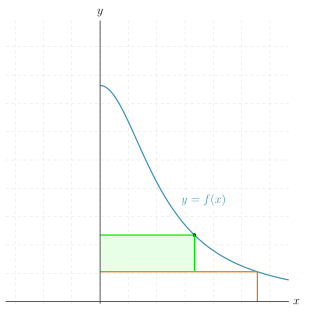
- For \(t\ge0\), let \(A_0(t)\) be the area of the largest rectangle with sides parallel to the coordinate axes that can fit in the region bounded by the curve \(y=\f(x)\), the \(y\)-axis and the line \(y=\f(t)\). Show that \(A_0(t)\) can be written in the form \[ A_0(t) =x_0\left( \f(x_0) -\f(t)\right), \] where \(x_0\) satisfies \(x_0 \f'(x_0) +\f(x_0) = \f(t)\,\).
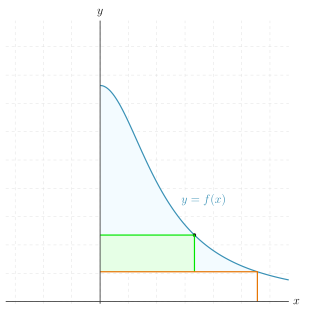
- The function g is defined, for \(t> 0\), by \[ \g(t) =\frac 1t \int_0^t \f(x) \d x\,. \] Show that \(t \g'(t) = \f(t) -\g(t)\,\). Making use of a sketch show that, for \(t>0\), \[ \int_0^t \left( \f(x) - \f(t)\right) \d x > A_0(t) \] and deduce that \(-t^2 \g'(t)> A_0(t)\).
- In the case \(\f(x)= \dfrac 1 {1+x}\,\), use the above to establish the inequality \[ \ln \sqrt{1+t} > 1 - \frac 1 {\sqrt{1+t}} \,, \] for \(t>0\).
Solution
- First, not that the point must be ony the curve:
Since otherwise it's pretty clear we could make the area of the rectangle larger by moving the point onto the curve. Therefore \(A = x(f(x)-f(t))\). To maximise this we need \(xf'(x) + f(x)-f(t) = 0\), ie \(x_0f'(x_0) + f(x_0) = f(t)\)
- Suppose \(\displaystyle \g(t) =\frac 1t \int_0^t \f(x) \d x\) then
\begin{align*}
&& \g(t) &=\frac 1t \int_0^t \f(x) \d x\\
\Rightarrow && tg(t) &= \int_0^t \f(x) \d x \\
\Rightarrow && tg'(t) +g(t) &= f(t) \\
\Rightarrow && tg'(t) &= f(t) - g(t)
\end{align*}
Clearly the blue area + green area is larger than the green area. So \(\displaystyle \int_0^t (f(x) - f(t))\d x > A_0(t)\). Notice that \(f(t) = \frac1{t} \int_0^t f(t) \d x \) so \(-t^2g'(t) = \int_0^t f(x) \d x > A_0(t)\)
- Not that if \(f(x) = \dfrac{1}{1+x}\), the \(f'(x) = -\frac{1}{(1+x)^2}\) and so \begin{align*} && -\frac{x_0}{(1+x_0)^2} + \frac{1}{1+x_0} &= \frac{1}{1+t} \\ && \frac{1}{(1+x_0)^2} &= \frac{1}{1+t} \\ \Rightarrow && x_0 &= \sqrt{1+t} - 1 \\ && A_0(t) &= (\sqrt{1+t} - 1) \left ( \frac{1}{\sqrt{1+t}} - \frac{1}{t+1} \right) \\ &&&= 1 - \frac{1}{\sqrt{1+t}} - \frac{1}{\sqrt{1+t}} + \frac{1}{1+t} \\ &&&= \frac{2+t}{1+t} - \frac{2}{\sqrt{1+t}} \\ && g(t) &= \frac{1}{t} \int_0^t \frac{1}{1+x} \d x \\ &&&= \frac{\ln(1+t)}{t} \\ \Rightarrow && g'(t) &= \frac{\frac{t}{1+t} - \ln(1+t)}{t^2} \\ \Rightarrow && -t^2g(t) &= \ln(1+t) - \frac{t}{1+t} \\ \Rightarrow && \ln(1+t) - \frac{t}{1+t} &> \frac{2+t}{1+t} - \frac{2}{\sqrt{1+t}} \\ \Rightarrow && \ln \sqrt{1+t} & > 1 - \frac{1}{\sqrt{1+t}} \end{align*}
Examiner's report
— 2013 STEP 2, Question 8
Below Average
Bimodal distribution of scores; particularly low number of attempts within Pure questions
From the paper introduction
All questions were attempted by a significant number of candidates, with questions 1 to 3 and 7 the most popular. The Pure questions were more popular than both the Mechanics and the Probability and Statistics questions, with only question 8 receiving a particularly low number of attempts within the Pure questions and only question 11 receiving a particularly high number of attempts.
Source: Cambridge STEP 2013 Examiner's Report
· 2013-full.pdf
Rating Information
Difficulty Rating: 1600.0
Difficulty Comparisons: 0
Banger Rating: 1484.0
Banger Comparisons: 1
Show LaTeX source
Problem source
The function $\f$ satisfies  $\f(x)>0$ for $x\ge0$ and  is strictly
decreasing (which means that $\f(b)<\f(a)$ for $b>a$).

\begin{questionparts}
\item
For $t\ge0$, let  $A_0(t)$ be the area of the largest rectangle with sides parallel to the coordinate axes that can fit in the region bounded by the curve $y=\f(x)$, the $y$-axis and the line $y=\f(t)$. Show that $A_0(t)$ can be written in the form
\[
A_0(t) =x_0\left( \f(x_0) -\f(t)\right),
\]
where $x_0$ satisfies $x_0 \f'(x_0) +\f(x_0) = \f(t)\,$.
\item The function g is defined, for $t>  0$,  by
\[
\g(t) =\frac 1t \int_0^t \f(x) \d x\,.
\]
Show that $t \g'(t) = \f(t) -\g(t)\,$.
Making use of a sketch show that, for $t>0$,
\[
 \int_0^t \left( \f(x) - \f(t)\right) \d x >
A_0(t)
\]
and deduce that $-t^2 \g'(t)> A_0(t)$.
\item In the case $\f(x)= \dfrac 1 {1+x}\,$, use the above to establish the inequality
\[
\ln \sqrt{1+t} > 1 - \frac 1 {\sqrt{1+t}}
\,,
\]
for $t>0$.

\end{questionparts}
Solution source
\begin{questionparts}
\item First, not that the point must be ony the curve:

\begin{center}
    \begin{tikzpicture}
    \def\functionf(#1){1/(1+(#1)*(#1))};
    \def\xl{-1.5};
    \def\xu{3};
    \def\yl{-0.01}; \def\yu{1.3};

    % Calculate scaling factors to make the plot square
    \pgfmathsetmacro{\xrange}{\xu-\xl}
    \pgfmathsetmacro{\yrange}{\yu-\yl}
    \pgfmathsetmacro{\xscale}{10/\xrange}
    \pgfmathsetmacro{\yscale}{10/\yrange}

    % Define the reusable styles to keep code clean
    \tikzset{
        x=\xscale cm, y=\yscale cm,
        axis/.style={thick, draw=black!80, -{Stealth[scale=1.2]}},
        grid/.style={thin, dashed, gray!30},
        curveA/.style={very thick, color=cyan!70!black, smooth},
        curveB/.style={very thick, color=orange!90!black, smooth},
        dot/.style={circle, fill=black, inner sep=1.2pt},
        labelbox/.style={fill=white, inner sep=2pt, rounded corners=2pt} % Protects text from lines
    }

    % Draw background grid
    \draw[grid] (\xl,\yl) grid (\xu,\yu);


    % Define the bounding region with clip
    \begin{scope}
        \clip (\xl,\yl) rectangle (\xu,\yu);

         \foreach \x in {5,6,7,8,9,10} {
            \draw[curveB, fill=orange!40] ({\x-0.5}, 0) rectangle ({\x+0.5}, {\functionf(\x)});
        }

        \draw[curveA, domain=0:\xu, samples=150]
            plot ({\x},{\functionf(\x)});


        \filldraw[color=green!10] (0, {\functionf(1.5)}) -- (1.5, {\functionf(1.5)}) -- (1.5, {\functionf(2.5)}) -- (0, {\functionf(2.5)}) -- cycle;;


        \filldraw (1.5, {\functionf(1.5)}) circle (1.5pt);

        \draw[very thick, color=green!90!black, smooth] (0, {\functionf(1.5)}) -- (1.5, {\functionf(1.5)}) -- (1.5, {\functionf(2.5)});
        \draw[curveB] (2.5, 0) -- (2.5, {\functionf(2.5)}) -- (0, {\functionf(2.5)});

    \end{scope}
        % Set up axes
    \draw[axis] (\xl,0) -- (\xu,0) node[right, black] {$x$};
    \draw[axis] (0,\yl) -- (0,\yu) node[above, black] {$y$};

    % Annotate Function Names
    \node[curveA, labelbox, right] at ({(\xl+\xu)/2+.5}, {\functionf((\xl+\xu)/2)}) {$y = f(x)$};
    % \node[curveB, labelbox] at (1.85, -1.1) {$x = \frac{4y^2+1}{3}$};


    \end{tikzpicture}
\end{center}

Since otherwise it's pretty clear we could make the area of the rectangle larger by moving the point onto the curve.

Therefore $A = x(f(x)-f(t))$. To maximise this we need $xf'(x) + f(x)-f(t) = 0$, ie $x_0f'(x_0) + f(x_0) = f(t)$

\item Suppose $\displaystyle \g(t) =\frac 1t \int_0^t \f(x) \d x$ then
\begin{align*}
&& \g(t) &=\frac 1t \int_0^t \f(x) \d x\\
\Rightarrow && tg(t) &= \int_0^t \f(x) \d x \\
\Rightarrow && tg'(t) +g(t) &= f(t) \\
\Rightarrow && tg'(t) &= f(t) - g(t)
\end{align*}


\begin{center}
    \begin{tikzpicture}
    \def\functionf(#1){1/(1+(#1)*(#1))};
    \def\xl{-1.5};
    \def\xu{3};
    \def\yl{-0.01}; \def\yu{1.3};

    % Calculate scaling factors to make the plot square
    \pgfmathsetmacro{\xrange}{\xu-\xl}
    \pgfmathsetmacro{\yrange}{\yu-\yl}
    \pgfmathsetmacro{\xscale}{10/\xrange}
    \pgfmathsetmacro{\yscale}{10/\yrange}

    % Define the reusable styles to keep code clean
    \tikzset{
        x=\xscale cm, y=\yscale cm,
        axis/.style={thick, draw=black!80, -{Stealth[scale=1.2]}},
        grid/.style={thin, dashed, gray!30},
        curveA/.style={very thick, color=cyan!70!black, smooth},
        curveB/.style={very thick, color=orange!90!black, smooth},
        dot/.style={circle, fill=black, inner sep=1.2pt},
        labelbox/.style={fill=white, inner sep=2pt, rounded corners=2pt} % Protects text from lines
    }

    % Draw background grid
    \draw[grid] (\xl,\yl) grid (\xu,\yu);


    % Define the bounding region with clip
    \begin{scope}
        \clip (\xl,\yl) rectangle (\xu,\yu);


        \filldraw[color=cyan!5, domain=0:2.5] plot ({\x},{\functionf(\x)}) -- (0, {\functionf(2.5)});

        \draw[curveA, domain=0:\xu, samples=150]
            plot ({\x},{\functionf(\x)});


        \filldraw[color=green!10] (0, {\functionf(1.5)}) -- (1.5, {\functionf(1.5)}) -- (1.5, {\functionf(2.5)}) -- (0, {\functionf(2.5)}) -- cycle;;


        \filldraw (1.5, {\functionf(1.5)}) circle (1.5pt);

        \draw[very thick, color=green!90!black, smooth] (0, {\functionf(1.5)}) -- (1.5, {\functionf(1.5)}) -- (1.5, {\functionf(2.5)});
        \draw[curveB] (2.5, 0) -- (2.5, {\functionf(2.5)}) -- (0, {\functionf(2.5)});

    \end{scope}
        % Set up axes
    \draw[axis] (\xl,0) -- (\xu,0) node[right, black] {$x$};
    \draw[axis] (0,\yl) -- (0,\yu) node[above, black] {$y$};

    % Annotate Function Names
    \node[curveA, labelbox, right] at ({(\xl+\xu)/2+.5}, {\functionf((\xl+\xu)/2)}) {$y = f(x)$};
    % \node[curveB, labelbox] at (1.85, -1.1) {$x = \frac{4y^2+1}{3}$};


    \end{tikzpicture}
\end{center}

Clearly the blue area + green area is larger than the green area. So $\displaystyle \int_0^t (f(x) - f(t))\d x > A_0(t)$.

Notice that $f(t) = \frac1{t} \int_0^t f(t) \d x $ so $-t^2g'(t) = \int_0^t f(x) \d x > A_0(t)$

\item Not that if $f(x) = \dfrac{1}{1+x}$, the $f'(x) = -\frac{1}{(1+x)^2}$ and so

\begin{align*}
&& -\frac{x_0}{(1+x_0)^2} + \frac{1}{1+x_0} &= \frac{1}{1+t} \\
&& \frac{1}{(1+x_0)^2} &= \frac{1}{1+t} \\
\Rightarrow && x_0 &= \sqrt{1+t} - 1 \\
&& A_0(t) &= (\sqrt{1+t} - 1) \left ( \frac{1}{\sqrt{1+t}} - \frac{1}{t+1} \right) \\
&&&= 1 - \frac{1}{\sqrt{1+t}} - \frac{1}{\sqrt{1+t}} + \frac{1}{1+t} \\
&&&= \frac{2+t}{1+t} - \frac{2}{\sqrt{1+t}}
\\
&& g(t) &= \frac{1}{t} \int_0^t \frac{1}{1+x} \d x \\
&&&= \frac{\ln(1+t)}{t} \\
\Rightarrow && g'(t) &= \frac{\frac{t}{1+t} - \ln(1+t)}{t^2} \\
\Rightarrow && -t^2g(t) &= \ln(1+t) - \frac{t}{1+t} \\
\Rightarrow && \ln(1+t) - \frac{t}{1+t} &> \frac{2+t}{1+t} - \frac{2}{\sqrt{1+t}} \\
\Rightarrow && \ln \sqrt{1+t} & > 1 - \frac{1}{\sqrt{1+t}}
\end{align*}
\end{questionparts}
Candidates attempting question 8 generally received either a very low or a very high score. Many attempts did not progress further than an attempt to sketch the graph and identify the rectangle to be used. There were also some attempts that confused the line with a transformation of the curve. In the second part of the question there were some difficulties with the differentiation, but those candidates who successfully completed this section did not in general have any difficulties with the remainder of the question.