2013 Paper 2 Q3
Year: 2013
Paper: 2
Question Number: 3
Course: LFM Stats And Pure
Section: Polynomials
Problem
- Given that the cubic equation \(x^3+3ax^2 + 3bx +c=0\) has three distinct real roots and \(c<0\), show with the help of sketches that either exactly one of the roots is positive or all three of the roots are positive.
- Given that the equation \(x^3 +3ax^2+3bx+c=0\) has three distinct real positive roots show that \begin{equation*} a^2>b>0, \ \ \ \ a<0, \ \ \ \ c<0\,. \tag{\(*\)} \end{equation*} [Hint: Consider the turning points.]
- Given that the equation \(x^3 +3ax^2+3bx+c=0\) has three distinct real roots and that \begin{equation*} ab<0, \ \ \ \ c>0\,, \end{equation*} determine, with the help of sketches, the signs of the roots.
- Show by means of an explicit example (giving values for \(a\), \(b\) and \(c\)) that it is possible for the conditions (\(*\)) to be satisfied even though the corresponding cubic equation has only one real root.
Solution
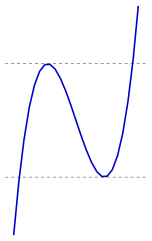
- First notice that this cubic has leading first term \(1\) and three real roots, so it must have the shape:
With the \(x\)-axis running somewhere between the dashed lines. Since \(c < 0\), the \(y\)-axis must meet the curve below the \(x\)-axis, ie somewhere on the blue section of this curve:
 Therefore there will be either \(1\) (if it meets it in the \(\cup\) area) or \(3\) (if it meets it on the far left) positive roots.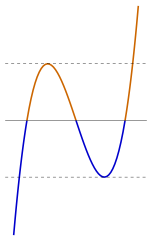
- First notice that if \(c > 0\) we cannot have three positive real roots since the function would need to pass \(0\) between \(0\) and \(-\infty\). Secondly, notice both turning points must be larger than zero, ie \begin{align*} && 0 &= 3x^2 + 6ax + 3b \\ \Leftrightarrow && 0 &= (x+a)^2 + b - a^2 \end{align*} has both roots larger than zero, (and it needs to have two roots, so \(a^2 > b\) and \(-a > 0\), ie \(a < 0\). If \(b < 0\), then just looking at \(x^2+2ax+b\) we can see that it is \(<0\) at \(0\) and one of the roots will be negative, therefore \(c < 0\), \(a^2 > b > 0\) and \(a < 0\)
- Since \(c > 0\) we can see that at least one root is negative.
ie the \(y\)-axis passes through an orange section of this curve. What now matters is where the larger turning point is. Considering \(x^2 + 2ax + b\), we notice that \(ab < 0\) means that \((x-\alpha)(x-\beta)\) we must have \((\alpha + \beta)\alpha \beta > 0\) which isn't possible if both roots are negative. Therefore the \(y\)-axis passes through the orange \(\cap\) and there are \(2\) positive real roots.
- If we take \(a = 1, b = -1, c = 1\) then we have \(x^3 + 3x^2-3x+1\). This has turning points when \(x^2+2x-1 = 0\), ie \(x = -1 \pm \sqrt{2}\) Notice that \begin{align*} && y(-1\pm \sqrt2) &= (-1 \pm \sqrt{2})^3 + 3(-1 \pm \sqrt{2})^2-3(-1 \pm \sqrt{2}) + 1 \\ &&&= (-1\pm \sqrt{2}) \cdot (3 \mp 2\sqrt2) + 3(3 \mp \sqrt2) -3(-1\pm \sqrt2) + 1 \\ &&&= (-7 \pm 5 \sqrt2) + (9 \mp 3\sqrt2) +(3 \mp 3\sqrt2) + 1 \\ &&&= 24 \mp 16\sqrt2 = 8(3 \mp 2 \sqrt2) >0 \end{align*} ie both turning points are above zero and hence only one real root
Examiner's report
— 2013 STEP 2, Question 3All questions were attempted by a significant number of candidates, with questions 1 to 3 and 7 the most popular. The Pure questions were more popular than both the Mechanics and the Probability and Statistics questions, with only question 8 receiving a particularly low number of attempts within the Pure questions and only question 11 receiving a particularly high number of attempts.
Rating Information
Difficulty Rating: 1600.0
Difficulty Comparisons: 0
Banger Rating: 1500.0
Banger Comparisons: 0
Show LaTeX source
Problem source
\begin{questionparts}
\item Given that the cubic equation $x^3+3ax^2 + 3bx +c=0$ has three distinct real roots and $c<0$, show with the help of sketches that either exactly one of the roots is positive or all three of the roots are positive.

\item Given that the equation $x^3 +3ax^2+3bx+c=0$ has three distinct real positive roots show that
\begin{equation*}
a^2>b>0, \ \ \ \ a<0, \ \ \ \ c<0\,.
\tag{$*$}
\end{equation*}
[\textbf{Hint}: Consider the turning points.]
\item Given that the equation $x^3 +3ax^2+3bx+c=0$ has three distinct real roots and that
\begin{equation*}
 ab<0, \ \ \ \ c>0\,,
\end{equation*}
determine, with the help of sketches,  the signs of the roots.

\item Show by means of an explicit example (giving values for $a$, $b$ and $c$) that it is possible for  the conditions ($*$) to be satisfied even though the corresponding cubic equation has only one real root.
\end{questionparts}
Solution source
\begin{questionparts}
\item First notice that this cubic has leading first term $1$ and three real roots, so it must have the shape:

\begin{center}
    \begin{tikzpicture}
        \draw[ultra thick, blue!80!black, domain=-2.2:2.2] plot (\x, {(\x)^3-3*\x});
        \draw[dashed] (-2.5, -2) -- (2.5, -2);
        \draw[dashed] (-2.5, 2) -- (2.5, 2);
    \end{tikzpicture}
\end{center}

With the $x$-axis running somewhere between the dashed lines.

Since $c < 0$, the $y$-axis must meet the curve below the $x$-axis, ie somewhere on the blue section of this curve:

\begin{center}
    \begin{tikzpicture}
        \draw[ultra thick, blue!80!black, domain=-2.2:{-sqrt(3)}] plot (\x, {(\x)^3-3*\x});
        \draw[ultra thick, orange!80!black, domain={-sqrt(3)}:0] plot (\x, {(\x)^3-3*\x});
        \draw[ultra thick, blue!80!black, domain=-0:{sqrt(3)}] plot (\x, {(\x)^3-3*\x});
        \draw[ultra thick, orange!80!black, domain={sqrt(3)}:2.2] plot (\x, {(\x)^3-3*\x});
        \draw[dashed] (-2.5, -2) -- (2.5, -2);
        \draw[dashed] (-2.5, 2) -- (2.5, 2);
        \draw (-2.5, -0) -- (2.5, 0);
    \end{tikzpicture}
\end{center}

Therefore there will be either $1$ (if it meets it in the $\cup$ area) or $3$ (if it meets it on the far left) positive roots.

\item First notice that if $c > 0$ we cannot have three positive real roots since the function would need to pass $0$ between $0$ and $-\infty$.

Secondly, notice both turning points must be larger than zero, ie
\begin{align*}
&& 0 &= 3x^2 + 6ax + 3b \\
\Leftrightarrow && 0 &= (x+a)^2 + b - a^2
\end{align*}
has both roots larger than zero, (and it needs to have two roots, so $a^2 > b$ and $-a > 0$, ie $a < 0$. If $b < 0$, then just looking at $x^2+2ax+b$ we can see that it is $<0$ at $0$ and one of the roots will be negative, therefore

$c < 0$, $a^2 > b > 0$ and $a < 0$

\item Since $c > 0$ we can see that at least one root is negative.

\begin{center}
    \begin{tikzpicture}
        \draw[ultra thick, blue!80!black, domain=-2.2:{-sqrt(3)}] plot (\x, {(\x)^3-3*\x});
        \draw[ultra thick, orange!80!black, domain={-sqrt(3)}:0] plot (\x, {(\x)^3-3*\x});
        \draw[ultra thick, blue!80!black, domain=-0:{sqrt(3)}] plot (\x, {(\x)^3-3*\x});
        \draw[ultra thick, orange!80!black, domain={sqrt(3)}:2.2] plot (\x, {(\x)^3-3*\x});
        \draw[dashed] (-2.5, -2) -- (2.5, -2);
        \draw[dashed] (-2.5, 2) -- (2.5, 2);
        \draw (-2.5, -0) -- (2.5, 0);
    \end{tikzpicture}
\end{center}

ie the $y$-axis passes through an orange section of this curve.

What now matters is where the larger turning point is. Considering $x^2 + 2ax + b$, we notice that $ab < 0$ means that $(x-\alpha)(x-\beta)$ we must have $(\alpha + \beta)\alpha \beta > 0$ which isn't possible if both roots are negative. Therefore the $y$-axis passes through the orange $\cap$ and there are $2$ positive real roots.

\item If we take $a = 1, b = -1, c = 1$ then we have $x^3 + 3x^2-3x+1$. This has turning points when $x^2+2x-1 = 0$, ie $x = -1 \pm \sqrt{2}$

Notice that

\begin{align*}
&& y(-1\pm \sqrt2) &= (-1 \pm \sqrt{2})^3 + 3(-1 \pm \sqrt{2})^2-3(-1 \pm \sqrt{2}) + 1 \\
&&&= (-1\pm \sqrt{2}) \cdot (3 \mp 2\sqrt2) + 3(3 \mp \sqrt2) -3(-1\pm \sqrt2) + 1 \\
&&&= (-7 \pm 5 \sqrt2) + (9 \mp 3\sqrt2) +(3 \mp 3\sqrt2) + 1 \\
&&&= 24 \mp 16\sqrt2 = 8(3 \mp 2 \sqrt2) >0
\end{align*}

ie both turning points are above zero and hence only one real root

\end{questionparts}
This question was again popular and had an average score of about half of the marks. In the first part almost all candidates were able to sketch the correct shape of graph, but some did not provide suitable explanations to accompany these or included additional cases that were not asked for. A number of candidates attempting the second part of the question reached one of the results by squaring an inequality without considering the signs and many assumed that the result of part (i) implied that c must be negative. Only about half of the candidates attempted part (iii), and many of those who did did not use sketches in their solutions. Solutions to part (iv) generally involved guessing of the values of a, b and c followed by a check that the conditions were met.