2013 Paper 2 Q5
Year: 2013
Paper: 2
Question Number: 5
Course: LFM Pure and Mechanics
Section: Differentiation from first principles
Problem
- A function \(\f(x)\) satisfies \(\f(x) = \f(1-x)\) for all \(x\). Show, by differentiating with respect to \(x\), that \(\f'(\frac12) =0\,\). If, in addition, \(\f(x) = \f(\frac1x)\) for all (non-zero) \(x\), show that \(\f'(-1)=0\) and that \(\f'(2)=0\).
- The function \(\f\) is defined, for \(x\ne0\) and \(x\ne1\), by \[ \f(x) = \frac {(x^2-x+1)^3}{(x^2-x)^2} \,. \] Show that \(\f(x)= \f(\frac 1 x)\) and \(\f(x) = \f(1-x)\). Given that it has exactly three stationary points, sketch the curve \(y=\f(x)\).
- Hence, or otherwise, find all the roots of the equation \(\f(x) = \dfrac {27} 4\,\) and state the ranges of values of \(x\) for which \(\f(x) > \dfrac{27} 4\,\). Find also all the roots of the equation \(\f(x) = \dfrac{343}{36}\,\) and state the ranges of values of \(x\) for which \(\f(x) > \dfrac{343}{36}\).
Solution
- \(\,\) \begin{align*} && f(x) &= f(1-x) \\ \Rightarrow && f'(x) &= -f'(1-x) \\ \Rightarrow && f'(\tfrac12) &= -f'(\tfrac12) \\ \Rightarrow && f'(\tfrac12) &= 0 \\ \\ && f(x) &= f(\tfrac1x) \\ \Rightarrow && f'(x) &= f'(\tfrac1x) \cdot \frac{-1}{x^2} \\ \Rightarrow && f'(-1) &= -f'(-1) \\ \Rightarrow && f'(-1) &= 0 \\ \\ && f'(2) &= -\frac{1}{4}f'(\tfrac12) \\ &&&= 0 \end{align*}
- Suppose \begin{align*}
&& f(x) &= \frac{(x^2-x+1)^3}{(x^2-x)^2} \\
&& f(1/x) &= \frac{(x^{-2}-x^{-1}+1)^3}{(x^{-2}-x^{-1})^2} \\
&&&= \frac{(1-x+x^2)^3/x^6}{((x-x^2)^2/x^6} \\
&&&= f(x) \\
\\
&& f(1-x) &= \frac{((1-x)^2-(1-x)+1)^3}{((1-x)^2-(1-x))^2} \\
&&&= \frac{(1-x+x^2)^3}{(x^2-x)^2} = f(x)
\end{align*}
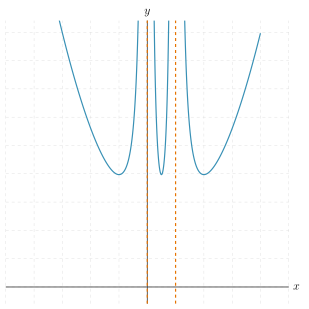
- Clearly \(x = -1\) is a root of \(f(x) = \frac{27}{4}\), so we must also have \(x=2\) and \(x = \frac12\), therefore \(f(x) > \frac{27}{4}\) if \(x \in \mathbb{R} \setminus \{-1, 2, \tfrac12, 0, 1 \}\). Clearly \(x = 3\) and \(x = -2\) are solutions so we also have: \(\frac13, -\frac12, \frac32, \frac23\) and these must be all solutions so we must have: \(f(x) > \frac{343}{36} \Leftrightarrow x \in (-\infty, -2) \cup (-\frac12, 0) \cup (0, \frac13) \cup (\frac23, 1) \cup (1, \frac32) \cup (3, \infty)\)
Examiner's report
— 2013 STEP 2, Question 5All questions were attempted by a significant number of candidates, with questions 1 to 3 and 7 the most popular. The Pure questions were more popular than both the Mechanics and the Probability and Statistics questions, with only question 8 receiving a particularly low number of attempts within the Pure questions and only question 11 receiving a particularly high number of attempts.
Rating Information
Difficulty Rating: 1600.0
Difficulty Comparisons: 0
Banger Rating: 1484.0
Banger Comparisons: 1
Show LaTeX source
Problem source
\begin{questionparts}
\item A function $\f(x)$ satisfies $\f(x) = \f(1-x)$ for all $x$.
Show, by differentiating with respect to $x$, that $\f'(\frac12) =0\,$.
If, in addition,  $\f(x) = \f(\frac1x)$ for all (non-zero) $x$, show that
$\f'(-1)=0$ and that  $\f'(2)=0$.
\item  The function $\f$ is defined, for $x\ne0$ and $x\ne1$, by
\[
\f(x) = \frac {(x^2-x+1)^3}{(x^2-x)^2} \,.
\]
Show that $\f(x)= \f(\frac 1 x)$ and $\f(x) = \f(1-x)$.
Given that it has exactly three stationary points,
sketch the
curve  $y=\f(x)$.
\item
Hence, or otherwise,
 find all the roots of the equation $\f(x) = \dfrac {27} 4\,$
and state the ranges of values of $x$ for which $\f(x) > \dfrac{27} 4\,$.
 Find also all  the roots of the  equation $\f(x) = \dfrac{343}{36}\,$
and state the ranges of values of $x$ for which
$\f(x) >   \dfrac{343}{36}$.
 \end{questionparts}
Solution source
\begin{questionparts}
\item $\,$ \begin{align*}
&& f(x) &= f(1-x) \\
\Rightarrow && f'(x) &= -f'(1-x) \\
\Rightarrow && f'(\tfrac12) &= -f'(\tfrac12) \\
\Rightarrow && f'(\tfrac12) &= 0 \\
\\
&& f(x) &= f(\tfrac1x) \\
\Rightarrow && f'(x) &= f'(\tfrac1x) \cdot \frac{-1}{x^2} \\
\Rightarrow && f'(-1) &= -f'(-1) \\
\Rightarrow && f'(-1) &= 0 \\
\\
&& f'(2) &= -\frac{1}{4}f'(\tfrac12) \\
&&&= 0
\end{align*}

\item Suppose \begin{align*}
&& f(x) &= \frac{(x^2-x+1)^3}{(x^2-x)^2} \\
&& f(1/x) &= \frac{(x^{-2}-x^{-1}+1)^3}{(x^{-2}-x^{-1})^2} \\
&&&= \frac{(1-x+x^2)^3/x^6}{((x-x^2)^2/x^6} \\
&&&= f(x) \\
\\
&& f(1-x) &= \frac{((1-x)^2-(1-x)+1)^3}{((1-x)^2-(1-x))^2} \\
&&&= \frac{(1-x+x^2)^3}{(x^2-x)^2} = f(x)
\end{align*}


\begin{center}
    \begin{tikzpicture}
    \def\functionf(#1){((#1)^2-(#1)+1)^3/(((#1)^2-(#1))^2)};
    % \def\functiong(#1){sin(deg(10*#1))*exp(-#1)};
    \def\xl{-5};
    \def\xu{5};
    \def\yl{-1};
    \def\yu{16};

    % Calculate scaling factors to make the plot square
    \pgfmathsetmacro{\xrange}{\xu-\xl}
    \pgfmathsetmacro{\yrange}{\yu-\yl}
    \pgfmathsetmacro{\xscale}{10/\xrange}
    \pgfmathsetmacro{\yscale}{10/\yrange}

    % Define the reusable styles to keep code clean
    \tikzset{
        x=\xscale cm, y=\yscale cm,
        axis/.style={thick, draw=black!80, -{Stealth[scale=1.2]}},
        grid/.style={thin, dashed, gray!30},
        curveA/.style={very thick, color=cyan!70!black, smooth},
        curveB/.style={very thick, color=orange!90!black, smooth},
        curveC/.style={very thick, color=green!70!black, smooth},
        dot/.style={circle, fill=black, inner sep=1.2pt},
        labelbox/.style={fill=white, inner sep=2pt, rounded corners=2pt} % Protects text from lines
    }


    % Draw background grid
    \draw[grid] (\xl,\yl) grid (\xu,\yu);

    % Set up axes
    \draw[axis] (\xl,0) -- (\xu,0) node[right, black] {$x$};
    \draw[axis] (0,\yl) -- (0,\yu) node[above, black] {$y$};

    % Define the bounding region with clip
    \begin{scope}
        \clip (\xl,\yl) rectangle (\xu,\yu);

        \draw[curveA, domain=0.1:0.9, samples=450]
            plot ({\x},{\functionf(\x)});
        \draw[curveA, domain=-4:-.1, samples=450]
            plot ({\x},{\functionf(\x)});
        \draw[curveA, domain=1.1:4, samples=450]
            plot ({\x},{\functionf(\x)});

        \draw[curveB, dashed] (1, \yl) -- (1, \yu);
        \draw[curveB, dashed] (0, \yl) -- (0, \yu);
        % \draw[curveB, domain=\xl:\xu, samples=450]
            % plot ({\x},{\functiong(\x)});
    \end{scope}


    \end{tikzpicture}
\end{center}

\item Clearly $x = -1$ is a root of $f(x) = \frac{27}{4}$, so we must also have $x=2$ and $x = \frac12$, therefore $f(x) > \frac{27}{4}$ if $x \in \mathbb{R} \setminus \{-1, 2, \tfrac12, 0, 1  \}$.

Clearly $x = 3$ and $x = -2$ are solutions so we also have: $\frac13, -\frac12, \frac32, \frac23$ and these must be all solutions so we must have:

$f(x) > \frac{343}{36} \Leftrightarrow x \in (-\infty, -2) \cup (-\frac12, 0) \cup (0, \frac13) \cup (\frac23, 1) \cup (1, \frac32) \cup (3, \infty)$
\end{questionparts}
This was one of the more successfully attempted questions on the paper and the Pure Mathematics question with the highest average mark. While some candidates struggled with the application of the chain rule throughout this question, many were able to complete the first part of the question without much difficulty. Showing that f satisfied the required conditions in part (i) was generally well done, but the sketching of the graph was found to be more difficult, with a number of candidates not identifying the asymptotes and some thinking that part of the graph would drop below the x-axis. Most of the candidates who attempted part (iii) found the roots of the equation successfully, but a large number forgot to exclude the roots when solving the inequality. In the final part, many identified x=3 as a solution, but those who split the fraction into two equations (one for the numerator equalling 343 and one for the denominator equalling 36) did not check that the solution worked for both parts. Those who used the symmetries established in part (i) were then able to identify the other roots easily, while those who attempted algebraic solutions for the other roots were generally not successful.