2014 Paper 2 Q6
Year: 2014
Paper: 2
Question Number: 6
Course: LFM Pure
Section: Differentiation
Problem
- Find the stationary points of \(S_2(x)\) for \(0\le x\le\pi\), and sketch this function.
- Show that if \(S_n(x)\) has a stationary point at \(x=x_0\), where \(0< x_0 < \pi\), then \[ \sin nx_0 = (1-\cos nx_0) \tan\tfrac12 x_0 \] and hence that \(S_n(x_0) \ge S_{n-1}(x_0)\). Deduce that if \(S_{n-1}(x) > 0\) for all \(x\) in the interval \(0 < x < \pi\), then \(S_{n}(x) > 0\) for all \(x\) in this interval.
- Prove that \(S_n(x)\ge0\) for \(n\ge1\) and \(0\le x\le\pi\).
Solution
- \(\,\) \begin{align*}
&& S_2(x) &= \sin x + \tfrac12 \sin 2 x \\
&& S'_2(x) &= \cos x + \cos 2x \\
&&&= \cos x + 2\cos^2 x - 1 \\
&&&= (2\cos x -1)(\cos x + 1) \\
\end{align*}
Therefore the turning points are \(\cos x= \frac12 \Rightarrow x = \frac{\pi}{3}\) and \(\cos x = -1 \Rightarrow x = \pi\)
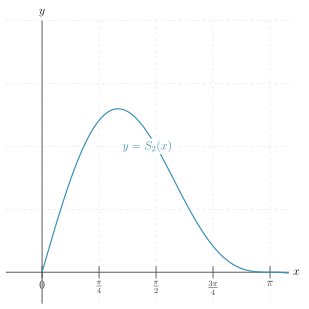
- Suppose \(S_n(x)\) has a stationary point at \(x_0\), then $$ therefore \begin{align*} &&0 &= S_n'(x_0) \\ &&&= \cos x_0 + \cos 2x_0 + \cdots + \cos n x_0 \\ &&&= \frac{\sin(n+\tfrac12)x_0 - \sin \tfrac12x_0}{2 \sin \tfrac12 x_0} \\ \Rightarrow &&\sin\tfrac12 x_0&= \sin nx_0 \cos \tfrac12 x_0 + \cos nx_0 \sin \tfrac12x_0 \\ \Rightarrow && \sin nx_0 &= (1-\cos nx_0)\tan \tfrac12 x_0 \end{align*} Therefore \(S_n(x_0) -S_{n-1}(x_0) = \tfrac1n \sin n x_0 = \tfrac1n \underbrace{(1-\cos nx_0)}_{\geq 0}\underbrace{\tan\tfrac12 x_0}_{\geq 0} \geq 0\). Therefore if \(S_{n-1}(x) > 0\) for all \(x\) on \(0 < x < \pi\) then since \(S_n(x) > S_{n-1}(x)\) at the turning points and since they agree at the end points, it must be larger at all points inbetween.
- Notice that \(S_1(x) = \sin x \geq 0\) for all \(x \in [0,1]\) and by our previous argument we can show \(S_n > S_{n-1}\) inside the interval and equal on the boundary we must have \(S_n(x) \geq 0\) for \(x \in [0, \pi]\)
Examiner's report
— 2014 STEP 2, Question 6There were good solutions presented to all of the questions, although there was generally less success in those questions that required explanations of results or the use of diagrams and graphs to reach the solution. Algebraic manipulation was generally well done by many of the candidates although a range of common errors such as confusing differentiation and integration and simple arithmetic slips were evident. Candidates should also be advised to use the methods that are asked for in questions unless it is clear that other methods will be accepted (such as by the use of the phrase "or otherwise").
Rating Information
Difficulty Rating: 1600.0
Difficulty Comparisons: 0
Banger Rating: 1484.2
Banger Comparisons: 1
Show LaTeX source
Problem source
By simplifying $\sin(r+\frac12)x - \sin(r-\frac12)x$ or otherwise show that, for $\sin\frac12 x \ne0$,
  \[
  \cos x + \cos 2x +\cdots + \cos nx = \frac{\sin(n+\frac12)x -
    \sin\frac12 x}{2\sin\frac12x}\,.
  \]
  The functions $S_n$, for $n=1, 2, \dots$, are defined  by
  \[
  S_n(x) = \sum_{r=1}^n \frac 1 r \sin rx \qquad (0\le
  x \le \pi).
  \]
  \begin{questionparts}
  \item Find the stationary points of $S_2(x)$ for $0\le x\le\pi$, and sketch this function.
  \item Show that if $S_n(x)$ has a stationary point at $x=x_0$, where $0< x_0 < \pi$, then
    \[
    \sin nx_0 = (1-\cos nx_0) \tan\tfrac12 x_0
    \]
    and hence that $S_n(x_0) \ge S_{n-1}(x_0)$.  Deduce that if $S_{n-1}(x) > 0$ for all $x$ in the interval $0 < x < \pi$, then $S_{n}(x) > 0$ for all $x$ in this interval.
  \item Prove that $S_n(x)\ge0$ for $n\ge1$ and $0\le x\le\pi$.
  \end{questionparts}
Solution source
\begin{align*}
&& \sin(r + \tfrac12)x - \sin(r - \tfrac12) x &= \sin rx \cos \tfrac12x + \cos r x\sin\tfrac12x - \sin r x \cos \tfrac12 x + \cos rx \sin \tfrac12 x \\
&&&= 2\cos r x \sin\tfrac12 x \\
\\
&& S &= \cos x + \cos 2x + \cdots + \cos n x \\
&& 2\sin \tfrac12 x S &= \sin(1 + \tfrac12)x - \sin \tfrac12 x + \\
&&&\quad+ \sin(2+\tfrac12)x - \sin(2-  \tfrac12)x + \\
&&&\quad+ \sin(3+\tfrac12)x - \sin(3 - \tfrac12)x + \\
&&& \quad + \cdots + \\
&&&\quad + \sin(n+\tfrac12)x - \sin(n-\tfrac12)x \\
&&&=\sin(n+\tfrac12)x - \sin\tfrac12 x \\
\Rightarrow && S &= \frac{\sin(n+\tfrac12)x - \sin\tfrac12 x}{2 \sin \tfrac12 x}
\end{align*}

\begin{questionparts}
\item $\,$ \begin{align*}
&& S_2(x) &= \sin x + \tfrac12 \sin 2 x \\
&& S'_2(x) &= \cos x + \cos 2x \\
&&&= \cos x + 2\cos^2 x - 1 \\
&&&= (2\cos x -1)(\cos x + 1) \\
\end{align*}

Therefore the turning points are $\cos x= \frac12 \Rightarrow x = \frac{\pi}{3}$ and $\cos x = -1 \Rightarrow x = \pi$


\begin{center}
    \begin{tikzpicture}
    \def\functionf(#1){sin(deg(#1))+0.5*sin(2*deg(#1))};
    \def\xl{-0.5};
    \def\xu{3.4};
    \def\yl{-.25};
    \def\yu{2};

    % Calculate scaling factors to make the plot square
    \pgfmathsetmacro{\xrange}{\xu-\xl}
    \pgfmathsetmacro{\yrange}{\yu-\yl}
    \pgfmathsetmacro{\xscale}{10/\xrange}
    \pgfmathsetmacro{\yscale}{10/\yrange}

    % Define the reusable styles to keep code clean
    \tikzset{
        x=\xscale cm, y=\yscale cm,
        axis/.style={thick, draw=black!80, -{Stealth[scale=1.2]}},
        grid/.style={thin, dashed, gray!30},
        curveA/.style={very thick, color=cyan!70!black, smooth},
        curveB/.style={very thick, color=orange!90!black, smooth},
        dot/.style={circle, fill=black, inner sep=1.2pt},
        labelbox/.style={fill=white, inner sep=2pt, rounded corners=2pt} % Protects text from lines
    }

    \foreach \x/\xtext in {
        {0}/0,
        {pi/4}/\frac{\pi}{4},
        {pi/2}/\frac{\pi}{2},
        {3*pi/4}/\frac{3\pi}{4},
        {pi}/\pi
    } {
        % Draw tick marks slightly above and below the x-axis, then attach the label
        \draw[thick, black!80] ({\x}, 0.05) -- ({\x}, -0.05) node[below, labelbox] {$\xtext$};
    }

    % Draw background grid
    \draw[grid] (\xl,\yl) grid[xstep={pi/4},ystep=0.5] (\xu,\yu);

    % Set up axes
    \draw[axis] (\xl,0) -- (\xu,0) node[right, black] {$x$};
    \draw[axis] (0,\yl) -- (0,\yu) node[above, black] {$y$};

    % Define the bounding region with clip
    \begin{scope}
        \clip (\xl,\yl) rectangle (\xu,\yu);


        \draw[curveA, domain=0:\xu, samples=150]
            plot ({\x},{\functionf(\x)});

    \end{scope}

    % Annotate Function Names
    \node[curveA, labelbox] at ({(\xl+\xu)/2}, {1}) {$y = S_2(x)$};


    \end{tikzpicture}
\end{center}

\item Suppose $S_n(x)$ has a stationary point at $x_0$, then $$ therefore

\begin{align*}
&&0 &= S_n'(x_0) \\
&&&= \cos x_0 + \cos 2x_0 + \cdots + \cos n x_0 \\
&&&= \frac{\sin(n+\tfrac12)x_0 - \sin \tfrac12x_0}{2 \sin \tfrac12 x_0} \\
\Rightarrow &&\sin\tfrac12 x_0&= \sin nx_0 \cos \tfrac12 x_0 + \cos nx_0 \sin \tfrac12x_0  \\
\Rightarrow && \sin nx_0 &= (1-\cos nx_0)\tan \tfrac12 x_0
\end{align*}

Therefore $S_n(x_0) -S_{n-1}(x_0) = \tfrac1n \sin n x_0 = \tfrac1n \underbrace{(1-\cos nx_0)}_{\geq 0}\underbrace{\tan\tfrac12 x_0}_{\geq 0} \geq 0$. Therefore if $S_{n-1}(x) > 0$ for all $x$ on $0 < x < \pi$ then since $S_n(x) > S_{n-1}(x)$ at the turning points and since they agree at the end points, it must be larger at all points inbetween.

\item Notice that $S_1(x) = \sin x \geq 0$ for all $x \in [0,1]$ and by our previous argument we can show $S_n > S_{n-1}$ inside the interval and equal on the boundary we must have $S_n(x) \geq 0$ for $x \in [0, \pi]$
\end{questionparts}
This was one of the less popular of the pure maths questions, but the average mark achieved on this paper was one of the highest for the paper. The first section did not present too much difficulty for the majority of candidates, with a variety of methods being used to show the first result such as proof by induction or use of cosθ + i sinθ. In the second part of the question many of the candidates struggled to explain the reasoning clearly to show the required result. Most candidates who reached the final part of the question realised that the previous part provides the basis for a proof by induction.