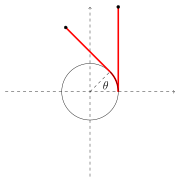
Circular Motion 2
Points \(A\) and \(B\) are at the same height and a distance \(\sqrt{2}r\) apart. Two small, spherical particles of equal mass, \(P\) and \(Q\), are suspended from \(A\) and \(B\), respectively, by light inextensible strings of length \(r\). Each particle individually may move freely around and inside a circle centred at the point of suspension. The particles are projected simultaneously from points which are a distance \(r\) vertically below their points of suspension, directly towards each other and each with speed \(u\). When the particles collide, the coefficient of restitution in the collision is \(e\).
- Show that, immediately after the collision, the horizontal component of each particle's velocity has magnitude \(\frac{1}{2}ev\sqrt{2}\), where \(v^2 = u^2 - gr(2 - \sqrt{2})\) and write down the vertical component in terms of \(v\).
- Show that the strings will become taut again at a time \(t\) after the collision, where \(t\) is a non-zero root of the equation \[(r - evt)^2 + \left(-r + vt - \frac{1}{2}\sqrt{2}gt^2\right)^2 = 2r^2.\]
- Show that, in terms of the dimensionless variables \[z = \frac{vt}{r} \quad \text{and} \quad c = \frac{\sqrt{2}v^2}{rg}\] this equation becomes \[\left(\frac{z}{c}\right)^3 - 2\left(\frac{z}{c}\right)^2 + \left(\frac{2}{c} + 1 + e^2\right)\left(\frac{z}{c}\right) - \frac{2}{c}(1 + e) = 0.\]
- Show that, if this equation has three equal non-zero roots, \(e = \frac{1}{3}\) and \(v^2 = \frac{9}{2}\sqrt{2}rg\). Explain briefly why, in this case, no energy is lost when the string becomes taut.
- In the case described in (iv), the particles have speed \(U\) when they again reach the points of their motion vertically below their points of suspension. Find \(U^2\) in terms of \(r\) and \(g\).

- Assuming the particles have mass \(m\), and speed \(v\) just before collision, then \begin{align*} \text{COE}: && \underbrace{\frac12 m u^2}_{\text{initial kinetic energy}} + \underbrace{0}_{\text{initial GPE}} &= \underbrace{\frac12m v^2}_{\text{kinetic energy just before collision}} + \underbrace{mgr\left(1-\frac1{\sqrt{2}}\right)}_{\text{GPE just before collision}} \\ \Rightarrow && v^2 &= u^2 - gr(2-\sqrt{2}) \end{align*} Therefore the particles has velocity \(\frac{\sqrt{2}}2v \binom{\pm 1}{1}\) before the collision. By symmetry, the impulse between the particles will be horizontal, so the vertical velocities will be unchanged at \(\frac{\sqrt{2}}{2}v\). By conservation of momentum (or symmetry) the particles will have equal but opposite velocities after the collision (say \(w\)) satisfying: \[ e = \frac{2w}{2\frac{\sqrt{2}}{2}v} \] ie \(w = \frac{\sqrt{2}}2 e v\) as required.
- Once the particles have rebounded, they will be projectiles whilst the strings are slack. If we consider the left-most point \(A = (0,0)\) then the particles colide at \(\left ( \frac{\sqrt{2}}{2}, -\frac{\sqrt{2}}{2} \right)\) and the position at time \(t\) after the collision (before the string goes slack) will be: \begin{align*} \mathbf{x}_t &= \frac{\sqrt{2}}{2}r\binom{1}{-1} + \frac{\sqrt{2}}{2} vt \binom{-e}{1} + \frac12 gt^2 \binom{0}{-1} \end{align*} The string will go taught when \(|\mathbf{x}_t|^2 = r^2\), ie \begin{align*} && r^2 &= \left ( \frac{\sqrt{2}}{2} r - \frac{\sqrt{2}}{2}evt \right)^2 + \left (-\frac{\sqrt{2}}{2} r + \frac{\sqrt{2}}{2}vt -\frac12 gt^2 \right)^2 \\ \Rightarrow && r^2 &= \frac12 \left (r - evt \right)^2 + \frac12 \left (-r+vt - \frac{\sqrt{2}}{2}gt^2 \right)^2 \\ \Rightarrow && 2r^2 &= \left (r - evt \right)^2 + \left (-r+vt - \frac{\sqrt{2}}{2}gt^2 \right)^2 \\ \end{align*} as required.
- Suppose \(z = \frac{vt}{r}\), \(c = \frac{\sqrt{2}v^2}{rg}\), then \begin{align*} && 2r^2 &= \left (r - evt \right)^2 + \left (-r+vt - \frac{\sqrt{2}}{2}gt^2 \right)^2 \\ \Leftrightarrow && 2 &= \left (1 - e\frac{vt}{r} \right)^2 + \left (-1 + \frac{vt}{r}- \frac{\sqrt{2}}{2} \frac{gt^2}{r} \right)^2 \\ \Leftrightarrow && 2 &= \left (1 - ez \right)^2 + \left (-1 +z- \frac{v^2t^2}{r^2} \frac{gr}{\sqrt{2}v^2}\right)^2 \\ \Leftrightarrow && 2 &= \left (1 - ez \right)^2 + \left (-1 +z- \frac{z^2}{c} \right)^2 \\ \Leftrightarrow && 2 &= 1-2ez + e^2z^2 + 1 + z^2 +\frac{z^4}{c^2} - 2z-2\frac{z^3}{c}+2\frac{z^2}{c} \\ \Leftrightarrow && 0 &= z(-2e-2) + z^2(e^2+1 + \frac{2}{c}) + z^3(-\frac{2}{c}) + z^4 \frac{1}{c^2} \\ \underbrace{\Leftrightarrow}_{z \neq 0} && 0 &= \left ( \frac{z}{c} \right)^3 - 2\left ( \frac{z}{c} \right)^2 + \left ( \frac{z}{c} \right) (1 + e^2 + \frac{2}{c} ) - \frac{2}{c}(1+e) \end{align*} as required, (where on the last step we divide by \(z/c\)).
- If a cubic has \(3\) equal, non-zero roots then it must have the form \((z-a)^3 = z^3 -3az^2 + 3a^2 z -a^3 = 0\), so \(3a = 2\), and so the expansion must be \(\left ( \frac{z}{c} \right)^3 - 2\left ( \frac{z}{c} \right)^2 + \frac{4}{3}\left ( \frac{z}{c} \right) - \frac{8}{27} = 0\) \begin{align*} && \frac{2}{c}(1+e) &= \frac{8}{27} \\ \Rightarrow && \frac{2}{c} &= \frac{8}{27} \frac{1}{1+e} \\ && 1 + e^2 + \frac{2}{c} &= \frac43 \\ \Rightarrow && e^2 + \frac{8}{27(1+e)} &= \frac{1}{3} \\ \Rightarrow && 27(1+e)e^2+8 &= 9(1+e) \\ \Rightarrow && 27e^3 + 27e^2-9e-1 &= 0 \\ \Rightarrow && (3e-1)(9e^2+12e+1) &= 0 \end{align*} The only (positive) root is \(e = \frac13\), therefore \(e = \frac13\). We must also have \begin{align*} && \frac{2}{c} \frac43 &= \frac{8}{27} \\ \Rightarrow && c &= 9 \\ \Rightarrow && \frac{\sqrt{2}v^2}{rg} &= 9 \\ \Rightarrow && v^2 &= \frac{9\sqrt{2}rg}{2} \end{align*} as required. If we consider the path of the particle acting as a projectile, iff the path is tangent to the circle then there will be exactly one solution for \(z/c\) and (importantly) it will be a repeated root. Therefore the particle rejoins the circle at a tangent and the tension is acting perpendicularly to the direction of motion (ie no energy loss).
- Since the only energy lost is lost in the collision, we can apply conservation of energy again: \begin{align*} \text{COE:} && \frac12 m U^2 &= \frac12 m \frac12v^2(1+e^2) + mgr\left (1 - \frac1{\sqrt{2}} \right) \\ \Rightarrow && U^2 &= \frac12 \frac{9 \sqrt{2}}{2}gr(1+\frac19) + gr(2 - \sqrt{2}) \\ &&&= \left (\frac{5\sqrt{2}}{2}+2 - \sqrt{2} \right)gr \\ &&&= \left (\frac{4+3\sqrt{2}}{2} \right)gr \end{align*}
In this question, \(\mathbf{i}\) and \(\mathbf{j}\) are perpendicular unit vectors and \(\mathbf{j}\) is vertically upwards. A smooth hemisphere of mass \(M\) and radius \(a\) rests on a smooth horizontal table with its plane face in contact with the table. The point \(A\) is at the top of the hemisphere and the point \(O\) is at the centre of its plane face. Initially, a particle \(P\) of mass \(m\) rests at \(A\). It is then given a small displacement in the positive \(\mathbf{i}\) direction. At a later time \(t\), when the particle is still in contact with the hemisphere, the hemisphere has been displaced by \(-s\mathbf{i}\) and \(\angle AOP = \theta\).
- Let \(\mathbf{r}\) be the position vector of the particle at time \(t\) with respect to the initial position of \(O\). Write down an expression for \(\mathbf{r}\) in terms of \(a\), \(\theta\) and \(s\) and show that $$\dot{\mathbf{r}} = (a\dot{\theta} \cos \theta - \dot{s})\mathbf{i} - a\dot{\theta} \sin \theta \mathbf{j}.$$ Show also that $$\dot{s} = (1 - k)a\dot{\theta} \cos \theta,$$ where \(k = \frac{M}{m + M}\), and deduce that $$\dot{\mathbf{r}} = a\dot{\theta}(k \cos \theta \mathbf{i} - \sin \theta \mathbf{j}).$$
- Show that $$a\dot{\theta}^2 \left(k \cos^2 \theta + \sin^2 \theta\right) = 2g(1 - \cos \theta).$$
- At time \(T\), when \(\theta = \alpha\), the particle leaves the hemisphere. By considering the component of \(\ddot{\mathbf{r}}\) parallel to the vector \(\sin \theta \mathbf{i} + k \cos \theta \mathbf{j}\), or otherwise, show that at time \(T\) $$a\dot{\theta}^2 = g \cos \alpha.$$ Find a cubic equation for \(\cos \alpha\) and deduce that \(\cos \alpha > \frac{2}{3}\).
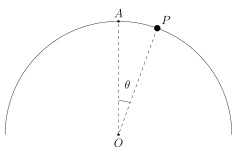
- \(\mathbf{r} = (a \sin \theta - s) \mathbf{i}+a\cos \theta\mathbf{j}\), so \begin{align*} && \dot{\mathbf{r}} &=(a \dot{\theta} \cos \theta - \dot{s}) \mathbf{i}- a\dot{\theta} \sin \theta \mathbf{j}\\ \\ \text{COM}(\rightarrow): && 0 &= M(-\dot{s}) + m(a \dot{\theta} \cos \theta - \dot{s}) \\ \Rightarrow && \dot{s} &= \frac{ma \dot{\theta} \cos \theta}{m+M} \\ &&&= \left ( 1- \frac{M}{m+M} \right) a\dot{\theta} \cos \theta \\ &&&= (1 - k) a\dot{\theta} \cos \theta \\ \\ \Rightarrow && \dot{\mathbf{r}} &=(a \dot{\theta} \cos \theta - \dot{s}) \mathbf{i}- a\dot{\theta} \sin \theta \mathbf{j} \\ &&&= (a \dot{\theta} \cos \theta - (1 - k) a\dot{\theta} \cos \theta) \mathbf{i}- a\dot{\theta} \sin \theta \mathbf{j} \\ &&&= a\dot{\theta} \left ( k \cos \theta \mathbf{i} - \sin \theta \mathbf{j} \right) \end{align*}
- \(\,\) \begin{align*} COE: &&\underbrace{0}_{\text{k.e.}}+ \underbrace{mga}_{\text{GPE}} &= \underbrace{\frac12 m \mathbf{\dot{r}}\cdot\mathbf{\dot{r}}}_{\text{k.e. }P} + \underbrace{mg a\cos \theta}_{\text{GPE}} + \underbrace{\frac12 M \dot{s}^2}_{\text{k.e. hemisphere}} \\ \Rightarrow && 2amg(1-\cos \theta) &= a^2m \dot{\theta}^2(k^2 \cos^2 \theta + \sin^2 \theta)+ M(1 - k)^2 a^2\dot{\theta}^2 \cos^2 \theta \\ \Rightarrow && 2mg(1-\cos \theta) &= a \dot{\theta}^2 \left (m\sin^2 \theta + (mk^2 + M(1-k)^2)\cos^2 \theta \right) \\ &&&= a \dot{\theta}^2 \left (m\sin^2 \theta + mk\cos^2 \theta \right) \\ \Rightarrow && 2g(1-\cos \theta) &= a \dot{\theta}^2 \left (\sin^2 \theta + k\cos^2 \theta \right) \\ \end{align*}
- The equation of motion is \(m \ddot{\mathbf{r}} = \mathbf{R} - mg\mathbf{j}\) and the particle will leave the surface when \(\mathbf{R} = 0\). If we take the component in the directions suggested: \begin{align*} && \ddot{\mathbf{r}} &= a\ddot{\theta}(k \cos \theta \mathbf{i}- \sin \theta \mathbf{j}) + a \dot{\theta}(-k\dot{\theta} \sin \theta \mathbf{i}- \dot{\theta} \cos \theta \mathbf{j}) \\ &&&= ak (\ddot{\theta} \cos \theta - \dot{\theta}^2 \sin \theta) \mathbf{i} -a(\ddot{\theta} \sin \theta + \dot{\theta}^2 \cos \theta) \mathbf{j} \\ \Rightarrow && \mathbf{\ddot{r}} \cdot (\sin \theta \mathbf{i} + k \cos \theta \mathbf{j}) &= ak (\ddot{\theta} \cos \theta - \dot{\theta}^2 \sin \theta) \sin \theta -ak(\ddot{\theta} \sin \theta + \dot{\theta}^2 \cos \theta)\cos \theta \\ &&&= - ak \dot{\theta}^2 \\ && (-g\mathbf{j}) \cdot (\sin \theta \mathbf{i} + k \cos \theta \mathbf{j}) &= -gk \cos \theta \\ \mathbf{R} = 0: && gk \cos \theta &= ak \dot{\theta}^2 \\ \Rightarrow && g \cos \theta &= a \dot{\theta}^2 \end{align*}
- \(\,\) \begin{align*} && 2g(1-\cos \theta) &= a \dot{\theta}^2(k \cos^2 \theta + \sin^2 \theta) \\ && a \dot{\theta}^2 &= g \cos \alpha \\ \Rightarrow && 2g(1-\cos \alpha) &= g \cos \alpha(k \cos^2 \alpha + (1-\cos^2 \alpha)) \\ \Rightarrow && 0 &= g(k-1)c^3+3gc-2g \\ \Rightarrow && 0 &= (k-1)c^3+3c - 2 \end{align*} When \(c =1, f(c) = k > 0\) when \(c = \frac23, f(c) = k-1 < 0\). Therefore there is a root with \(\cos \alpha > \frac23\)
A particle is attached to one end of a light inextensible string of length \(b\). The other end of the string is attached to a fixed point \(O\). Initially the particle hangs vertically below \(O\). The particle then receives a horizontal impulse. The particle moves in a circular arc with the string taut until the acute angle between the string and the upward vertical is \(\alpha\), at which time it becomes slack. Express \(V\), the speed of the particle when the string becomes slack, in terms of \( b\), \(g\) and \(\alpha\). Show that the string becomes taut again a time \(T\) later, where \[ gT = 4V \sin\alpha \,,\] and that just before this time the trajectory of the particle makes an angle \(\beta \) with the horizontal where \(\tan\beta = 3\tan \alpha \,\). When the string becomes taut, the momentum of the particle in the direction of the string is destroyed. Show that the particle comes instantaneously to rest at this time if and only if \[ \sin^2\alpha = \dfrac {1+\sqrt3}4 \,. \]
Show Solution
A smooth plane is inclined at an angle \(\alpha\) to the horizontal. A particle \(P\) of mass \(m\) is attached to a fixed point \(A\) above the plane by a light inextensible string of length \(a\). The particle rests in equilibrium on the plane, and the string makes an angle \(\beta\) with the plane. The particle is given a horizontal impulse parallel to the plane so that it has an initial speed of \(u\). Show that the particle will not immediately leave the plane if \(ag\cos(\alpha + \beta)> u^2 \tan\beta\). Show further that a necessary condition for the particle to perform a complete circle whilst in contact with the plane is \(6\tan\alpha \tan \beta < 1\).
An equilateral triangle \(ABC\) is made of three light rods each of length \(a\). It is free to rotate in a vertical plane about a horizontal axis through \(A\). Particles of mass \(3m\) and \(5m\) are attached to \(B\) and \(C\) respectively. Initially, the system hangs in equilibrium with \(BC\) below \(A\).
- Show that, initially, the angle \(\theta\) that \(BC\) makes with the horizontal is given by \(\sin\theta = \frac17\).
- The triangle receives an impulse that imparts a speed \(v\) to the particle \(B\). Find the minimum speed \(v_0\) such that the system will perform complete rotations if \(v>v_0\).
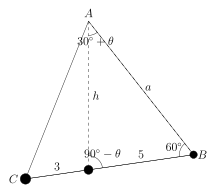
- The sine rule tells us: \begin{align*} && \frac{\frac58 a}{\sin(30^\circ + \theta)} &= \frac{a}{\sin(90^{\circ}-\theta)} \\ \Rightarrow &&\frac58 \cos \theta &= \frac12 \cos \theta+ \frac{\sqrt{3}}2 \sin \theta \\ \Rightarrow && \frac{1}{4\sqrt{3}} &= \tan \theta \\ \Rightarrow && \sin \theta &= \sqrt{\frac{1}{48+1}} = \frac17 \end{align*}
- \(\,\) \begin{align*} && \text{initial energy} &= \frac12(5m)v^2 + \frac12 (3m)v^2 - 3m \cdot g \cdot a \cos(30^{\circ}+\theta) -5m \cdot g \cdot a\cos(30^\circ - \theta) \\ &&&= 4m v^2 - amg(4\sqrt{3} \cos \theta + \sin \theta) \\ &&&= 4mv^2 - 7amg \\ && \text{energy at top} &= \frac12 m v_{top}^2 + 7amg \end{align*} We need this equation to be positive for all values of \(v_{top} \geq 0\), so \(4mv^2 \geq 14amg \Rightarrow v_0 = \sqrt{\frac{7ag}2}\)
A small ring of mass \(m\) is free to slide without friction on a hoop of radius \(a\). The hoop is fixed in a vertical plane. The ring is connected by a light elastic string of natural length \(a\) to the highest point of the hoop. The ring is initially at rest at the lowest point of the hoop and is then slightly displaced. In the subsequent motion the angle of the string to the downward vertical is \(\phi\). Given that the ring first comes to rest just as the string becomes slack, find an expression for the modulus of elasticity of the string in terms of \(m\) and \(g\). Show that, throughout the motion, the magnitude \(R\) of the reaction between the ring and the hoop is given by \[ R = ( 12\cos^2\phi -15\cos\phi +5) mg \] and that \(R\) is non-zero throughout the motion.
Particles \(P\) and \(Q\) have masses \(3m\) and \(4m\), respectively. They lie on the outer curved surface of a~smooth circular cylinder of radius~\(a\) which is fixed with its axis horizontal. They are connected by a light inextensible string of length \(\frac12 \pi a\), which passes over the surface of the cylinder. The particles and the string all lie in a vertical plane perpendicular to the axis of the cylinder, and the axis intersects this plane at \(O\). Initially, the particles are in equilibrium. Equilibrium is slightly disturbed and \(Q\) begins to move downwards. Show that while the two particles are still in contact with the cylinder the angle \(\theta\) between \(OQ\) and the vertical satisfies \[ 7a\dot\theta^2 +8g \cos\theta + 6 g\sin\theta = 10g\,. \]
- Given that \(Q\) loses contact with the cylinder first, show that it does so when~\(\theta=\beta\), where \(\beta\) satisfies \[ 15\cos\beta +6\sin\beta =10. \]
- Show also that while \(P\) and \(Q\) are still in contact with the cylinder the tension in the string is $\frac {12}7 mg(\sin\theta +\cos\theta)\,$.
A thin uniform circular disc of radius \(a\) and mass \(m\) is held in equilibrium in a horizontal plane a distance \(b\) below a horizontal ceiling, where \(b>2a\). It is held in this way by \(n\) light inextensible vertical strings, each of length \(b\); one end of each string is attached to the edge of the disc and the other end is attached to a point on the ceiling. The strings are equally spaced around the edge of the disc. One of the strings is attached to the point \(P\) on the disc which has coordinates \((a,0,-b)\) with respect to cartesian axes with origin on the ceiling directly above the centre of the disc. The disc is then rotated through an angle \(\theta\) (where \(\theta<\pi\)) about its vertical axis of symmetry and held at rest by a couple acting in the plane of the disc. Show that the string attached to~\(P\) now makes an angle \(\phi\) with the vertical, where \[ b\sin\phi = 2a \sin\tfrac12 \theta\,. \] Show further that the magnitude of the couple is \[ \frac {mga^2\sin\theta}{\sqrt{b^2-4a^2\sin^2 \frac12\theta \ } \ }\,. \] The disc is now released from rest. Show that its angular speed, \(\omega\), when the strings are vertical is given by \[ \frac{a^2\omega^2}{4g} = b-\sqrt{b^2 - 4a^2\sin^2 \tfrac12\theta \;}\,. \]
\(\,\)
Two identical particles \(P\) and \(Q\), each of mass \(m\), are attached to the ends of a diameter of a light thin circular hoop of radius \(a\). The hoop rolls without slipping along a straight line on a horizontal table with the plane of the hoop vertical. Initially, \(P\) is in contact with the table. At time \(t\), the hoop has rotated through an angle \(\theta\). Write down the position at time \(t\) of \(P\), relative to its starting point, in cartesian coordinates, and determine its speed in terms of \(a\), \(\theta\) and \(\dot\theta\). Show that the total kinetic energy of the two particles is \(2ma^2\dot\theta^2\). Given that the only external forces on the system are gravity and the vertical reaction of the table on the hoop, show that the hoop rolls with constant speed.
Show Solution
- A wheel consists of a thin
light circular rim attached by light spokes of length \(a\)
to a small hub of mass
\(m\). The wheel rolls without slipping
on a rough horizontal table
directly towards a straight edge of the table.
The plane of the wheel is vertical throughout the motion.
The speed of the wheel is \(u\), where
\(u^2
- Two particles, each of mass \(m/2\), are attached to a light circular hoop of radius \(a\), at the ends of a diameter. The hoop rolls without slipping on a rough horizontal table directly towards a straight edge of the table. The plane of the hoop is vertical throughout the motion. When the centre of the hoop is vertically above the edge of the table it has speed \(u\), where \(u^2
- Two particles, each of mass \(m/2\), are attached to a light circular hoop of radius \(a\), at the ends of a diameter. The hoop rolls without slipping on a rough horizontal table directly towards a straight edge of the table. The plane of the hoop is vertical throughout the motion. When the centre of the hoop is vertically above the edge of the table it has speed \(u\), where \(u^2
A horizontal spindle rotates freely in a fixed bearing. Three light rods are each attached by one end to the spindle so that they rotate in a vertical plane. A particle of mass \(m\) is fixed to the other end of each of the three rods. The rods have lengths \(a\), \(b\) and \(c\), with \(a > b > c\,\) and the angle between any pair of rods is \(\frac23 \pi\). The angle between the rod of length \(a\) and the vertical is \(\theta\), as shown in the diagram. \vspace*{-0.1in}
A circular hoop of radius \(a\) is free to rotate about a fixed horizontal axis passing through a point \(P\) on its circumference. The plane of the hoop is perpendicular to this axis. The hoop hangs in equilibrium with its centre, \(O\), vertically below \(P\). The point \(A\) on the hoop is vertically below \(O\), so that \(POA\) is a diameter of the hoop. A mouse \(M\) runs at constant speed \(u\) round the rough inner surface of the lower part of the hoop. Show that the mouse can choose its speed so that the hoop remains in equilibrium with diameter \(POA\) vertical. Describe what happens to the hoop when the mouse passes the point at which angle \(AOM = 2 \arctan \mu\,\), where \(\mu\) is the coefficient of friction between mouse and hoop.
A light hollow cylinder of radius \(a\) can rotate freely about its axis of symmetry, which is fixed and horizontal. A particle of mass \(m\) is fixed to the cylinder, and a second particle, also of mass \(m\), moves on the rough inside surface of the cylinder. Initially, the cylinder is at rest, with the fixed particle on the same horizontal level as its axis and the second particle at rest vertically below this axis. The system is then released. Show that, if \(\theta\) is the angle through which the cylinder has rotated, then \[ \ddot{\theta} = {g \over 2a} \l \cos \theta - \sin \theta \r \,, \] provided that the second particle does not slip. Given that the coefficient of friction is \( (3 + \sqrt{3})/6\), show that the second particle starts to slip when the cylinder has rotated through \(60^\circ\).
The point \(A\) is vertically above the point \(B\). A light inextensible string, with a smooth ring \(P\) of mass \(m\) threaded onto it, has its ends attached at \(A\) and \(B\). The plane \(APB\) rotates about \(AB\) with constant angular velocity \(\omega\) so that \(P\) describes a horizontal circle of radius \(r\) and the string is taut. The angle \(BAP\) has value \(\theta\) and the angle \(ABP\) has value \(\phi\). Show that \[\tan\frac{\phi-\theta}{2}=\frac{g}{r\omega^{2}}.\] Find the tension in the string in terms of \(m\), \(g\), \(r\), \(\omega\) and \(\sin\frac{1}{2}(\theta+\phi)\). Deduce from your results that if \(r\omega^2\) is small compared with \(g\), then the tension is approximately \(\frac{mg}{2}\)
Show Solution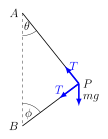
The plot of `Rhode Island Red and the Henhouse of Doom' calls for the heroine to cling on to the circumference of a fairground wheel of radius \(a\) rotating with constant angular velocity \(\omega\) about its horizontal axis and then let go. Let \(\omega_{0}\) be the largest value of \(\omega\) for which it is not possible for her subsequent path to carry her higher than the top of the wheel. Find \(\omega_{0}\) in terms of \(a\) and \(g\). If \(\omega>\omega_{0}\) show that the greatest height above the top of the wheel to which she can rise is \[\frac{a}{2}\left(\frac{\omega}{\omega_{0}} -\frac{\omega_{0}}{\omega}\right)^{\!\!2}.\]
Show Solution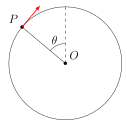
A particle of mass \(m\) is at rest on top of a smooth fixed sphere of radius \(a\). Show that, if the particle is given a small displacement, it reaches the horizontal plane through the centre of the sphere at a distance % at least $$a(5\sqrt5+4\sqrt23)/27$$ from the centre of the sphere. [Air resistance should be neglected.]
\(\,\)
\(\,\)
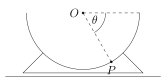
A smooth tube whose axis is horizontal has an elliptic cross-section in the form of the curve with parametric equations \[ x=a\cos\theta\qquad y=b\sin\theta \] where the \(x\)-axis is horizontal and the \(y\)-axis is vertically upwards. A particle moves freely under gravity on the inside of the tube in the plane of this cross-section. By first finding \(\ddot{x}\) and \(\ddot{y},\) or otherwise, show that the acceleration along the inward normal at the point with parameter \(\theta\) is \[ \frac{ab\dot{\theta}^{2}}{\sqrt{a^{2}\sin^{2}\theta+b^{2}\cos^{2}\theta}}. \] The particle is projected along the surface in the vertical cross-section plane, with speed \(2\sqrt{bg},\) from the lowest point. Given that \(2a=3b,\) show that it will leave the surface at the point with parameter \(\theta\) where \[ 5\sin^{3}\theta+12\sin\theta-8=0. \]
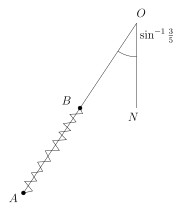
A particle \(P\) is projected, from the lowest point, along the smooth inside surface of a fixed sphere with centre \(O\). It leaves the surface when \(OP\) makes an angle \(\theta\) with the upward vertical. Find the smallest angle that must be exceeded by \(\theta\) to ensure that \(P\) will strike the surface below the level of \(O\). You may find it helpful to find the time at which the particle strikes the sphere.
Show Solution
One end of a light inextrnsible string of length \(l\) is fixed to a point on the upper surface of a thin, smooth, horizontal table-top, at a distance \((l-a)\) from one edge of the table-top. A particle of mass \(m\) is fixed to the other end of the string, and held a distance \(a\) away from this edge of the table-top, so that the string is horizontal and taut. The particle is then released. Find the tension in the string after the string has rotated through an angle \(\theta,\) and show that the largest magnitude of the force on the edge of the table top is \(8mg/\sqrt{3}.\)
Show Solution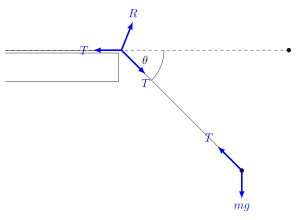
A smooth horizontal plane rotates with constant angular velocity \(\Omega\) about a fixed vertical axis through a fixed point \(O\) of the plane. The point \(A\) is fixed in the plane and \(OA=a.\) A particle \(P\) lies on the plane and is joined to \(A\) by a light rod of length \(b(>a)\) freely pivoted at \(A\). Initially \(OAP\) is a straight line and \(P\) is moving with speed \((a+2\sqrt{ab})\Omega\) perpendicular to \(OP\) in the same sense as \(\Omega.\) At time \(t,\) \(AP\) makes an angle \(\phi\) with \(OA\) produced. Obtain an expression for the component of the acceleration of \(P\) perpendicular to \(AP\) in terms of \(\dfrac{\mathrm{d}^{2}\phi}{\mathrm{d}t^{2}},\phi,a,b\) and \(\Omega.\) Hence find \(\dfrac{\mathrm{d}\phi}{\mathrm{d}t}\), in terms of \(\phi,a,b\) and \(\Omega,\) and show that \(P\) never crosses \(OA.\)
Show SolutionA heavy particle lies on a smooth horizontal table, and is attached to one end of a light inextensible string of length \(L\). The other end of the string is attached to a point \(P\) on the circumference of the base of a vertical post which is fixed into the table. The base of the post is a circle of radius \(a\) with its centre at a point \(O\) on the table. Initially, at time \(t=0\), the string is taut and perpendicular to the line \(OP.\) The particle is then struck in such a way that the string starts winding round the post and remains taut. At a later time \(t\), a length \(a\theta(t)\ (< L)\) of the string is in contact with the post. Using cartesian axes with origin \(O\), find the position and velocity vectors of the particle at time \(t\) in terms of \(a,L,\theta\) and \(\dot{\theta},\) and hence show that the speed of the particle is \((L-a\theta)\dot{\theta}.\) If the initial speed of the particle is \(v\), show that the particle hits the post at a time \(L^{2}/(2av).\)
Show Solution