1988 Paper 2 Q11
Year: 1988
Paper: 2
Question Number: 11
Course: UFM Mechanics
Section: Circular Motion 2
Difficulty: 1600.0
Banger: 1500.0
circular motion
string winding around post
inextensible string
cartesian coordinates
position and velocity vectors
speed
conservation of energy
smooth table
integration
Problem
A heavy particle lies on a smooth horizontal table, and is attached to one end of a light inextensible string of length \(L\). The other end of the string is attached to a point \(P\) on the circumference of the base of a vertical post which is fixed into the table. The base of the post is a circle of radius \(a\) with its centre at a point \(O\) on the table. Initially, at time \(t=0\), the string is taut and perpendicular to the line \(OP.\) The particle is then struck in such a way that the string starts winding round the post and remains taut.
At a later time \(t\), a length \(a\theta(t)\ (< L)\) of the string is in contact with the post. Using cartesian axes with origin \(O\), find the position and velocity vectors of the particle at time \(t\) in terms of \(a,L,\theta\) and \(\dot{\theta},\) and hence show that the speed of the particle is \((L-a\theta)\dot{\theta}.\)
If the initial speed of the particle is \(v\), show that the particle hits the post at a time \(L^{2}/(2av).\)
Solution
Rating Information
Difficulty Rating: 1600.0
Difficulty Comparisons: 0
Banger Rating: 1500.0
Banger Comparisons: 0
Show LaTeX source
Problem source
A heavy particle lies on a smooth horizontal table, and is attached to one end of a light inextensible string of length $L$. The other end of the string is attached to a point $P$ on the circumference of the base of a vertical post which is fixed into the table. The base of the post is a circle of radius $a$ with its centre at a point $O$ on the table. Initially, at time $t=0$, the string is taut and perpendicular to the line $OP.$ The particle is then struck in such a way that the string starts winding round the post and remains taut.
At a later time $t$, a length $a\theta(t)\ (< L)$ of the string is in contact with the post. Using cartesian axes with origin $O$, find the position and velocity vectors of the particle at time $t$ in terms of $a,L,\theta$ and $\dot{\theta},$ and hence show that the speed of the particle is $(L-a\theta)\dot{\theta}.$
If the initial speed of the particle is $v$, show that the particle hits the post at a time $L^{2}/(2av).$
Solution source
\begin{center}
    \begin{tikzpicture}[scale=1]
        \draw[->, dashed] (-3, 0) -- (3,0);
        \draw[->, dashed] (0, -3) -- (0,3);
        \draw (0,0) circle (1);
        \draw[ultra thick, red] (1,0) -- (1,3);
        \draw[domain = 0:45, samples=50, variable = \x, red, ultra thick]  plot ({cos(\x)},{sin(\x)});
        \draw[ultra thick, red] ({1/sqrt(2)},{1/sqrt(2)}) -- ({(-3+pi/4+1)/sqrt(2)},{(3-pi/4+1)/sqrt(2)});

        \coordinate (O) at (0,0);
        \coordinate (P) at (1,0);
        \coordinate (Q) at ({1/sqrt(2)},{1/sqrt(2)});

        \filldraw (1,3) circle (1.5pt);
        \filldraw ({(-3+pi/4+1)/sqrt(2)},{(3-pi/4+1)/sqrt(2)}) circle (1.5pt);


        \draw[dashed] (O) -- (Q);
        \pic [draw, angle radius=1cm, "$\theta$"] {angle = P--O--Q};
    \end{tikzpicture}
\end{center}

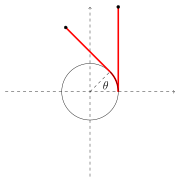
As the string wraps around, the total length in contact will be $a \theta$. The end contact point will be at $(a\cos \theta, a\sin \theta)$ and the string will be tangential to that. The tangent (unit) vector will be $\binom{-\sin \theta}{\cos \theta}$, and so the particle will be at $\binom{a\cos \theta - (L-a\theta) \sin \theta}{a \sin \theta + (L-a \theta) \cos \theta}$.

The velocity will be:

\begin{align*}
\frac{\d}{\d t} \binom{a\cos \theta - (L-a\theta) \sin \theta}{a \sin \theta + (L-a \theta) \cos \theta} &= \binom{-a \sin \theta \cdot \dot{\theta} -(L-a \theta) \cos \theta \cdot \dot{\theta} + a \sin \theta \cdot \dot{\theta} }{a \cos \theta \cdot \dot{\theta} + (L-a \theta) \sin \theta \cdot \dot{\theta} - a \cos \theta \cdot \dot{\theta}} \\
&= \binom{-(L-a \theta) \cos \theta \cdot \dot{\theta}  }{ (L-a \theta) \sin \theta \cdot \dot{\theta}} \\
\end{align*}

Therefore the speed is $(L-a\theta) \dot{\theta}$.

By conservation of energy, we must have that speed is constant, ie:

\begin{align*}
&& (L - a \theta)\dot{\theta} &= v \\
\Rightarrow && \int_0^{L/a} (L - a \theta)\d \theta &= \int_0^T v \d t \\
\Rightarrow && vT &= \frac{L^2}{a} - a\frac{L^2}{2a^2} \\
&&&= \frac{L^2}{2a} \\
\Rightarrow && T &= \frac{L^2}{2av}
\end{align*}

as requried