2019 Paper 3 Q9
Year: 2019
Paper: 3
Question Number: 9
Course: UFM Mechanics
Section: Circular Motion 2
Problem
- Let \(\mathbf{r}\) be the position vector of the particle at time \(t\) with respect to the initial position of \(O\). Write down an expression for \(\mathbf{r}\) in terms of \(a\), \(\theta\) and \(s\) and show that $$\dot{\mathbf{r}} = (a\dot{\theta} \cos \theta - \dot{s})\mathbf{i} - a\dot{\theta} \sin \theta \mathbf{j}.$$ Show also that $$\dot{s} = (1 - k)a\dot{\theta} \cos \theta,$$ where \(k = \frac{M}{m + M}\), and deduce that $$\dot{\mathbf{r}} = a\dot{\theta}(k \cos \theta \mathbf{i} - \sin \theta \mathbf{j}).$$
- Show that $$a\dot{\theta}^2 \left(k \cos^2 \theta + \sin^2 \theta\right) = 2g(1 - \cos \theta).$$
- At time \(T\), when \(\theta = \alpha\), the particle leaves the hemisphere. By considering the component of \(\ddot{\mathbf{r}}\) parallel to the vector \(\sin \theta \mathbf{i} + k \cos \theta \mathbf{j}\), or otherwise, show that at time \(T\) $$a\dot{\theta}^2 = g \cos \alpha.$$ Find a cubic equation for \(\cos \alpha\) and deduce that \(\cos \alpha > \frac{2}{3}\).
Solution
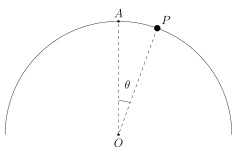
- \(\mathbf{r} = (a \sin \theta - s) \mathbf{i}+a\cos \theta\mathbf{j}\), so \begin{align*} && \dot{\mathbf{r}} &=(a \dot{\theta} \cos \theta - \dot{s}) \mathbf{i}- a\dot{\theta} \sin \theta \mathbf{j}\\ \\ \text{COM}(\rightarrow): && 0 &= M(-\dot{s}) + m(a \dot{\theta} \cos \theta - \dot{s}) \\ \Rightarrow && \dot{s} &= \frac{ma \dot{\theta} \cos \theta}{m+M} \\ &&&= \left ( 1- \frac{M}{m+M} \right) a\dot{\theta} \cos \theta \\ &&&= (1 - k) a\dot{\theta} \cos \theta \\ \\ \Rightarrow && \dot{\mathbf{r}} &=(a \dot{\theta} \cos \theta - \dot{s}) \mathbf{i}- a\dot{\theta} \sin \theta \mathbf{j} \\ &&&= (a \dot{\theta} \cos \theta - (1 - k) a\dot{\theta} \cos \theta) \mathbf{i}- a\dot{\theta} \sin \theta \mathbf{j} \\ &&&= a\dot{\theta} \left ( k \cos \theta \mathbf{i} - \sin \theta \mathbf{j} \right) \end{align*}
- \(\,\) \begin{align*} COE: &&\underbrace{0}_{\text{k.e.}}+ \underbrace{mga}_{\text{GPE}} &= \underbrace{\frac12 m \mathbf{\dot{r}}\cdot\mathbf{\dot{r}}}_{\text{k.e. }P} + \underbrace{mg a\cos \theta}_{\text{GPE}} + \underbrace{\frac12 M \dot{s}^2}_{\text{k.e. hemisphere}} \\ \Rightarrow && 2amg(1-\cos \theta) &= a^2m \dot{\theta}^2(k^2 \cos^2 \theta + \sin^2 \theta)+ M(1 - k)^2 a^2\dot{\theta}^2 \cos^2 \theta \\ \Rightarrow && 2mg(1-\cos \theta) &= a \dot{\theta}^2 \left (m\sin^2 \theta + (mk^2 + M(1-k)^2)\cos^2 \theta \right) \\ &&&= a \dot{\theta}^2 \left (m\sin^2 \theta + mk\cos^2 \theta \right) \\ \Rightarrow && 2g(1-\cos \theta) &= a \dot{\theta}^2 \left (\sin^2 \theta + k\cos^2 \theta \right) \\ \end{align*}
- The equation of motion is \(m \ddot{\mathbf{r}} = \mathbf{R} - mg\mathbf{j}\) and the particle will leave the surface when \(\mathbf{R} = 0\). If we take the component in the directions suggested: \begin{align*} && \ddot{\mathbf{r}} &= a\ddot{\theta}(k \cos \theta \mathbf{i}- \sin \theta \mathbf{j}) + a \dot{\theta}(-k\dot{\theta} \sin \theta \mathbf{i}- \dot{\theta} \cos \theta \mathbf{j}) \\ &&&= ak (\ddot{\theta} \cos \theta - \dot{\theta}^2 \sin \theta) \mathbf{i} -a(\ddot{\theta} \sin \theta + \dot{\theta}^2 \cos \theta) \mathbf{j} \\ \Rightarrow && \mathbf{\ddot{r}} \cdot (\sin \theta \mathbf{i} + k \cos \theta \mathbf{j}) &= ak (\ddot{\theta} \cos \theta - \dot{\theta}^2 \sin \theta) \sin \theta -ak(\ddot{\theta} \sin \theta + \dot{\theta}^2 \cos \theta)\cos \theta \\ &&&= - ak \dot{\theta}^2 \\ && (-g\mathbf{j}) \cdot (\sin \theta \mathbf{i} + k \cos \theta \mathbf{j}) &= -gk \cos \theta \\ \mathbf{R} = 0: && gk \cos \theta &= ak \dot{\theta}^2 \\ \Rightarrow && g \cos \theta &= a \dot{\theta}^2 \end{align*}
- \(\,\) \begin{align*} && 2g(1-\cos \theta) &= a \dot{\theta}^2(k \cos^2 \theta + \sin^2 \theta) \\ && a \dot{\theta}^2 &= g \cos \alpha \\ \Rightarrow && 2g(1-\cos \alpha) &= g \cos \alpha(k \cos^2 \alpha + (1-\cos^2 \alpha)) \\ \Rightarrow && 0 &= g(k-1)c^3+3gc-2g \\ \Rightarrow && 0 &= (k-1)c^3+3c - 2 \end{align*} When \(c =1, f(c) = k > 0\) when \(c = \frac23, f(c) = k-1 < 0\). Therefore there is a root with \(\cos \alpha > \frac23\)
Examiner's report
— 2019 STEP 3, Question 9There was a significant rise in the total entry this year with an increase of nearly 8.5% on 2018. One question was attempted by over 90%, two others were very popular, and three further questions were attempted by 60% or more. No question was generally avoided and even the least popular attracted more than 10% of the candidates. 88% restricted themselves to attempting no more than 7 questions, and only a handful, but not the very best, scored strongly attempting more than 7 questions.
Rating Information
Difficulty Rating: 1500.0
Difficulty Comparisons: 0
Banger Rating: 1500.0
Banger Comparisons: 0
Show LaTeX source
Problem source
In this question, $\mathbf{i}$ and $\mathbf{j}$ are perpendicular unit vectors and $\mathbf{j}$ is vertically upwards.
A smooth hemisphere of mass $M$ and radius $a$ rests on a smooth horizontal table with its plane face in contact with the table. The point $A$ is at the top of the hemisphere and the point $O$ is at the centre of its plane face.
Initially, a particle $P$ of mass $m$ rests at $A$. It is then given a small displacement in the positive $\mathbf{i}$ direction. At a later time $t$, when the particle is still in contact with the hemisphere, the hemisphere has been displaced by $-s\mathbf{i}$ and $\angle AOP = \theta$.
\begin{questionparts}
\item Let $\mathbf{r}$ be the position vector of the particle at time $t$ with respect to the initial position of $O$. Write down an expression for $\mathbf{r}$ in terms of $a$, $\theta$ and $s$ and show that
$$\dot{\mathbf{r}} = (a\dot{\theta} \cos \theta - \dot{s})\mathbf{i} - a\dot{\theta} \sin \theta \mathbf{j}.$$
Show also that
$$\dot{s} = (1 - k)a\dot{\theta} \cos \theta,$$
where $k = \frac{M}{m + M}$, and deduce that
$$\dot{\mathbf{r}} = a\dot{\theta}(k \cos \theta \mathbf{i} - \sin \theta \mathbf{j}).$$
\item Show that
$$a\dot{\theta}^2 \left(k \cos^2 \theta + \sin^2 \theta\right) = 2g(1 - \cos \theta).$$
\item At time $T$, when $\theta = \alpha$, the particle leaves the hemisphere. By considering the component of $\ddot{\mathbf{r}}$ parallel to the vector $\sin \theta \mathbf{i} + k \cos \theta \mathbf{j}$, or otherwise, show that at time $T$
$$a\dot{\theta}^2 = g \cos \alpha.$$
Find a cubic equation for $\cos \alpha$ and deduce that $\cos \alpha > \frac{2}{3}$.
\end{questionparts}
Solution source
\begin{center}
    \begin{tikzpicture}[scale=2]
        \def\a{2};
        \coordinate (P) at ({\a*cos(70)}, {\a*sin(70)});
        \coordinate (O) at (0,0);
        \coordinate (A) at ({0}, {\a});


        \filldraw (P) circle (1.5pt) node[above right] {$P$};
        \filldraw (A) circle (0.5pt) node[above] {$A$};
        \filldraw (O) circle (0.5pt) node[below] {$O$};

        \draw[domain = 0:180, samples=100]
            plot({\a*cos(\x)}, {\a*sin(\x)});

        \draw[dashed] (P) -- (O) -- (A);
        \pic [draw, angle radius=1.2cm, angle eccentricity=1.5, "$\theta$"] {angle = P--O--A};
    \end{tikzpicture}
\end{center}


\begin{questionparts}
    \item $\mathbf{r} = (a \sin \theta - s) \mathbf{i}+a\cos \theta\mathbf{j}$, so
    \begin{align*}
        && \dot{\mathbf{r}} &=(a \dot{\theta} \cos \theta - \dot{s}) \mathbf{i}- a\dot{\theta} \sin \theta \mathbf{j}\\
        \\
        \text{COM}(\rightarrow): && 0 &= M(-\dot{s}) + m(a \dot{\theta} \cos \theta - \dot{s}) \\
        \Rightarrow && \dot{s} &= \frac{ma \dot{\theta} \cos \theta}{m+M} \\
        &&&= \left ( 1- \frac{M}{m+M} \right) a\dot{\theta} \cos \theta \\
        &&&= (1 - k)  a\dot{\theta} \cos \theta \\
        \\
        \Rightarrow &&  \dot{\mathbf{r}} &=(a \dot{\theta} \cos \theta - \dot{s}) \mathbf{i}- a\dot{\theta} \sin \theta \mathbf{j} \\
        &&&= (a \dot{\theta} \cos \theta - (1 - k)  a\dot{\theta} \cos \theta) \mathbf{i}- a\dot{\theta} \sin \theta \mathbf{j} \\
        &&&= a\dot{\theta} \left ( k \cos \theta \mathbf{i} - \sin \theta \mathbf{j} \right)
    \end{align*}

\item $\,$ \begin{align*}
    COE: &&\underbrace{0}_{\text{k.e.}}+ \underbrace{mga}_{\text{GPE}} &= \underbrace{\frac12 m \mathbf{\dot{r}}\cdot\mathbf{\dot{r}}}_{\text{k.e. }P} + \underbrace{mg a\cos \theta}_{\text{GPE}} + \underbrace{\frac12 M \dot{s}^2}_{\text{k.e. hemisphere}} \\
    \Rightarrow && 2amg(1-\cos \theta) &= a^2m \dot{\theta}^2(k^2 \cos^2 \theta + \sin^2 \theta)+ M(1 - k)^2  a^2\dot{\theta}^2 \cos^2 \theta \\
    \Rightarrow && 2mg(1-\cos \theta) &= a  \dot{\theta}^2 \left (m\sin^2 \theta + (mk^2 + M(1-k)^2)\cos^2 \theta \right) \\
    &&&= a  \dot{\theta}^2 \left (m\sin^2 \theta + mk\cos^2 \theta \right) \\
    \Rightarrow && 2g(1-\cos \theta) &= a  \dot{\theta}^2 \left (\sin^2 \theta + k\cos^2 \theta \right) \\
\end{align*}

\item The equation of motion is $m \ddot{\mathbf{r}} = \mathbf{R} - mg\mathbf{j}$ and the particle will leave the surface when $\mathbf{R} = 0$. If we take the component in the directions suggested:
\begin{align*}
    && \ddot{\mathbf{r}} &= a\ddot{\theta}(k \cos \theta \mathbf{i}- \sin \theta \mathbf{j}) + a \dot{\theta}(-k\dot{\theta} \sin \theta \mathbf{i}- \dot{\theta} \cos \theta \mathbf{j}) \\
    &&&= ak (\ddot{\theta} \cos \theta - \dot{\theta}^2 \sin \theta) \mathbf{i} -a(\ddot{\theta} \sin \theta + \dot{\theta}^2 \cos \theta) \mathbf{j} \\
    \Rightarrow && \mathbf{\ddot{r}} \cdot (\sin \theta \mathbf{i} + k \cos \theta \mathbf{j}) &= ak (\ddot{\theta} \cos \theta - \dot{\theta}^2 \sin \theta) \sin \theta -ak(\ddot{\theta} \sin \theta + \dot{\theta}^2 \cos \theta)\cos \theta \\
    &&&= - ak \dot{\theta}^2 \\
    && (-g\mathbf{j}) \cdot (\sin \theta \mathbf{i} + k \cos \theta \mathbf{j}) &= -gk \cos \theta \\
    \mathbf{R} = 0: && gk \cos \theta &= ak \dot{\theta}^2 \\
    \Rightarrow && g \cos \theta &= a \dot{\theta}^2
\end{align*}


\item $\,$
\begin{align*}
     && 2g(1-\cos \theta) &= a  \dot{\theta}^2(k \cos^2 \theta + \sin^2 \theta) \\
     && a  \dot{\theta}^2 &= g \cos \alpha \\
     \Rightarrow &&  2g(1-\cos \alpha) &=  g \cos \alpha(k \cos^2 \alpha + (1-\cos^2 \alpha)) \\
     \Rightarrow && 0 &= g(k-1)c^3+3gc-2g \\
     \Rightarrow && 0 &= (k-1)c^3+3c - 2
\end{align*}

When $c =1, f(c) = k > 0$ when $c = \frac23, f(c) = k-1 < 0$. Therefore there is a root with $\cos \alpha > \frac23$

\end{questionparts}
Although this was the least frequently attempted question, it was tried by just over 10% scoring on average marginally under one third marks. The position and velocity in (i) were successful for most, and those considering momentum (or centre of mass) found the next result easy, although those considering forces struggled. Most struggled with (ii), for whilst considering energy, typically they forgot the kinetic energy of the hemisphere. Part (iii) evoked a number of approaches, which were usually unsuccessful, and most could not make use of the suggested method. Even candidates who were unsuccessful with the rest of the question were able to obtain the cubic equation, though hardly any could justify the final inequality.