2015 Paper 2 Q9
Year: 2015
Paper: 2
Question Number: 9
Course: UFM Mechanics
Section: Circular Motion 2
Problem
- Show that, initially, the angle \(\theta\) that \(BC\) makes with the horizontal is given by \(\sin\theta = \frac17\).
- The triangle receives an impulse that imparts a speed \(v\) to the particle \(B\). Find the minimum speed \(v_0\) such that the system will perform complete rotations if \(v>v_0\).
Solution
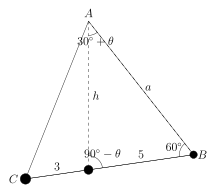
- The sine rule tells us: \begin{align*} && \frac{\frac58 a}{\sin(30^\circ + \theta)} &= \frac{a}{\sin(90^{\circ}-\theta)} \\ \Rightarrow &&\frac58 \cos \theta &= \frac12 \cos \theta+ \frac{\sqrt{3}}2 \sin \theta \\ \Rightarrow && \frac{1}{4\sqrt{3}} &= \tan \theta \\ \Rightarrow && \sin \theta &= \sqrt{\frac{1}{48+1}} = \frac17 \end{align*}
- \(\,\) \begin{align*} && \text{initial energy} &= \frac12(5m)v^2 + \frac12 (3m)v^2 - 3m \cdot g \cdot a \cos(30^{\circ}+\theta) -5m \cdot g \cdot a\cos(30^\circ - \theta) \\ &&&= 4m v^2 - amg(4\sqrt{3} \cos \theta + \sin \theta) \\ &&&= 4mv^2 - 7amg \\ && \text{energy at top} &= \frac12 m v_{top}^2 + 7amg \end{align*} We need this equation to be positive for all values of \(v_{top} \geq 0\), so \(4mv^2 \geq 14amg \Rightarrow v_0 = \sqrt{\frac{7ag}2}\)
Examiner's report
— 2015 STEP 2, Question 9As in previous years the Pure questions were the most popular of the paper with questions 1, 2 and 6 the most popular. The least popular questions on the paper were questions 8, 11 and 13 with fewer than 250 attempts for each of them. There were many examples of solutions in this paper that were insufficiently well explained given that the answer to be reached had been provided in the question.
Rating Information
Difficulty Rating: 1600.0
Difficulty Comparisons: 0
Banger Rating: 1484.0
Banger Comparisons: 1
Show LaTeX source
Problem source
An equilateral triangle $ABC$ is made of three light rods each of length $a$. It is free to rotate in a vertical plane about a horizontal axis through $A$.  Particles of mass $3m$ and $5m$ are attached to $B$ and $C$ respectively. Initially, the system hangs in equilibrium with $BC$ below $A$.
\begin{questionparts}
\item Show that, initially, the angle $\theta$ that $BC$ makes with the horizontal is given by $\sin\theta = \frac17$.
\item The triangle  receives an impulse that imparts a speed $v$ to the particle $B$. Find the minimum speed $v_0$ such that the system will perform complete rotations if $v>v_0$.
\end{questionparts}
Solution source
\begin{center}
    \begin{tikzpicture}[scale=3]

        \coordinate (A) at (0,0);
        \coordinate (B) at ({2*cos(asin(1/7)-60)},{2*sin(asin(1/7)-60)});
        \coordinate (C) at ({2*cos(asin(1/7)-120)},{2*sin(asin(1/7)-120)});
        \coordinate (G) at ($(C)!0.375!(B)$);
        % \coordinate (C) at ({2*cos(140)},{2*sin(140)});

        \draw (A) -- (B) -- (C) -- cycle;

        \filldraw (B) circle (1.25pt) node[right] {$B$};
        \filldraw (C) circle (1.75pt) node[left] {$C\;$};
        \filldraw (G) circle (1.5pt);

        \node[above] at (A) {$A$};

        \draw (B) -- (G) node[pos=0.5, above] {$5$};
        \draw (C) -- (G) node[pos=0.5, above] {$3$};

        \draw[dashed] (A) -- (G) node[pos=0.5, right] {$h$};
        \draw[dashed] (A) -- (B) node[pos=0.5, right] {$a$};

        \pic [draw, angle radius=.5cm, angle eccentricity=1.5, "$60^\circ$"] {angle = A--B--C};
        \pic [draw, angle radius=.5cm, angle eccentricity=1.5, "$90^\circ - \theta$"] {angle = B--G--A};
        \pic [draw, angle radius=.5cm, angle eccentricity=1.5, "$30^\circ + \theta$"] {angle = G--A--B};

    \end{tikzpicture}
\end{center}

\begin{questionparts}

\item The sine rule tells us:

\begin{align*}
    && \frac{\frac58 a}{\sin(30^\circ + \theta)} &= \frac{a}{\sin(90^{\circ}-\theta)} \\
    \Rightarrow &&\frac58 \cos \theta &= \frac12 \cos \theta+ \frac{\sqrt{3}}2 \sin \theta \\
    \Rightarrow && \frac{1}{4\sqrt{3}} &= \tan \theta \\
    \Rightarrow && \sin \theta &= \sqrt{\frac{1}{48+1}} = \frac17
 \end{align*}

\item $\,$ \begin{align*}
    && \text{initial energy} &= \frac12(5m)v^2 + \frac12 (3m)v^2 - 3m \cdot g \cdot a \cos(30^{\circ}+\theta) -5m \cdot g \cdot a\cos(30^\circ - \theta) \\
    &&&= 4m v^2 - amg(4\sqrt{3} \cos \theta + \sin \theta) \\
    &&&= 4mv^2 - 7amg \\
    && \text{energy at top} &= \frac12 m v_{top}^2 + 7amg
\end{align*}

We need this equation to be positive for all values of $v_{top} \geq 0$, so $4mv^2 \geq 14amg \Rightarrow v_0 = \sqrt{\frac{7ag}2}$
\end{questionparts}
This was the most popular of the Mechanics questions, but many candidates struggled to achieve good marks. In the first section many candidates had difficulties in finding the correct angles to work with – a clear diagram is very helpful in tackling this problem. Candidates often introduced new notation to help with the steps toward the solution, but this was sometimes poorly chosen and made solution of the problem more difficult. Explanations of the methods being used were also often poor – in particular the triangles being used at different stages were not clearly identified. There were also a number of errors when taking moments or when recalling exact values of the sine and cosine functions. There were a number of good attempts at the second part of the question, but a large number of candidates calculated the kinetic energy incorrectly.