1989 Paper 2 Q14
Year: 1989
Paper: 2
Question Number: 14
Course: UFM Mechanics
Section: Circular Motion 2
Difficulty: 1600.0
Banger: 1473.5
circular motion
horizontal table
string tension
energy conservation
constraint force
optimisation
light inextensible string
Problem
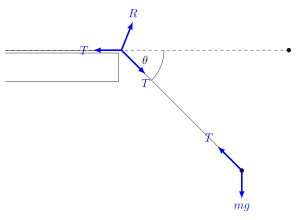
One end of a light inextrnsible string of length \(l\) is fixed to a point on the upper surface of a thin, smooth, horizontal table-top, at a distance \((l-a)\) from one edge of the table-top. A particle of mass \(m\) is fixed to the other end of the string, and held a distance \(a\) away from this edge of the table-top, so that the string is horizontal and taut. The particle is then released. Find the tension in the string after the string has rotated through an angle \(\theta,\) and show that the largest magnitude of the force on the edge of the table top is \(8mg/\sqrt{3}.\)
Solution
Rating Information
Difficulty Rating: 1600.0
Difficulty Comparisons: 0
Banger Rating: 1473.5
Banger Comparisons: 2
Show LaTeX source
Problem source
One end of a light inextrnsible string of length $l$ is fixed to a point on the upper surface of a thin, smooth, horizontal table-top, at a distance $(l-a)$ from one edge of the table-top. A particle of mass $m$ is fixed to the other end of the string, and held a distance $a$ away from this edge of the table-top, so that the string is horizontal and taut. The particle is then released. Find the tension in the string after the string has rotated through an angle $\theta,$ and show that the largest magnitude of the force on the edge of the table top is $8mg/\sqrt{3}.$Solution source
\begin{center}
    \begin{tikzpicture}[scale=2]
        \draw (0,5) -- (2,5) -- (2,4.5) -- (0,4.5);

        \coordinate (P) at ({2.05+3*cos(45)}, {5.05-3*sin(45)});
        \coordinate (E) at (2.05, 5.05);
        \coordinate (S) at (5,5.05);

        \draw[dashed] (0,5.05) -- (S);
        \draw (0,5.05) -- (E) -- (P);

        \pic [draw, angle radius=1.5cm, "$\theta$"] {angle = P--E--S};

        \filldraw (P) circle (1pt);
        \filldraw (S) circle (1pt);

        \draw[-latex, blue, ultra thick] (P) -- ++(0, -0.5) node[below] {$mg$};
        \draw[-latex, blue, ultra thick] (P) -- ($(P)!0.2!(E)$) node[above left] {$T$};
        \draw[-latex, blue, ultra thick] (E) -- ($(P)!0.8!(E)$) node[below] {$T$};
        \draw[-latex, blue, ultra thick] (E) -- ++(-0.5,0) node[left] {$T$};
        \draw[-latex, blue, ultra thick] (E) -- ++(0.2,0.5) node[above] {$R$};

    \end{tikzpicture}
\end{center}

\begin{align*}
\text{N2}(\nwarrow): && T - mg \sin \theta &= m \left ( \frac{v^2}{r}\right) \\
&&&= \frac{m v^2}{a} \\
\text{COE}:&& \underbrace{0}_{\text{assume initial GPE level is }0} &= \frac12 m v^2 - mga\sin \theta \\
\Rightarrow && v^2 &= 2ag \sin \theta \\
\Rightarrow && T &= \frac{m}{a} \cdot 2 ag \sin \theta + mg \sin \theta \\
&&&= 3mg \sin\theta
\end{align*}

Considering the force on the edge of the table will be:

\begin{align*}
&& \mathbf{R} &= \binom{-T}{0} + \binom{T \cos \theta}{-T \sin \theta} \\
&&&= \binom{T(1-\cos \theta)}{-T \sin \theta} \\
&&&= 3mg \sin \theta \binom{1-\cos \theta}{-\sin \theta} \\
\Rightarrow && |\mathbf{R}| &= 3mg \sin \theta \sqrt{(1-\cos \theta)^2 + \sin ^2 \theta} \\
&&&= 3mg \sin \theta \sqrt{2 - 2 \cos \theta} \\
&&&= 3mg \sin \theta\sqrt{4 \sin^2 \tfrac{\theta} {2}} \\
&&&= 6mg \sin \theta |\sin  \tfrac{\theta} {2} | \\
s = \sin \tfrac \theta2:&&&= 12mg s^2 \sqrt{1-s^2}
\end{align*}

We can maximise $V = x\sqrt{1-x}$ by differentiating:
\begin{align*}
&& \frac{\d V}{\d x} &= \sqrt{1-x} - \frac{x}{2\sqrt{1-x}} \\
&&&= \sqrt{1-x} \left ( 1 - \frac{x}{2-2x}\right) \\
&&&= \sqrt{1-x} \frac{2-3x}{2-2x} \\
\Rightarrow && x &= \frac23
\end{align*}

Therefore the maximum for will be:

\begin{align*}
|\mathbf{R}| &= 12 mg \frac 23 \sqrt{\frac13} \\
&= 8mg/\sqrt{3}
\end{align*}

as required.