1997 Paper 1 Q10
Year: 1997
Paper: 1
Question Number: 10
Course: UFM Mechanics
Section: Circular Motion 2
Difficulty: 1516.0
Banger: 1484.0
circular motion
vertical
conical pendulum
smooth ring
string tension
trigonometric identity
resolving forces
approximation
Problem
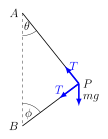
The point \(A\) is vertically above
the point \(B\). A light inextensible
string, with a smooth ring \(P\)
of mass \(m\) threaded onto it, has its ends
attached at \(A\) and \(B\). The plane \(APB\) rotates
about \(AB\) with constant angular velocity \(\omega\)
so that \(P\) describes a horizontal circle of radius \(r\)
and the string is taut. The angle \(BAP\) has value
\(\theta\) and the angle \(ABP\) has value \(\phi\).
Show that
\[\tan\frac{\phi-\theta}{2}=\frac{g}{r\omega^{2}}.\]
Find the tension in the string
in terms of \(m\), \(g\), \(r\), \(\omega\)
and \(\sin\frac{1}{2}(\theta+\phi)\).
Deduce from your results that if \(r\omega^2\) is small compared with \(g\), then the tension is approximately \(\frac{mg}{2}\)
Solution
None
\begin{multicols}{2}
 \columnbreak
\begin{align*}
N2(\uparrow): && T \cos \theta - T \cos \phi - mg &= 0 \\
N2(\rightarrow): && T \sin \theta + T \sin \phi &= m r \omega^2
\\
\\
&& T \cos \theta - T \cos \phi &= mg \tag{\(*\)}\\
&& T \sin \theta + T \sin \phi &= m r \omega^2 \tag{{\(**\)}}
\end{align*}
\end{multicols}
Dividing \((*)\) by \((**)\) we obtain:
\begin{align*}
\frac{g}{r\omega^2} &= \frac{\cos \theta - \cos \phi}{\sin \theta + \sin \phi} \\
&= \frac{2 \sin \left ( \frac{\theta + \phi}2 \right )\sin \left (\frac{\phi - \theta}2 \right )}{2 \sin \left ( \frac{\theta + \phi}2 \right )\cos \left (\frac{\phi - \theta}2 \right )} \\
&= \tan \left ( \frac{\phi - \theta}2 \right )
\end{align*}
as required.
Squaring and adding \((*)\) and \((**)\) we obtain:
\begin{align*}
&& m^2(g^2 + r^2 \omega^4) &= T^2(2 + \sin \theta \sin \phi - \cos \theta \cos \phi) \\
&& &= T^2(2 - 2\cos (\theta + \phi)) \\
&& &= T^2(2 - 2(1 - 2 \sin^2 \left ( \frac{\theta + \phi}2 \right ) )) \\
&& &= T^2(4 \sin^2 \left ( \frac{\theta + \phi}2 \right )) \\
\Rightarrow && T &= \frac{m\sqrt{g^2 + r^2 \omega^4}}{2 \sin \left ( \frac{\theta + \phi}2 \right )} \\
\Rightarrow && T &= \frac{mg\sqrt{1 + \frac{r^2 \omega^4}{g^2}}}{2 \sin \left ( \frac{\theta + \phi}2 \right )}
\end{align*}
If \(r \omega^2 \ll g\) then \(\tan \l \frac{\phi - \theta}2 \r\) is very large, so \(\phi - \theta \approx \pi\) and so \(\phi + \theta \approx \pi\). We can then say that
\[ T \approx \frac{mg}{2}\]
\columnbreak
\begin{align*}
N2(\uparrow): && T \cos \theta - T \cos \phi - mg &= 0 \\
N2(\rightarrow): && T \sin \theta + T \sin \phi &= m r \omega^2
\\
\\
&& T \cos \theta - T \cos \phi &= mg \tag{\(*\)}\\
&& T \sin \theta + T \sin \phi &= m r \omega^2 \tag{{\(**\)}}
\end{align*}
\end{multicols}
Dividing \((*)\) by \((**)\) we obtain:
\begin{align*}
\frac{g}{r\omega^2} &= \frac{\cos \theta - \cos \phi}{\sin \theta + \sin \phi} \\
&= \frac{2 \sin \left ( \frac{\theta + \phi}2 \right )\sin \left (\frac{\phi - \theta}2 \right )}{2 \sin \left ( \frac{\theta + \phi}2 \right )\cos \left (\frac{\phi - \theta}2 \right )} \\
&= \tan \left ( \frac{\phi - \theta}2 \right )
\end{align*}
as required.
Squaring and adding \((*)\) and \((**)\) we obtain:
\begin{align*}
&& m^2(g^2 + r^2 \omega^4) &= T^2(2 + \sin \theta \sin \phi - \cos \theta \cos \phi) \\
&& &= T^2(2 - 2\cos (\theta + \phi)) \\
&& &= T^2(2 - 2(1 - 2 \sin^2 \left ( \frac{\theta + \phi}2 \right ) )) \\
&& &= T^2(4 \sin^2 \left ( \frac{\theta + \phi}2 \right )) \\
\Rightarrow && T &= \frac{m\sqrt{g^2 + r^2 \omega^4}}{2 \sin \left ( \frac{\theta + \phi}2 \right )} \\
\Rightarrow && T &= \frac{mg\sqrt{1 + \frac{r^2 \omega^4}{g^2}}}{2 \sin \left ( \frac{\theta + \phi}2 \right )}
\end{align*}
If \(r \omega^2 \ll g\) then \(\tan \l \frac{\phi - \theta}2 \r\) is very large, so \(\phi - \theta \approx \pi\) and so \(\phi + \theta \approx \pi\). We can then say that
\[ T \approx \frac{mg}{2}\]
Rating Information
Difficulty Rating: 1516.0
Difficulty Comparisons: 1
Banger Rating: 1484.0
Banger Comparisons: 1
Show LaTeX source
Problem source
The point $A$ is vertically above
the point $B$. A light inextensible
string, with a smooth ring $P$
of mass $m$ threaded onto it, has its ends
attached at $A$ and $B$. The plane $APB$ rotates
about $AB$ with constant angular velocity $\omega$
so that $P$ describes a horizontal circle of radius $r$
and the string is taut. The angle $BAP$ has value
$\theta$ and the angle $ABP$ has value $\phi$.
Show that
\[\tan\frac{\phi-\theta}{2}=\frac{g}{r\omega^{2}}.\]
Find the tension in the string
in terms of $m$, $g$, $r$, $\omega$
and $\sin\frac{1}{2}(\theta+\phi)$.
Deduce from your results that if $r\omega^2$ is small compared with $g$, then the tension is approximately $\frac{mg}{2}$
Solution source
None
\begin{multicols}{2}
\begin{center}

\begin{tikzpicture}[scale=1]
    % Define points
    \coordinate (A) at (0,4);
    \coordinate (B) at (0,0);
    % \coordinate (T) at (3,3);
    \coordinate (P) at (2,1.5);

    % Draw lines
    \draw[thick] (A) -- (P);
    \draw[thick] (B) -- (P);
    \draw[dashed] (A) -- (B);
    % \draw[thick] (T) -- (P);

    % Add points labels
    \node[left] at (A) {$A$};
    \node[left] at (B) {$B$};
    % \node[right] at (T) {$T$};
    \node[right] at (P) {$P$};

    % Add angle θ at B
    \pic [draw, angle radius=0.8cm, "$\phi$"] {angle = P--B--A};

    % Add angle φ at T
    \pic [draw, angle radius=0.8cm, "$\theta$"] {angle = B--A--P};

    % Add weight label
    \node[right] at ($(P)+(0,-0.5)$) {$mg$};

    % Add an arrow for weight if needed
    \draw[-latex, blue, ultra thick] (P) -- ++(0,-0.8) node[right] {};
    \draw[-latex, blue, ultra thick] (P) -- ($(P)!0.25!(A)$) node[right] {$T$};
    \draw[-latex, blue, ultra thick] (P) -- ($(P)!0.35!(B)$) node [above] {$T$};
    % \draw[-latex, thick] (P) -- ({P+(A-P)/2}) node[right] {};
\end{tikzpicture}
\end{center}
\columnbreak
\begin{align*}
N2(\uparrow): && T \cos \theta - T \cos \phi - mg &= 0 \\
N2(\rightarrow): &&  T \sin \theta + T \sin \phi &= m r \omega^2
\\
\\
&&  T \cos \theta - T \cos \phi &= mg \tag{$*$}\\
&&  T \sin \theta + T \sin \phi &= m r \omega^2 \tag{{$**$}}
\end{align*}
\end{multicols}

Dividing $(*)$ by $(**)$ we obtain:

\begin{align*}
    \frac{g}{r\omega^2} &= \frac{\cos \theta - \cos \phi}{\sin \theta + \sin \phi} \\
    &= \frac{2 \sin \left ( \frac{\theta + \phi}2 \right )\sin \left (\frac{\phi - \theta}2 \right )}{2 \sin \left ( \frac{\theta + \phi}2 \right )\cos \left (\frac{\phi - \theta}2 \right )} \\
    &= \tan \left ( \frac{\phi - \theta}2 \right )
\end{align*}

as required.

Squaring and adding $(*)$ and $(**)$ we obtain:

\begin{align*}
    && m^2(g^2 + r^2 \omega^4) &= T^2(2 + \sin \theta \sin \phi - \cos \theta \cos \phi) \\
    && &= T^2(2 - 2\cos (\theta + \phi)) \\
    && &= T^2(2 - 2(1 - 2 \sin^2 \left ( \frac{\theta + \phi}2 \right ) )) \\
    && &= T^2(4 \sin^2 \left ( \frac{\theta + \phi}2 \right )) \\
    \Rightarrow && T &= \frac{m\sqrt{g^2 + r^2 \omega^4}}{2 \sin \left ( \frac{\theta + \phi}2 \right )} \\
    \Rightarrow && T &= \frac{mg\sqrt{1 + \frac{r^2 \omega^4}{g^2}}}{2 \sin \left ( \frac{\theta + \phi}2 \right )}
\end{align*}

If $r \omega^2 \ll g$ then $\tan \l \frac{\phi - \theta}2 \r$ is very large, so $\phi - \theta \approx \pi$ and so $\phi + \theta \approx \pi$. We can then say that

\[ T \approx \frac{mg}{2}\]