Momentum and Collisions 2
- Two particles \(A\) and \(B\), of masses \(m\) and \(km\) respectively, lie at rest on a smooth horizontal surface. The coefficient of restitution between the particles is \(e\), where \(0 < e < 1\). Particle \(A\) is then projected directly towards particle \(B\) with speed \(u\). Let \(v_1\) and \(v_2\) be the velocities of particles \(A\) and \(B\), respectively, after the collision, in the direction of the initial velocity of \(A\). Show that \(v_1 = \alpha u\) and \(v_2 = \beta u\), where \(\alpha = \dfrac{1 - ke}{k+1}\) and \(\beta = \dfrac{1+e}{k+1}\). Particle \(B\) strikes a vertical wall which is perpendicular to its direction of motion and a distance \(D\) from the point of collision with \(A\), and rebounds. The coefficient of restitution between particle \(B\) and the wall is also \(e\). Show that, if \(A\) and \(B\) collide for a second time at a point \(\frac{1}{2}D\) from the wall, then \[ k = \frac{1+e-e^2}{e(2e+1)}\,. \]
- Three particles \(A\), \(B\) and \(C\), of masses \(m\), \(km\) and \(k^2m\) respectively, lie at rest on a smooth horizontal surface in a straight line, with \(B\) between \(A\) and \(C\). A vertical wall is perpendicular to this line and lies on the side of \(C\) away from \(A\) and \(B\). The distance between \(B\) and \(C\) is equal to \(d\) and the distance between \(C\) and the wall is equal to \(3d\). The coefficient of restitution between each pair of particles, and between particle \(C\) and the wall, is \(e\), where \(0 < e < 1\). Particle \(A\) is then projected directly towards particle \(B\) with speed \(u\). Show that, if all three particles collide simultaneously at a point \(\frac{3}{2}d\) from the wall, then \(e = \frac{1}{2}\).
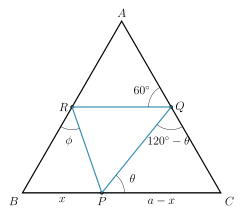
An equilateral triangle \(ABC\) has sides of length \(a\). The points \(P\), \(Q\) and \(R\) lie on the sides \(BC\), \(CA\) and \(AB\), respectively, such that the length \(BP\) is \(x\) and \(QR\) is parallel to \(CB\). Show that \[ (\sqrt{3}\cot\phi + 1)(\sqrt{3}\cot\theta + 1)x = 4(a - x), \] where \(\theta = \angle CPQ\) and \(\phi = \angle BRP\). A horizontal triangular frame with sides of length \(a\) and vertices \(A\), \(B\) and \(C\) is fixed on a smooth horizontal table. A small ball is placed at a point \(P\) inside the frame, in contact with side \(BC\) at a distance \(x\) from \(B\). It is struck so that it moves round the triangle \(PQR\) described above, bouncing off the frame at \(Q\) and then \(R\) before returning to point \(P\). The frame is smooth and the coefficient of restitution between the ball and the frame is \(e\). Show that \[ x = \frac{ae}{1 + e}. \] Show further that if the ball continues to move round \(PQR\) after returning to \(P\), then \(e = 1\).
Show Solution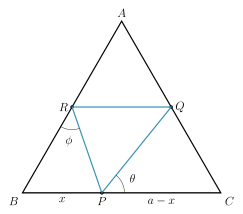
Two identical smooth spheres \(P\) and \(Q\) can move on a smooth horizontal table. Initially, \(P\) moves with speed \(u\) and \(Q\) is at rest. Then \(P\) collides with \(Q\). The direction of travel of \(P\) before the collision makes an acute angle \(\alpha\) with the line joining the centres of \(P\) and \(Q\) at the moment of the collision. The coefficient of restitution between \(P\) and \(Q\) is \(e\) where \(e < 1\). As a result of the collision, \(P\) has speed \(v\) and \(Q\) has speed \(w\), and \(P\) is deflected through an angle \(\theta\).
- Show that $$u \sin \alpha = v \sin(\alpha + \theta)$$ and find an expression for \(w\) in terms of \(v\), \(\theta\) and \(\alpha\).
- Show further that $$\sin \theta = \cos(\theta + \alpha) \sin \alpha + e \sin(\theta + \alpha) \cos \alpha$$ and find an expression for \(\tan \theta\) in terms of \(\tan \alpha\) and \(e\). Find, in terms of \(e\), the maximum value of \(\tan \theta\) as \(\alpha\) varies.
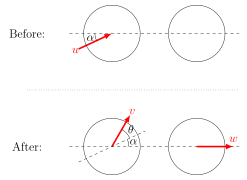
- Since the impulse is along the line of centres, the velocities are as show in the diagram. Additionally, vertical velocity is unchanged, so: \(v \sin (\theta + \alpha) = u \sin \alpha\) \begin{align*} \text{COM}(\rightarrow): && u \cos\alpha &= v \cos(\alpha + \theta) + w \\ \Rightarrow && w &= u \cos \alpha - v \cos (\alpha + \theta) \end{align*}
- Since the approach speed (horizontally) is \(u \cos \alpha\) the speed of separation is \(e u \cos \alpha\), in particular \(w - v \cos(\theta + \alpha) = e u \cos \alpha\) or \(w = v \cos (\theta + \alpha) + e u \cos \alpha\). \begin{align*} && w &= w \\ && v \cos (\theta + \alpha) + e u \cos \alpha &= u \cos \alpha - v \cos (\alpha + \theta) \\ \Rightarrow && \frac{u \sin \alpha}{\sin (\alpha + \theta)} \cos (\theta + \alpha) + e u \cos \alpha &= u \cos \alpha - \frac{u \sin \alpha}{\sin (\alpha + \theta)} \cos (\alpha + \theta) \\ \Rightarrow && \sin \alpha \cos(\theta + \alpha) + e \sin (\alpha+\theta)\cos \alpha &= \sin(\alpha+\theta) \cos \alpha - \cos(\alpha+\theta)\sin \alpha \\ &&&= \sin ((\alpha+\theta)-\alpha) \\ &&&= \sin \theta \end{align*} as required. \begin{align*} && \sin \theta &= \cos(\theta+ \alpha)\sin \alpha + e \sin (\theta + \alpha) \cos \alpha \\ &&&= \cos \theta \cos \alpha \sin \alpha - \sin \theta \sin^2 \alpha + e \sin \theta \cos ^2 \alpha + e \cos \theta \sin \alpha \cos \alpha \\ \Rightarrow && \tan \theta \sec^2 \alpha &= \tan \alpha - \tan \theta \tan^2 \alpha + e \tan \theta + e \tan \alpha \\ \Rightarrow && \tan \theta (1 + \tan^2 \alpha+\tan^2 \alpha-e) &= \tan \alpha + e \tan \alpha \\ \Rightarrow && \tan \theta &= \frac{(1+e)\tan \alpha}{1-e + 2\tan^2 \alpha} \end{align*} We seek to maximise \(y = \frac{x}{c+2x^2}\), \begin{align*} && \frac{\d y}{\d x} &= \frac{c+2x^2-4x^2}{(c+2x^2)^2} \\ &&&= \frac{c-2x^2}{(c+2x^2)^2} \end{align*} Therefore the maximum will occur at \(x = \sqrt{c/2}\), ie \(\tan \alpha = \sqrt{(1-e)/2}\) and theta will be \(\displaystyle \frac{(1+e)\sqrt{(1-e)/2}}{2(1-e)} =\frac{1}{2\sqrt{2}} \frac{1+e}{\sqrt{1-e}}\)
Two particles of masses \(m\) and \(M\), with \(M>m\), lie in a smooth circular groove on a horizontal plane. The coefficient of restitution between the particles is \(e\). The particles are initially projected round the groove with the same speed \(u\) but in opposite directions. Find the speeds of the particles after they collide for the first time and show that they will both change direction if \(2em> M-m\). After a further \(2n\) collisions, the speed of the particle of mass \(m\) is \(v\) and the speed of the particle of mass \(M\) is \(V\). Given that at each collision both particles change their directions of motion, explain why \[ mv-MV = u(M-m), \] and find \(v\) and \(V\) in terms of \(m\), \(M\), \(e\), \(u\) and \(n\).
Show Solution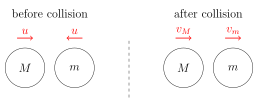
\(\,\)
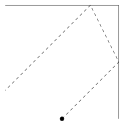
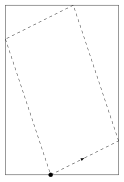
The lengths of the sides of a rectangular billiards table \(ABCD\) are given by \(AB = DC = a\) and \(AD=BC = 2b\). There are small pockets at the midpoints \(M\) and \(N\) of the sides \(AD\) and \(BC\), respectively. The sides of the table may be taken as smooth vertical walls. A small ball is projected along the table from the corner \(A\). It strikes the side \(BC\) at \(X\), then the side \(DC\) at \(Y\) and then goes directly into the pocket at \(M\). The angles \(BAX\), \(CXY\) and \(DY\!M\) are \(\alpha\), \(\beta\) and \(\gamma\) respectively. On each stage of its path, the ball moves with constant speed in a straight line, the speeds being \(u\), \(v\) and \(w\) respectively. The coefficient of restitution between the ball and the sides is \(e\), where \(e>0\).
- Show that \(\tan\alpha \tan \beta = e\) and find \(\gamma\) in terms of \(\alpha\).
- Show that \(\displaystyle \tan\alpha = \frac {(1+2e)b} {(1+e)a}\) and deduce that the shot is possible whatever the value of \(e\).
- Find an expression in terms of \(e\) for the fraction of the kinetic energy of the ball that is lost during the motion.
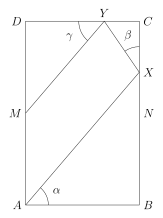
- The initial velocity is \(u = \binom{u \cos\alpha}{u \sin \alpha}\), therefore \(v = \binom{v_x}{u \sin \alpha}\). Newton's experimental law tells us \(v_x = -e u_x = -eu \cos\alpha\), therefore \(v = \binom{-eu \cos \alpha}{u \sin \alpha} = \binom{-v \sin \beta}{v\cos \beta} \Rightarrow -\tan \beta = -e \cot \alpha \Rightarrow \tan \alpha \tan \beta = e\). There is nothing special about the result here, and so it must also be the case that \(\tan \beta \tan \gamma = e \Rightarrow \tan \gamma = \tan \alpha\)
- \(\tan \alpha = \frac{XB}{BA}\) so the point \(X\) is at \((a, \tan \alpha a)\). The point \(Y\) satisfies \(\tan \beta = \frac{CY}{CX} = \frac{CY}{2b - \tan \alpha a}\) so the point \(Y\) is \((a-(2b - a \tan \alpha)\tan \beta,2b) = (a - 2b\tan \beta + ea, 2b) = ((1+e)a-2b\tan \beta, 2b)\). Finally, the point \(M\) is the midpoint, so \(\tan \gamma = \frac{DM}{DY}\) so \(M\) is the point \((0, 2b - ((1+e)a-2b\tan \beta)\tan \gamma) = (0, 2b - (1+e)a \tan \gamma - 2b e) = (0, (2b(1-e) - (1+e)a \tan \gamma)\), but \(M\) is the point \((0, b)\), ie \begin{align*} && b &= 2b(1-e) - (1+e)a \tan \gamma \\ \Rightarrow && b+2eb &= (1+e)a \tan \gamma \\ \Rightarrow && \tan \gamma &= \frac{(1+2e)b}{(1+e)a} \\ \Rightarrow && \tan \alpha &= \frac{(1+2e)b}{(1+e)a} \end{align*} Since \( \frac{(1+2e)b}{(1+e)a} = \frac{b}{a} + \frac{e}{1+e}b\) which is clearly an increasing function of \(e\) on \([0,1]\), so \(\tan \alpha \in \left [\frac{b}{a}, \frac{3b}{2a} \right]\) which are all all angles which place \(X\) in sensible places, therefore we can always hit the middle pocket. (Except \(e = 0\), where we would put the ball in \(N\), but we are given \(e > 0\)).
- After the first collision the velocity is \(\binom{-eu \cos \alpha}{u \sin \alpha}\) after the second collision the velocity is \(\binom{-eu \cos \alpha}{-eu \sin \alpha}\). Initial kinetic energy is therefore \(\frac12 m u^2\) and final kinetic energy is \(\frac12 m e^2u^2\) therefore the fraction lost is \(\frac{\frac12 m u^2 - \frac12 m e^2u^2}{\frac12 m u^2} = 1-e^2\)
\(\,\)
A particle moves on a smooth triangular horizontal surface \(AOB\) with angle \(AOB = 30^\circ\). The surface is bounded by two vertical walls \(OA\) and \(OB\) and the coefficient of restitution between the particle and the walls is \(e\), where \(e < 1\). The particle, which is initially at point \(P\) on the surface and moving with velocity \(u_1\), strikes the wall \(OA\) at \(M_1\), with angle \(PM_1A = \theta\), and rebounds, with velocity \(v_1\), to strike the wall \(OB\) at \(N_1\), with angle \(M_1N_1B = \theta\). Find \(e\) and \(\displaystyle {v_1 \over u_1}\) in terms of \(\theta\). The motion continues, with the particle striking side \(OA\) at \(M_2\), \(M_3\), \( \ldots \) and striking side \(OB\) at \(N_2\), \(N_3\), \(\ldots \). Show that, if \(\theta < 60^\circ\,\), the particle reaches \(O\) in a finite time.
Two small discs of masses \(m\) and \(\mu m\) lie on a smooth horizontal surface. The disc of mass \(\mu m\) is at rest, and the disc of mass \(m\) is projected towards it with velocity \(\mathbf{u}\). After the collision, the disc of mass \(\mu m\) moves in the direction given by unit vector \(\mathbf{n}\). The collision is perfectly elastic.
- Show that the speed of the disc of mass \(\mu m\) after the collision is \ \ $ \dfrac {2\mathbf{u} \cdot \mathbf{n}}{1+\mu}. $
- Given that the two discs have equal kinetic energy after the collision, find an expression for the cosine of the angle between \(\bf n\) and \(\bf u\) and show that \(3-\sqrt8\le \mu \le 3+\sqrt8\).
- In the direction of \(\mathbf{n}\), Conservation of momentum gives: \(m \mathbf{u} \cdot \mathbf{n} = m v_m + \mu m v_{\mu m}\) Newton's experimental law gives: \(\frac{\mathbf{u} \cdot \mathbf{n}}{v_{\mu m} - v_m} = 1\) Therefore \begin{align*} && \mathbf{u} \cdot \mathbf{n} &= v_m + \mu v_{\mu m} \\ && \mathbf{u} \cdot \mathbf{n} &= v_{\mu m} - v_m \\ \Rightarrow && 2 \mathbf{u} \cdot \mathbf{n} &= (1 + \mu)v_{\mu m} \\ \Rightarrow && v_{\mu m} &= \frac{2 \mathbf{u} \cdot \mathbf{n}}{1 + \mu} \\ \end{align*}
- Kinetic energy after the collision for the second mass is: \(\frac12 m \mu \frac{4 (\mathbf{u} \cdot \mathbf{n})^2 }{(1 + \mu)^2}\) For the first mass the final speed (in the direction \(\mathbf{n}\) is: \(\mathbf{u} \cdot \mathbf{n}- \frac{2 \mathbf{u} \cdot \mathbf{n}}{1 + \mu} = \frac{(\mu - 1) \mathbf{u} \cdot \mathbf{n}}{1 + \mu}\) It's velocity perpendicular to \(\mathbf{n}\) is unchanged, which is \(\mathbf{u} - (\mathbf{u} \cdot \mathbf{n}) \mathbf{n}\), so it's speed squared is \(\mathbf{u}\cdot \mathbf{u} - (\mathbf{u} \cdot \mathbf{n})^2\) Therefore the total kinetic energy is: \(\frac12 m \frac{(\mu - 1)^2 (\mathbf{u} \cdot \mathbf{n})^2}{(1 + \mu)} + \frac12 m (\mathbf{u}\cdot \mathbf{u} - (\mathbf{u} \cdot \mathbf{n})^2)\) Therefore since the kinetic energies are equal we have: \begin{align*} && \frac12 m \frac{(\mu - 1)^2 (\mathbf{u} \cdot \mathbf{n})^2}{(1 + \mu)} + \frac12 m (\mathbf{u}\cdot \mathbf{u} - (\mathbf{u} \cdot \mathbf{n})^2) &= \frac12 m \mu \frac{4 (\mathbf{u} \cdot \mathbf{n})^2 }{(1 + \mu)^2} \\ \Rightarrow && \frac{(\mu - 1)^2 (\mathbf{u} \cdot \mathbf{n})^2}{(1 + \mu)} + (\mathbf{u}\cdot \mathbf{u} - (\mathbf{u} \cdot \mathbf{n})^2) &= \mu \frac{4 (\mathbf{u} \cdot \mathbf{n})^2 }{(1 + \mu)^2} \\ \Rightarrow && (\mathbf{u} \cdot \mathbf{n})^2 \l 1 + \frac{4\mu}{(1+ \mu)^2} - \frac{(1-\mu)^2}{(1+ \mu)^2} \r &= (\mathbf{u} \cdot \mathbf{u}) \\ \Rightarrow && (\mathbf{u} \cdot \mathbf{n})^2 \l \frac{(1 + \mu)^2 + 4\mu - (1-\mu)^2}{(1+ \mu)^2} \r &= (\mathbf{u} \cdot \mathbf{u}) \\ \Rightarrow && (\mathbf{u} \cdot \mathbf{n})^2 \l \frac{8\mu}{(1+ \mu)^2} \r &= (\mathbf{u} \cdot \mathbf{u}) \\ \Rightarrow && \cos^2 \theta &=\frac{(1 + \mu)^2}{8\mu} \\ \end{align*} We need \begin{align*} && \frac{(1 + \mu)^2}{8\mu} & \leq 1 \\ \Rightarrow && 1 +2 \mu + \mu^2 \leq 8 \mu \\ \Rightarrow && 1 - 6 \mu + \mu^2 \leq 0 \end{align*} This quadratic has roots at \(3 \pm \sqrt{8}\) and therefore our quadratic inequality is satisfied if: \(\boxed{3 - \sqrt{8} \leq \mu \leq 3 + \sqrt{8}}\)
Two identical spherical balls, moving on a horizontal, smooth table, collide in such a way that both momentum and kinetic energy are conserved. Let \({\bf v}_1\) and \({\bf v}_2\) be the velocities of the balls before the collision and let \({\bf v}'_1\) and \({\bf v}'_2\) be the velocities of the balls after the collision, where \({\bf v}_1\), \({\bf v}_2\), \({\bf v}'_1\) and \({\bf v}'_2\) are two-dimensional vectors. Write down the equations for conservation of momentum and kinetic energy in terms of these vectors. Hence show that their relative speed is also conserved. Show that, if one ball is initially at rest but after the collision both balls are moving, their final velocities are perpendicular. Now suppose that one ball is initially at rest, and the second is moving with speed \(V\). After a collision in which they lose a proportion \(k\) of their original kinetic energy (\(0\le k\le 1\)), the direction of motion of the second ball has changed by an angle \(\theta\). Find a quadratic equation satisfied by the final speed of the second ball, with coefficients depending on \(k\), \(V\) and \(\theta\). Hence show that \(k\le \frac{1}{2}\).
Show SolutionA particle rests at a point \(A\) on a horizontal table and is joined to a point \(O\) on the table by a taut inextensible string of length \(c\). The particle is projected vertically upwards at a speed \(64\surd(6gc)\). It next strikes the table at a point \(B\) and rebounds. The coefficient of restitution for any impact between the particle and the table is \({1\over 2}\). After rebounding at \(B\), the particle will rebound alternately at \(A\) and \(B\) until the string becomes slack. Show that when the string becomes slack the particle is at height \(c/2\) above the table. Determine whether the first rebound between \(A\) and \(B\) is nearer to \(A\) or to \(B\).
Show SolutionA smooth particle \(P_{1}\) is projected from a point \(O\) on the horizontal floor of a room with has a horizontal ceiling at a height \(h\) above the floor. The speed of projection is \(\sqrt{8gh}\) and the direction of projection makes an acute angle \(\alpha\) with the horizontal. The particle strikes the ceiling and rebounds, the impact being perfectly elastic. Show that for this to happen \(\alpha\) must be at least \(\frac{1}{6}\pi\) and that the range on the floor is then \[ 8h\cos\alpha\left(2\sin\alpha-\sqrt{4\sin^{2}\alpha-1}\right). \] Another particle \(P_{2}\) is projected from \(O\) with the same velocity as \(P_{1}\) but its impact with the ceiling is perfectly inelastic. Find the difference \(D\) between the ranges of \(P_{1}\) and \(P_{2}\) on the floor and show that, as \(\alpha\) varies, \(D\) has a maximum value when \(\alpha=\frac{1}{4}\pi.\)
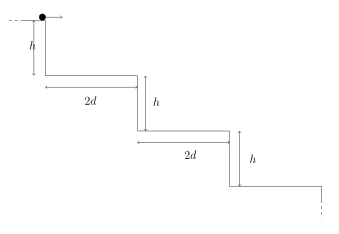
A straight staircase consists of \(N\) smooth horizontal stairs each of height \(h\). A particle slides over the top stair at speed \(U\), with velocity perpendicular to the edge of the stair, and then falls down the staircase, bouncing once on every stair. The coefficient of restitution between the particle and each stair is \(e\), where \(e<1\). Show that the horizontal distance \(d_{n}\) travelled between the \(n\)th and \((n+1)\)th bounces is given by \[ d_{n}=U\left(\frac{2h}{g}\right)^{\frac{1}{2}}\left(e\alpha_{n}+\alpha_{n+1}\right), \] where \({\displaystyle \alpha_{n}=\left(\frac{1-e^{2n}}{1-e^{2}}\right)^{\frac{1}{2}}}\). If \(N\) is very large, show that \(U\) must satisfy \[ U=\left(\frac{L^{2}g}{2h}\right)^{\frac{1}{2}}\left(\frac{1-e}{1+e}\right)^{\frac{1}{2}}, \] where \(L\) is the horizontal distance between the edges of successive stairs.
A smooth uniform sphere, with centre \(A\), radius \(2a\) and mass \(3m,\) is suspended from a fixed point \(O\) by means of a light inextensible string, of length \(3a,\) attached to its surface at \(C\). A second smooth unifom sphere, with centre \(B,\) radius \(3a\) and mass \(25m,\) is held with its surface touching \(O\) and with \(OB\) horizontal. The second sphere is released from rest, falls and strikes the first sphere. The coefficient of restitution between the spheres is \(3/4.\) Find the speed \(U\) of \(A\) immediately after the impact in terms of the speed \(V\) of \(B\) immediately before impact. The same system is now set up with a light rigid rod replacing the string and rigidly attached to the sphere so that \(OCA\) is a straight line. The rod can turn freely about \(O\). The sphere with centre \(B\) is dropped as before. Show that the speed of \(A\) immediately after impact is \(125U/127.\)
A smooth billiard ball moving on a smooth horizontal table strikes another identical ball which is at rest. The coefficient of restitution between the balls is \(e(<1)\). Show that after the collision the angle between the velocities of the balls is less than \(\frac{1}{2}\pi.\) Show also that the maximum angle of deflection of the first ball is \[ \sin^{-1}\left(\frac{1+e}{3-e}\right). \]
Show Solution
\(\,\) \vspace{-1cm}
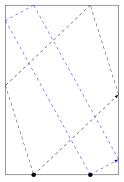
Ice snooker is played on a rectangular horizontal table, of length \(L\) and width \(B\), on which a small disc (the puck) slides without friction. The table is bounded by smooth vertical walls (the cushions) and the coefficient of restitution between the puck and any cushion is \(e\). If the puck is hit so that it bounces off two adjacent cushions, show that its final path (after two bounces) is parallel to its original path. The puck rests against the cushion at a point which divides the side of length \(L\) in the ratio \(z:1\). Show that it is possible, whatever \(z\), to hit the puck so that it bounces off the three other cushions in succession clockwise and returns to the spot at which it started. By considering these paths as \(z\) varies, explain briefly why there are two different ways in which, starting at any point away from the cushions, it is possible to perform a shot in which the puck bounces off all four cushions in succession clockwise and returns to its starting point.
Show Solution