2008 Paper 2 Q10
Year: 2008
Paper: 2
Question Number: 10
Course: UFM Mechanics
Section: Momentum and Collisions 2
Problem
- Show that \(\tan\alpha \tan \beta = e\) and find \(\gamma\) in terms of \(\alpha\).
- Show that \(\displaystyle \tan\alpha = \frac {(1+2e)b} {(1+e)a}\) and deduce that the shot is possible whatever the value of \(e\).
- Find an expression in terms of \(e\) for the fraction of the kinetic energy of the ball that is lost during the motion.
Solution
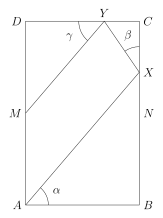
- The initial velocity is \(u = \binom{u \cos\alpha}{u \sin \alpha}\), therefore \(v = \binom{v_x}{u \sin \alpha}\). Newton's experimental law tells us \(v_x = -e u_x = -eu \cos\alpha\), therefore \(v = \binom{-eu \cos \alpha}{u \sin \alpha} = \binom{-v \sin \beta}{v\cos \beta} \Rightarrow -\tan \beta = -e \cot \alpha \Rightarrow \tan \alpha \tan \beta = e\). There is nothing special about the result here, and so it must also be the case that \(\tan \beta \tan \gamma = e \Rightarrow \tan \gamma = \tan \alpha\)
- \(\tan \alpha = \frac{XB}{BA}\) so the point \(X\) is at \((a, \tan \alpha a)\). The point \(Y\) satisfies \(\tan \beta = \frac{CY}{CX} = \frac{CY}{2b - \tan \alpha a}\) so the point \(Y\) is \((a-(2b - a \tan \alpha)\tan \beta,2b) = (a - 2b\tan \beta + ea, 2b) = ((1+e)a-2b\tan \beta, 2b)\). Finally, the point \(M\) is the midpoint, so \(\tan \gamma = \frac{DM}{DY}\) so \(M\) is the point \((0, 2b - ((1+e)a-2b\tan \beta)\tan \gamma) = (0, 2b - (1+e)a \tan \gamma - 2b e) = (0, (2b(1-e) - (1+e)a \tan \gamma)\), but \(M\) is the point \((0, b)\), ie \begin{align*} && b &= 2b(1-e) - (1+e)a \tan \gamma \\ \Rightarrow && b+2eb &= (1+e)a \tan \gamma \\ \Rightarrow && \tan \gamma &= \frac{(1+2e)b}{(1+e)a} \\ \Rightarrow && \tan \alpha &= \frac{(1+2e)b}{(1+e)a} \end{align*} Since \( \frac{(1+2e)b}{(1+e)a} = \frac{b}{a} + \frac{e}{1+e}b\) which is clearly an increasing function of \(e\) on \([0,1]\), so \(\tan \alpha \in \left [\frac{b}{a}, \frac{3b}{2a} \right]\) which are all all angles which place \(X\) in sensible places, therefore we can always hit the middle pocket. (Except \(e = 0\), where we would put the ball in \(N\), but we are given \(e > 0\)).
- After the first collision the velocity is \(\binom{-eu \cos \alpha}{u \sin \alpha}\) after the second collision the velocity is \(\binom{-eu \cos \alpha}{-eu \sin \alpha}\). Initial kinetic energy is therefore \(\frac12 m u^2\) and final kinetic energy is \(\frac12 m e^2u^2\) therefore the fraction lost is \(\frac{\frac12 m u^2 - \frac12 m e^2u^2}{\frac12 m u^2} = 1-e^2\)
Examiner's report
— 2008 STEP 2, Question 10There were around 850 candidates for this paper – a slight increase on the 800 of the past two years – and the scripts received covered the full range of marks (and beyond!). The questions on this paper in recent years have been designed to be a little more accessible to all top A-level students, and this has been reflected in the numbers of candidates making good attempts at more than just a couple of questions, in the numbers making decent stabs at the six questions required by the rubric, and in the total scores achieved by candidates. Most candidates made attempts at five or more questions, and most genuinely able mathematicians would have found the experience a positive one in some measure at least. With this greater emphasis on accessibility, it is more important than ever that candidates produce really strong, essentially-complete efforts to at least four questions. Around half marks are required in order to be competing for a grade 2, and around 70 for a grade 1. The range of abilities on show was still quite wide. Just over 100 candidates failed to score a total mark of at least 30, with a further 100 failing to reach a total of 40. At the other end of the scale, more than 70 candidates scored a mark in excess of 100, and there were several who produced completely (or nearly so) successful attempts at more than six questions; if more than six questions had been permitted to contribute towards their paper totals, they would have comfortably exceeded the maximum mark of 120. While on the issue of the "best-six question-scores count" rubric, almost a third of candidates produced efforts at more than six questions, and this is generally a policy not to be encouraged. In most such cases, the seventh, eighth, or even ninth, question-efforts were very low scoring and little more than a waste of time for the candidates concerned. Having said that, it was clear that, in many of these cases, these partial attempts represented an abandonment of a question after a brief start, with the candidates presumably having decided that they were unlikely to make much successful further progress on it, and this is a much better employment of resources. As in recent years, most candidates' contributing question-scores came exclusively from attempts at the pure maths questions in Section A. Attempts at the mechanics and statistics questions were very much more of a rarity, although more (and better) attempts were seen at these than in other recent papers.
Rating Information
Difficulty Rating: 1600.0
Difficulty Comparisons: 0
Banger Rating: 1540.1
Banger Comparisons: 5
Show LaTeX source
Problem source
The lengths of the sides of a rectangular billiards table $ABCD$ are given by  $AB = DC = a$ and $AD=BC = 2b$. There are small pockets at the midpoints $M$ and $N$ of the sides $AD$ and $BC$, respectively. The sides of the table may be taken as smooth vertical walls. A small ball is projected along the table from the corner $A$. It strikes the side $BC$ at $X$, then the side $DC$ at $Y$ and then goes directly into the pocket at $M$.
The angles $BAX$, $CXY$ and $DY\!M$ are $\alpha$, $\beta$ and $\gamma$ respectively. On each stage of its path, the ball moves with constant speed in a straight line, the speeds being $u$, $v$ and $w$ respectively.  The coefficient of restitution between the ball and the sides is $e$, where $e>0$.
\begin{questionparts}
\item Show that $\tan\alpha \tan \beta = e$ and find $\gamma$ in terms of $\alpha$.
\item Show that $\displaystyle \tan\alpha = \frac {(1+2e)b} {(1+e)a}$ and deduce that the shot is possible whatever the value of $e$.

\item Find an expression in terms of $e$ for the fraction of the kinetic energy of the ball that is lost during the motion.
\end{questionparts}
Solution source
\begin{center}
    \begin{tikzpicture}[scale=2]
        \def\a{2};
        \def\b{1.618};
        \def\e{.8};
        \def\ta{((1+2*\e)*\b/(1+\e)/\a)};
        \coordinate (A) at (0,0);
        \coordinate (B) at (\a,0);
        \coordinate (C) at (\a,{2*\b});
        \coordinate (D) at (0,{2*\b});
        \coordinate (M) at (0,{\b});
        \coordinate (N) at (\a,{\b});

        \coordinate (X) at ({\a},{\ta*\a});
        \coordinate (Y) at ({\b/\ta},{2*\b});

        \draw (A) -- (B) -- (C) -- (D) -- cycle;

        \node[left] at (A) {$A$};
        \node[right] at (B) {$B$};
        \node[right] at (C) {$C$};
        \node[left] at (D) {$D$};
        \node[left] at (M) {$M$};
        \node[right] at (N) {$N$};
        \node[right] at (X) {$X$};
        \node[above] at (Y) {$Y$};

        \draw (A) -- (X) -- (Y) -- (M);

        \pic [draw, angle radius=.8cm, angle eccentricity=1.5, "$\alpha$"] {angle = B--A--X};
        \pic [draw, angle radius=.9cm, angle eccentricity=1.5, "$\beta$"] {angle = C--X--Y};
        \pic [draw, angle radius=.9cm, angle eccentricity=1.5, "$\gamma$"] {angle = D--Y--M};

    \end{tikzpicture}
\end{center}

\begin{questionparts}
\item The initial velocity is $u = \binom{u \cos\alpha}{u \sin \alpha}$, therefore $v = \binom{v_x}{u \sin \alpha}$. Newton's experimental law tells us $v_x = -e u_x = -eu \cos\alpha$, therefore $v = \binom{-eu \cos \alpha}{u \sin \alpha} = \binom{-v \sin \beta}{v\cos \beta} \Rightarrow -\tan \beta = -e \cot \alpha \Rightarrow \tan \alpha \tan \beta = e$.

There is nothing special about the result here, and so it must also be the case that $\tan \beta \tan \gamma = e \Rightarrow \tan \gamma = \tan \alpha$

\item $\tan \alpha = \frac{XB}{BA}$ so the point $X$ is at $(a, \tan \alpha a)$.
The point $Y$ satisfies $\tan \beta = \frac{CY}{CX} = \frac{CY}{2b - \tan \alpha a}$ so the point $Y$ is $(a-(2b - a \tan \alpha)\tan \beta,2b) = (a - 2b\tan \beta + ea, 2b) = ((1+e)a-2b\tan \beta, 2b)$.
Finally, the point $M$ is the midpoint, so $\tan \gamma = \frac{DM}{DY}$ so $M$ is the point $(0, 2b - ((1+e)a-2b\tan \beta)\tan \gamma) = (0, 2b - (1+e)a \tan \gamma - 2b e) = (0, (2b(1-e) - (1+e)a \tan \gamma)$, but $M$ is the point $(0, b)$, ie

\begin{align*}
&& b &= 2b(1-e) - (1+e)a \tan \gamma \\
\Rightarrow && b+2eb &= (1+e)a \tan \gamma \\
\Rightarrow && \tan \gamma &= \frac{(1+2e)b}{(1+e)a} \\
\Rightarrow && \tan \alpha &= \frac{(1+2e)b}{(1+e)a}
\end{align*}

Since $ \frac{(1+2e)b}{(1+e)a} = \frac{b}{a} + \frac{e}{1+e}b$ which is clearly an increasing function of $e$ on $[0,1]$, so $\tan \alpha \in \left [\frac{b}{a}, \frac{3b}{2a} \right]$ which are all all angles which place $X$ in sensible places, therefore we can always hit the middle pocket. (Except $e = 0$, where we would put the ball in $N$, but we are given $e > 0$).

\item After the first collision the velocity is $\binom{-eu \cos \alpha}{u \sin \alpha}$ after the second collision the velocity is $\binom{-eu \cos \alpha}{-eu \sin \alpha}$. Initial kinetic energy is therefore $\frac12 m u^2$ and final kinetic energy is $\frac12 m e^2u^2$ therefore the fraction lost is $\frac{\frac12 m u^2 - \frac12 m e^2u^2}{\frac12 m u^2} = 1-e^2$

\end{questionparts}
Though much less popular than Q9, the attempts at this question followed a similar pattern, with most candidates coping pretty well with the routine opening demands – the use of the two main principles governing collisions questions: Conservation of Linear Momentum and Newton's Experimental Law of Restitution – but then falling down when a little more care and imagination were required in the parts that followed. With some careful application of ideas relating to similar triangles and a bit of inequalities work to follow, most candidates attempting these questions were just not up to the task. Few got as far as working on the initial and final kinetic energies; of these only a very small number noticed that there was a very quick way to go about it (see the SOLUTIONS). I don't recall seeing anyone successfully managing to get the right answer after having taken the longer route.