1987 Paper 1 Q12
Year: 1987
Paper: 1
Question Number: 12
Course: UFM Mechanics
Section: Momentum and Collisions 2
Difficulty: 1500.0
Banger: 1500.0
momentum and collisions
coefficient of restitution
projectile
bouncing particle
steps
kinematics
repeated motion
Problem
\(\,\)
\vspace{-1cm}
 A particle is placed at the edge of the top step of a flight of steps.
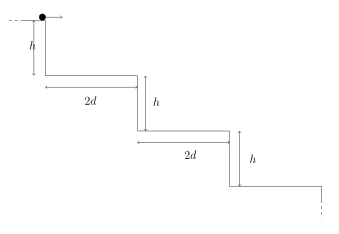
Each step is of width \(2d\) and height \(h\). The particle is kicked horizontally perpendicular to the edge of the top step. On its first and second bounces it lands exactly in the middle of each of the first and second steps from the top. Find the coefficient of restitution between the particle and the steps.
Determine whether it is possible for the particle to continue bouncing down the steps, hitting the middle of each successive step.
A particle is placed at the edge of the top step of a flight of steps.
Each step is of width \(2d\) and height \(h\). The particle is kicked horizontally perpendicular to the edge of the top step. On its first and second bounces it lands exactly in the middle of each of the first and second steps from the top. Find the coefficient of restitution between the particle and the steps.
Determine whether it is possible for the particle to continue bouncing down the steps, hitting the middle of each successive step.
Solution
Considering the horizontal component, this will be constant as there are no forces acting in that direction.
The first step will take the particle \(t = \sqrt{\frac{2h}g}\) to reach. At which point it will be travelling with speed \(v = \sqrt{2gh} \) (by energy considerations, \(mgh = \frac12 mv^2\)).
To reach the second step must take twice as long (since the ball has to travel \(2d\) horizontally, rather than \(d\)). Since \(t = 2\sqrt{\frac{2h}g}\) we must have that:
\begin{align*}
&& s &= ut + \frac12 gt^2 \\
\Rightarrow && h &= u 2\sqrt{\frac{2h}g} + \frac12 g \frac{8h}g \\
\Rightarrow && u &= -\frac{3}{2} h\sqrt{\frac{g}{2h}} \\
&&&= -\frac{3}{2\sqrt{2}} \sqrt{gh}
\end{align*}
Therefore, using Newton's experimental law, we must have that \(e = \frac{\frac{3}{2 \sqrt{2}} \sqrt{gh}}{\sqrt{2} \sqrt{gh}} = \frac{3}{4}\).
Again by conservation of energy \(mgh + \frac12 \frac{9}{8} mgh = \frac12 mv^2 \Rightarrow v = \frac{5}{2\sqrt{2}} \sqrt{gh}\) when it lands on the next step. Therefore we would need the coefficient of restitution for the second (and subsequent steps) to be: \(\displaystyle \frac{\frac{3}{2\sqrt{2}} \sqrt{gh}}{\frac{5}{2\sqrt{2}} \sqrt{gh}} = \frac35\)
Rating Information
Difficulty Rating: 1500.0
Difficulty Comparisons: 0
Banger Rating: 1500.0
Banger Comparisons: 0
Show LaTeX source
Problem source
$\,$
	\vspace{-1cm}
\begin{center}
\begin{tikzpicture}[scale=1.3]
% Setting up the same viewport/dimensions
\clip (-1.09,-1.66) rectangle (7.83,4.42);
% Drawing the solid lines
\draw (-0.59,4) -- (0,4);
\draw (0,4) -- (0,2.5);
\draw (2.5,2.5) -- (0,2.5);
\draw (2.5,2.5) -- (2.5,1);
\draw (2.5,1) -- (5,1);
\draw (5,1) -- (5,-0.5);
\draw (5,-0.5) -- (7.5,-0.5);
\draw (7.5,-0.5) -- (7.49,-0.87);
% Drawing the dashed lines
\draw[dashed] (-0.59,4) -- (-1,4);
\draw[dashed] (7.49,-0.87) -- (7.49,-1.37);
% Drawing the double-sided arrows
\draw[<->] (-0.31,4) -- (-0.31,2.51);
\draw[<->] (0,2.19) -- (2.5,2.19);
\draw[<->] (2.72,2.5) -- (2.72,1);
\draw[<->] (2.5,0.69) -- (5,0.69);
\draw[<->] (5.27,1) -- (5.27,-0.5);
% Drawing the single arrow
\draw[->] (-0.08,4.09) -- (0.46,4.09);
% Adding the text labels
\node at (-0.55,3.55) [anchor=north west] {$h$};
\node at (2.81,2.02) [anchor=north west] {$h$};
\node at (5.43,0.47) [anchor=north west] {$h$};
\node at (0.95,2.05) [anchor=north west] {$2d$};
\node at (3.66,0.58) [anchor=north west] {$2d$};
% Adding the dot
\filldraw (-0.08,4.09) circle (2.5pt);
\end{tikzpicture}
\end{center}
A particle is placed at the edge of the top step of a flight of steps.
Each step is of width $2d$ and height $h$. The particle is kicked horizontally perpendicular to the edge of the top step. On its first and second bounces it lands exactly in the middle of each of the first and second steps from the top. Find the coefficient of restitution between the particle and the steps.
Determine whether it is possible for the particle to continue bouncing down the steps, hitting the middle of each successive step.
Solution source
Considering the horizontal component, this will be constant as there are no forces acting in that direction.

The first step will take the particle $t = \sqrt{\frac{2h}g}$ to reach. At which point it will be travelling with speed $v = \sqrt{2gh} $ (by energy considerations, $mgh = \frac12 mv^2$).

To reach the second step must take twice as long (since the ball has to travel $2d$ horizontally, rather than $d$). Since $t = 2\sqrt{\frac{2h}g}$ we must have that:

\begin{align*}
&& s &= ut + \frac12 gt^2 \\
\Rightarrow && h &= u 2\sqrt{\frac{2h}g} + \frac12 g \frac{8h}g \\
\Rightarrow && u &= -\frac{3}{2} h\sqrt{\frac{g}{2h}} \\
&&&= -\frac{3}{2\sqrt{2}} \sqrt{gh}
\end{align*}

Therefore, using Newton's experimental law, we must have that $e = \frac{\frac{3}{2 \sqrt{2}} \sqrt{gh}}{\sqrt{2} \sqrt{gh}} = \frac{3}{4}$.

Again by conservation of energy $mgh + \frac12 \frac{9}{8} mgh = \frac12 mv^2 \Rightarrow v = \frac{5}{2\sqrt{2}} \sqrt{gh}$ when it lands on the next step. Therefore we would need the coefficient of restitution for the second (and subsequent steps) to be: $\displaystyle \frac{\frac{3}{2\sqrt{2}} \sqrt{gh}}{\frac{5}{2\sqrt{2}} \sqrt{gh}} = \frac35$