1987 Paper 2 Q13
Year: 1987
Paper: 2
Question Number: 13
Course: UFM Mechanics
Section: Momentum and Collisions 2
Difficulty: 1500.0
Banger: 1500.0
momentum and collisions
coefficient of restitution
geometry
reflection
parallel paths
rectangular table
snooker/billiards
locus
Problem
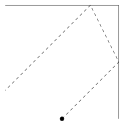
Ice snooker is played on a rectangular horizontal table, of length \(L\) and width \(B\), on which a small disc (the puck) slides without friction. The table is bounded by smooth vertical walls (the cushions) and the coefficient of restitution between the puck and any cushion is \(e\). If the puck is hit so that it bounces off two adjacent cushions, show that its final path (after two bounces) is parallel to its original path.
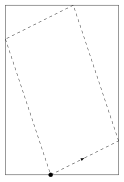
The puck rests against the cushion at a point which divides the side of length \(L\) in the ratio \(z:1\). Show that it is possible, whatever \(z\), to hit the puck so that it bounces off the three other cushions in succession clockwise and returns to the spot at which it started.
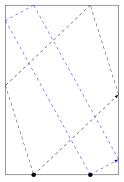
By considering these paths as \(z\) varies, explain briefly why there are two different ways in which, starting at any point away from the cushions, it is possible to perform a shot in which the puck bounces off all four cushions in succession clockwise and returns to its starting point.
Solution
Rating Information
Difficulty Rating: 1500.0
Difficulty Comparisons: 0
Banger Rating: 1500.0
Banger Comparisons: 0
Show LaTeX source
Problem source
Ice snooker is played on a rectangular horizontal table, of length $L$ and width $B$, on which a small disc (the puck) slides without friction. The table is bounded by smooth vertical walls (the cushions) and the coefficient of restitution between the puck and any cushion is $e$. If the puck is hit so that it bounces off two adjacent cushions, show that its final path (after two bounces) is parallel to its original path.
The puck rests against the cushion at a point which divides the side of length $L$ in the ratio $z:1$. Show that it is possible, whatever $z$, to hit the puck so that it bounces off the three other cushions in succession clockwise and returns to the spot at which it started.
By considering these paths as $z$ varies, explain briefly why there are two different ways in which, starting at any point away from the cushions, it is possible to perform a shot in which the puck bounces off all four cushions in succession clockwise and returns to its starting point.
Solution source
\begin{center}
    \begin{tikzpicture}[scale=2]
        \draw (2, 0) -- (2,2);
        \draw (2,2) -- (0,2);

        \filldraw (1,0) circle (1pt);
        \draw[dashed] (1,0) -- (2,1) -- (1.5,2) -- (0, 2-1.5);
    \end{tikzpicture}
\end{center}

The puck sets off at some velocity $\displaystyle \binom{u_x}{u_y}$, after the first bounce off the wall parallel to the $y$-axis, it has velocity $\displaystyle  \binom{-eu_x}{u_y}$. After it bounces off the wall parallel to the $x$-axis, it has velocity $\displaystyle \binom{-eu_x}{-eu_y}$ which is clearly parallel to the original velocity.

\begin{center}
    \begin{tikzpicture}[scale=2]
        \draw (0,0) -- (2,0) -- (2, 3) -- (0, 3) -- cycle;


        \def\t{0.5};
        \def\s{1.2};
        \def\r{0.8};

        \filldraw ({\r},0) circle (1pt);

        \draw[dashed, -latex] (0.8,0) -- ({0.5*(0.8+2)},{0.5*(2-\r)*\t});
        \draw[dashed] ({0.5*(0.8+2)},{0.5*(2-\r)*\t}) -- (2,{(2-\r)*\t}); % gradient \t
        \draw[dashed] (2,{(2-\r)*\t}) -- ({\s},3); % gradient (3-\t*(2-\r))/(\s-2)
        \draw[dashed] ({\s},3)-- (0, {3-\s*\t});
        \draw[dashed] (0, {3-\s*\t}) -- ({-(\s-2)/(3-\t*(2-\r))*(3-\s*\t)} , 0);
    \end{tikzpicture}
\end{center}

If the puck bounces off 3 walls and returns to the same point the shape formed must be a parallelogram.  We need to hit the point on the opposite side which is in a ratio of $1:z$, but this must be possible if we aim towards the side further away.

\begin{center}
    \begin{tikzpicture}[scale=2]
        \draw (0,0) -- (2,0) -- (2, 3) -- (0, 3) -- cycle;

        \def\t{0.5};
        \def\e{.3};
        % \def\r{0.8}; % Original fixed value for comparison if needed
        % Calculated \r
        \pgfmathsetmacro{\rval}{(3*\e*(-2 + \t))/(\e*(-2 + \t) - \t)};

        \filldraw ({\t},0) circle (1pt);

        % --- Force calculation of gOne beforehand ---
        \pgfmathsetmacro{\gOneValue}{\rval/(2-\t)};

        % Use the calculated value \gOneValue
        \draw[dashed, -latex] (\t,0) -- (2,{0+(2-\t)*\gOneValue});


        \pgfmathsetmacro{\xTwoValue}{(2-(3-\rval)*\e/\gOneValue)};
        \pgfmathsetmacro{\yThreeValue}{(3 - \xTwoValue*\gOneValue)};
        \pgfmathsetmacro{\zFourValue}{(\yThreeValue * \e / \gOneValue)};

        \draw[dashed] (2, {\rval}) -- ({\xTwoValue} , 3);
        \draw[dashed] ({\xTwoValue}, 3) -- (0, {\yThreeValue});
        \draw[dashed] (0, {\yThreeValue}) -- ({\zFourValue},0);

        \def\t{1.5};
        % \def\r{0.8}; % Original fixed value for comparison if needed
        % Calculated \r
        \pgfmathsetmacro{\rval}{(3*\e*(-2 + \t))/(\e*(-2 + \t) - \t)};

        \filldraw ({\t},0) circle (1pt);

        % --- Force calculation of gOne beforehand ---
        \pgfmathsetmacro{\gOneValue}{\rval/(2-\t)};

        % Use the calculated value \gOneValue
        \draw[dashed, -latex, blue] (\t,0) -- (2,{0+(2-\t)*\gOneValue});


        \pgfmathsetmacro{\xTwoValue}{(2-(3-\rval)*\e/\gOneValue)};
        \pgfmathsetmacro{\yThreeValue}{(3 - \xTwoValue*\gOneValue)};
        \pgfmathsetmacro{\zFourValue}{(\yThreeValue * \e / \gOneValue)};

        \draw[dashed, blue] (2, {\rval}) -- ({\xTwoValue} , 3);
        \draw[dashed, blue] ({\xTwoValue}, 3) -- (0, {\yThreeValue});
        \draw[dashed, blue] (0, {\yThreeValue}) -- ({\zFourValue},0);


    \end{tikzpicture}
\end{center}


For a fixed path, as $z$ increases we generate more parallelograms which cross ours (on two of the legs) twice. As they move the full length it will cover the full leg of the parallogram. Similarly going the other way will cover the other leg of the parallelogram. Therefore from every point there are two circuits round the table