Momentum and Collisions 1
Two small beads, \(A\) and \(B\), of the same mass, are threaded onto a vertical wire on which they slide without friction, and which is fixed to the ground at \(P\). They are released simultaneously from rest, \(A\) from a height of \(8h\) above \(P\) and \(B\) from a height of \(17h\) above \(P\). When \(A\) reaches the ground for the first time, it is moving with speed \( V\). It then rebounds with coefficient of restitution \(\frac{1}{2}\) and subsequently collides with \(B\) at height \(H\) above \(P\). Show that \(H= \frac{15}8h\) and find, in terms of \(g\) and \(h\), the speeds \(u_A\) and \(u_B\) of the two beads just before the collision. When \(A\) reaches the ground for the second time, it is again moving with speed \( V\). Determine the coefficient of restitution between the two beads.
Show Solution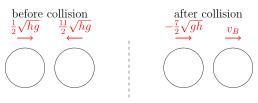
A particle \(P\) of mass \(m\) is projected with speed \(u_0\) along a smooth horizontal floor directly towards a wall. It collides with a particle \(Q\) of mass \(km\) which is moving directly away from the wall with speed \(v_0\). In the subsequent motion, \(Q\) collides alternately with the wall and with \(P\). The coefficient of restitution between \(Q\) and \(P\) is \(e\), and the coefficient of restitution between \(Q\) and the wall is 1. Let \(u_n\) and \(v_n\) be the velocities of \(P\) and \(Q\), respectively, towards the wall after the \(n\)th collision between \(P\) and \(Q\).
- Show that, for \(n\ge2\), \[ (1+k)u_{n} - (1-k)(1+e)u_{n-1} + e(1+k)u_{n-2} =0\,. \tag{\(*\)} \]
- You are now given that \(e=\frac12\) and \(k = \frac1{34}\), and that the solution of \((*)\) is of the form \[ \phantom{(n\ge0)} u_n= A\left( \tfrac 7{10}\right)^n + B\left( \tfrac 5{7 }\right)^n \ \ \ \ \ \ (n\ge0) \,, \] where \(A\) and \(B\) are independent of \(n\). Find expressions for \(A\) and \(B\) in terms of \(u_0\) and \(v_0\). Show that, if \(0 < 6u_0 < v_0\), then \(u_n\) will be negative for large \(n\).
- Just before collision \(n-1\): Velocity of \(P\) is \(u_{n-2}\) Velocity of \(Q\) is \(-v_{n-2}\) \begin{align*} COM: && mu_{n-2}+km(-v_{n-2}) &= mu_{n-1}+kmv_{n-1} \\ \Rightarrow && u_{n-2}-kv_{n-2} &= u_{n-1}+kv_{n-1} \\ NEL: && v_{n-1}-u_{n-1} &= -e((-v_{n-2})-u_{n-2}) \\ \Rightarrow && v_{n-1}-u_{n-1} &= e(v_{n-2}+u_{n-2}) \end{align*} \begin{align*} &&kv_{n-1} &= u_{n-2} - kv_{n-2}-u_{n-1} \\ &&kv_{n-1}&= ku_{n-1}+kev_{n-2}+keu_{n-2} \\ \Rightarrow && kv_{n-2}(1+e) &= u_{n-2}(1-ke)-u_{n-1}(1+k) \\ \Rightarrow && kv_{n-1}(1+e) &= u_{n-1}(1-ke)-u_{n}(1+k) \\ && k(1+e)v_{n-1}-k(1+e)u_{n-1} &= k(1+e)e(v_{n-2}+u_{n-2}) \\ \Rightarrow && u_{n-1}(1-ke)-u_{n}(1+k)-k(1+e)u_{n-1} &= e(u_{n-2}(1-ke)-u_{n-1}(1+k))+k(1+e)eu_{n-2} \\ \Rightarrow && 0 &= (1+k)u_n + ((ke-1)+k(1+e)-e(1+k))u_{n-1} \\ &&& \quad \quad + (e(1-ke)+k(1+e)e)u_{n-2} \\ \Rightarrow && 0 &= (1+k)u_n- (1-k)(1+e)u_{n-1} +e(1+k)u_{n-2} \end{align*}
- \(u_0 = A + B\) \begin{align*} &&& \begin{cases}u_0 - kv_0 &= kv_1 + u_1 \\ \frac12 (u_0+v_0) &= v_1 - u_1 \\ \end{cases} \\ \Rightarrow && (1+k)u_1 &= u_0 - kv_0 - \frac{k}{2}(u_0 + v_0) \\ \Rightarrow && u_1 &= \frac{1}{k+1} \l u_0 (1-\frac{k}{2}) - \frac32 k v_0 \r \\ &&&= \frac{67}{70} u_0 - \frac{3}{70} v_0 \end{align*} Therefore \(A+B = u_0, \frac{49A+50B}{70} = \frac{67}{70} u_0 - \frac{3}{70} v_0\) \begin{align*} && A+B &= u_0 \\ && 49A+50B &= 67u_0 - 3v_0 \\ \Rightarrow && 50u_0 - A &= 67u_0 - 3v_0 \\ \Rightarrow && A &= -17u_0 + 3v_0 \\ && B &= 18u_0 - 3v_0 \end{align*} If \(0 < 6u_0 < v_0\), then \(B < 0\) and as \(n \to \infty\) we will find that \(\l \frac57 \r^n\) dominates \(\l \frac7{10} \r^n\) and so our velocity will be negative and the particle will change direction
Particles \(P_1\), \(P_2\), \(\ldots\) are at rest on the \(x\)-axis, and the \(x\)-coordinate of \(P_n\) is \(n\). The mass of \(P_n\) is \(\lambda^nm\). Particle \(P\), of mass \(m\), is projected from the origin at speed \(u\) towards \(P_1\). A series of collisions takes place, and the coefficient of restitution at each collision is \(e\), where \(0 < e <1\). The speed of \(P_n\) immediately after its first collision is \(u_n\) and the speed of \(P_n\) immediately after its second collision is \(v_n\). No external forces act on the particles.
- Show that \(u_1=\dfrac{1+e}{1+\lambda}\, u\) and find expressions for \(u_n\) and \(v_n\) in terms of \(e\), \(\lambda\), \(u\) and \(n\).
- Show that, if \(e > \lambda\), then each particle (except \(P\)) is involved in exactly two collisions.
- Describe what happens if \(e=\lambda\) and show that, in this case, the fraction of the initial kinetic energy lost approaches \(e\) as the number of collisions increases.
- Describe what happens if \(\lambda e=1\). What fraction of the initial kinetic energy is \mbox{eventually} lost in this case?
- \begin{align*} \text{COM}: && mu &= mv + \lambda m u_1 \\ \Rightarrow && u &= v + \lambda u_1 \tag{1} \\ \text{NEL}: && e &= \frac{u_1-v}{u} \\ \Rightarrow && eu &= u_1 - v \tag{2} \\ (1)+(2) && (1+e)u &= (1+\lambda) u_1 \\ \Rightarrow && u_1 &= \frac{1+e}{1+\lambda}u \\ && v &= u_1 - eu \\ &&&= \frac{1+e - (1+\lambda)e}{1+\lambda} u \\ &&&= \frac{1-\lambda e}{1+\lambda}u \end{align*} Note that subsequent (first (and second)) are the same as these, therefore: \begin{align*} u_n &= \left ( \frac{1+e}{1+\lambda} \right)^n u \\ v_n &= \frac{1-\lambda e}{1+\lambda } u_n \\ &= \frac{1-\lambda e}{1+\lambda } \left ( \frac{1+e}{1+\lambda} \right)^n u \end{align*}

- If \(e > \lambda\) then \((1-\lambda e) > 1-e^2 > 0\) and \begin{align*} \frac{v_{n+1}}{v_n} &= \frac{1+e}{1+\lambda} > 1 \end{align*} So the particles are moving away from each other - hence no more collisions.
- If \(e = \lambda\) then \(u_n = u\) and \(v_n = (1-\lambda)u\) so all the particles end up moving at the same speed. \begin{align*} \text{initial k.e.} &= \frac12 m u^2 \\ \text{final k.e.} &= \frac12 m((1-e)u)^2 + \sum_{n = 1}^{\infty} \frac12 \lambda^n m ((1-e)u)^2 \\ &= \frac12mu^2(1-e)^2 \left ( \sum_{n=0}^{\infty} e^n \right) \tag{\(e = \lambda\)} \\ &= \frac12 mu^2(1-e)^2 \frac{1}{1-e} \\ &= \frac12m u^2 (1-e) \\ \text{change in k.e.} &= \frac12 m u^2 - \frac12m u^2 (1-e) \\ &= e\frac12m u^2 \end{align*} Ie the total energy lost approaches a fraction of \(e\).
- If \(\lambda e = 1\), after the second collision the particle will be stationary. ie \begin{align*} \text{initial k.e.} &= \frac12 m u^2 \\ \text{k.e. after }n\text{ collisions} &= \frac12 \lambda^n m \left (\left ( \frac{1+e}{1+\lambda} \right)^n u \right)^2\\ &= \frac12 \lambda^n m \left ( \frac{1+\frac1{\lambda}}{1+\lambda} \right)^{2n} u&2\\ &= \frac12 \lambda^n m \left ( \frac{1+\frac1{\lambda}}{1+\lambda} \right)^{2n} u\\ &= \frac12 \lambda^n m \left ( \frac{1}{\lambda} \right)^{2n} u\\ &= \frac12 m \lambda^{-n} u\\ &\to 0 \end{align*} Eventually we lose all the kinetic energy.
A railway truck, initially at rest, can move forwards without friction on a long straight horizontal track. On the truck, \(n\) guns are mounted parallel to the track and facing backwards, where \(n>1\). Each of the guns is loaded with a single projectile of mass \(m\). The mass of the truck and guns (but not including the projectiles) is \(M\). When a gun is fired, the projectile leaves its muzzle horizontally with a speed \(v-V\) relative to the ground, where \(V\) is the speed of the truck immediately before the gun is fired.
- All \(n\) guns are fired simultaneously. Find the speed, \(u\), with which the truck moves, and show that the kinetic energy, \(K\), which is gained by the system (truck, guns and projectiles) is given by \[ K= \tfrac{1}{2}nmv^2\left(1 +\frac{nm}{M} \right) . \]
- Instead, the guns are fired one at a time. Let \(u_r\) be the speed of the truck when \(r\) guns have been fired, so that \(u_0= 0\). Show that, for \(1\le r \le n\,\), \[ u_r - u_{r-1} = \frac{mv}{M+(n-r)m} \tag{\(*\)} \] and hence that \(u_n < u\,\).
- Let \(K_r\) be the total kinetic energy of the system when \(r\) guns have been fired (one at a time), so that \(K_0 = 0\). Using \((*)\), show that, for \(1\le r\le n\,\), \[ K_r -K_{r-1} = \tfrac 12 mv^2 + \tfrac12 mv (u_r-u_{r-1}) \] and hence show that \[ K_n = \tfrac{1}{2}nmv^2 +\tfrac{1}{2}mvu_n \,. \] Deduce that \(K_n < K\).
- \(\,\) \begin{align*} \text{COM}: && 0 &= nm(v-0) - Mu \\ \Rightarrow && u &= \frac{nm}{M}v \\ \\ \Rightarrow && \text{K.E.} &= \underbrace{\tfrac12 nmv^2}_{\text{projectiles}} + \underbrace{\tfrac12Mu^2}_{\text{guns and truck}} \\ &&&= \tfrac12nmv^2 + \tfrac12M \frac{n^2m^2}{M^2}v^2 \\ &&&= \tfrac12 nmv^2 \left (1 + \frac{nm}{M} \right) \end{align*}
- \(\,\) \begin{align*} \text{COM}: && ((n-r+1)m+M)u_{r-1} &= -m(v-u_{r-1})+ ((n-r)m+M)u_r \\ \Rightarrow && mv &= -((n-r+1)m+M-m)u_{r-1}+((n-r)m+M)u_r \\ \Rightarrow && u_r-u_{r-1} &= \frac{mv}{M+(n-r)m} \\ \\ && u_n &= \frac{mv}{M+(n-1)m} + \frac{mv}{M+(n-2)m} + \cdots + \frac{mv}{M} \\ &&&< \frac{mv}M + \cdots + \frac{mv}{M} \\ &&&= \frac{mn}{M}v = u \end{align*}
- \(\,\) \begin{align*} && K_r &= \underbrace{K_{r-1}-\frac12(m(n-r+1)+M)u_{r-1}^2}_{\text{energy of already dispersed projectiles}} + \frac12m(v-u_{r-1})^2 + \frac12(m(n-r)+M)u_r^2 \\ \Rightarrow && K_r-K_{r-1} &= \tfrac12(u_r^2-u_{r-1}^2)(M+m(n-r))+\tfrac12mv^2-mvu_{r-1} \\ &&&=\tfrac12mv^2+ \tfrac12(u_r+u_{r-1})mv-mvu_{r-1} \\ &&&= \tfrac12mv^2 + \tfrac12mv(u_r-u_{r-1}) \\ \\ && K_n &= \frac12nmv^2 + \tfrac12mv(u_n - u_0) \\ &&&= \tfrac12nmv^2 + \tfrac12mvu_n \\ &&&< \tfrac12nmv^2 + \tfrac12mvu \\ &&&= \tfrac12nmv^2 + \tfrac12mv \frac{nm}{M}v \\ &&&= \tfrac12nmv^2 \left (1 +\frac{m}{M} \right) \\ &&&\leq K \end{align*}
Four particles \(A\), \(B\), \(C\) and \(D\) are initially at rest on a smooth horizontal table. They lie equally spaced a small distance apart, in the order \(ABCD\), in a straight line. Their masses are \(\lambda m\), \(m\), \(m\) and \(m\), respectively, where \(\lambda>1\). Particles \(A\) and \(D\) are simultaneously projected, both at speed \(u\), so that they collide with \(B\) and \(C\) (respectively). In the following collision between \(B\) and \(C\), particle \(B\) is brought to rest. The coefficient of restitution in each collision is \(e\).
- Show that \(e = \dfrac {\lambda-1}{3\lambda+1}\) and deduce that \(e < \frac 13\,\).
- Given also that \(C\) and \(D\) move towards each other with the same speed, find the value of \(\lambda\) and of \(e\).


- \begin{align*} \text{NEL}: && w_C &= e(v_B - v_C) \\ \text{COM}: && mv_B+ mv_C &= m w_C \\ \Rightarrow && w_C &= v_B + v_C\\ \Rightarrow && e(v_B - v_C) &= (v_B + v_C) \\ \Rightarrow && (1-e)v_B &= -(1+e)v_C \\ \Rightarrow && (1-e) \frac{\lambda(1+ e)}{1+\lambda} &= (1+e) \frac{1+e}{2} \\ \Rightarrow && 2\lambda - 2\lambda e &= 1+\lambda + e + \lambda e \\ \Rightarrow && (3\lambda +1)e &= \lambda - 1 \\ \Rightarrow && e &= \frac{\lambda -1}{3\lambda + 1} \\ &&&< \frac{\lambda - 1 + \frac{4}{3}}{3\lambda + 1} \\ &&& = \frac13 \end{align*}

- Since they move towards each other at the same speed \(w_C = - v_D\) \begin{align*} && w_C &= - v_D \\ \Rightarrow && v_B + v_C &= -(v_C+eu) \\ \Rightarrow && -eu &= v_B +2v_C \\ &&&= \frac{\lambda(1+ e)}{1+\lambda} u -(1+e)u \\ \Rightarrow && 1 &= \frac{\lambda(1+e)}{1+\lambda} \\ \Rightarrow && 1+\lambda &= \lambda \left ( 1 + \frac{\lambda -1}{3\lambda+1} \right) \\ &&&= \lambda \frac{4\lambda}{3\lambda +1} \\ \Rightarrow && 1+4\lambda + 3\lambda^2 &= 4\lambda^2 \\ \Rightarrow && 0 &= \lambda^2 - 4\lambda - 1 \\ \Rightarrow && \lambda &= \frac{4 \pm \sqrt{20}}{2} \\ &&&= 2\pm \sqrt{5} \\ \Rightarrow && \lambda &= 2 + \sqrt{5} \\ && e &= \frac{1+\sqrt{5}}{7+3\sqrt{5}} \\ &&&=\sqrt{5}-2 \end{align*}
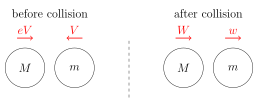
- A uniform spherical ball of mass \(M\) and radius \(R\) is released from rest with its centre a distance \(H+R\) above horizontal ground. The coefficient of restitution between the ball and the ground is \(e\). Show that, after bouncing, the centre of the ball reaches a height \(R+He^2\) above the ground.
- A second uniform spherical ball, of mass \(m\) and radius \(r\), is now released from rest together with the first ball (whose centre is again a distance \(H+R\) above the ground when it is released). The two balls are initially one on top of the other, with the second ball (of mass \(m\)) above the first. The two balls separate slightly during their fall, with their centres remaining in the same vertical line, so that they collide immediately after the first ball has bounced on the ground. The coefficient of restitution between the balls is also \(e\). The centre of the second ball attains a height \(h\) above the ground. Given that \(R=0.2\), \(r=0.05\), \(H=1.8\), \(h=4.5\) and \(e=\frac23\), determine the value of \(M/m\).
- The story for first ball (before it collides with the second ball) will be exactly the same, ie it rebounds with speed \(eV\).
For the second ball, it will also have fallen a distance \(H\) and will be travelling with the same speed \(V\). Their speed of approach therefore will be \((1+e)V\), and the speed of separating therefore must be \(e(1+e)V\)
Given the centre of the second ball reaches a height of \(h\) (from a position of height) \(2R+r\), we must have:
\begin{align*}
&& v^2 &= u^2 + 2as \\
&& 0 &= w^2 - 2g(h - 2R-r) \\
\Rightarrow && w^2 &= 2g(h-2R-r)
\end{align*}
Taking upwards to be positive, then we have:
\begin{align*} \text{COM}: && MeV + m(-V) &= M(w-e(1+e)V) + mw \\ \Rightarrow && V(Me-m)+e(1+e)MV &= w(M+m) \\ \Rightarrow && w &= \frac{2Me+e^2M-m}{M+m} V \\ \Rightarrow && w^2 &= \left ( \frac{M/m(2e+e^2)-1}{M/m+1}\right)^2 V^2 \\ \Rightarrow && 2g(h-2R-r) &= \left ( \frac{M/m(2e+e^2)-1}{M/m+1}\right)^2 2gH \\ \Rightarrow && \left ( \frac{M/m(2e+e^2)-1}{M/m+1}\right)^2 &= \frac{h-2R-r}{H} \\ &&&= \frac{4.5-0.4-0.05}{1.8} \\ &&&= \frac{9}{4} \\ \Rightarrow && \frac{M/m(\frac43+\frac49)-1}{M/m+1} &= \frac32 \\ \Rightarrow && \frac{16}9M/m-1 &= \frac32 M/m+\frac32 \\ \Rightarrow && \frac{5}{18}M/m &= \frac{5}{2} \\ \Rightarrow && M/m &= 9 \end{align*}
Two parallel vertical barriers are fixed a distance \(d\) apart on horizontal ice. A small ice hockey puck moves on the ice backwards and forwards between the barriers, in the direction perpendicular to the barriers, colliding with each in turn. The coefficient of friction between the puck and the ice is \(\mu\) and the coefficient of restitution between the puck and each of the barriers is \(r\). The puck starts at one of the barriers, moving with speed \(v\) towards the other barrier. Show that \[ v_{i+1}^2 - r^2 v_i^2 = - 2 r^2 \mu gd\, \] where \(v_i\) is the speed of the puck just after its \(i\)th collision. The puck comes to rest against one of the barriers after traversing the gap between them \(n\) times. In the case \(r\ne1\), express \(n\) in terms of \(r\) and \(k\), where \(k= \dfrac{v^2}{2\mu g d}\,\). If \(r=\e^{-1}\) (where \(\e\) is the base of natural logarithms) show that \[ n = \tfrac12 \ln\big(1+k(\e^2-1)\big)\,. \] Give an expression for \(n\) in the case \(r=1\).
Show SolutionThree identical particles lie, not touching one another, in a straight line on a smooth horizontal surface. One particle is projected with speed \(u\) directly towards the other two which are at rest. The coefficient of restitution in all collisions is \(e\), where \(0 < e < 1\,\).
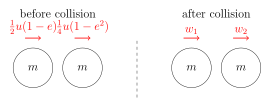
- Show that, after the second collision, the speeds of the particles are \(\frac12u(1-e)\), \(\frac14u (1-e^2)\) and \(\frac14u(1+e)^2\). Deduce that there will be a third collision whatever the value of \(e\).
- Show that there will be a fourth collision if and only if \(e\) is less than a particular value which you should determine.
- First Collision:
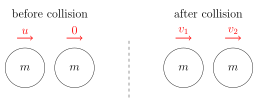
By NEL, \(v_2 = v_1 + eu\), so \begin{align*} \text{COM}: && mu &= mv_1 + m(v_1 + eu) \\ \Rightarrow && 2mv_1 &= mu(1-e) \\ \Rightarrow && v_1 &= \frac12 u(1-e) \\ && v_2 &= \frac12 u(1-e) + eu \\ &&&= \frac12 u(1+e) \end{align*} The second collision is identical to the first except replacing \(u\) with \(\frac12u(1+e)\), therefore after that collision: \begin{align*} && \text{first particle} &= \frac12 u(1-e) \\ && \text{second particle} &= \frac12 \left (\frac12 u(1+e) \right)(1-e) \\ &&&= \frac14 u(1-e^2) \\ && \text{third particle} &= \frac12 \left (\frac12 u(1+e) \right)(1+e) \\ &&&= \frac14 u(1+e)^2 \end{align*} After all these collisions, all particles are moving in the same direction (since they all have positive velocity), but the first particle is now travelling faster than the second particle (as \(\frac12(1-e) < 1\)). Therefore they will collide again.
- The third collision:
The speed of approach will be \(\frac12u(1-e) - \frac14u(1-e^2) = \frac14u(1-e)(2 - (1+e)) = \frac14 u(1-e)^2\), therefore by NEL, \(w_2 = w_1 + \frac14ue(1-e)^2\) \begin{align*} \text{COM}: && m\frac12u(1-e) + m \frac14u(1-e^2) &= mw_1 + m\left (w_1 + \frac14ue(1-e)^2 \right) \\ \Rightarrow && \frac14u(1-e)(2+(1+e)) &= 2w_1 + \frac14ue(1-e)^2 \\ \Rightarrow && 2w_1 &= \frac14u(1-e)(3+e)-\frac14ue(1-e)^2 \\ &&&= \frac14u(1-e)(3+e-e(1-e)) \\ &&&= \frac14u(1-e)(3+e^2) \\ \Rightarrow && w_1 &= \frac18 u(1-e)(3+e^2) \\ && w_2 &= \frac18 u(1-e)(3+e^2) + \frac14ue(1-e)^2 \\ &&&= \frac18u(1-e)(3+e^2+2e(1-e)) \\ &&&= \frac18u(1-e)(3+2e-e^2) \\ &&&= \frac18u(1-e)(1+e)(3-e) \\ \end{align*} A fourth collision is possible, iff \begin{align*} && \frac18u(1-e)(1+e)(3-e)&> \frac14 u(1+e)^2 \\ \Leftrightarrow && (1-e)(3-e)&> 2 (1+e) \\ \Leftrightarrow &&3-4e-e^2&> 2+2e \\ \Leftrightarrow &&1-5e-e^2&>0 \\ \Leftrightarrow && e &< 3-\sqrt{2} \end{align*}
A small block of mass \(km\) is initially at rest on a smooth horizontal surface. Particles \(P_1\), \(P_2\), \(P_3\), \(\ldots\) are fired, in order, along the surface from a fixed point towards the block. The mass of the \(i\)th particle is \(im\) (\(i = 1, 2, \ldots\))and the speed at which it is fired is \(u/i\,\). Each particle that collides with the block is embedded in it. Show that, if the \(n\)th particle collides with the block, the speed of the block after the collision is \[ \frac{2nu}{2k +n(n+1)}\,. \] In the case \(2k = N(N+1)\), where \(N\) is a positive integer, determine the number of collisions that occur. Show that the total kinetic energy lost in all the collisions is \[ \tfrac12 mu^2\bigg( \sum_{n=2}^{N+1} \frac 1 n \bigg)\,. \]
Show SolutionA particle, \(A\), is dropped from a point \(P\) which is at a height \(h\) above a horizontal plane. A~second particle, \(B\), is dropped from \(P\) and first collides with \(A\) after \(A\) has bounced on the plane and before \(A\) reaches \(P\) again. The bounce and the collision are both perfectly elastic. Explain why the speeds of \(A\) and \(B\) immediately before the first collision are the same. The masses of \(A\) and \(B\) are \(M\) and \(m\), respectively, where \(M>3m\), and the speed of the particles immediately before the first collision is \(u\). Show that both particles move upwards after their first collision and that the maximum height of \(B\) above the plane after the first collision and before the second collision is \[ h+ \frac{4M(M-m)u^2}{(M+m)^2g}\,. \]
Two particles, \(A\) of mass \(2m\) and \(B\) of mass \(m\), are moving towards each other in a straight line on a smooth horizontal plane, with speeds \(2u\) and \(u\) respectively. They collide directly. Given that the coefficient of restitution between the particles is \(e\), where \(0 < e \le 1\), determine the speeds of the particles after the collision. After the collision, \(B\) collides directly with a smooth vertical wall, rebounding and then colliding directly with \(A\) for a second time. The coefficient of restitution between \(B\) and the wall is \(f\), where \(0 < f \le 1\). Show that the velocity of \(B\) after its second collision with \(A\) is \[ \tfrac23 (1-e^2)u - \tfrac13(1-4e^2)fu \] towards the wall and that \(B\) moves towards (not away from) the wall for all values of \(e\) and \(f\).
Show Solution
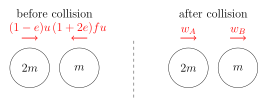
- In an experiment, a particle \(A\) of mass \(m\) is at rest on a smooth horizontal table. A particle \(B\) of mass \(bm\), where \(b >1\), is projected along the table directly towards \(A\) with speed \(u\). The collision is perfectly elastic. Find an expression for the speed of \(A\) after the collision in terms of \(b\) and \(u\), and show that, irrespective of the relative masses of the particles, \(A\) cannot be made to move at twice the initial speed of \(B\).
- In a second experiment, a particle \(B_1\) is projected along the table directly towards \(A\) with speed \(u\). This time, particles \(B_2\), \(B_3\), \(\ldots\,\), \(B_n\) are at rest in order on the line between \(B_1\) and \(A\). The mass of \(B_i\) (\(i=1\), \(2\), \(\ldots\,\), \(n\)) is \(\lambda^{n+1-i}m\), where \(\lambda>1\). All collisions are perfectly elastic. Show that, by choosing \(n\) sufficiently large, there is no upper limit on the speed at which \(A\) can be made to move. In the case \(\lambda=4\), determine the least value of \(n\) for which \(A\) moves at more than \(20u\). You may use the approximation \(\log_{10}2 \approx 0.30103\).
- Since the collision is perfectly elastic, the speed of approach and separation are equal, ie \(v_B = v_A - u\) \begin{align*} \text{COM}: && bmu &= bm(v_A - u) + mv_A \\ \Rightarrow && (b+1)v_A &= 2bu \\ \Rightarrow && v_A &= \frac{2b}{b+1} u \end{align*} Since \(0 < \frac{b}{b+1} < 1\), the largest \(0 < v_A < 2u\)

- After the first collision with each \(B_i\) we will have \(\displaystyle v_{i+1} = \frac{2\lambda}{\lambda + 1}v_i\), ie \(\displaystyle v_{i+1} = \left (\frac{2\lambda}{\lambda + 1} \right)^i u\) and so \(\displaystyle v_A = \left (\frac{2\lambda}{\lambda + 1} \right)^n u\) which can be arbitrarily large. Suppose \(\lambda = 4\), then \begin{align*} && 20u &< v_A \\ &&&= \left (\frac{8}{5} \right)^n u \\ \Rightarrow && \log_{10} 20 < n \log_{10}(16/10) \\ && \log_{10} 2 + 1 < n 4\log_{10} 2 - n \\ \Rightarrow && n &> \frac{ \log_{10} 2 + 1}{ 4\log_{10} 2 - 1} \\ &&&\approx \frac{0.30103+1}{4 \times 0.30103 -1}\\ &&&= \frac{1.30103}{0.20412} \\ &&&>6 \end{align*} So \(n =7\) is the smallest possible
A bullet of mass \(m\) is fired horizontally with speed \(u\) into a wooden block of mass \(M\) at rest on a horizontal surface. The coefficient of friction between the block and the surface is \(\mu\). While the bullet is moving through the block, it experiences a constant force of resistance to its motion of magnitude \(R\), where \(R>(M+m)\mu g\). The bullet moves horizontally in the block and does not emerge from the other side of the block.
- Show that the magnitude, \(a\), of the deceleration of the bullet relative to the block while the bullet is moving through the block is given by \[ a= \frac R m + \frac {R-(M+m)\mu g}{M}\, . \]
- Show that the common speed, \(v\), of the block and bullet when the bullet stops moving through the block satisfies \[ av = \frac{Ru-(M+m)\mu gu}M\,. \]
- Obtain an expression, in terms of \(u\), \(v\) and \(a\), for the distance moved by the block while the bullet is moving through the block.
- Show that the total distance moved by the block is \[ \frac{muv}{2(M+m)\mu g}\,. \]
Two particles move on a smooth horizontal table and collide. The masses of the particles are \(m\) and \(M\). Their velocities before the collision are \(u{\bf i}\) and \(v{\bf i}\,\), respectively, where \(\bf i\) is a unit vector and \(u>v\). Their velocities after the collision are \(p{\bf i}\) and \(q{\bf i}\,\), respectively. The coefficient of restitution between the two particles is \(e\), where \(e<1\).
- Show that the loss of kinetic energy due to the collision is \[ \tfrac12 m (u-p)(u-v)(1-e)\,, \] and deduce that \(u\ge p\).
- Given that each particle loses the same (non-zero) amount of kinetic energy in the collision, show that \[ u+v+p+q=0\,, \] and that, if \(m\ne M\), \[ e= \frac{(M+3m)u + (3M+m)v}{(M-m)(u-v)}\,. \]
- \begin{align*} \text{COM}: && mu + Mv &= mp + Mq \\ \Rightarrow && m(u-p) &= M(q-v) \\ \text{NEL}: && q-p &= e(u-v) \\ && q +ev &= p+eu \\ && \Delta \text{ k.e.} &= \frac12 m u^2 + \frac12 M v^2 -\frac12 m p^2 - \frac12 M q^2 \\ &&&= \frac12m (u^2 - p^2)+\frac12M(v^2-q^2) \\ &&&= \frac12m (u^2 - p^2)+\frac12M(v-q)(v+q) \\ &&&= \frac12m(u^2-p^2) - \frac12 m(u-p)(v+q) \\ &&&= \frac12 m(u-p) \left ( u+p-v-q\right) \\ &&&= \frac12 m(u-p) \left (u-v+(p-q)\right) \\ &&&= \frac12 m(u-p) \left (u-v-e(u-v)\right) \\ &&&= \frac12m(u-p)(u-v)(1-e) \end{align*} Since the loss in energy is positive, and \(m\), \(u-v\) and \(1-e\) are all positive, so is \(u-p\), ie \(u \geq p\)
- \begin{align*} && \frac12 m u^2 - \frac12mp^2 &= \frac12Mv^2 - \frac12Mq^2 \\ && \frac12 m(u-p)(u+p) &= \frac12 M (v-q)(v+q) \\ && \frac12 m (u-p)(u+p) &= -\frac12 m(u-p)(v+q) \\ \Rightarrow && u+p+v+q &= 0 \end{align*} \begin{align*} && p+q &= -(u+v)\\ &&mp+Mq &= mu+Mv \\ \Rightarrow && (M-m)q &= mu+Mv+mu+mv\\ \Rightarrow && q &= \frac{(M+m)v+2mu}{M-m} \\ \Rightarrow && (m-M)p &= mu+Mv+Mu+Mv \\ \Rightarrow && p &= -\frac{(M+m)u+2Mv}{M-m} \\ \\ && e &= \frac{q-p}{u-v} \\ &&&= \frac{(M+m)v+2mu+(M+m)u+2Mv}{(u-v)(M-m)} \\ &&&= \frac{(3M+m)v+(3m+M)u}{(u-v)(M-m)} \end{align*}
Particles \(A_1\), \(A_2\), \(A_3\), \(\ldots\), \(A_n\) (where \(n\ge 2\)) lie at rest in that order in a smooth straight horizontal trough. The mass of \(A_{n-1}\) is \(m\) and the mass of \(A_n\) is \(\lambda m\), where \(\lambda>1\). Another particle, \(A_0\), of mass \(m\), slides along the trough with speed \(u\) towards the particles and collides with \(A_1\). Momentum and energy are conserved in all collisions.
- Show that it is not possible for there to be exactly one particle moving after all collisions have taken place.
- Show that it is not possible for \(A_{n-1}\) and \(A_n\) to be the only particles moving after all collisions have taken place.
- Show that it is not possible for \(A_{n-2}\), \(A_{n-1}\) and \(A_n\) to be the only particles moving after all collisions have taken place.
- Given that there are exactly two particles moving after all collisions have taken place, find the speeds of these particles in terms of \(u\) and \(\lambda\).
Three particles, \(A\), \(B\) and \(C\), of masses \(m\), \(km\) and \(3m\) respectively, are initially at rest lying in a straight line on a smooth horizontal surface. Then \(A\) is projected towards \(B\) at speed \(u\). After the collision, \(B\) collides with \(C\). The coefficient of restitution between \(A\) and \(B\) is \(\frac12\) and the coefficient of restitution between \(B\) and \(C\) is \(\frac14\).
- Find the range of values of \(k\) for which \(A\) and \(B\) collide for a second time.
- Given that \(k=1\) and that \(B\) and \(C\) are initially a distance \(d\) apart, show that the time that elapses between the two collisions of \(A\) and \(B\) is \(\dfrac{60d}{13u}\,\).
- After the first collision, it takes \(B\), \(\frac{d}{v_B} = \frac{d}{u} \frac{2(k+1)}{3} = \frac{4d}{3u}\) to collide with \(C\). During which time \(B\) and \(A\) have been moving apart with speed \(\frac12u\) and so are a distance \(\frac{2d}{3}\) apart. After the second collision, \(w_B = \frac{3(4\cdot 1 - 3)}{8(1+1)(1+3)}u = \frac{3}{64}u\) and \(v_A = \frac{1}{4}u\) so they are moving together at speed \(\frac{16-3}{64}u = \frac{13}{64}u\). It will take them \(\frac{2d}{3} \div \frac{13}{64}u = \frac{128d}{3 \times 13u}\) to do this for a total time of \(\frac{128d}{3 \times 13u} + \frac{4d}{3u} = \frac{(128+52)d}{3 \times 13 u} = \frac{60d}{13u}\)
A lift of mass \(M\) and its counterweight of mass \(M\) are connected by a light inextensible cable which passes over a fixed frictionless pulley. The lift is constrained to move vertically between smooth guides. The distance between the floor and the ceiling of the lift is \(h\). Initially, the lift is at rest, and the distance between the top of the lift and the pulley is greater than \(h\). A small tile of mass \(m\) becomes detached from the ceiling of the lift and falls to the floor of the lift. Show that the speed of the tile just before the impact is \[ \sqrt{\frac{(2M-m)gh \;}{M}}\;. \] The coefficient of restitution between the tile and the floor of the lift is \(e\). Given that the magnitude of the impulsive force on the lift due to tension in the cable is equal to the magnitude of the impulsive force on the counterweight due to tension in the cable, show that the loss of energy of the system due to the impact is \(mgh(1-e^2)\). Comment on this result.
Three collinear, non-touching particles \(A\), \(B\) and \(C\) have masses \(a\), \(b\) and \(c\), respectively, and are at rest on a smooth horizontal surface. The particle \(A\) is given an initial velocity \(u\) towards~\(B\). These particles collide, giving \(B\) a velocity \(v\) towards \(C\). These two particles then collide, giving \(C\) a velocity \(w\). The coefficient of restitution is \(e\) in both collisions. Determine an expression for \(v\), and show that \[ \displaystyle w = \frac {abu \l 1+e \r^2}{\l a + b \r \l b+c \r}\;. \] Determine the final velocities of each of the three particles in the cases:
- \(\displaystyle \frac ab = \frac bc = e\,\);
- \(\displaystyle \frac ba = \frac cb = e\,\).
Two particles, A and B, move without friction along a horizontal line which is perpendicular to a vertical wall. The coefficient of restitution between the two particles is \(e\) and the coefficient of restitution between particle B and the wall is also \(e\), where \( 0< e < 1\). The mass of particle~A is \(4em\) (with \(m > 0\)), and the mass of particle B is \((1-e)^2m\)\,. Initially, A is moving towards the wall with speed \((1-e)v\) (where \(v > 0\)) and B is moving away from the wall and towards A with speed \(2ev\). The two particles collide at a distance \(d\) from the wall. Find the speeds of A and B after the collision. When B strikes the wall, it rebounds along the same line. Show that a second collision will take place, at a distance \(de\) from the wall. Deduce that further collisions will take place. Find the distance from the wall at which the \(n\)th collision takes place, and show that the times between successive collisions are equal.
A smooth plane is inclined at an angle \(\alpha\) to the horizontal. \(A\) and \(B\) are two points a distance \(d\) apart on a line of greatest slope of the plane, with \(B\) higher than \(A\). A particle is projected up the plane from \(A\) towards \(B\) with initial speed \(u\), and simultaneously another particle is released from rest at \(B\,\). Show that they collide after a time \(\displaystyle {d /u}\,\). The coefficient of restitution between the two particles is \(e\) and both particles have mass \(m\,\). Show that the loss of kinetic energy in the collision is \(\frac14 {m u^2 \big( 1 - e^2 \big) }\,\).
Show Solution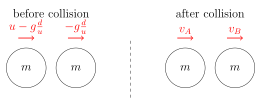
A bicycle pump consists of a cylinder and a piston. The piston is pushed in with steady speed~\(u\). A particle of air moves to and fro between the piston and the end of the cylinder, colliding perfectly elastically with the piston and the end of the cylinder, and always moving parallel with the axis of the cylinder. Initially, the particle is moving towards the piston at speed \(v\). Show that the speed, \(v_n\), of the particle just after the \(n\)th collision with the piston is given by \(v_n=v+2nu\). Let \(d_n\) be the distance between the piston and the end of the cylinder at the \(n\)th collision, and let \(t_n\) be the time between the \(n\)th and \((n+1)\)th collisions. Express \(d_n - d_{n+1}\) in terms of \(u\) and \(t_n\), and show that \[ d_{n+1} = \frac{v+(2n-1)u}{v+(2n+1)u} \, d_n \;. \] Express \(d_n\) in terms of \(d_1\), \(u\), \(v\) and \(n\). In the case \(v=u\), show that \(ut_n = \displaystyle \frac {d_1} {n(n+1)}\). %%%%%Verify that \(\sum\limits_1^\infty t_n = d/u\).
Two particles \(A\) and \(B\) of masses \(m\) and \(km\), respectively, are at rest on a smooth horizontal surface. The direction of the line passing through \(A\) and \(B\) is perpendicular to a vertical wall which is on the other side of \(B\) from \(A\). The particle \(A\) is now set in motion towards \(B\) with speed \(u\). The coefficient of restitution between \(A\) and \(B\) is \(e_1\) and between \(B\) and the wall is \(e_2\). Show that there will be a second collision between \(A\) and \(B\) provided $$ k< \frac {1+e_2(1+e_1)} {e_1}\;. $$ Show that, if \(e_1=\frac13\), \(e_2=\frac12\) and \(k<5\), then the kinetic energy of \(A\) and \(B\) immediately after \(B\) rebounds from the wall is greater than \(mu^2/27\).
Show Solution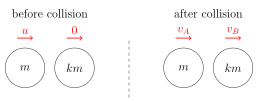
Three particles \(P_1\), \(P_2\) and \(P_3\) of masses \(m_{1}\), \(m_{2}\) and \(m_{3}\) respectively lie at rest in a straight line on a smooth horizontal table. \(P_1\) is projected with speed \(v\) towards \(P_2\) and brought to rest by the collision. After \(P_2\) collides with \(P_3\), the latter moves forward with speed \(v\). The coefficients of restitution in the first and second collisions are \(e\) and \(e'\), respectively. Show that \[ e'= \frac{m_{2}+m_{3}-m_{1}}{m_{1}}. \] Show that \(2m_1\ge m_2 +m_3\ge m_1\) for such collisions to be possible. If \(m_1\), \(m_3\) and \(v\) are fixed, find, in terms of \(m_1\), \(m_3\) and \(v\), the largest and smallest possible values for the final energy of the system.
\(N\) particles \(P_1\), \(P_2\), \(P_3\), \(\ldots\), \(P_N\) with masses \(m\), \(qm\), \(q^2m\), \(\ldots\) , \({q^{N-1}}m\), respectively, are at rest at distinct points along a straight line in gravity-free space. The particle \(P_1\) is set in motion towards \(P_2\) with velocity \(V\) and in every subsequent impact the coefficient of restitution is \(e\), where \(0 < e < 1\). Show that after the first impact the velocities of \(P_1\) and \(P_2\) are $$ {\left({{1-eq}\over{1+q}}\right)}V \mbox{ \ \ \ and \ \ \ } {\left({{1+e}\over{1+q}}\right)}V, $$ respectively. Show that if \(q \le e\), then there are exactly \(N-1\) impacts and that if \(q=e\), then the total loss of kinetic energy after all impacts have occurred is equal to $$ {1\over 2}{me}{\left(1-e^{N-1}\right)}{V^2}. $$
A chain of mass \(m\) and length \(l\) is composed of \(n\) small smooth links. It is suspended vertically over a horizontal table with its end just touching the table, and released so that it collapses inelastically onto the table. Calculate the change in momentum of the \((k+1)\)th link from the bottom of the chain as it falls onto the table. Write down an expression for the total impulse sustained by the table in this way from the whole chain. By approximating the sum by an integral, show that this total impulse is approximately \[ {\textstyle \frac23} m \surd(2gl) \] when \(n\) is large.