Problems
Filters
218 problems found
2017 Paper 2 Q3
- Sketch, on \(x\)-\(y\) axes, the set of all points satisfying \(\sin y = \sin x\), for \(-\pi \le x \le \pi\) and \(-\pi \le y \le \pi\). You should give the equations of all the lines on your sketch.
- Given that \[ \sin y = \tfrac12 \sin x \] obtain an expression, in terms of \(x\), for \(y'\) when \(0\le x \le \frac12 \pi\) and \(0\le y \le \frac12 \pi\), and show that \[ y'' = - \frac {3\sin x}{(4-\sin^2 x)^{\frac32}} \;. \] Use these results to sketch the set of all points satisfying \(\sin y = \tfrac12 \sin x\) for \(0 \le x \le \frac12 \pi\) and \(0 \le y \le \frac12 \pi\). Hence sketch the set of all points satisfying \(\sin y = \tfrac12 \sin x\) for \(-\pi\! \le \! x \! \le \! \pi\) and \mbox{\( -\pi \, \le\, y\, \le\, \pi\,\)}.
- Without further calculation, sketch the set of all points satisfying \(\cos y = \tfrac12 \sin x\) for \(- \pi \le x \le \pi\) and \( -\pi \le y \le \pi\).
Solution:
- \(\,\)
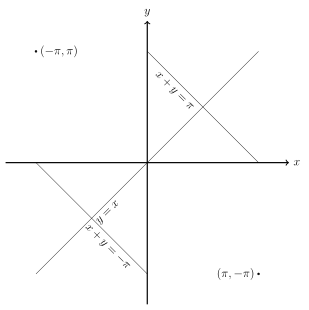
- \(\,\) \begin{align*}
&& \sin y &= \tfrac12 \sin x \\
\Rightarrow && \frac{\d y}{\d x} \cos y &= \tfrac12 \cos x \\
\Rightarrow && \frac{\d y}{\d x} &= \frac{\cos x}{2 \cos y} \\
&&&= \frac{\cos x}{2 \sqrt{1-\sin^2 y}} \\
&&&= \frac{\cos x}{2 \sqrt{1-\frac14 \sin^2 x}} \\
&&&= \frac{\cos x}{\sqrt{4-\sin^2 x}} \\
\\
&& y'' &= \frac{-\sin x \cdot (4-\sin^2 x)^{\frac12} - \cos x \cdot (4-\sin^2 x)^{-\frac12} \cdot 2 \sin x \cos x}{(4-\sin^2 x)} \\
&&&= \frac{-\sin x \cdot (4-\sin^2 x) - \cos x \cdot 2 \sin x \cos x}{(4-\sin^2x)^{\frac32}} \\
&&&= \frac{-\sin x \cdot (4-\sin^2 x) - \sin x (1-\sin^2x)}{(4-\sin^2x)^{\frac32}} \\
&&&= \frac{-3\sin x }{(4-\sin^2x)^{\frac32}} \\
\end{align*}
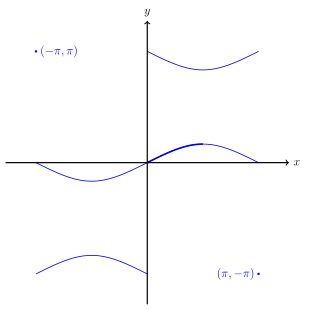
- \(\,\)
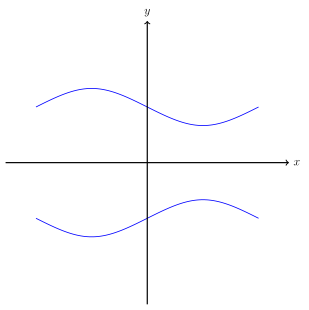
2017 Paper 2 Q7
The functions \(\f\) and \(\g\) are defined, for \(x>0\), by \[ \f(x) = x^x\,, \ \ \ \ \ \g(x) = x^{\f(x)}\,. \]
- By taking logarithms, or otherwise, show that \(\f(x) > x\) for \(0 < x < 1\,\). Show further that \(x < \g(x) < \f(x)\) for \(0 < x < 1\,\). Write down the corresponding results for \(x > 1 \,\).
- Find the value of \(x\) for which \(\f'(x)=0\,\).
- Use the result \(x\ln x \to 0\) as \(x\to 0\) to find \(\lim\limits_{x\to0}\f(x)\), and write down \(\lim\limits_{x\to0}\g(x)\,\).
- Show that \( x^{-1}+\, \ln x \ge 1\,\) for \(x>0\). Using this result, or otherwise, show that \(\g'(x) > 0\,\).
Solution:
- \(\,\) \begin{align*} && \ln f(x) &= x \ln x \\ &&&> \ln x \quad (\text{if } 0 < x < 1)\\ \Rightarrow && f(x) &> x\quad\quad (\text{if } 0 < x < 1)\\ \Rightarrow && x^{f(x)} &< x^x \\ && g(x) &< f(x) \\ && 1&>f(x) \\ \Rightarrow && x &< x^{f(x)} = g(x) \end{align*}
- \(\,\) \begin{align*} && f(x) &= e^{x \ln x} \\ \Rightarrow && f'(x) &= (\ln x + 1)e^{x \ln x} \\ \Rightarrow && f'(x) = 0 &\Leftrightarrow x = \frac1e \end{align*}
- \(\,\) \begin{align*} && \lim_{x \to 0} f(x) &= \lim_{x \to 0} \exp \left ( x \ln x \right ) \\ &&&= \exp \left ( \lim_{x \to 0} \left ( x \ln x \right )\right) \\ &&&= \exp \left ( 0 \right) = 1\\ \\ && \lim_{x \to 0} g(x) &= \lim_{x \to 0} \exp \left ( f(x) \ln x\right) \\ &&&= \exp \left (\lim_{x \to 0} \ln x f(x)\right) \\ &&&= \exp \left (\lim_{x \to 0} \ln x \lim_{x \to 0}f(x)\right) \\ &&&= \exp \left (\lim_{x \to 0} \ln x\right) \\ &&&= 0 \end{align*}
- \(y = x^{-1} + \ln x \Rightarrow y' = -x^{-2} + x^{-1}\) which has roots at \(x =1\), therefore the minimum value is \(1\). (We can see it's a minimum by considering \(x \to 0, x \to \infty\). So \begin{align*} && g'(x) &= x^{f(x)} \cdot (f'(x) \ln x + f(x) x^{-1})\\ &&&= x^{f(x)} \cdot f(x) \cdot ((1+\ln x) \ln x + x^{-1}) \\ &&&= x^{f(x)} \cdot f(x) \cdot (\ln x + x^{-1} + (\ln x)^2) \\ &&&\geq x^{f(x)} \cdot f(x) > 0 \end{align*}
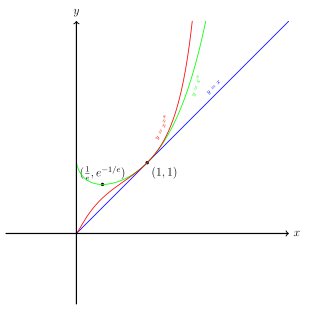
2017 Paper 3 Q5
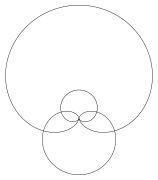
The point with cartesian coordinates \((x,y)\) lies on a curve with polar equation \(r=\f(\theta)\,\). Find an expression for \(\dfrac{\d y}{\d x}\) in terms of \(\f(\theta)\), \(\f'(\theta)\) and \(\tan\theta\,\). Two curves, with polar equations \(r=\f(\theta)\) and \(r=\g(\theta)\), meet at right angles. Show that where they meet \[ \f'(\theta) \g'(\theta) +\f(\theta)\g(\theta) = 0 \,. \] The curve \(C\) has polar equation \(r=\f(\theta)\) and passes through the point given by \(r=4\), \(\theta = - \frac12\pi\). For each positive value of \(a\), the curve with polar equation \(r= a(1+\sin\theta)\) meets~\(C\) at right angles. Find \(\f(\theta)\,\). Sketch on a single diagram the three curves with polar equations \(r= 1+\sin\theta\,\), \ \(r= 4(1+\sin\theta)\) and \(r=\f(\theta)\,\).
Solution: \((x, y) = (f(\theta)\cos(\theta), f(\theta)\sin(\theta))\) so \begin{align*} \frac{dy}{d\theta} &= -f(\theta)\sin(\theta) + f'(\theta)\cos(\theta) \\ \frac{dx}{d\theta} &= f(\theta)\cos(\theta) + f'(\theta)\sin(\theta) \\ \frac{dy}{dx} &= \frac{-f(\theta)\sin(\theta) + f'(\theta)\cos(\theta)}{f(\theta)\cos(\theta) + f'(\theta)\sin(\theta) } \\ &= \frac{-f(\theta)\tan(\theta) + f'(\theta)}{f(\theta) + f'(\theta)\tan(\theta) } \end{align*} If the curves meet at right angles then the product of their gradients is \(-1\), ie \begin{align*} \frac{-f(\theta)\tan(\theta) + f'(\theta)}{f(\theta) + f'(\theta)\tan(\theta) } \cdot \frac{-g(\theta)\tan(\theta) + g'(\theta)}{g(\theta) + g'(\theta)\tan(\theta) } &= -1 \\ f(\theta)g(\theta)\tan^2 \theta - f(\theta)g'(\theta)\tan \theta - f'(\theta)g(\theta)\tan \theta + f'(\theta)g'(\theta) &= \\ \quad - \l f(\theta)g(\theta) + f(\theta)g'(\theta)\tan(\theta) + f'(\theta)g(\theta)\tan(\theta) + f'(\theta)g'(\theta)\tan^2 \theta \r \\ \tan^2\theta \l f(\theta)g(\theta) + f'(\theta)g'(\theta) \r + f'(\theta)g'(\theta) + f(\theta)g(\theta) &= 0 \\ (\tan^2\theta + 1) \l f(\theta)g(\theta) + f'(\theta)g'(\theta) \r &= 0 \\ f(\theta)g(\theta) + f'(\theta)g'(\theta) &= 0 \end{align*} \(g(\theta) = a(1+\sin\theta), g'(\theta) = a\cos\theta\) Therefore \(f'(\theta)a\cos \theta+f(\theta)a(1+\sin(\theta)) = 0\) \begin{align*} && \frac{f'(\theta)}{f(\theta)} &= -\sec(\theta) - \tan(\theta) \\ \Rightarrow && \ln(f(\theta)) &= -\ln |\tan(\theta) + \sec(\theta)| + \ln |\cos(\theta)| + C \\ \Rightarrow && f(\theta) &= A \frac{\cos \theta}{\tan \theta + \sec \theta} \\ &&&= A \frac{\cos^2 \theta}{\sin \theta + 1} \\ &&&= A \frac{1-\sin^2 \theta}{\sin \theta + 1} \\ &&&= A (1-\sin \theta) \end{align*} When \(\theta = -\frac12 \pi, r = 4\), so \(A = 2\).
2016 Paper 1 Q3
In this question, \(\lfloor x \rfloor\) denotes the greatest integer that is less than or equal to \(x\), so that (for example) \(\lfloor 2.9 \rfloor = 2\), \(\lfloor 2\rfloor = 2\) and \(\lfloor -1.5 \rfloor = -2\). On separate diagrams draw the graphs, for \(-\pi \le x \le \pi\), of:
Solution:


2016 Paper 2 Q1
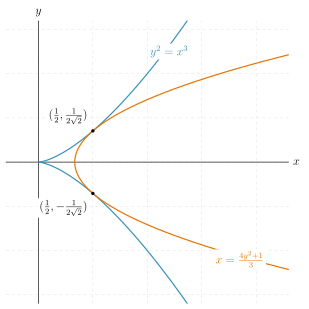
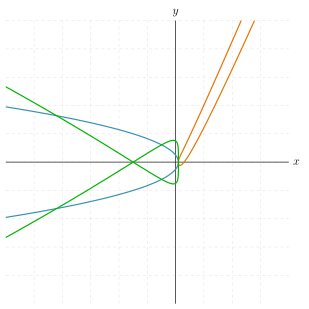
The curve \(C_1\) has parametric equations \(x=t^2\), \(y= t^3\), where \(-\infty < t < \infty\,\). Let \(O\) denote the point \((0,0)\). The points \(P\) and \(Q\) on \(C_1\) are such that \(\angle POQ\) is a right angle. Show that the tangents to \(C_1\) at \(P\) and \(Q\) intersect on the curve \(C_2\) with equation \(4y^2=3x-1\). Determine whether \(C_1\) and \(C_2\) meet, and sketch the two curves on the same axes.
Solution: \(\angle POQ = 90^\circ\) means that if \(P(p^2,p^3)\) and \(Q(q^2,q^3)\) are our points then \(OP^2+OQ^2 = PQ^2\), so \begin{align*} && p^4+p^6+q^4+q^6 &= (p^2-q^2)^2+(p^3-q^3)^2 \\ &&&= p^4+q^4-2p^2q^2+p^6+q^6-2p^3q^3 \\ \Rightarrow && 0 &= 2p^2q^2(1+pq) \\ \Rightarrow && pq &= -1 \\ \\ && \frac{\d y}{ \d x} &= \frac{\frac{\d y }{\d t}}{\frac{\d x}{\d t}} \\ &&&= \frac{3t^2}{2t} = \tfrac32t \\ \Rightarrow && \frac{y-p^3}{x-p^2} &= \tfrac32p \\ \Rightarrow && 2(y-p^3) &=3p(x-p^2) \\ && 2(y-q^3) &=3q(x-q^2) \\ \Rightarrow && 2(q^3-p^3) &= (3p-3q)x+3(q^3-p^3) \\ && p^3-q^3 &= 3(p-q)x \\ \Rightarrow && x &= \tfrac13(p^2+q^2+pq) \\ && 2y &= 3p(\tfrac13(p^2+q^2+pq)-p^2)+2p^3 \\ &&&= p(p^2+q^2+pq)-p^3 \\ &&&= pq^2+p^2q \\ &&&= -p-q \\ &&y&= -\frac{p+q}{2} \\ \\ && 4y^2 &= p^2+q^2 \\ && 3x-1 &= p^2+q^2 \\ \end{align*} To check if they meet, try \(4t^6=3t^2 - 1\). Consider \(y = 4x^3-3x+1\) \(y(0) = 1\) and \(y' = 12x^2-3 = 3(4x^2-1)\) which has roots at \(\pm \tfrac12\), therefore we need to test \(y(\tfrac12) = \tfrac12-\tfrac32 + 1 = 0\), so there is a one intersection at \(x = \tfrac1{2}, y = \tfrac1{2\sqrt{2}}\)
2016 Paper 2 Q3
For each non-negative integer \(n\), the polynomial \(\f_n\) is defined by \[ \f_n(x) = 1 + x + \frac{x^2}{2!} + \frac {x^3}{3!} + \cdots + \frac{x^n}{n!} \]
- Show that \(\f'_{n}(x) = \f_{n-1}(x)\,\) (for \(n\ge1\)).
- Show that, if \(a\) is a real root of the equation \[\f_n(x)=0\,,\tag{\(*\)}\] then \(a<0\).
- Let \(a\) and \(b\) be distinct real roots of \((*)\), for \(n\ge2\). Show that \(\f_n'(a)\, \f_n'(b)>0\,\) and use a sketch to deduce that \(\f_n(c)=0\) for some number \(c\) between \(a\) and \(b\). Deduce that \((*)\) has at most one real root. How many real roots does \((*)\) have if \(n\) is odd? How many real roots does \((*)\) have if \(n\) is even?
Solution:
- \(\,\) \begin{align*} && f'_n(x) &= 0 + 1 + \frac{2x}{2!} + \frac{3x^2}{3!} + \cdots + \frac{nx^{n-1}}{n!} \\ &&&= 1 + x + \frac{x^2}{2!} + \frac{x^3}{3!} + \cdots + \frac{x^{n-1}}{(n-1)!} \\ &&&= f_{n-1}(x) \end{align*}
- Claim: \(f_n(x) > 0\) for all \(x > 0\) Proof: (By induction) Base case: (\(n = 1\)) \(f_1(x) = 1 + x > 1\) therefore \(f_1(x) > 0\) Suppose it's true for \(n = k\), then consider \(f_{k+1}\), if we differentiate it, we find it is increasing on \((0, \infty)\) by our inductive hypothesis. But then \(f_{k+1}(0) = 1 > 0\). Therefore \(f_{k+1}(x) > 0\) as well. Therefore by the principle of mathematical induction we are done. Since \(f_n(x) > 0\) for non-negative \(x\), if \(a\) is a root it must be negative.
- Suppose \(f_n(a) = f_n(b) = 0\) then \(f'_n(a) = -\frac{a^n}{n!}\) and \(f'_n(b) = -\frac{b^n}{n!}\), but then \(f_n'(a) f_n'(b) = \frac{(-a)^n(-b)^n}{(n!)^2} > 0\) since \(a < 0, b < 0\). \(_n'(a) f_n'(b)\) is positive, the two gradients must have the same sign (and not be zero). Therefore if they are both increasing, at some point the curve must cross the axis in between. Therefore there is some root \(c\) between \(a\) and \(b\). But then there is also a root between \(c\) and \(a\) and \(c\) and \(b\), and very quickly we find more than \(n\) roots which is not possivel. Therefore there must be at most \(1\) root. If \(n\) is odd there must be exactly one root, since \(f_n\) changes sign as \(x \to -\infty\) vs \(x = 0\). If \(n\) is even then there can't be any roots, since if it crossed the \(x\)-axis there would be two roots (not possible) and it cannot touch the axis, since \(f'_n(a) \neq 0\) unless \(a = 0\), and we know \(a < 0\)
2016 Paper 2 Q8
Evaluate the integral \[ \hphantom{ \ \ \ \ \ \ \ \ \ (m> \tfrac12)\,.} \int_{m-\frac12} ^\infty \frac 1{x^2}\, \d x { \ \ \ \ \ \ \ \ \ (m > \tfrac12)\,.} \] Show by means of a sketch that \[ \sum_{r=m}^n \frac 1 {r^2} \approx \int_{m-\frac12}^{n+\frac12} \frac1 {x^2} \, \d x \,, \tag{\(*\)} \] where \(m\) and \(n\) are positive integers with \(m < n\).
- You are given that the infinite series \(\displaystyle \sum_{r=1}^\infty \frac 1 {r^2}\) converges to a value denoted by \(E\). Use \((*)\) to obtain the following approximations for \(E\): \[ E\approx 2\,; \ \ \ \ E\approx \frac53\,; \ \ \ \ E\approx \frac{33}{20} \,.\]
- Show that, when \(r\) is large, the error in approximating \(\dfrac 1{r^2}\) by \(\displaystyle \int_{r-\frac12}^{r+\frac12} \frac 1 {x^2} \, \d x\) is approximately \(\dfrac 1{4r^4}\,\). Given that \(E \approx 1.645\), show that \(\displaystyle \sum_{r=1}^\infty \frac1{r^4} \approx 1.08\, \).
Solution: \begin{align*} && \int_{m-\frac12}^\infty \frac{1}{x^2} \d x &= \lim_{K \to \infty} \left [ -x^{-1} \right]_{m-\frac12}^K \\ &&&= \frac{1}{m-\frac12} - \lim_{K \to \infty }\frac{1}K \\ &&&= \frac{1}{m-\frac12} \end{align*}

- \(\,\) \begin{align*} E &\approx \int_{1-\frac12}^\infty \frac1{x^2} \d x = \frac{1}{1-\frac12} = 2 \\ E &\approx 1 + \int_{2-\frac12}^\infty \frac1{x^2} \d x= 1 + \frac{1}{2 - \frac12} = \frac53 \\ E &\approx 1 +\frac14 + \int_{3-\frac12}^\infty \frac1{x^2} \d x= \frac54 + \frac{1}{3-\frac12} \\ &= \frac54+\frac{2}{5} = \frac{33}{20} \end{align*}
- The error is \begin{align*} && \epsilon &= \int_{r-\frac12}^{r+\frac12} \frac 1 {x^2} \, \d x - \frac1{r^2} \\ &&&= \frac{1}{r-\frac12} - \frac{1}{r + \frac12} - \frac1{r^2} \\ &&&= \frac{1}{r^2 - \frac14} - \frac1{r^2} \\ &&&= \frac{\frac14}{r^2(r^2-\frac14)} \\ &&&\approx \frac{1}{4r^4} \end{align*} Therefore \begin{align*} && \sum_{n=1}^\infty \frac1{r^4} &\approx 4 \left ( 1 +\frac14 + \int_{3-\frac12}^\infty \frac1{x^2} \d x-\sum_{r=1}^\infty \frac{1}{r^2} \right) + 1 + \frac{1}{2^4}\\ &&&= 4 \left ( \frac{33}{20}-1.645 \right) + 1 + \frac{1}{2^4} \\ &&&= 4 \left ( 1.65-1.645 \right) + 1 + \frac{1}{2^4} \\ &&&= 1.0825 \approx 1.08 \end{align*}
2015 Paper 1 Q1
- Sketch the curve \(y = \e^x (2x^2 -5x+ 2)\,.\) Hence determine how many real values of \(x\) satisfy the equation \(\e^x (2x^2 -5x+ 2)= k\) in the different cases that arise according to the value of \(k\). {\em You may assume that \(x^n \e^x\to 0\) as \(x\to-\infty\) for any integer \(n\).}
- Sketch the curve \(\displaystyle y = \e^{x^2} (2x^4 -5x^2+ 2)\,\).
Solution:
- \(y = e^x(2x^2-5x+2) = e^x(2x-1)(x-2)\), we also have \(y' = e^x(2x^2-5x+2 + 4x-5) = e^x(2x^2-x-3) = e^x(2x-3)(x+1)\)
\(y(-1) = \frac{9}{e}\), \(y(\frac32) = -e^{3/2}\)
If \(k < -e^{3/2}\) there are no solutions. If \(k = -e^{3/2}\) there is a unique solution. If \(-e^{3/2} < k \leq 0\) there are two solutions. If \(0 < k < \frac{9}{e}\) there are three solutions. Otherwise there is a unique solution.


2015 Paper 1 Q5
- The function \(\f\) is defined, for \(x>0\), by \[ \f(x) =\int_{1}^3 (t-1)^{x-1} \, \d t \,. \] By evaluating the integral, sketch the curve \(y=\f(x)\).
- The function \(\g\) is defined, for \(-\infty < x < \infty\), by \[ \g(x)= \int_{-1}^1 \frac 1 {\sqrt{1-2xt +x^2} \ }\, \d t \,.\] By evaluating the integral, sketch the curve \(y=\g(x)\).
Solution:
- \(\,\)
\begin{align*}
&& f(x) &= \int_1^3 (t-1)^{x-1} \d t \\
&&&= \left [ \frac1x(t-1)^{x} \right]_1^3 \\
&&&= \frac{2^x}{x}
\end{align*}

- \(\,\)
\begin{align*}
&& g(x) &= \int_{-1}^1 \frac{1}{\sqrt{1-2xt+x^2}} \d t \\
&&&= \left [ -\frac{1}{x}(1 +x^2 - 2xt)^{\frac12} \right]_{-1}^1 \\
&&&= \frac1x \left ( \sqrt{1+x^2+2x}-\sqrt{1+x^2-2x}\right) \\
&&&= \frac1x \left ( |1+x|-|1-x| \right)
\end{align*}

2015 Paper 2 Q4
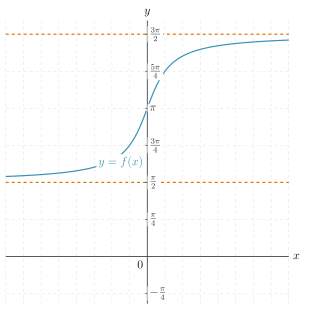
- The continuous function \(\f\) is defined by \[ \tan \f(x) = x \ \ \ \ \ (-\infty < x <\infty) \] and \(\f(0)=\pi\). Sketch the curve \(y=\f(x)\).
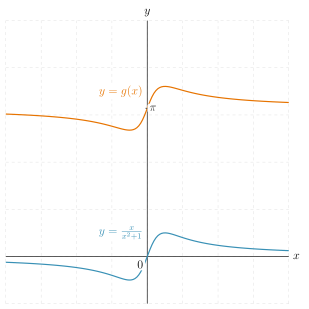
- The continuous function \(\g\) is defined by \[ \tan \g(x) = \frac x {1+x^2} \ \ \ \ \ \ (-\infty < x <\infty) \] and \(\g(0)=\pi\). Sketch the curves \(y= \dfrac x {1+x^2} \ \) and \(y=\g(x)\).
- The continuous function \(\h \) is defined by \(\h (0)=\pi\) and \[ \tan \h (x)= \frac x {1-x^2}\, \ \ \ \ \ (x \ne \pm 1) \,. \] (The values of \(\h (x)\) at \(x=\pm1\) are such that \(\h (x)\) is continuous at these points.) Sketch the curves \(y= \dfrac x {1-x^2} \ \) and \(y=\h (x)\).
- [Not on original exam] The continuous functions \(\h_1\) and \(\h_2\) are defined by: \(\h_1(0)=\h_2(0)=\pi \), \[ \tan \h_1(x) = \frac {x+x^4} {1+x^2+x^4} \ \ \ \ \ \text{and} \ \ \ \ \ \ \tan \h_2(x) = \frac {4x-x^3} {1-x^4} \,. \] for values of \(x\) at which the right hand sides are defined. Find \(\lim\limits_{x\to\infty}\h_1(x)\) and \(\lim\limits_{x\to\infty}\h_2(x)\,\).
Solution:
- \(\,\)
- \(\,\)
- \(\,\)
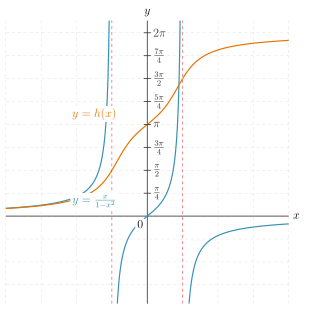
- Note that \(\frac{x+x^4}{1+x^2+x^4}\) is continuous, and nicely behaved on \((-\infty, \infty)\) so we can see that \(\lim_{x \to \infty} h_1(x) = \pi + \frac{\pi}{4} = \frac{5\pi}{4}\). \(\frac{4x-x^3}{1-x^4}\) on the other hand has asymptotes at \(\pm 1\). So as as \(x \to 1\), \(h_1(x) \to \pi + \frac{\pi}{2} = \frac{3\pi}{2}\). Then as \(x \to \infty\) we increase by another \(\frac{\pi}{2}\), so \(\lim_{x \to \infty} h_2(x) = 2\pi\)
2015 Paper 3 Q3
In this question, \(r\) and \(\theta\) are polar coordinates with \(r \ge0\) and \(- \pi < \theta\le \pi\), and \(a\) and \(b\) are positive constants. Let \(L\) be a fixed line and let \(A\) be a fixed point not lying on \(L\). Then the locus of points that are a fixed distance (call it \(d\)) from \(L\) measured along lines through \(A\) is called a conchoid of Nicomedes.
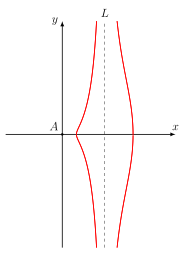
- Show that if \[ \vert r- a \sec\theta \vert = b\,, \tag{\(*\)} \] where \(a>b\), then \(\sec\theta >0\). Show that all points with coordinates satisfying (\(*\)) lie on a certain conchoid of Nicomedes (you should identify \(L\), \(d\) and \(A\)). Sketch the locus of these points.
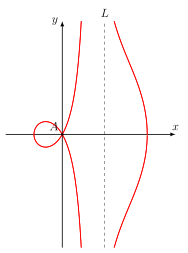
- In the case \(a < b\), sketch the curve (including the loop for which \(\sec\theta<0\)) given by \[ \vert r- a \sec\theta \vert = b\, . \] Find the area of the loop in the case \(a=1\) and \(b=2\). [Note: $ %\displaystyle \int \! \sec\theta \,\d \theta = \ln \vert \sec\theta + \tan\theta \vert + C \,. $]
Solution:
- \(r = a \sec \theta \pm b\). The points on \(r = a \sec \theta \Leftrightarrow r \cos \theta = a \Leftrightarrow x = a\) are points on the line \(x = a\). Therefore points on the curve \(r = a \sec \theta \pm b\) are points which are a distance \(b\) from the line \(x = a\) measured towards \(O\). So \(A\) is the origin and \(d = b\).
- The loop starts and ends when \(r = a \sec \theta - b = 0 \Rightarrow \cos \theta = \frac{a}{b}\), so when \(a = 1, b = 2\), this is \(-\frac{\pi}{3}\) to \(\frac{\pi}{3}\) \begin{align*} && A &= \frac12 \int r^2 \d \theta \\ &&&= \frac12 \int_{-\pi/3}^{\pi/3} \left ( \sec \theta - 2 \right)^2 \d \theta \\ &&&= \frac12 \int_{-\pi/3}^{\pi/3} \left (\sec^2 \theta - 4 \sec \theta + 4\right)\d \theta \\ &&&= \frac12 \left [ \tan \theta -4 \ln | \sec \theta + \tan \theta| + 4 \theta \right]_{-\pi/3}^{\pi/3} \\ &&&= \frac12 \left (\left (\tan \frac{\pi}3 - 4 \ln | \sec \frac{\pi}3 + \tan \frac{\pi}3 | + 4\left ( \frac{\pi}3 \right)\right) - \left (\tan \left (-\frac{\pi}3 \right) - 4 \ln | \sec \left (-\frac{\pi}3 \right)+ \tan\left ( -\frac{\pi}3 \right) | + 4\left ( -\frac{\pi}3 \right)\right) \right) \\ &&&= \frac12 \left ( 2\sqrt{3} - 4 \ln |2 + \sqrt{3}| + 4 \ln |2-\sqrt{3}| + \frac{8\pi}3 \right) \\ &&&= \sqrt{3} + 2\ln \frac{2-\sqrt{3}}{2+\sqrt{3}} + \frac{4\pi}3 \\ &&&= \sqrt{3} + 4 \ln (2 - \sqrt{3})+ \frac{4\pi}3 \end{align*}
2015 Paper 3 Q8
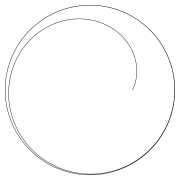
- Show that under the changes of variable \(x= r\cos\theta\) and \(y = r\sin\theta\), where \(r\) is a function of \(\theta\) with \(r>0\), the differential equation \[ (y+x)\frac{\d y}{\d x} = y-x \] becomes \[ \frac{\d r}{\d\theta} + r=0 \,. \] Sketch a solution in the \(x\)-\(y\) plane.
- Show that the solutions of \[ \left( y+x -x(x^2+y^2) \right) \, \frac{\d y }{\d x} = y-x - y(x^2+y^2) \] can be written in the form \\ \[ r^2 = \dfrac 1 {1+A\e^{2\theta}}\, \]\\ and sketch the different forms of solution that arise according to the value of \(A\).
Solution:
- \begin{align*}
&& (y+x)\frac{\d y}{\d x} &= y-x \\
\Rightarrow && (r \sin \theta + r \cos\theta) \frac{\frac{dy}{d\theta}}{\frac{dx}{d\theta}} &= (r \sin\theta - r \cos\theta) \\
\Rightarrow && ( \sin \theta + \cos\theta) \frac{dy}{d\theta} &= (\sin\theta - \cos\theta){\frac{dx}{d\theta}} \\
\Rightarrow && ( \sin \theta + \cos\theta) \left ( \frac{dr}{d\theta} \cos \theta - r \sin \theta\right ) &= (\sin\theta - \cos\theta)\left ( \frac{dr}{d\theta} \sin\theta + r \cos \theta\right) \\
\Rightarrow && \frac{dr}{d\theta} \left (\sin \theta \cos \theta + \cos^2 \theta - \sin^2 \theta + \sin \theta \cos \theta \right)&= r \left (\sin \theta \cos \theta - \cos^2 \theta + \sin^2 \theta + \sin\theta \cos \theta\right) \\
\Rightarrow && \frac{dr}{d\theta}&= -r \\
\end{align*}
Therefore \(r = Ae^{-\theta}\)

- \begin{align*}
&& \left( y+x -x(x^2+y^2) \right) \, \frac{\d y }{\d x} &= y-x - y(x^2+y^2) \\
\Rightarrow && \left( r \sin \theta+r\cos \theta -r^3\cos \theta \right) \, \frac{\d y }{\d \theta} &= \left ( r \sin \theta- r \cos \theta- r^3\sin \theta \right)\frac{\d x }{\d \theta} \\
\Rightarrow && \left( r \sin \theta+r\cos \theta -r^3\cos \theta \right) \, \left (\frac{\d r}{\d \theta} \sin \theta + r \cos \theta \right) &= \\
&& \left ( r \sin \theta- r \cos \theta- r^3\sin \theta \right)&\left (\frac{\d r}{\d \theta} \cos \theta - r \sin \theta \right) \\
\Rightarrow && \frac{\d r}{\d \theta} \left (\sin \theta ( \sin \theta + \cos \theta - r^2 \cos \theta) - \cos \theta (\sin \theta - \cos \theta - r^2 \sin \theta) \right) &= \\
&& r ( -\sin \theta (\sin \theta - \cos \theta - r^2 \sin \theta) - \cos \theta ( \sin \theta + \cos \theta &- r^2 \cos \theta)) \\
\Rightarrow && \frac{\d r}{\d \theta} &= r ( -1 +r^2) \\
\Rightarrow && \int \frac{1}{r(r-1)(r+1)} \d r &= \int \d \theta \\
\Rightarrow && \int \l \frac{-1}{r} + \frac{1}{2(r-1)} + \frac{1}{2(r+1)} \r \d r &= \int \d \theta \\
\Rightarrow && \l -\log r+ \frac12 \log (1+r)+ \frac12 \log (1-r)\r + C &= \theta \\
\Rightarrow && \frac12 \log \left (\frac{1-r^2}{r^2} \right) + C &= \theta \\
\Rightarrow && \log \left (\frac{1}{r^2}-1 \right) + C &= 2\theta \\
\Rightarrow && r &= \frac{1}{1 + Ae^{2\theta}} \\
\end{align*}


2014 Paper 1 Q2
- Show that \(\int \ln (2-x) \d x = -(2-x)\ln (2-x) + (2-x) + c \,,\ \) where \(x<2\).
- Sketch the curve \(A\) given by \(y= \ln \vert x^2-4\vert\).
- Show that the area of the finite region enclosed by the positive \(x\)-axis, the \(y\)-axis and the curve \(A\) is \(4\ln(2+\sqrt3)-2\sqrt3\,\).
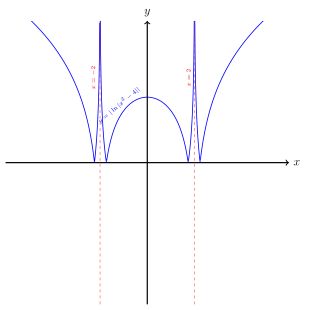
- The curve \(B\) is given by \(y= \vert \ln \vert x^2-4\vert \vert\,\). Find the area between the curve \(B\) and the \(x\)-axis with \(| x| <2\). Note: you may assume that \(t \ln t \to 0\) as \(t\to 0\).
Solution:
- \(\,\) \begin{align*} && \int \ln (2- x) \d x &= \left [ (x-2) \ln (2- x) \right] - \int -\frac{x-2}{2-x} \d x \\ && \int \ln (2- x) \d x &= \left [ (x-2) \ln (2- x) \right] + \int 1 \d x \\ &&&= -(2-x) \ln (2-x) +(2-x) + C \end{align*}
- \(\,\)
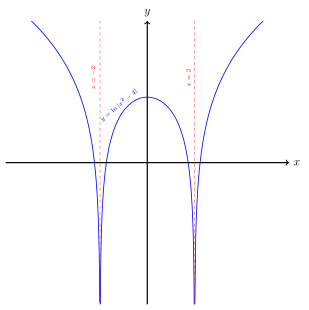
- \begin{align*} && \text{Area} &= \int_0^{\sqrt{3}} \ln | x^2 - 4 | \d x \\ &&&= \int_0^\sqrt{3} \ln(4-x^2) \d x \\ &&&= \int_0^\sqrt{3} \left ( \ln(2-x) + \ln (2+x) \right) \d x \\ &&&= \left [ -(2-x) \ln (2-x) +(2-x) +(2+x)\ln(2+x)-(2+x)\right]_0^{\sqrt{3}} \\ &&&= \left ( -(2-\sqrt{3}) \ln (2-\sqrt{3}) +(2-\sqrt{3}) +(2+\sqrt{3})\ln(2+\sqrt{3})-(2+\sqrt{3}) \right) - \\ &&&\quad \quad \left (- 2\ln (2)+2 +2\ln(2)-2 \right) \\ &&&=\left ( -(2-\sqrt{3}) \ln \left ( \frac{1}{2+\sqrt{3}} \right) -2\sqrt{3} +(2+\sqrt{3})\ln(2+\sqrt{3}) \right) \\ &&&= 4\ln(2 + \sqrt{3}) - 2 \sqrt{3} \end{align*}
- \begin{align*} && \text{Area} &= 2 \left ( \int_0^\sqrt{3} \ln (4-x^2) \d x - \lim_{t \to 2}\int_{\sqrt{3}}^t \ln(4-x^2) \d x \right) \\ &&&= 8\ln(2 + \sqrt{3})-4\sqrt{3} - 2 \lim_{t \to 2}\int_{\sqrt{3}}^t \left ( \ln (2-x) + \ln (2+x) \right) \d x \\ &&&= 8\ln(2 + \sqrt{3})-4\sqrt{3} - 2 \lim_{t \to 2} \left [ -(2-x) \ln (2-x) +(2-x) +(2+x)\ln(2+x)-(2+x)\right]_{\sqrt{3}}^{t} \\ &&&= 16 \ln(2+\sqrt{3})-8\sqrt{3} - 2 \lim_{t \to 2} \left(-(2-t) \ln (2-t) +(2-t) +(2+t)\ln(2+t)-(2+x) \right) \\ &&&= 16 \ln(2+\sqrt{3})-8\sqrt{3} -2(4 \ln4-4) \\ &&&= 16 \ln(2 + \sqrt{3}) - 16 \ln 2 +8(1-\sqrt{3}) \end{align*}
2014 Paper 1 Q3
The numbers \(a\) and \(b\), where \(b > a\ge0\), are such that \[ \int_a^b x^2 \d x = \left ( \int_a^b x \d x\right)^{\!\!2}\,. \]
- In the case \(a=0\) and \(b>0\), find the value of \(b\).
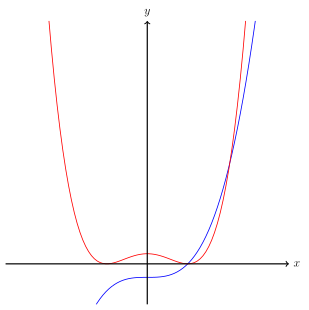
- In the case \(a=1\), show that \(b\) satisfies \[ 3b^3 -b^2-7b -7 =0\,. \] Show further, with the help of a sketch, that there is only one (real) value of \(b\) that satisfies this equation and that it lies between \(2\) and \(3\).
- Show that \(3p^2 + q^2 = 3p^2q\), where \(p=b+a\) and \(q=b-a\), and express \(p^2\) in terms of \(q\). Deduce that \(1< b-a\le\frac43\).
Solution:
- \(\,\) \begin{align*} && \int_0^b x^2 \d x &= \left ( \int_0^b x \d x \right)^2 \\ \Rightarrow && \frac{b^3}{3} &= \left ( \frac{b^2}{2} \right)^2 \\ \Rightarrow && b &= \frac{4}{3} \end{align*}
- \(\,\)
\begin{align*}
&& \int_1^b x^2 \d x &= \left ( \int_1^b x \d x \right)^2 \\
\Rightarrow && \frac{b^3}{3} - \frac{1}{3} &= \left ( \frac{b^2}{2} - \frac{1}{2} \right)^2 \\
\Rightarrow && 4(b^3 - 1) &= 3(b^2-1)^2 \\
\Rightarrow && 4(b^3-1) &= 3(b^4-2b^2+1) \\
\Rightarrow && 0 &= 3b^4-4b^3-6b^2+7 \\
&&&= (b-1)(3b^3-b^2-7b-7) \\
\Rightarrow && 0 &= 3b^3-b^2-7b-7
\end{align*}
Let \(f(x) = 3x^3-x^2-7x-7\) then \(f(2) = 3 \cdot 8 - 4 - 14 - 7 = -1 < 0\), \(f(3) = 3 \cdot 27 - 9 - 21 - 7 = 44 > 0\) therefore the root must lie between \(2\) and \(3\).
- \(,\) \begin{align*} && \int_a^b x^2 \d x &= \left ( \int_a^b x \d x \right)^2 \\ \Rightarrow && \frac{b^3}{3} - \frac{a^3}{3} &= \left ( \frac{b^2}{2} - \frac{a^2}{2} \right)^2 \\ \Rightarrow && 4(b^3 - a^3) &= 3(b^2-a^2)^2 \\ \Rightarrow && 4(b^2+ab+a^2) &= 3(b-a)(b+a)^2 \\ \Rightarrow && 4 \left ( \left ( \frac{p+q}{2}\right)^2+\left ( \frac{p+q}{2}\right)\left ( \frac{p-q}{2}\right)+\left ( \frac{p-q}{2}\right)^2\right) &= 3qp^2 \\ \Rightarrow && 3p^2 + q^2 &= 3qp^2 \\ \Rightarrow && 3p^2(q-1) &= q^2 \\ \Rightarrow && p^2 &= \frac{q^2}{3(q-1)} \\ \Rightarrow && 1 &\leq \frac{1}{3(q-1)} \\ \Rightarrow && 3(q-1) &\leq 1 \\ \Rightarrow && q & \leq \frac{4}{3} \\ \end{align*}
2014 Paper 1 Q5
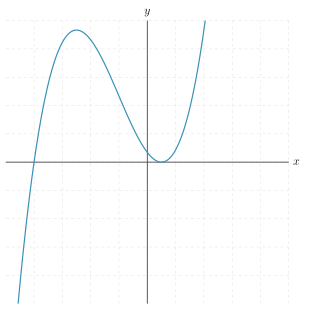
- Let \(f(x) = (x+2a)^3 -27 a^2 x\), where \(a\ge 0\). By sketching \(f(x)\), show that \(f(x)\ge 0\) for \(x \ge0\).
- Use part (i) to find the greatest value of \(xy^2\) in the region of the \(x\)-\(y\) plane given by \(x\ge0\), \(y\ge0\) and \(x+2y\le 3\,\). For what values of \(x\) and \(y\) is this greatest value achieved?
- Use part (i) to show that \((p+q+r)^3 \ge 27pqr\) for any non-negative numbers \(p\), \(q\) and \(r\). If \((p+q+r)^3 = 27pqr\), what relationship must \(p\), \(q\) and \(r\) satisfy?
Solution:
- Note that \(f(x) = (x+2a)^3 - 27a^2x\) so \(f'(x) = 3(x+2a)^2-27a^2 = 3x^2+12ax-15a^2 = (x-a)(3x+15a)\) so the turning points are at \(x = a, x = -5a\). But \(f(a) = 0\), so the curve just touches the \(x\)-axis. Note also that \(f(0) = 8a^3 \geq 0\) so:
- \(\,\) \begin{align*} && 0 &\leq (x+2y)^3 - 27y^2 x \\ &&& \leq 3^3 - 27 y^2 x \\ &&&= 27(1-y^2x) \\ \Rightarrow && xy^2 &\leq1 \end{align*} with equality when \(x = y = 1\)
- Notice that \begin{align*} && 0 &\leq (p+q+r)^3 - 27\left (\frac{q+r}{2}\right)^2 p \\ \Rightarrow && (p+q+r)^3 &\geq 27\left (\frac{q+r}{2}\right)^2 p \\ &&&\underbrace{\geq}_{AM-GM} 27\left (\sqrt{qr}\right)^2 p \\ &&&= 27pqr \end{align*} Equality can only hold if \(p = \frac{q+r}{2}\), but by symmetry we must also have \(q = \frac{r+p}{2}, r = \frac{p+q}{2}\) ie \(p = q = r\). And indeed equality does hold in this case.