2014 Paper 1 Q3
Year: 2014
Paper: 1
Question Number: 3
Course: LFM Pure
Section: Integration
Problem
- In the case \(a=0\) and \(b>0\), find the value of \(b\).
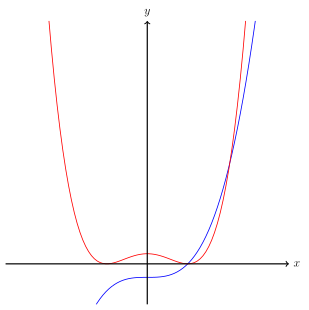
- In the case \(a=1\), show that \(b\) satisfies \[ 3b^3 -b^2-7b -7 =0\,. \] Show further, with the help of a sketch, that there is only one (real) value of \(b\) that satisfies this equation and that it lies between \(2\) and \(3\).
- Show that \(3p^2 + q^2 = 3p^2q\), where \(p=b+a\) and \(q=b-a\), and express \(p^2\) in terms of \(q\). Deduce that \(1< b-a\le\frac43\).
Solution
- \(\,\) \begin{align*} && \int_0^b x^2 \d x &= \left ( \int_0^b x \d x \right)^2 \\ \Rightarrow && \frac{b^3}{3} &= \left ( \frac{b^2}{2} \right)^2 \\ \Rightarrow && b &= \frac{4}{3} \end{align*}
- \(\,\)
\begin{align*}
&& \int_1^b x^2 \d x &= \left ( \int_1^b x \d x \right)^2 \\
\Rightarrow && \frac{b^3}{3} - \frac{1}{3} &= \left ( \frac{b^2}{2} - \frac{1}{2} \right)^2 \\
\Rightarrow && 4(b^3 - 1) &= 3(b^2-1)^2 \\
\Rightarrow && 4(b^3-1) &= 3(b^4-2b^2+1) \\
\Rightarrow && 0 &= 3b^4-4b^3-6b^2+7 \\
&&&= (b-1)(3b^3-b^2-7b-7) \\
\Rightarrow && 0 &= 3b^3-b^2-7b-7
\end{align*}
Let \(f(x) = 3x^3-x^2-7x-7\) then \(f(2) = 3 \cdot 8 - 4 - 14 - 7 = -1 < 0\), \(f(3) = 3 \cdot 27 - 9 - 21 - 7 = 44 > 0\) therefore the root must lie between \(2\) and \(3\).
- \(,\) \begin{align*} && \int_a^b x^2 \d x &= \left ( \int_a^b x \d x \right)^2 \\ \Rightarrow && \frac{b^3}{3} - \frac{a^3}{3} &= \left ( \frac{b^2}{2} - \frac{a^2}{2} \right)^2 \\ \Rightarrow && 4(b^3 - a^3) &= 3(b^2-a^2)^2 \\ \Rightarrow && 4(b^2+ab+a^2) &= 3(b-a)(b+a)^2 \\ \Rightarrow && 4 \left ( \left ( \frac{p+q}{2}\right)^2+\left ( \frac{p+q}{2}\right)\left ( \frac{p-q}{2}\right)+\left ( \frac{p-q}{2}\right)^2\right) &= 3qp^2 \\ \Rightarrow && 3p^2 + q^2 &= 3qp^2 \\ \Rightarrow && 3p^2(q-1) &= q^2 \\ \Rightarrow && p^2 &= \frac{q^2}{3(q-1)} \\ \Rightarrow && 1 &\leq \frac{1}{3(q-1)} \\ \Rightarrow && 3(q-1) &\leq 1 \\ \Rightarrow && q & \leq \frac{4}{3} \\ \end{align*}
Examiner's report
— 2014 STEP 1, Question 3More than 1800 candidates sat this paper, which represents another increase in uptake for this STEP paper. The impression given, however, is that many of these extra candidates are just not sufficiently well prepared for questions which are not structured in the same way as are the A-level questions that they are, perhaps, more accustomed to seeing. Although STEP questions try to give all able candidates "a bit of an intro." into each question, they are not intended to be easy, and (at some point) imagination and real flair (as well as determination) are required if one is to score well on them. In general, it is simply not possible to get very far into a question without making some attempt to think about what is actually going on in the situation presented therein; and those students who expect to be told exactly what to do at each stage of a process are in for a shock. Too many candidates only attempt the first parts of many questions, restricting themselves to 3-6 marks on each, rather than trying to get to grips with substantial portions of work – the readiness to give up and try to find something else that is "easy pickings" seldom allows such candidates to acquire more than 40 marks (as was the case with almost half of this year's candidature, in fact). Poor preparation was strongly in evidence – curve-sketching skills were weak, inequalities very poorly handled, algebraic capabilities (especially in non-standard settings) were often pretty poor, and the ability to get to grips with extended bits of working lacking in the extreme; also, an unwillingness to be imaginative and creative, allied with a lack of thoroughness and attention to detail, made this a disappointing (and, possibly, very uncomfortable) experience for many of those students who took the paper. On the other side of the coin, there was a very pleasing number of candidates who produced exceptional pieces of work on 5 or 6 questions, and thus scored very highly indeed on the paper overall. Around 100 of them scored 90+ marks of the 120 available, and they should be very proud of their performance – it is a significant and noteworthy achievement.
Rating Information
Difficulty Rating: 1500.0
Difficulty Comparisons: 0
Banger Rating: 1484.0
Banger Comparisons: 1
Show LaTeX source
Problem source
The numbers $a$ and $b$, where $b > a\ge0$,  are such that
  \[
  \int_a^b x^2 \d x = \left ( \int_a^b x \d x\right)^{\!\!2}\,.
  \]
  \begin{questionparts}
  \item In the case $a=0$ and $b>0$, find the  value of $b$.
  \item In the case $a=1$, show that $b$ satisfies
    \[
    3b^3 -b^2-7b -7 =0\,.
    \]
    Show further, with the help of a sketch, that there is only one
    (real) value of $b$ that satisfies this equation and that it lies
    between $2$ and $3$.
  \item Show that  $3p^2 + q^2 = 3p^2q$,
    where $p=b+a$ and $q=b-a$, and express $p^2$ in terms of $q$.
   Deduce that $1< b-a\le\frac43$.
  \end{questionparts}
Solution source
\begin{questionparts}
\item $\,$
\begin{align*}
&& \int_0^b x^2 \d x &= \left ( \int_0^b x \d x \right)^2 \\
\Rightarrow && \frac{b^3}{3} &= \left ( \frac{b^2}{2} \right)^2 \\
\Rightarrow && b &= \frac{4}{3}
\end{align*}

\item $\,$
\begin{align*}
&& \int_1^b x^2 \d x &= \left ( \int_1^b x \d x \right)^2 \\
\Rightarrow && \frac{b^3}{3} - \frac{1}{3} &= \left ( \frac{b^2}{2} - \frac{1}{2} \right)^2 \\
\Rightarrow && 4(b^3 - 1) &= 3(b^2-1)^2 \\
\Rightarrow && 4(b^3-1) &= 3(b^4-2b^2+1) \\
\Rightarrow && 0 &= 3b^4-4b^3-6b^2+7 \\
&&&= (b-1)(3b^3-b^2-7b-7) \\
\Rightarrow && 0 &= 3b^3-b^2-7b-7
\end{align*}


\begin{center}
    \begin{tikzpicture}
    \def\functionf(#1){((#1)^3/3 - 1/3)};
    \def\functiong(#1){((#1)^2/2 - 1/2)^2};
    \def\xl{-3.5};
    \def\xu{3.5};
    \def\yl{-1};
    \def\yu{6};

    % Calculate scaling factors to make the plot square
    \pgfmathsetmacro{\xrange}{\xu-\xl}
    \pgfmathsetmacro{\yrange}{\yu-\yl}
    \pgfmathsetmacro{\xscale}{10/\xrange}
    \pgfmathsetmacro{\yscale}{10/\yrange}

    % Define the styles for the axes and grid
    \tikzset{
        axis/.style={very thick, ->},
        grid/.style={thin, gray!30},
        x=\xscale cm,
        y=\yscale cm
    }

    % Define the bounding region with clip
    \begin{scope}
        % You can modify these values to change your plotting region
        \clip (\xl,\yl) rectangle (\xu,\yu);

        % Draw a grid (optional)
        % \draw[grid] (-5,-3) grid (5,3);

        \draw[thick, blue, smooth, domain=\xl:\xu, samples=100]
            plot (\x, {\functionf(\x)});
        \draw[thick, red, smooth, domain=\xl:\xu, samples=100]
            plot (\x, {\functiong(\x)});

    \end{scope}

    % Set up axes
    \draw[axis] (\xl,0) -- (\xu,0) node[right] {$x$};
    \draw[axis] (0,\yl) -- (0,\yu) node[above] {$y$};

    \end{tikzpicture}
\end{center}

Let $f(x) = 3x^3-x^2-7x-7$ then $f(2) = 3 \cdot 8 - 4 - 14 - 7 = -1 < 0$, $f(3) = 3 \cdot 27 - 9 - 21 - 7 = 44 > 0$ therefore the root must lie between $2$ and $3$.

\item $,$
\begin{align*}
&& \int_a^b x^2 \d x &= \left ( \int_a^b x \d x \right)^2 \\
\Rightarrow && \frac{b^3}{3} - \frac{a^3}{3} &= \left ( \frac{b^2}{2} - \frac{a^2}{2} \right)^2 \\
\Rightarrow && 4(b^3 - a^3) &= 3(b^2-a^2)^2 \\
\Rightarrow && 4(b^2+ab+a^2) &= 3(b-a)(b+a)^2 \\
\Rightarrow && 4 \left ( \left ( \frac{p+q}{2}\right)^2+\left ( \frac{p+q}{2}\right)\left ( \frac{p-q}{2}\right)+\left ( \frac{p-q}{2}\right)^2\right) &= 3qp^2 \\
\Rightarrow && 3p^2 + q^2 &= 3qp^2 \\
\Rightarrow && 3p^2(q-1) &= q^2 \\
\Rightarrow && p^2 &= \frac{q^2}{3(q-1)} \\
\Rightarrow && 1 &\leq \frac{1}{3(q-1)} \\
\Rightarrow && 3(q-1) &\leq 1 \\
\Rightarrow && q & \leq \frac{4}{3} \\
\end{align*}
\end{questionparts}
This was, by far, the most popular question on the paper, with around 90% of candidates making an attempt at it. The mean score on it was just under 9/20. There was much on this question that made it straightforward, although there were several points at which candidates either overlooked something or were not sufficiently careful in their explanation. Almost all candidates managed part (i) successfully and managed to obtain the quartic equation in (ii). Many of these, however, assumed they had made a mistake since the question gives a cubic instead, and some of them tried, often repeatedly, the same working again rather than try to remove the "obvious" factor of (b – 1). Continuing with the given result again allowed candidates to employ some fairly routine skills, and many did so successfully (though often without important bits of explanation). Part (iii) proved to be rather less successful for most candidates, as they simply substituted straightaway for p and q and then found themselves in difficulties with the ab term that arose. Finally, it was (once again) clear that the majority of candidates are really not very comfortable with inequalities and very few of them managed to establish both "halves" of the required result.