2015 Paper 2 Q4
Year: 2015
Paper: 2
Question Number: 4
Course: LFM Pure
Section: Trigonometry 2
Problem
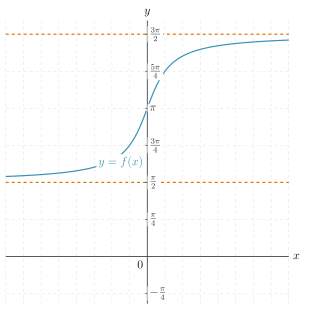
- The continuous function \(\f\) is defined by \[ \tan \f(x) = x \ \ \ \ \ (-\infty < x <\infty) \] and \(\f(0)=\pi\). Sketch the curve \(y=\f(x)\).
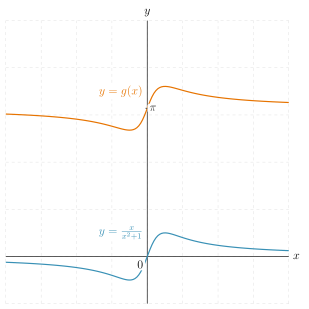
- The continuous function \(\g\) is defined by \[ \tan \g(x) = \frac x {1+x^2} \ \ \ \ \ \ (-\infty < x <\infty) \] and \(\g(0)=\pi\). Sketch the curves \(y= \dfrac x {1+x^2} \ \) and \(y=\g(x)\).
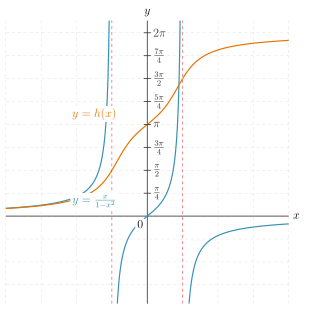
- The continuous function \(\h \) is defined by \(\h (0)=\pi\) and \[ \tan \h (x)= \frac x {1-x^2}\, \ \ \ \ \ (x \ne \pm 1) \,. \] (The values of \(\h (x)\) at \(x=\pm1\) are such that \(\h (x)\) is continuous at these points.) Sketch the curves \(y= \dfrac x {1-x^2} \ \) and \(y=\h (x)\).
- [Not on original exam] The continuous functions \(\h_1\) and \(\h_2\) are defined by: \(\h_1(0)=\h_2(0)=\pi \), \[ \tan \h_1(x) = \frac {x+x^4} {1+x^2+x^4} \ \ \ \ \ \text{and} \ \ \ \ \ \ \tan \h_2(x) = \frac {4x-x^3} {1-x^4} \,. \] for values of \(x\) at which the right hand sides are defined. Find \(\lim\limits_{x\to\infty}\h_1(x)\) and \(\lim\limits_{x\to\infty}\h_2(x)\,\).
Solution
- \(\,\)
- \(\,\)
- \(\,\)
- Note that \(\frac{x+x^4}{1+x^2+x^4}\) is continuous, and nicely behaved on \((-\infty, \infty)\) so we can see that \(\lim_{x \to \infty} h_1(x) = \pi + \frac{\pi}{4} = \frac{5\pi}{4}\). \(\frac{4x-x^3}{1-x^4}\) on the other hand has asymptotes at \(\pm 1\). So as as \(x \to 1\), \(h_1(x) \to \pi + \frac{\pi}{2} = \frac{3\pi}{2}\). Then as \(x \to \infty\) we increase by another \(\frac{\pi}{2}\), so \(\lim_{x \to \infty} h_2(x) = 2\pi\)
Examiner's report
— 2015 STEP 2, Question 4As in previous years the Pure questions were the most popular of the paper with questions 1, 2 and 6 the most popular. The least popular questions on the paper were questions 8, 11 and 13 with fewer than 250 attempts for each of them. There were many examples of solutions in this paper that were insufficiently well explained given that the answer to be reached had been provided in the question.
Rating Information
Difficulty Rating: 1600.0
Difficulty Comparisons: 0
Banger Rating: 1516.0
Banger Comparisons: 1
Show LaTeX source
Problem source
\begin{questionparts}
\item The continuous function $\f$ is defined by
\[
\tan \f(x) = x    \ \ \ \ \ (-\infty < x <\infty)
\]
and $\f(0)=\pi$. Sketch the curve $y=\f(x)$.
\item The continuous function $\g$ is defined by
\[
\tan \g(x) = \frac x {1+x^2} \ \ \ \ \ \  (-\infty < x <\infty)
\]
and $\g(0)=\pi$. Sketch the curves $y=  \dfrac x {1+x^2} \ $ and  $y=\g(x)$.
\item
The continuous function $\h  $ is defined by $\h  (0)=\pi$ and
\[
\tan \h  (x)=  \frac x {1-x^2}\,
\ \ \ \ \ (x \ne \pm 1)
\,.
\]
(The values of $\h  (x)$ at $x=\pm1$ are such that $\h  (x)$ is continuous at these points.)
Sketch the curves $y=  \dfrac x {1-x^2} \ $ and $y=\h  (x)$.

\item [Not on original exam] The continuous functions $\h_1$ and $\h_2$ are defined by: $\h_1(0)=\h_2(0)=\pi $,
\[ \tan \h_1(x) = \frac {x+x^4} {1+x^2+x^4} \ \ \ \ \  \text{and} \ \ \ \ \ \  \tan \h_2(x) = \frac {4x-x^3} {1-x^4} \,. \]
for values of $x$ at which the right hand sides are defined.
Find $\lim\limits_{x\to\infty}\h_1(x)$ and $\lim\limits_{x\to\infty}\h_2(x)\,$.
\end{questionparts}
Solution source
\begin{questionparts}
\item $\,$
\begin{center}
    \begin{tikzpicture}
    \def\functionf(#1){atan(#1)/180*pi+pi};
    \def\xl{-8};
    \def\xu{8};
    \def\yl{-1};
    \def\yu{5};

    % Calculate scaling factors to make the plot square
    \pgfmathsetmacro{\xrange}{\xu-\xl}
    \pgfmathsetmacro{\yrange}{\yu-\yl}
    \pgfmathsetmacro{\xscale}{10/\xrange}
    \pgfmathsetmacro{\yscale}{10/\yrange}

    % Define the reusable styles to keep code clean
    \tikzset{
        x=\xscale cm, y=\yscale cm,
        axis/.style={thick, draw=black!80, -{Stealth[scale=1.2]}},
        grid/.style={thin, dashed, gray!30},
        curveA/.style={very thick, color=cyan!70!black, smooth},
        curveB/.style={very thick, color=orange!90!black, smooth},
        dot/.style={circle, fill=black, inner sep=1.2pt},
        labelbox/.style={fill=white, inner sep=2pt, rounded corners=2pt} % Protects text from lines
    }


    % Draw background grid
    \draw[grid] (\xl,\yl) grid[xstep=1,ystep={pi/4}] (\xu,\yu);

    % Set up axes
    \draw[axis] (\xl,0) -- (\xu,0) node[right, black] {$x$};
    \draw[axis] (0,\yl) -- (0,\yu) node[above, black] {$y$};

    % Define the bounding region with clip
    \begin{scope}
        \clip (\xl,\yl) rectangle (\xu,\yu);


        \draw[curveA, domain=\xl:{-0.05}, samples=150]
            plot ({\x},{\functionf(\x)});
        \draw[curveA, domain={0.05}:\xu, samples=150]
            plot ({\x},{\functionf(\x)});
        \draw[curveB, dashed] (\xl, {pi/2}) -- (\xu, {pi/2});
        \draw[curveB, dashed] (\xl, {3*pi/2}) -- (\xu, {3*pi/2});

        \foreach \n/\lbl in {
            -1/-\frac{\pi}{4},
            1/\frac{\pi}{4},
            2/\frac{\pi}{2},
            3/\frac{3\pi}{4},
            4/\pi,
            5/\frac{5\pi}{4},
            6/\frac{3\pi}{2}%
        } {
            % Draws a small tick mark and places the label
            \draw[thick, black!80] (-0.1, {\n*pi/4}) -- (0.1, {\n*pi/4})
                node[right, labelbox, xshift=-2pt] {$\lbl$};
        }
         \node[below left, labelbox, xshift=-2pt, yshift=-2pt] at (0,0) {$0$};
    \end{scope}

    % Annotate Function Names
    \node[curveA, labelbox] at ({-1.5}, {2}) {$y = f(x)$};

    \end{tikzpicture}
\end{center}

\item $\,$
\begin{center}
    \begin{tikzpicture}
    \def\functionf(#1){(#1)/((#1)^2+1)};
    \def\functiong(#1){atan((#1)/((#1)^2+1))*pi/180 + pi};
    \def\xl{-8};
    \def\xu{8};
    \def\yl{-1};
    \def\yu{5};

    % Calculate scaling factors to make the plot square
    \pgfmathsetmacro{\xrange}{\xu-\xl}
    \pgfmathsetmacro{\yrange}{\yu-\yl}
    \pgfmathsetmacro{\xscale}{10/\xrange}
    \pgfmathsetmacro{\yscale}{10/\yrange}

    % Define the reusable styles to keep code clean
    \tikzset{
        x=\xscale cm, y=\yscale cm,
        axis/.style={thick, draw=black!80, -{Stealth[scale=1.2]}},
        grid/.style={thin, dashed, gray!30},
        curveA/.style={very thick, color=cyan!70!black, smooth},
        curveB/.style={very thick, color=orange!90!black, smooth},
        dot/.style={circle, fill=black, inner sep=1.2pt},
        labelbox/.style={fill=white, inner sep=2pt, rounded corners=2pt} % Protects text from lines
    }


    % Draw background grid
    \draw[grid] (\xl,\yl) grid[xstep=2,ystep=1] (\xu,\yu);

    % Set up axes
    \draw[axis] (\xl,0) -- (\xu,0) node[right, black] {$x$};
    \draw[axis] (0,\yl) -- (0,\yu) node[above, black] {$y$};

    % Define the bounding region with clip
    \begin{scope}
        \clip (\xl,\yl) rectangle (\xu,\yu);


        \draw[curveA, domain=\xl:\xu, samples=150]
            plot ({\x},{\functionf(\x)});
        \draw[curveB, domain=\xl:\xu, samples=150]
            plot ({\x},{\functiong(\x)});

        \foreach \n/\lbl in {
            % -1/-\frac{\pi}{4},
            % 1/\frac{\pi}{4},
            % 2/\frac{\pi}{2},
            % 3/\frac{3\pi}{4},
            4/\pi
            % 5/\frac{5\pi}{4},
            % 6/\frac{3\pi}{2}%
        } {
            % Draws a small tick mark and places the label
            \draw[thick, black!80] (-0.1, {\n*pi/4}) -- (0.1, {\n*pi/4})
                node[right, labelbox, xshift=-2pt] {$\lbl$};
        }
         \node[below left, labelbox, xshift=-2pt, yshift=-2pt] at (0,0) {$0$};
    \end{scope}

    % Annotate Function Names
    \node[curveA, labelbox] at ({-1.5}, {0.5}) {$y = \frac{x}{x^2+1}$};
    \node[curveB, labelbox] at ({-1.5}, {3.5}) {$y = g(x)$};

    \end{tikzpicture}
\end{center}

\item $\,$
\begin{center}
    \begin{tikzpicture}
    \def\functionf(#1){(#1)/(1-(#1)^2)};
    \def\functiong(#1){atan((#1)/(1-(#1)^2))*pi/180 + pi};
    \def\xl{-4};
    \def\xu{4};
    \def\yl{-3};
    \def\yu{6.7};

    % Calculate scaling factors to make the plot square
    \pgfmathsetmacro{\xrange}{\xu-\xl}
    \pgfmathsetmacro{\yrange}{\yu-\yl}
    \pgfmathsetmacro{\xscale}{10/\xrange}
    \pgfmathsetmacro{\yscale}{10/\yrange}

    % Define the reusable styles to keep code clean
    \tikzset{
        x=\xscale cm, y=\yscale cm,
        axis/.style={thick, draw=black!80, -{Stealth[scale=1.2]}},
        grid/.style={thin, dashed, gray!30},
        curveA/.style={very thick, color=cyan!70!black, smooth},
        curveB/.style={very thick, color=orange!90!black, smooth},
        dot/.style={circle, fill=black, inner sep=1.2pt},
        labelbox/.style={fill=white, inner sep=2pt, rounded corners=2pt} % Protects text from lines
    }


    % Draw background grid
    \draw[grid] (\xl,\yl) grid[xstep=1,ystep={pi/4}] (\xu,\yu);

    % Set up axes
    \draw[axis] (\xl,0) -- (\xu,0) node[right, black] {$x$};
    \draw[axis] (0,\yl) -- (0,\yu) node[above, black] {$y$};

    % Define the bounding region with clip
    \begin{scope}
        \clip (\xl,\yl) rectangle (\xu,\yu);


        \draw[curveA, domain=\xl:{-1.05}, samples=150]
            plot ({\x},{\functionf(\x)});
        \draw[curveA, domain={-0.95}:{0.95}, samples=150]
            plot ({\x},{\functionf(\x)});
        \draw[curveA, domain={1.05}:\xu, samples=150]
            plot ({\x},{\functionf(\x)});
        \draw[curveB, domain=\xl:{-1.001}, samples=150]
            plot ({\x},{\functiong(\x)-pi});
        \draw[curveB, domain={-0.999}:{0.999}, samples=150]
            plot ({\x},{\functiong(\x)});
        \draw[curveB, domain={1.001}:\xu, samples=150]
            plot ({\x},{\functiong(\x)+pi});

        \draw[red, dashed] (-1, \yl) -- (-1, \yu);
        \draw[red, dashed] (1, \yl) -- (1, \yu);

        \foreach \n/\lbl in {
            % -1/-\frac{\pi}{4},
            1/\frac{\pi}{4},
            2/\frac{\pi}{2},
            3/\frac{3\pi}{4},
            4/\pi,
            5/\frac{5\pi}{4},
            6/\frac{3\pi}{2},
            7/\frac{7\pi}{4},
            8/2\pi
        } {
            % Draws a small tick mark and places the label
            \draw[thick, black!80] (-0.1, {\n*pi/4}) -- (0.1, {\n*pi/4})
                node[right, xshift=-2pt] {$\lbl$};
        }
         \node[below left, labelbox, xshift=-2pt, yshift=-2pt] at (0,0) {$0$};
    \end{scope}

    % Annotate Function Names
    \node[curveA, labelbox] at ({-1.5}, {0.5}) {$y = \frac{x}{1-x^2}$};
    \node[curveB, labelbox] at ({-1.5}, {3.5}) {$y = h(x)$};

    \end{tikzpicture}
\end{center}

\item Note that $\frac{x+x^4}{1+x^2+x^4}$ is continuous, and nicely behaved on $(-\infty, \infty)$ so we can see that $\lim_{x \to \infty} h_1(x) = \pi + \frac{\pi}{4} = \frac{5\pi}{4}$.

$\frac{4x-x^3}{1-x^4}$ on the other hand has asymptotes at $\pm 1$. So as as $x \to 1$, $h_1(x) \to \pi + \frac{\pi}{2} = \frac{3\pi}{2}$. Then as $x \to \infty$ we increase by another $\frac{\pi}{2}$, so $\lim_{x \to \infty} h_2(x) = 2\pi$
\end{questionparts}


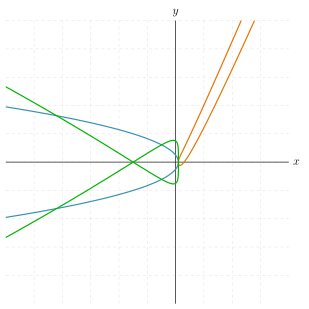
An alternative way to think about the last two parts is to consider $h$ as giving the (continuous) argument (shifted by $\pi$) of $(1-t^2)+it$ (blue), $(1+t^2+t^4)+i(t+t^4)$ (orange) or $(1-t^4)+i(4t-t^3)$ (green).

We can see the orange line never wraps around the origin, so the argument is always easy to find. The blue does one full circuit, from $-\pi$ to $\pi$ (or $0$ to $2\pi$ in our world. And the green line also does a full $2\pi$ loop.

\begin{center}
    \begin{tikzpicture}
    \def\functionf(#1){(#1)/(1-(#1)^2)};
    \def\functiong(#1){atan((#1)/(1-(#1)^2))*pi/180 + pi};
    \def\xl{-60};
    \def\xu{40};
    \def\yl{-20};
    \def\yu{20};

    % Calculate scaling factors to make the plot square
    \pgfmathsetmacro{\xrange}{\xu-\xl}
    \pgfmathsetmacro{\yrange}{\yu-\yl}
    \pgfmathsetmacro{\xscale}{10/\xrange}
    \pgfmathsetmacro{\yscale}{10/\yrange}

    % Define the reusable styles to keep code clean
    \tikzset{
        x=\xscale cm, y=\yscale cm,
        axis/.style={thick, draw=black!80, -{Stealth[scale=1.2]}},
        grid/.style={thin, dashed, gray!30},
        curveA/.style={very thick, color=cyan!70!black, smooth},
        curveB/.style={very thick, color=orange!90!black, smooth},
        curveC/.style={very thick, color=green!70!black, smooth},
        dot/.style={circle, fill=black, inner sep=1.2pt},
        labelbox/.style={fill=white, inner sep=2pt, rounded corners=2pt} % Protects text from lines
    }


    % Draw background grid
    \draw[grid] (\xl,\yl) grid (\xu,\yu);

    % Set up axes
    \draw[axis] (\xl,0) -- (\xu,0) node[right, black] {$x$};
    \draw[axis] (0,\yl) -- (0,\yu) node[above, black] {$y$};

    % Define the bounding region with clip
    \begin{scope}
        \clip (\xl,\yl) rectangle (\xu,\yu);


        \draw[curveA, domain=-10:10, samples=150]
            plot ({1-(\x)^2},{\x});
        \draw[curveB, domain={-5}:{5}, samples=150]
            plot ({1+(\x)^2+(\x)^4},{(\x +(\x)^4});
        \draw[curveC, domain={-5}:{5}, samples=150]
            plot ({1-(\x)^4},{(4*\x -(\x)^3});
    \end{scope}


    \end{tikzpicture}
\end{center}
This was a generally well attempted question, although it was a common error to draw graphs that were not continuous, even in some cases with statements that they were continuous. Marks were also lost through mislabelling of points on the graphs or through incorrect attempts to use arguments based on graphical transformations to deduce the shape of the graph. A number of candidates when trying to find the stationary points stated that they were going to differentiate a function, but then integrated it.