2016 Paper 2 Q1
Year: 2016
Paper: 2
Question Number: 1
Course: LFM Pure and Mechanics
Section: Parametric equations
Problem
Solution
Examiner's report
— 2016 STEP 2, Question 1As in previous years the Pure questions were the most popular of the paper with questions 1, 3 and 7 the most popular of these. The least popular questions of the paper were questions 10, 11, 12 and 13 with fewer than 400 attempts for each of them. There were many examples of solutions in this paper that were insufficiently well explained, given that the answer to be reached had been provided in the question.
Rating Information
Difficulty Rating: 1600.0
Difficulty Comparisons: 0
Banger Rating: 1516.0
Banger Comparisons: 1
Show LaTeX source
Problem source
The curve $C_1$ has parametric equations $x=t^2$, $y= t^3$, where
$-\infty < t < \infty\,$.
Let $O$ denote the point $(0,0)$.
The points $P$ and $Q$ on $C_1$  are such that $\angle POQ$ is
a right angle. Show that the tangents to $C_1$  at $P$ and $Q$
intersect on the curve $C_2$  with equation $4y^2=3x-1$.

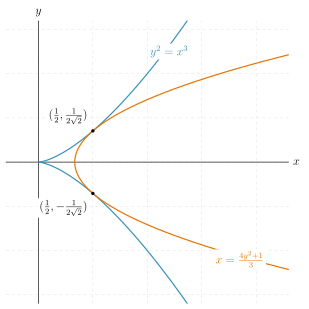
Determine whether  $C_1$ and $C_2$ meet, and sketch the two
curves on the same axes.
Solution source
$\angle POQ = 90^\circ$ means that if $P(p^2,p^3)$ and $Q(q^2,q^3)$ are our points then $OP^2+OQ^2 = PQ^2$, so

\begin{align*}
&& p^4+p^6+q^4+q^6 &= (p^2-q^2)^2+(p^3-q^3)^2 \\
&&&= p^4+q^4-2p^2q^2+p^6+q^6-2p^3q^3 \\
\Rightarrow && 0 &= 2p^2q^2(1+pq) \\
\Rightarrow && pq &= -1 \\
\\
&& \frac{\d y}{ \d x} &= \frac{\frac{\d y }{\d t}}{\frac{\d x}{\d t}} \\
&&&= \frac{3t^2}{2t} = \tfrac32t \\
\Rightarrow && \frac{y-p^3}{x-p^2} &= \tfrac32p \\
\Rightarrow && 2(y-p^3) &=3p(x-p^2) \\
&&  2(y-q^3) &=3q(x-q^2) \\
\Rightarrow && 2(q^3-p^3) &= (3p-3q)x+3(q^3-p^3) \\
&& p^3-q^3 &= 3(p-q)x \\
\Rightarrow && x &= \tfrac13(p^2+q^2+pq) \\
&& 2y &= 3p(\tfrac13(p^2+q^2+pq)-p^2)+2p^3 \\
&&&= p(p^2+q^2+pq)-p^3 \\
&&&= pq^2+p^2q \\
&&&= -p-q \\
&&y&= -\frac{p+q}{2} \\
\\
&& 4y^2 &= p^2+q^2 \\
&& 3x-1 &= p^2+q^2 \\
\end{align*}

To check if they meet, try $4t^6=3t^2 - 1$.

Consider $y = 4x^3-3x+1$ $y(0) = 1$ and $y' = 12x^2-3 = 3(4x^2-1)$ which has roots at $\pm \tfrac12$, therefore we need to test $y(\tfrac12) = \tfrac12-\tfrac32 + 1 = 0$, so there is a one intersection at $x = \tfrac1{2}, y = \tfrac1{2\sqrt{2}}$


\begin{center}
    \begin{tikzpicture}
    % Slightly expanded bounding limits for breathing room
    \def\xl{-.3}; \def\xu{2.3};
    \def\yl{-1.6}; \def\yu{1.6};

    % Calculate scaling factors to make the plot square
    \pgfmathsetmacro{\xrange}{\xu-\xl}
    \pgfmathsetmacro{\yrange}{\yu-\yl}
    \pgfmathsetmacro{\xscale}{10/\xrange}
    \pgfmathsetmacro{\yscale}{10/\yrange}

    % Define the reusable styles to keep code clean
    \tikzset{
        x=\xscale cm, y=\yscale cm,
        axis/.style={thick, draw=black!80, -{Stealth[scale=1.2]}},
        grid/.style={thin, dashed, gray!30},
        curveA/.style={very thick, color=cyan!70!black, smooth},
        curveB/.style={very thick, color=orange!90!black, smooth},
        dot/.style={circle, fill=black, inner sep=1.2pt},
        labelbox/.style={fill=white, inner sep=2pt, rounded corners=2pt} % Protects text from lines
    }

    % Draw background grid
    \draw[grid] (\xl,\yl) grid[step=0.5] (\xu,\yu);

    % Set up axes
    \draw[axis] (\xl,0) -- (\xu,0) node[right, black] {$x$};
    \draw[axis] (0,\yl) -- (0,\yu) node[above, black] {$y$};

    % Define the bounding region with clip
    \begin{scope}
        \clip (\xl,\yl) rectangle (\xu,\yu);

        \draw[curveA, domain=-3:3, samples=150]
            plot ({\x*\x},{\x*\x*\x});

        \draw[curveB, domain=-3:3, samples=150]
            plot ({(4*\x*\x+1)/3},{\x});
    \end{scope}

    % Annotate Function Names
    \node[curveA, labelbox] at (1.2, 1.25) {$y^2 = x^3$};
    \node[curveB, labelbox] at (1.85, -1.1) {$x = \frac{4y^2+1}{3}$};

    % Define specific coordinates mathematically to avoid repeating math expressions
    \def\px{0.5}
    \def\py{0.35355} % 1/(2*sqrt(2))

    % Top intersection
    \node[dot] at (\px, \py) {};
    \node[labelbox, anchor=south east] at (\px - 0.03, \py + 0.05) {$(\frac{1}{2}, \frac{1}{2\sqrt{2}})$};

    % Bottom intersection
    \node[dot] at (\px, -\py) {};
    \node[labelbox, anchor=north east] at (\px - 0.03, -\py - 0.05) {$(\frac{1}{2}, -\frac{1}{2\sqrt{2}})$};

    \end{tikzpicture}
\end{center}
This was a popular question and many very good solutions were seen. The first part of the question was a relatively straightforward application of differentiation and parametric equations and was successfully completed by many of the candidates. The sketches produced were generally the correct shape for the parabola, although in some cases it was not in the correct position. The other curve caused more problems with some candidates drawing another parabola or similar shape.