2017 Paper 3 Q5
Year: 2017
Paper: 3
Question Number: 5
Course: UFM Pure
Section: Polar coordinates
Problem
Solution
Examiner's report
— 2017 STEP 3, Question 5The total entry was only very slightly smaller than that of 2016, which was a record entry, but was still over 10% more than 2015. No question was attempted by in excess of 90%, although two were very popular and also five others were attempted by 60% or more. No question was generally avoided with even the least popular one attracting more than 10% of the entry. Less than 10% of candidates attempted more than 7 questions, and, apart from 18 exceptions, those doing so did not achieve very good totals and seemed to be 'casting around' to find things they could do: the 18 exceptions were very strong candidates who were generally achieving close to full marks on all the questions they attempted. The general trend was that those with six attempts fared better than those with more than six.
Rating Information
Difficulty Rating: 1700.0
Difficulty Comparisons: 0
Banger Rating: 1484.0
Banger Comparisons: 1
Show LaTeX source
Problem source
The  point with cartesian coordinates $(x,y)$ lies on a
curve with polar equation $r=\f(\theta)\,$.
Find an  expression for $\dfrac{\d y}{\d x}$ in terms of $\f(\theta)$,
$\f'(\theta)$ and $\tan\theta\,$.

Two curves, with polar equations $r=\f(\theta)$ and
$r=\g(\theta)$, meet at right angles.
Show
that where they meet
\[
\f'(\theta) \g'(\theta) +\f(\theta)\g(\theta) = 0 \,.
\]

The curve $C$ has polar equation $r=\f(\theta)$ and passes through
the point given by $r=4$, $\theta = - \frac12\pi$.
For each positive value of $a$,
the curve with polar equation
$r= a(1+\sin\theta)$
meets~$C$ at right angles. Find $\f(\theta)\,$.

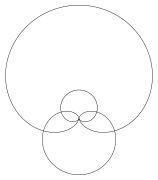
Sketch on a single diagram the three curves
with polar equations $r= 1+\sin\theta\,$, \
$r= 4(1+\sin\theta)$  and $r=\f(\theta)\,$.
Solution source
$(x, y) = (f(\theta)\cos(\theta), f(\theta)\sin(\theta))$ so

\begin{align*}
    \frac{dy}{d\theta} &= -f(\theta)\sin(\theta) + f'(\theta)\cos(\theta) \\
    \frac{dx}{d\theta} &= f(\theta)\cos(\theta) + f'(\theta)\sin(\theta) \\
    \frac{dy}{dx} &= \frac{-f(\theta)\sin(\theta) + f'(\theta)\cos(\theta)}{f(\theta)\cos(\theta) + f'(\theta)\sin(\theta) } \\
    &= \frac{-f(\theta)\tan(\theta) + f'(\theta)}{f(\theta) + f'(\theta)\tan(\theta)  }
\end{align*}

If the curves meet at right angles then the product of their gradients is $-1$, ie

\begin{align*}
\frac{-f(\theta)\tan(\theta) + f'(\theta)}{f(\theta) + f'(\theta)\tan(\theta)  } \cdot \frac{-g(\theta)\tan(\theta) + g'(\theta)}{g(\theta) + g'(\theta)\tan(\theta)  } &= -1 \\
f(\theta)g(\theta)\tan^2 \theta - f(\theta)g'(\theta)\tan \theta - f'(\theta)g(\theta)\tan \theta + f'(\theta)g'(\theta) &= \\
\quad - \l f(\theta)g(\theta) + f(\theta)g'(\theta)\tan(\theta) + f'(\theta)g(\theta)\tan(\theta) + f'(\theta)g'(\theta)\tan^2 \theta \r \\
\tan^2\theta \l f(\theta)g(\theta) + f'(\theta)g'(\theta) \r + f'(\theta)g'(\theta) + f(\theta)g(\theta) &= 0 \\
(\tan^2\theta + 1) \l f(\theta)g(\theta) + f'(\theta)g'(\theta) \r &= 0 \\
 f(\theta)g(\theta) + f'(\theta)g'(\theta) &= 0
\end{align*}

$g(\theta) = a(1+\sin\theta), g'(\theta) = a\cos\theta$

Therefore $f'(\theta)a\cos \theta+f(\theta)a(1+\sin(\theta)) = 0$

\begin{align*}
    && \frac{f'(\theta)}{f(\theta)} &= -\sec(\theta) - \tan(\theta) \\
    \Rightarrow && \ln(f(\theta)) &= -\ln |\tan(\theta) + \sec(\theta)| + \ln |\cos(\theta)| + C \\
    \Rightarrow && f(\theta) &= A \frac{\cos \theta}{\tan \theta + \sec \theta} \\
    &&&= A \frac{\cos^2 \theta}{\sin \theta + 1} \\
    &&&= A \frac{1-\sin^2 \theta}{\sin \theta + 1} \\
    &&&= A (1-\sin \theta)
\end{align*}

When $\theta = -\frac12 \pi, r = 4$, so $A = 2$.

\begin{center}
\begin{tikzpicture}[scale=0.5]
    \draw[domain = 0:360, samples=400, variable = \x]  plot ({(1 + sin(\x))*cos(\x)},{(1 + sin(\x))*sin(\x)});
    \draw[domain = 0:360, samples=400, variable = \x]  plot ({4*(1 + sin(\x))*cos(\x)},{4*(1 + sin(\x))*sin(\x)});
    \draw[domain = 0:360, samples=400, variable = \x]  plot ({2*(1 - sin(\x))*cos(\x)},{2*(1 - sin(\x))*sin(\x)});
\end{tikzpicture}
\end{center}
Very slightly more popular than question 4, the marks scored were on average 1 less per attempt. Most found successfully, though a significant minority swapped and . In this case, they could still obtain the displayed equation successfully, but in both categories, there were frequent sign errors when differentiating trigonometric functions. Most then attempted using the displayed result to find f, either by separating variables or using an integrating factor and got as far as f but then more than half got stuck. Most plotted the two given curves relatively correctly, but then a substantial number used guesswork having not previously obtained correctly.