2017 Paper 2 Q7
Year: 2017
Paper: 2
Question Number: 7
Course: LFM Pure
Section: Differentiation
Problem
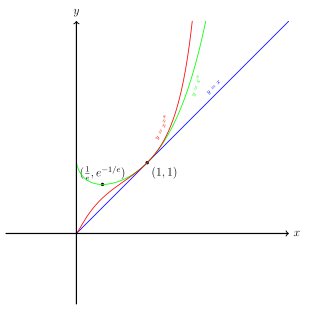
- By taking logarithms, or otherwise, show that \(\f(x) > x\) for \(0 < x < 1\,\). Show further that \(x < \g(x) < \f(x)\) for \(0 < x < 1\,\). Write down the corresponding results for \(x > 1 \,\).
- Find the value of \(x\) for which \(\f'(x)=0\,\).
- Use the result \(x\ln x \to 0\) as \(x\to 0\) to find \(\lim\limits_{x\to0}\f(x)\), and write down \(\lim\limits_{x\to0}\g(x)\,\).
- Show that \( x^{-1}+\, \ln x \ge 1\,\) for \(x>0\). Using this result, or otherwise, show that \(\g'(x) > 0\,\).
Solution
- \(\,\) \begin{align*} && \ln f(x) &= x \ln x \\ &&&> \ln x \quad (\text{if } 0 < x < 1)\\ \Rightarrow && f(x) &> x\quad\quad (\text{if } 0 < x < 1)\\ \Rightarrow && x^{f(x)} &< x^x \\ && g(x) &< f(x) \\ && 1&>f(x) \\ \Rightarrow && x &< x^{f(x)} = g(x) \end{align*}
- \(\,\) \begin{align*} && f(x) &= e^{x \ln x} \\ \Rightarrow && f'(x) &= (\ln x + 1)e^{x \ln x} \\ \Rightarrow && f'(x) = 0 &\Leftrightarrow x = \frac1e \end{align*}
- \(\,\) \begin{align*} && \lim_{x \to 0} f(x) &= \lim_{x \to 0} \exp \left ( x \ln x \right ) \\ &&&= \exp \left ( \lim_{x \to 0} \left ( x \ln x \right )\right) \\ &&&= \exp \left ( 0 \right) = 1\\ \\ && \lim_{x \to 0} g(x) &= \lim_{x \to 0} \exp \left ( f(x) \ln x\right) \\ &&&= \exp \left (\lim_{x \to 0} \ln x f(x)\right) \\ &&&= \exp \left (\lim_{x \to 0} \ln x \lim_{x \to 0}f(x)\right) \\ &&&= \exp \left (\lim_{x \to 0} \ln x\right) \\ &&&= 0 \end{align*}
- \(y = x^{-1} + \ln x \Rightarrow y' = -x^{-2} + x^{-1}\) which has roots at \(x =1\), therefore the minimum value is \(1\). (We can see it's a minimum by considering \(x \to 0, x \to \infty\). So \begin{align*} && g'(x) &= x^{f(x)} \cdot (f'(x) \ln x + f(x) x^{-1})\\ &&&= x^{f(x)} \cdot f(x) \cdot ((1+\ln x) \ln x + x^{-1}) \\ &&&= x^{f(x)} \cdot f(x) \cdot (\ln x + x^{-1} + (\ln x)^2) \\ &&&\geq x^{f(x)} \cdot f(x) > 0 \end{align*}
Examiner's report
— 2017 STEP 2, Question 7This year's paper was, perhaps, slightly more straightforward than usual, with more helpful guidance offered in some of the questions. Thus the mark required for a "1", a Distinction, was 80 (out of 120), around ten marks higher than that which would customarily be required to be awarded this grade. Nonetheless, a three‐figure mark is still a considerable achievement and, of the 1330 candidates sitting the paper, there were 89 who achieved this. At the other end of the scale, there were over 350 who scored 40 or below, including almost 150 who failed to exceed a total score of 25. As a general strategy for success in a STEP examination, candidates should be looking to find four "good" questions to work at (which may be chosen freely by the candidates from a total of 13 questions overall). It is unfortunately the case that so many low‐scoring candidates flit from one question to another, barely starting each one before moving on. There needs to be a willingness to persevere with a question until a measure of understanding as to the nature of the question's purpose and direction begins to emerge. Many low‐scoring candidates fail to deal with those parts of questions which cover routine mathematical processes ‐ processes that should be standard for an A‐level candidate. The significance of the "rule of four" is that four high‐scoring questions (15‐20 marks apiece) obtains you up to around the total of 70 that is usually required for a "1"; and with a couple of supporting starts to questions, such a total should not be beyond a good candidate who has prepared adequately. This year, significantly more than 10% of candidates failed to score at least half marks on any one question; and, given that Q1 (and often Q2 also) is (are) specifically set to give all candidates the opportunity to secure some marks, this indicates that these candidates are giving up too easily. Mathematics is about more than just getting to correct answers. It is about communicating clearly and precisely. Particularly with "show that" questions, candidates need to distinguish themselves from those who are just tracking back from given results. They should also be aware that convincing themselves is not sufficient, and if they are using a result from 3 pages earlier, they should make this clear in their working. A few specifics: In answers to mechanics questions, clarity of diagrams would have helped many students. If new variables or functions are introduced, it is important that students clearly define them. One area which is very important in STEP but which was very poorly done is dealing with inequalities. Although a wide range of approaches such as perturbation theory were attempted, at STEP level having a good understanding of the basics – such as changing the inequality if multiplying by a negative number – is more than enough. In fact, candidates who used more advanced methods rarely succeeded.
Rating Information
Difficulty Rating: 1600.0
Difficulty Comparisons: 0
Banger Rating: 1500.0
Banger Comparisons: 0
Show LaTeX source
Problem source
The functions $\f$ and $\g$ are defined, for $x>0$, by
\[ \f(x) = x^x\,, \ \ \ \ \ \g(x) = x^{\f(x)}\,. \]
\begin{questionparts}
\item By taking logarithms, or otherwise, show that $\f(x) > x$ for $0 < x < 1\,$. Show further that $x < \g(x) < \f(x)$ for $0 < x < 1\,$.
Write down the corresponding results for $x > 1 \,$.
\item Find the value of $x$ for which $\f'(x)=0\,$.
\item Use the result $x\ln x \to 0$ as $x\to 0$ to find  $\lim\limits_{x\to0}\f(x)$, and write down  $\lim\limits_{x\to0}\g(x)\,$.
\item Show that $  x^{-1}+\, \ln x \ge 1\,$ for $x>0$.
Using this result, or otherwise, show that $\g'(x) > 0\,$.
\end{questionparts}
Sketch the graphs, for $x > 0$,  of $y=x$, $y=\f(x)$ and $y=\g(x)$ on the same axes.
Solution source
\begin{questionparts}
\item $\,$
\begin{align*}
&& \ln f(x) &= x \ln x \\
&&&> \ln x  \quad (\text{if } 0 < x < 1)\\
\Rightarrow && f(x) &> x\quad\quad (\text{if } 0 < x < 1)\\
\Rightarrow && x^{f(x)} &< x^x \\
&& g(x) &< f(x) \\
&& 1&>f(x) \\
\Rightarrow && x &< x^{f(x)} = g(x)
\end{align*}

\item $\,$ \begin{align*}
&& f(x) &= e^{x \ln x} \\
\Rightarrow && f'(x) &= (\ln x + 1)e^{x \ln x} \\
\Rightarrow && f'(x) = 0 &\Leftrightarrow x = \frac1e
\end{align*}

\item $\,$ \begin{align*}
&& \lim_{x \to 0} f(x) &= \lim_{x \to 0} \exp \left ( x \ln x \right ) \\
&&&= \exp \left ( \lim_{x \to 0} \left ( x \ln x \right )\right) \\
&&&= \exp \left ( 0 \right)  = 1\\
\\
&& \lim_{x \to 0} g(x) &= \lim_{x \to 0} \exp \left ( f(x) \ln x\right) \\
&&&= \exp \left (\lim_{x \to 0}  \ln x f(x)\right) \\
&&&= \exp \left (\lim_{x \to 0}  \ln x \lim_{x \to 0}f(x)\right) \\
&&&= \exp \left (\lim_{x \to 0}  \ln x\right) \\
&&&= 0
\end{align*}

\item $y = x^{-1} + \ln x \Rightarrow y' = -x^{-2} + x^{-1}$ which has roots at $x =1$, therefore the minimum value is $1$. (We can see it's a minimum by considering $x \to 0, x \to \infty$.

So
\begin{align*}
&& g'(x) &= x^{f(x)} \cdot (f'(x) \ln x + f(x) x^{-1})\\
&&&= x^{f(x)} \cdot f(x) \cdot ((1+\ln x) \ln x + x^{-1}) \\
&&&= x^{f(x)} \cdot f(x) \cdot (\ln x + x^{-1} + (\ln x)^2) \\
&&&\geq x^{f(x)} \cdot f(x) > 0
\end{align*}

\end{questionparts}


\begin{center}
    \begin{tikzpicture}
    \def\functionf(#1){((#1)+.5)*((#1)-1)*((#1)-2.1)};
    \def\xl{-1};
    \def\xu{3};
    \def\yl{-1};
    \def\yu{3};

    % Calculate scaling factors to make the plot square
    \pgfmathsetmacro{\xrange}{\xu-\xl}
    \pgfmathsetmacro{\yrange}{\yu-\yl}
    \pgfmathsetmacro{\xscale}{10/\xrange}
    \pgfmathsetmacro{\yscale}{10/\yrange}

    % Define the styles for the axes and grid
    \tikzset{
        axis/.style={very thick, ->},
        grid/.style={thin, gray!30},
        x=\xscale cm,
        y=\yscale cm
    }

    % Define the bounding region with clip
    \begin{scope}
        % You can modify these values to change your plotting region
        \clip (\xl,\yl) rectangle (\xu,\yu);

        % Draw a grid (optional)
        % \draw[grid] (-5,-3) grid (5,3);

        \filldraw ({1/e}, {exp(-1/e)}) circle (1.5pt) node[above]{$(\frac1e, e^{-1/e})$};
        \filldraw (1, 1) circle (1.5pt) node[below right]{$(1,1)$};
        % \filldraw (2.1, 0) circle (1.5pt) node[below]{$r$};

        \draw[thick, blue, smooth, domain=0:\xu, samples=100]
            plot (\x, {\x});
        \draw[thick, green, smooth, domain=0.00001:2, samples=100]
            plot (\x, {exp(ln(\x)*\x)});
        \draw[thick, red, smooth, domain=0.00001:2, samples=100]
            plot (\x, {exp(ln(\x)*exp(ln(\x)*\x))});

        \node[blue, above, rotate=45] at (2,2) {\tiny $y = x$};
        \node[green, below, rotate=70] at (1.6,{exp(ln(1.6)*1.6)}) {\tiny $y = x^x$};
        \node[red, above, rotate=60] at (1.3,{exp(ln(1.3)*exp(ln(1.3)*1.3))}) {\tiny $y = x^{x^x}$};
    \end{scope}

    % Set up axes
    \draw[axis] (\xl,0) -- (\xu,0) node[right] {$x$};
    \draw[axis] (0,\yl) -- (0,\yu) node[above] {$y$};

    \end{tikzpicture}
\end{center}
Just over one thousand candidates attempted this question, but more than 400 of these attempts were not substantial; removing the large number of those scripts which got no further than part (i) raises the mean score from well under 8 to just over 12 out of 20. The difficulty with questions like this is that it is very easy to make correct statements but much more difficult to support them with logically‐crafted steps of reasoning based on results either given or known. Moreover, one needs to reason in such a way that the steps of working one writes down are justified … this was the principal barrier to anything more than the most faltering of starts. So, part (i) was an issue for candidates, with much written but not much of it coherently stated or supported. Of the few marks gained in the weaker attempts, part (ii) provided the majority of them, since most candidates were happy to take logs and then differentiate (the standard procedure for exponential equations of this kind). It was slightly surprising to note that so few candidates attempted to establish the initial result in part (iv) using calculus; most of those that got this far presumably thought some other "inequality" technique was being tested. Finally, even for those who had made good progress in several of the previous parts, the graphs at the end were frequently marred by a lack of labelling.