2015 Paper 3 Q3
Year: 2015
Paper: 3
Question Number: 3
Course: UFM Pure
Section: Polar coordinates
Problem
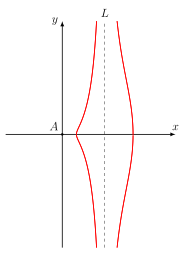
- Show that if \[ \vert r- a \sec\theta \vert = b\,, \tag{\(*\)} \] where \(a>b\), then \(\sec\theta >0\). Show that all points with coordinates satisfying (\(*\)) lie on a certain conchoid of Nicomedes (you should identify \(L\), \(d\) and \(A\)). Sketch the locus of these points.
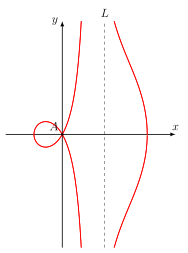
- In the case \(a < b\), sketch the curve (including the loop for which \(\sec\theta<0\)) given by \[ \vert r- a \sec\theta \vert = b\, . \] Find the area of the loop in the case \(a=1\) and \(b=2\). [Note: $ %\displaystyle \int \! \sec\theta \,\d \theta = \ln \vert \sec\theta + \tan\theta \vert + C \,. $]
Solution
- \(r = a \sec \theta \pm b\). The points on \(r = a \sec \theta \Leftrightarrow r \cos \theta = a \Leftrightarrow x = a\) are points on the line \(x = a\). Therefore points on the curve \(r = a \sec \theta \pm b\) are points which are a distance \(b\) from the line \(x = a\) measured towards \(O\). So \(A\) is the origin and \(d = b\).
- The loop starts and ends when \(r = a \sec \theta - b = 0 \Rightarrow \cos \theta = \frac{a}{b}\), so when \(a = 1, b = 2\), this is \(-\frac{\pi}{3}\) to \(\frac{\pi}{3}\) \begin{align*} && A &= \frac12 \int r^2 \d \theta \\ &&&= \frac12 \int_{-\pi/3}^{\pi/3} \left ( \sec \theta - 2 \right)^2 \d \theta \\ &&&= \frac12 \int_{-\pi/3}^{\pi/3} \left (\sec^2 \theta - 4 \sec \theta + 4\right)\d \theta \\ &&&= \frac12 \left [ \tan \theta -4 \ln | \sec \theta + \tan \theta| + 4 \theta \right]_{-\pi/3}^{\pi/3} \\ &&&= \frac12 \left (\left (\tan \frac{\pi}3 - 4 \ln | \sec \frac{\pi}3 + \tan \frac{\pi}3 | + 4\left ( \frac{\pi}3 \right)\right) - \left (\tan \left (-\frac{\pi}3 \right) - 4 \ln | \sec \left (-\frac{\pi}3 \right)+ \tan\left ( -\frac{\pi}3 \right) | + 4\left ( -\frac{\pi}3 \right)\right) \right) \\ &&&= \frac12 \left ( 2\sqrt{3} - 4 \ln |2 + \sqrt{3}| + 4 \ln |2-\sqrt{3}| + \frac{8\pi}3 \right) \\ &&&= \sqrt{3} + 2\ln \frac{2-\sqrt{3}}{2+\sqrt{3}} + \frac{4\pi}3 \\ &&&= \sqrt{3} + 4 \ln (2 - \sqrt{3})+ \frac{4\pi}3 \end{align*}
Examiner's report
— 2015 STEP 3, Question 3A very similar number of candidates to 2014 once again ensured that all questions received a decent number of attempts, with seven questions being very popular rather than five being so in 2014, but the most popular questions were attempted by percentages in the 80s rather than 90s. All but one question was answered perfectly at least once, the one exception receiving a number of very close to perfect solutions. About 70% attempted at least six questions, and in those cases where more than six were attempted, the extra attempts were usually fairly superficial.
Rating Information
Difficulty Rating: 1700.0
Difficulty Comparisons: 0
Banger Rating: 1484.0
Banger Comparisons: 1
Show LaTeX source
Problem source
In this question, $r$ and $\theta$ are polar coordinates with $r \ge0$ and  $- \pi < \theta\le  \pi$,  and $a$ and $b$ are positive constants.
Let $L$ be a fixed line and let $A$ be a fixed point not lying on $L$. Then  the locus of points that are a fixed distance (call it $d$) from $L$ measured along lines through $A$ is called a \textit{ conchoid of Nicomedes}.
\begin{questionparts}
\item Show that if
\[
\vert r- a \sec\theta \vert = b\,,
\tag{$*$}
\]
where $a>b$, then $\sec\theta >0$.   Show that all points with coordinates satisfying ($*$) lie on a certain conchoid of Nicomedes (you should identify  $L$, $d$ and $A$). Sketch the locus of these points.
\item In the case $a < b$, sketch the curve (including the loop for which $\sec\theta<0$) given by
\[
\vert r- a \sec\theta \vert = b\,
.
\]
Find the area of the loop in the case $a=1$ and $b=2$.

[Note:
$
%\displaystyle
\int \! \sec\theta \,\d \theta = \ln \vert \sec\theta + \tan\theta \vert + C
\,.
$]
\end{questionparts}
Solution source
\begin{questionparts}
\item $r = a \sec \theta \pm b$. The points on $r = a \sec \theta \Leftrightarrow r \cos \theta = a \Leftrightarrow x = a$ are points on the line $x = a$. Therefore points on the curve $r = a \sec \theta \pm b$ are points which are a distance $b$ from the line $x = a$ measured towards $O$. So $A$ is the origin and $d = b$.


\begin{center}
    \begin{tikzpicture}[scale=1]
        \draw[thick,->,>=latex] (-2,0)--(4,0) node[above] {$x$};
        \draw[thick,->,>=latex] (0,-4)--(0,4) node[left] {$y$};
        \begin{scope}
            % You can modify these values to change your plotting region
            \clip (-2,-4) rectangle (4,4);

            \draw[domain=0:89,samples=250, color=red, thick] plot (\x:{1 + 1.5/cos(\x)});
            \draw[domain=91:269,samples=250, color=red, thick] plot (\x:{1 + 1.5/cos(\x)});
            \draw[domain=271:359,samples=250, color=red, thick] plot (\x:{1 + 1.5/cos(\x)});


            \draw[domain=0:89,samples=250, color=red, thick] plot (\x:{-1 + 1.5/cos(\x)});
            \draw[domain=91:269,samples=250, color=red, thick] plot (\x:{-1 + 1.5/cos(\x)});
            \draw[domain=271:359,samples=250, color=red, thick] plot (\x:{-1 + 1.5/cos(\x)});
            \filldraw (0,0) circle (1pt) node[above left] {$A$};
        \end{scope}
        \draw[dashed] (1.5, -4) -- (1.5, 4) node[above] {$L$};

    \end{tikzpicture}
\end{center}

\item \begin{center}
    \begin{tikzpicture}[scale=1]
        \draw[thick,->,>=latex] (-2,0)--(4,0) node[above] {$x$};
        \draw[thick,->,>=latex] (0,-4)--(0,4) node[left] {$y$};
        \begin{scope}
            % You can modify these values to change your plotting region
            \clip (-2,-4) rectangle (4,4);
            \def\a{1};
            \def\b{2};
            \draw[domain=0:89,samples=250, color=red, thick] plot (\x:{\b + \a/cos(\x)});
            \draw[domain=91:269,samples=250, color=red, thick] plot (\x:{\b + \a/cos(\x)});
            \draw[domain=271:359,samples=250, color=red, thick] plot (\x:{\b + \a/cos(\x)});


            \draw[domain=0:89,samples=250, color=red, thick] plot (\x:{-\b + \a/cos(\x)});
            \draw[domain=91:269,samples=250, color=red, thick] plot (\x:{-\b + \a/cos(\x)});
            \draw[domain=271:359,samples=250, color=red, thick] plot (\x:{-\b + \a/cos(\x)});
            \filldraw (0,0) circle (1pt) node[above left] {$A$};
        \end{scope}
        \draw[dashed] (1.5, -4) -- (1.5, 4) node[above] {$L$};

    \end{tikzpicture}
\end{center}

The loop starts and ends when $r = a \sec \theta - b = 0 \Rightarrow \cos \theta = \frac{a}{b}$, so when $a = 1, b = 2$, this is $-\frac{\pi}{3}$ to $\frac{\pi}{3}$

\begin{align*}
&& A &= \frac12 \int r^2 \d \theta \\
&&&= \frac12 \int_{-\pi/3}^{\pi/3} \left ( \sec \theta - 2 \right)^2 \d \theta \\
&&&= \frac12 \int_{-\pi/3}^{\pi/3} \left (\sec^2 \theta - 4 \sec \theta + 4\right)\d \theta \\
&&&= \frac12 \left [ \tan \theta -4 \ln | \sec \theta + \tan \theta| + 4 \theta \right]_{-\pi/3}^{\pi/3} \\
&&&= \frac12 \left (\left (\tan \frac{\pi}3 - 4 \ln | \sec  \frac{\pi}3 + \tan \frac{\pi}3 | + 4\left ( \frac{\pi}3 \right)\right) - \left (\tan \left (-\frac{\pi}3 \right) - 4 \ln | \sec  \left (-\frac{\pi}3 \right)+ \tan\left ( -\frac{\pi}3 \right) | + 4\left ( -\frac{\pi}3 \right)\right) \right) \\
&&&= \frac12 \left ( 2\sqrt{3} - 4 \ln |2 + \sqrt{3}| + 4 \ln |2-\sqrt{3}| + \frac{8\pi}3 \right) \\
&&&= \sqrt{3} + 2\ln \frac{2-\sqrt{3}}{2+\sqrt{3}} + \frac{4\pi}3 \\
&&&= \sqrt{3} + 4 \ln (2 - \sqrt{3})+ \frac{4\pi}3
\end{align*}
\end{questionparts}
Under 20% attempted this, making it the least popular Pure question on the paper, and it was the least successfully attempted of all questions on the paper. Candidates seemed to find it intimidating, and many gave up before part (ii). They often got confused when dealing with separate cases and did not seem to understand what was required to show secθ ≥ 0 in part (i). Those that did make a stab at (ii) usually omitted a factor of two and most failed to find the correct limit to use.