2015 Paper 3 Q8
Year: 2015
Paper: 3
Question Number: 8
Course: UFM Pure
Section: Polar coordinates
Problem
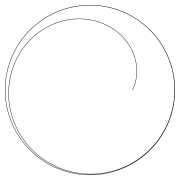
- Show that under the changes of variable \(x= r\cos\theta\) and \(y = r\sin\theta\), where \(r\) is a function of \(\theta\) with \(r>0\), the differential equation \[ (y+x)\frac{\d y}{\d x} = y-x \] becomes \[ \frac{\d r}{\d\theta} + r=0 \,. \] Sketch a solution in the \(x\)-\(y\) plane.
- Show that the solutions of \[ \left( y+x -x(x^2+y^2) \right) \, \frac{\d y }{\d x} = y-x - y(x^2+y^2) \] can be written in the form \\ \[ r^2 = \dfrac 1 {1+A\e^{2\theta}}\, \]\\ and sketch the different forms of solution that arise according to the value of \(A\).
Solution
- \begin{align*}
&& (y+x)\frac{\d y}{\d x} &= y-x \\
\Rightarrow && (r \sin \theta + r \cos\theta) \frac{\frac{dy}{d\theta}}{\frac{dx}{d\theta}} &= (r \sin\theta - r \cos\theta) \\
\Rightarrow && ( \sin \theta + \cos\theta) \frac{dy}{d\theta} &= (\sin\theta - \cos\theta){\frac{dx}{d\theta}} \\
\Rightarrow && ( \sin \theta + \cos\theta) \left ( \frac{dr}{d\theta} \cos \theta - r \sin \theta\right ) &= (\sin\theta - \cos\theta)\left ( \frac{dr}{d\theta} \sin\theta + r \cos \theta\right) \\
\Rightarrow && \frac{dr}{d\theta} \left (\sin \theta \cos \theta + \cos^2 \theta - \sin^2 \theta + \sin \theta \cos \theta \right)&= r \left (\sin \theta \cos \theta - \cos^2 \theta + \sin^2 \theta + \sin\theta \cos \theta\right) \\
\Rightarrow && \frac{dr}{d\theta}&= -r \\
\end{align*}
Therefore \(r = Ae^{-\theta}\)

- \begin{align*}
&& \left( y+x -x(x^2+y^2) \right) \, \frac{\d y }{\d x} &= y-x - y(x^2+y^2) \\
\Rightarrow && \left( r \sin \theta+r\cos \theta -r^3\cos \theta \right) \, \frac{\d y }{\d \theta} &= \left ( r \sin \theta- r \cos \theta- r^3\sin \theta \right)\frac{\d x }{\d \theta} \\
\Rightarrow && \left( r \sin \theta+r\cos \theta -r^3\cos \theta \right) \, \left (\frac{\d r}{\d \theta} \sin \theta + r \cos \theta \right) &= \\
&& \left ( r \sin \theta- r \cos \theta- r^3\sin \theta \right)&\left (\frac{\d r}{\d \theta} \cos \theta - r \sin \theta \right) \\
\Rightarrow && \frac{\d r}{\d \theta} \left (\sin \theta ( \sin \theta + \cos \theta - r^2 \cos \theta) - \cos \theta (\sin \theta - \cos \theta - r^2 \sin \theta) \right) &= \\
&& r ( -\sin \theta (\sin \theta - \cos \theta - r^2 \sin \theta) - \cos \theta ( \sin \theta + \cos \theta &- r^2 \cos \theta)) \\
\Rightarrow && \frac{\d r}{\d \theta} &= r ( -1 +r^2) \\
\Rightarrow && \int \frac{1}{r(r-1)(r+1)} \d r &= \int \d \theta \\
\Rightarrow && \int \l \frac{-1}{r} + \frac{1}{2(r-1)} + \frac{1}{2(r+1)} \r \d r &= \int \d \theta \\
\Rightarrow && \l -\log r+ \frac12 \log (1+r)+ \frac12 \log (1-r)\r + C &= \theta \\
\Rightarrow && \frac12 \log \left (\frac{1-r^2}{r^2} \right) + C &= \theta \\
\Rightarrow && \log \left (\frac{1}{r^2}-1 \right) + C &= 2\theta \\
\Rightarrow && r &= \frac{1}{1 + Ae^{2\theta}} \\
\end{align*}


Examiner's report
— 2015 STEP 3, Question 8A very similar number of candidates to 2014 once again ensured that all questions received a decent number of attempts, with seven questions being very popular rather than five being so in 2014, but the most popular questions were attempted by percentages in the 80s rather than 90s. All but one question was answered perfectly at least once, the one exception receiving a number of very close to perfect solutions. About 70% attempted at least six questions, and in those cases where more than six were attempted, the extra attempts were usually fairly superficial.
Rating Information
Difficulty Rating: 1700.0
Difficulty Comparisons: 0
Banger Rating: 1500.0
Banger Comparisons: 0
Show LaTeX source
Problem source
\begin{questionparts}
\item Show that under the changes of variable $x= r\cos\theta$ and $y = r\sin\theta$, where $r$ is a function of $\theta$ with $r>0$,  the differential equation
\[
(y+x)\frac{\d y}{\d x} =  y-x
\]
becomes
\[
\frac{\d r}{\d\theta} +  r=0 \,.
\]
Sketch a solution in the $x$-$y$ plane.
\item Show that the solutions of
\[
\left( y+x -x(x^2+y^2) \right) \, \frac{\d y }{\d x} = y-x - y(x^2+y^2)
\]
can be written in the form
\\
\[
r^2 = \dfrac 1 {1+A\e^{2\theta}}\,
\]\\
and sketch the different forms of solution that arise according to the value of $A$.
\end{questionparts}
Solution source
\begin{questionparts}
\item
\begin{align*}
&& (y+x)\frac{\d y}{\d x} &=  y-x \\
\Rightarrow && (r \sin \theta + r \cos\theta) \frac{\frac{dy}{d\theta}}{\frac{dx}{d\theta}} &= (r \sin\theta - r \cos\theta) \\
\Rightarrow && ( \sin \theta +  \cos\theta) \frac{dy}{d\theta} &= (\sin\theta -  \cos\theta){\frac{dx}{d\theta}} \\
\Rightarrow && ( \sin \theta +  \cos\theta) \left ( \frac{dr}{d\theta} \cos \theta - r \sin \theta\right ) &= (\sin\theta -  \cos\theta)\left ( \frac{dr}{d\theta} \sin\theta + r \cos \theta\right)  \\
\Rightarrow && \frac{dr}{d\theta} \left (\sin \theta \cos \theta + \cos^2 \theta - \sin^2 \theta + \sin \theta \cos \theta \right)&= r \left (\sin \theta \cos \theta - \cos^2 \theta  + \sin^2 \theta + \sin\theta \cos \theta\right)  \\
\Rightarrow && \frac{dr}{d\theta}&= -r  \\
\end{align*}

Therefore $r = Ae^{-\theta}$

\begin{center}
    \begin{tikzpicture}[scale=3]
        \draw[domain = 0:1800, samples=1800, variable = \x] plot ({exp(-\x*pi/180)*cos(\x)},{exp(-\x*pi/180)*sin(\x)});
    \end{tikzpicture}
\end{center}

\item
\begin{align*}
    && \left( y+x -x(x^2+y^2) \right) \, \frac{\d y }{\d x} &= y-x - y(x^2+y^2) \\
    \Rightarrow && \left( r \sin \theta+r\cos \theta -r^3\cos \theta \right) \, \frac{\d y }{\d \theta} &= \left ( r \sin \theta- r \cos \theta- r^3\sin \theta \right)\frac{\d x }{\d \theta} \\
    \Rightarrow && \left( r \sin \theta+r\cos \theta -r^3\cos \theta \right) \, \left (\frac{\d r}{\d \theta} \sin \theta + r \cos \theta \right) &=  \\
    &&  \left ( r \sin \theta- r \cos \theta- r^3\sin \theta \right)&\left (\frac{\d r}{\d \theta} \cos \theta - r \sin \theta \right) \\
    \Rightarrow && \frac{\d r}{\d \theta} \left (\sin \theta ( \sin \theta + \cos \theta - r^2 \cos \theta) - \cos \theta (\sin \theta - \cos \theta - r^2 \sin \theta) \right) &=  \\
    &&  r  ( -\sin \theta  (\sin \theta - \cos \theta - r^2 \sin \theta) - \cos \theta ( \sin \theta + \cos \theta &- r^2 \cos \theta)) \\
    \Rightarrow && \frac{\d r}{\d \theta} &=   r  ( -1  +r^2) \\
\Rightarrow && \int \frac{1}{r(r-1)(r+1)} \d r  &=  \int \d \theta \\
\Rightarrow && \int \l \frac{-1}{r} + \frac{1}{2(r-1)} + \frac{1}{2(r+1)} \r \d r  &=  \int \d \theta \\
\Rightarrow && \l -\log r+ \frac12 \log (1+r)+ \frac12 \log (1-r)\r + C  &=  \theta \\
\Rightarrow &&  \frac12 \log \left (\frac{1-r^2}{r^2} \right) + C  &=  \theta \\
\Rightarrow &&  \log \left (\frac{1}{r^2}-1 \right) + C  &=  2\theta \\
\Rightarrow &&  r &= \frac{1}{1 + Ae^{2\theta}} \\
\end{align*}

\begin{center}
    \begin{tikzpicture}[scale=3]
        \draw[domain = 0:1800, samples=1800, variable = \x] plot ({1/(1+exp(-\x*pi/180))*cos(\x)},{1/(1+exp(-\x*pi/180))*sin(\x)});
    \end{tikzpicture}

    \begin{tikzpicture}[scale=3]
        \draw[domain = 0:1800, samples=1800, variable = \x] plot ({1/(1+0*exp(-\x*pi/180))*cos(\x)},{1/(1+0*exp(-\x*pi/180))*sin(\x)});
    \end{tikzpicture}

    \begin{tikzpicture}[scale=3]
        \draw[domain = 0:1800, samples=1800, variable = \x] plot ({1/(1-1*exp(-\x*pi/180))*cos(\x)},{1/(1-1*exp(-\x*pi/180))*sin(\x)});
    \end{tikzpicture}
\end{center}
\end{questionparts}
This was a little less popular than question 1, but still was attempted by more than 80% of candidates, and was the question with highest scores. Many managed part (i) although several candidates did not realise that was a function of the variable. Part (ii) was generally fine as far as the transformed differential equation but then the correct use of partial fractions to integrate having separated variables was less frequent than it should have been. A surprising number made no attempt to sketch any solutions despite doing the rest of the question either well or perfectly. Nobody realised that the constant was truly arbitrary in part (ii) because of the modulus signs appearing in the log terms from the integral. The sketches tested all but the best.