Problems
Filters
66 problems found
2016 Paper 2 Q10
A thin uniform wire is bent into the shape of an isosceles triangle \(ABC\), where \(AB\) and \(AC\) are of equal length and the angle at \(A\) is \(2\theta\). The triangle \(ABC\) hangs on a small rough horizontal peg with the side \(BC\) resting on the peg. The coefficient of friction between the wire and the peg is \(\mu\). The plane containing \(ABC\) is vertical. Show that the triangle can rest in equilibrium with the peg in contact with any point on \(BC\) provided \[ \mu \ge 2\tan\theta(1+\sin\theta) \,. \]
Solution:


2015 Paper 1 Q11
Two long circular cylinders of equal radius lie in equilibrium on an inclined plane, in \mbox{contact} with one another and with their axes horizontal. The weights of the upper and lower \mbox{cylinders} are \(W_1\) and \(W_2\), respectively, where \(W_1>W_2\)\,. The coefficients of friction \mbox{between} the \mbox{inclined} plane and the upper and lower cylinders are \(\mu_1\) and \(\mu_2\), respectively, and the \mbox{coefficient} of friction \mbox{between} the two cylinders is \(\mu\). The angle of inclination of the plane is~\(\alpha\) (which is positive).
- Let \(F\) be the magnitude of the frictional force between the two cylinders, and let \(F_1\) and \(F_2\) be the magnitudes of the frictional forces between the upper cylinder and the plane, and the lower cylinder and the plane, respectively. Show that \(F=F_1=F_2\,\).
- Show that \[ \mu \ge \dfrac{W_1+W_2}{W_1-W_2} \,,\] and that \[ \tan\alpha \le \frac{ 2 \mu_1 W_1}{(1+\mu_1)(W_1+ W_2)}\,. \]
2014 Paper 2 Q9
A uniform rectangular lamina \(ABCD\) rests in equilibrium in a vertical plane with the \(A\) in contact with a rough vertical wall. The plane of the lamina is perpendicular to the wall. It is supported by a light inextensible string attached to the side \(AB\) at a distance \(d\) from \(A\). The other end of the string is attached to a point on the wall above \(A\) where it makes an acute angle \(\theta\) with the downwards vertical. The side \(AB\) makes an acute angle \(\phi\) with the upwards vertical at \(A\). The sides \(BC\) and \(AB\) have lengths \(2a\) and \(2b\) respectively. The coefficient of friction between the lamina and the wall is \(\mu\).
- Show that, when the lamina is in limiting equilibrium with the frictional force acting upwards, \begin{equation} d\sin(\theta +\phi) = (\cos\theta +\mu \sin\theta)(a\cos\phi +b\sin\phi)\,. \tag{\(*\)} \end{equation}
- How should \((*)\) be modified if the lamina is in limiting equilibrium with the frictional force acting downwards?
- Find a condition on \(d\), in terms of \(a\), \(b\), \(\tan\theta\) and \(\tan\phi\), which is necessary and sufficient for the frictional force to act upwards. Show that this condition cannot be satisfied if \(b(2\tan\theta+ \tan \phi) < a\).
Solution:
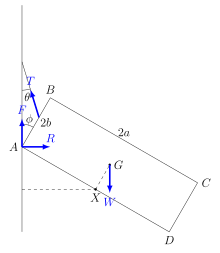
- \begin{align*} \text{N2}(\uparrow): && T \cos \theta + F -W &= 0 \\ && W &= T\cos \theta + \mu R \tag{1} \\ \text{N2}(\rightarrow): && R-T\sin \theta &= 0 \\ && R &= T \sin \theta \tag{2}\\ \\ (1)+(2): && W&=(\cos \theta + \mu \sin \theta)T \tag{3} \\ \overset{\curvearrowright}{A}: && 0 &= W(b\sin \phi + a \cos \phi) - Td\sin(\phi+\theta) \tag{4} \\ \\ (3)+(4): && 0 &= (\cos \theta + \mu \sin \theta)(b\sin \phi + a \cos \phi)-d\sin(\phi+\theta) \\ \Rightarrow && d\sin(\phi+\theta) &= (\cos \theta + \mu \sin \theta)(b\sin \phi + a \cos \phi) \end{align*} as required.
- If \(F\) is operating downwards, it's equivalent to \(-\mu\), ie: \[d\sin(\phi+\theta) = (\cos \theta - \mu \sin \theta)(b\sin \phi + a \cos \phi)\]
- For the frictional force to be acting upwards, we need \begin{align*} && d\sin(\phi+\theta) &\geq \cos \theta(b\sin \phi + a \cos \phi) \\ \Rightarrow && d &\geq \frac{\cos \theta(b\sin \phi + a \cos \phi)}{\sin(\phi + \theta)} \\ &&&= \frac{\cos \theta(b\sin \phi + a \cos \phi)}{\sin\phi \cos\theta+\cos\phi\sin \theta)}\\ &&&= \frac{(b\sin \phi + a \cos \phi)}{\sin\phi+\cos \phi \tan \theta)}\\ &&&= \frac{a+b\tan \phi}{\tan\theta+\tan\phi }\\ \end{align*} We know that \(d < 2b\), so \begin{align*} && 2b &>\frac{a+b\tan \phi}{\tan\theta+\tan\phi }\\ \Rightarrow && 2b \tan \theta + 2b \tan \phi &> a + b \tan \phi \\ \Rightarrow &&b(2 \tan \theta + \tan \phi) &> a\\ \end{align*} Therefore we will have problems if the inequality is reversed!
2013 Paper 1 Q10
Two parallel vertical barriers are fixed a distance \(d\) apart on horizontal ice. A small ice hockey puck moves on the ice backwards and forwards between the barriers, in the direction perpendicular to the barriers, colliding with each in turn. The coefficient of friction between the puck and the ice is \(\mu\) and the coefficient of restitution between the puck and each of the barriers is \(r\). The puck starts at one of the barriers, moving with speed \(v\) towards the other barrier. Show that \[ v_{i+1}^2 - r^2 v_i^2 = - 2 r^2 \mu gd\, \] where \(v_i\) is the speed of the puck just after its \(i\)th collision. The puck comes to rest against one of the barriers after traversing the gap between them \(n\) times. In the case \(r\ne1\), express \(n\) in terms of \(r\) and \(k\), where \(k= \dfrac{v^2}{2\mu g d}\,\). If \(r=\e^{-1}\) (where \(\e\) is the base of natural logarithms) show that \[ n = \tfrac12 \ln\big(1+k(\e^2-1)\big)\,. \] Give an expression for \(n\) in the case \(r=1\).
Solution: \begin{align*} \text{W.E.P.}: && \text{change in energy} &= \text{work done on particle} \\ \Rightarrow && \underbrace{\frac12mv^2}_{\text{speed before hitting barrier}} - \underbrace{\frac12mu^2}_{\text{speed leaving first barrier}} &= \underbrace{\left( -\mu mg \right)}_{F} \cdot \underbrace{d}_{d} \\ \Rightarrow && v^2 &= v_i^2-2\mu gd \end{align*} Newton's experimental law tells us that the speed leaving the barrier will be \(r\) times the speed approaching, ie \begin{align*} && v_{i+1} &= rv \\ \Rightarrow && v_{i+1}^2 &= r^2 v^2 \\ &&&= r^2v_i^2 - 2r^2\mu gd \\ \Rightarrow && v_{i+1}^2 - r^2v_i^2 &= - 2r^2\mu gd \end{align*} It must be the case that after \(n+1\) collisions the speed is zero, ie \(v_{n+1}^2 = 0\). Not that we can consider \(w_i = \frac{v_i^2}{2\mu gd}\) and we have the recurrence: \begin{align*} && w_{i+1} &=r^2w_i -r^2 \\ \end{align*} Looking at this we have a linear recurrence with a constant term, so let's try \(w_i = C\), then \begin{align*} && C &= r^2 C - r^2 \\ \Rightarrow && C &= \frac{-r^2}{1-r^2} \\ \end{align*} So \(w_i = Ar^{2i} - \frac{r^2}{1-r^2}\). \(w_0 = k \Rightarrow A = k+\frac{r^2}{1-r^2}\) Therefore \(w_n = \left (k+\frac{r^2}{1-r^2} \right)r^{2n} - \frac{r^2}{1-r^2}\) Suppose \(w_n = 0\) then, \begin{align*} && 0 &= \left (k+\frac{r^2}{1-r^2} \right)r^{2n} - \frac{r^2}{1-r^2} \\ \Rightarrow && r^{2n} &= \frac{r^2}{1-r^2} \frac{1}{k+\frac{r^2}{1-r^2}} \\ &&&= \frac{r^2}{k(1-r^2)+r^2} \\ \Rightarrow && 2n \ln r &= 2\ln r - \ln[k(1-r^2)+r^2] \\ \Rightarrow && n &= 1 - \frac1{2\ln r} \ln[k(1-r^2)+r^2)] \end{align*} If \(r = e^{-1}\) then \(\ln r = -1\) \begin{align*} && n &= 1 + \frac12 \ln [k(1-e^{-2}) + e^{-2}] \\ &&&= 1 + \frac12 \ln [e^{-2}(k(e^2-1)+1)] \\ &&&= 1 + \frac12 \ln e^{-2} + \frac12 \ln [1+k(e^2-1)] \\ &&&= \frac12 \ln [1+k(e^2-1)] \end{align*} If \(r = 1\) the recurrence becomes: \(w_{i+1} = w_i - 1\), so \(w_i = k-n\), so we have \(k\) collisions.
2013 Paper 1 Q11
\(\,\)
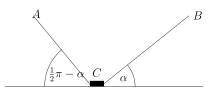
- In the case \(W> T\sin(\alpha+\beta)\), show that the block will remain at rest provided \[ W\sin\lambda \ge T\cos(\alpha+\beta- \lambda)\,, \] where \(\lambda\) is the acute angle such that \(\tan\lambda = \mu\).
- In the case \(W=T\tan\phi\), where \(2\phi =\alpha+\beta\), show that the block will start to move in a direction that makes an angle \(\phi\) with the horizontal.
Solution:
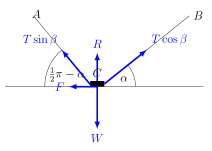
- Assuming the block is at rest we must have: \begin{align*} \text{N2}(\uparrow): && 0 &= T \sin \beta\cos \alpha + T \cos \beta \sin \alpha +R -W \\ \Rightarrow && W &> T \sin \beta\cos \alpha + T \cos \beta \sin \alpha \\ &&&= T\sin(\alpha+\beta) \\ \Rightarrow && R &= W-T\sin(\alpha+\beta)\\ \\ \text{N2}(\rightarrow): && 0 &= T \cos \beta \cos \alpha - T \sin \beta \sin \alpha - F \\ \Rightarrow && T \cos(\alpha+\beta) &= F \\ &&&\leq \mu (W-T\sin(\alpha+\beta)) \\ \Rightarrow && W \sin \lambda &\geq T \cos (\alpha+\beta)\cos \lambda +T \sin (\alpha+\beta) \sin \lambda \\ &&&= T\cos(\alpha+\beta-\lambda) \end{align*}
- If \(W = T\tan \phi\) where \(2\phi = \alpha + \beta\) then \begin{align*} \text{N2}(\uparrow): && ma_y &= T\sin(\alpha+\beta) - W \\ &&&= T \sin(\alpha+\beta) - T \tan \left ( \frac{\alpha+\beta}{2} \right ) \\ &&&= T \tan \left ( \frac{\alpha+\beta}{2} \right ) \left ( 2 \cos^2 \left ( \frac{\alpha+\beta}{2} \right ) -1\right) \\ &&&= T \tan \phi \cos \left ( \alpha+\beta\right ) \tag{notice this is positive so \(R=F=0\)} \\ \text{N2}(\rightarrow): && ma_x &= T \cos(\alpha+\beta) \\ \Rightarrow && \frac{a_y}{a_x} &= \tan \phi \end{align*} Therefore we are accelerating at an angle \(\phi\) to the horizontal
2013 Paper 2 Q9
The diagram shows three identical discs in equilibrium in a vertical plane. Two discs rest, not in contact with each other, on a horizontal surface and the third disc rests on the other two. The angle at the upper vertex of the triangle joining the centres of the discs is \(2\theta\).
- Show that the normal reaction between the horizontal surface and a disc in contact with the surface is \(\frac32 W\,\).
- Find the normal reaction between two discs in contact and show that the magnitude of the frictional force between two discs in contact is \(\dfrac{W\sin\theta}{2(1+\cos\theta)}\,\).
- Show that if \(\mu <2- \surd3\,\) there is no value of \(\theta\) for which equilibrium is possible.
2012 Paper 1 Q11
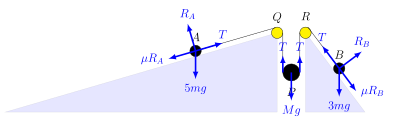
The diagram shows two particles, \(A\) of mass \(5m\) and \(B\) of mass \(3m\), connected by a light inextensible string which passes over two smooth, light, fixed pulleys, \(Q\) and \(R\), and under a smooth pulley \(P\) which has mass \(M\) and is free to move vertically. Particles \(A\) and \(B\) lie on fixed rough planes inclined to the horizontal at angles of \(\arctan \frac 7{24}\) and \(\arctan\frac43\) respectively. The segments \(AQ\) and \(RB\) of the string are parallel to their respective planes, and segments \(QP\) and \(PR\) are vertical. The coefficient of friction between each particle and its plane is \(\mu\).

- Given that the system is in equilibrium, with both \(A\) and \(B\) on the point of moving up their planes, determine the value of \(\mu\) and show that \(M = 6m\).
- In the case when \(M = 9m\), determine the initial accelerations of \(A\), \(B\) and \(P\) in terms of \(g\).
Solution:
2012 Paper 2 Q10
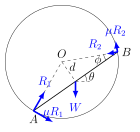
A hollow circular cylinder of internal radius \(r\) is held fixed with its axis horizontal. A uniform rod of length \(2a\) (where \(a < r\)) rests in equilibrium inside the cylinder inclined at an angle of \(\theta\) to the horizontal, where \(\theta\ne0\). The vertical plane containing the rod is perpendicular to the axis of the cylinder. The coefficient of friction between the cylinder and each end of the rod is \(\mu\), where \(\mu > 0\). Show that, if the rod is on the point of slipping, then the normal reactions \(R_1\) and \(R_2\) of the lower and higher ends of the rod, respectively, on the cylinder are related by \[ \mu(R_1+R_2) = (R_1-R_2)\tan\phi \] where \(\phi\) is the angle between the rod and the radius to an end of the rod. Show further that \[ \tan\theta = \frac {\mu r^2}{r^2 -a^2(1+\mu^2)}\,. \] Deduce that \(\lambda <\phi \), where \(\tan\lambda =\mu\).
Solution:
2010 Paper 1 Q9

Solution:


2010 Paper 3 Q11
A bullet of mass \(m\) is fired horizontally with speed \(u\) into a wooden block of mass \(M\) at rest on a horizontal surface. The coefficient of friction between the block and the surface is \(\mu\). While the bullet is moving through the block, it experiences a constant force of resistance to its motion of magnitude \(R\), where \(R>(M+m)\mu g\). The bullet moves horizontally in the block and does not emerge from the other side of the block.
- Show that the magnitude, \(a\), of the deceleration of the bullet relative to the block while the bullet is moving through the block is given by \[ a= \frac R m + \frac {R-(M+m)\mu g}{M}\, . \]
- Show that the common speed, \(v\), of the block and bullet when the bullet stops moving through the block satisfies \[ av = \frac{Ru-(M+m)\mu gu}M\,. \]
- Obtain an expression, in terms of \(u\), \(v\) and \(a\), for the distance moved by the block while the bullet is moving through the block.
- Show that the total distance moved by the block is \[ \frac{muv}{2(M+m)\mu g}\,. \]
2008 Paper 1 Q11
A straight uniform rod has mass \(m\). Its ends \(P_1\) and \(P_2\) are attached to small light rings that are constrained to move on a rough rigid circular wire with centre \(O\) fixed in a vertical plane, and the angle \(P_1OP_2\) is a right angle. The rod rests with \(P_1\) lower than \(P_2\), and with both ends lower than \(O\). The coefficient of friction between each of the rings and the wire is \(\mu\). Given that the rod is in limiting equilibrium (i.e. \ on the point of slipping at both ends), show that \[ \tan \alpha = \frac{1-2\mu -\mu^2}{1+2\mu -\mu^2}\,, \] where \(\alpha\) is the angle between \(P_1O\) and the vertical (\(0<\alpha<45^\circ\)). Let \(\theta\) be the acute angle between the rod and the horizontal. Show that \(\theta =2\lambda\), where \(\lambda \) is defined by \(\tan \lambda= \mu\) and \(0<\lambda<22.5^\circ\).
2008 Paper 2 Q11
A wedge of mass \(km\) has the shape (in cross-section) of a right-angled triangle. It stands on a smooth horizontal surface with one face vertical. The inclined face makes an angle \(\theta\) with the horizontal surface. A particle \(P\), of mass \(m\), is placed on the inclined face and released from rest. The horizontal face of the wedge is smooth, but the inclined face is rough and the coefficient of friction between \(P\) and this face is \(\mu\).
- When \(P\) is released, it slides down the inclined plane at an acceleration \(a\) relative to the wedge. Show that the acceleration of the wedge is \[ \frac {a \cos\theta}{k+1}\,. \] To a stationary observer, \(P\) appears to descend along a straight line inclined at an angle~\(45^\circ\) to the horizontal. Show that \[ \tan\theta = \frac k {k+1}\,. \] In the case \(k=3\), find an expression for \(a\) in terms of \(g\) and \(\mu\).
- What happens when \(P\) is released if \(\tan\theta \le \mu\)?
2008 Paper 3 Q9
A particle of mass \(m\) is initially at rest on a rough horizontal surface. The particle experiences a force \(mg\sin \pi t\), where \(t\) is time, acting in a fixed horizontal direction. The coefficient of friction between the particle and the surface is \(\mu\). Given that the particle starts to move first at \(t=T_0\), state the relation between \(T_0\) and \(\mu\).
- For \(\mu = \mu_0\), the particle comes to rest for the first time at \(t=1\). Sketch the acceleration-time graph for \(0\le t \le 1\). Show that \[ 1+\left(1-\mu_0^2\right)^{\frac12} -\mu_0\pi +\mu_0 \arcsin \mu_0 =0\,. \]
- For \(\mu=\mu_0\) sketch the acceleration-time graph for \(0\le t\le 3\). Describe the motion of the particle in this case and in the case \(\mu=0\).
2007 Paper 1 Q9
A particle of weight \(W\) is placed on a rough plane inclined at an angle of \(\theta\) to the horizontal. The coefficient of friction between the particle and the plane is \(\mu\). A horizontal force \(X\) acting on the particle is just sufficient to prevent the particle from sliding down the plane; when a horizontal force \(kX\) acts on the particle, the particle is about to slide up the plane. Both horizontal forces act in the vertical plane containing the line of greatest slope. Prove that \[ \left( k-1 \right) \left( 1 + \mu^2 \right) \sin \theta \cos \theta = \mu \left( k + 1 \right) \] and hence that $\displaystyle k \ge \frac{ \left( 1+ \mu \right)^2} { \left( 1 - \mu \right)^2}$ .
2007 Paper 2 Q10
A solid figure is composed of a uniform solid cylinder of density \(\rho\) and a uniform solid hemisphere of density \(3\rho\). The cylinder has circular cross-section, with radius \(r\), and height \(3r\), and the hemisphere has radius \(r\). The flat face of the hemisphere is joined to one end of the cylinder, so that their centres coincide. The figure is held in equilibrium by a force \(P\) so that one point of its flat base is in contact with a rough horizontal plane and its base is inclined at an angle \(\alpha\) to the horizontal. The force \(P\) is horizontal and acts through the highest point of the base. The coefficient of friction between the solid and the plane is \(\mu\). Show that \[\mu \ge \left\vert \tfrac98 -\tfrac12 \cot\alpha\right\vert\,. \]
Solution: The centre of mass of the sphere will be at \((0, \frac{3}{2}r)\) and the centre of mass of the hemisphere will be at \((0, 3r + \frac38r)\), their masses will be \(3\pi r^3 \cdot \rho \) and \(\frac23 \pi r^3 \cdot 3\rho \), meaning the center of mass will be \(\frac{\frac92r + \frac{27}{8} \cdot 2r}{3 + 2} = \frac{45/4}{5}r = \frac{9}{4}r\) above the center of the base.