2012 Paper 1 Q11
Year: 2012
Paper: 1
Question Number: 11
Course: LFM Pure and Mechanics
Section: Pulley systems
Difficulty: 1516.0
Banger: 1500.0
pulley systems
inclined plane
friction
equilibrium
Newton's second law
constraint equations
arctan angles
connected particles
Problem
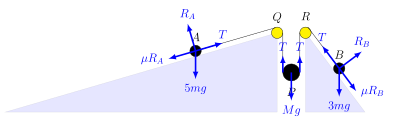
The diagram shows two particles, \(A\) of mass \(5m\) and \(B\) of mass \(3m\), connected by a light inextensible string which passes over two smooth, light, fixed pulleys, \(Q\) and \(R\), and under a smooth pulley \(P\) which has mass \(M\) and is free to move vertically.
Particles \(A\) and \(B\) lie on fixed rough planes inclined to the horizontal at angles of \(\arctan \frac 7{24}\) and \(\arctan\frac43\) respectively.
The segments \(AQ\) and \(RB\) of the string are
parallel to their respective planes, and segments \(QP\) and \(PR\) are vertical.
The coefficient of friction between each particle and its plane is \(\mu\).

- Given that the system is in equilibrium, with both \(A\) and \(B\) on the point of moving up their planes, determine the value of \(\mu\) and show that \(M = 6m\).
- In the case when \(M = 9m\), determine the initial accelerations of \(A\), \(B\) and \(P\) in terms of \(g\).
Solution
Examiner's report
— 2012 STEP 1, Question 11
Source: Cambridge STEP 2012 Examiner's Report
· 2012-full.pdf
Rating Information
Difficulty Rating: 1516.0
Difficulty Comparisons: 1
Banger Rating: 1500.0
Banger Comparisons: 0
Show LaTeX source
Problem source
The diagram shows two particles, $A$ of mass $5m$ and $B$ of mass $3m$, connected by a light  inextensible string which passes over two smooth, light, fixed pulleys, $Q$ and  $R$, and under a smooth pulley $P$ which has mass $M$ and is free to move vertically.
Particles $A$ and $B$ lie on fixed rough planes inclined to the horizontal at angles of $\arctan \frac 7{24}$ and $\arctan\frac43$ respectively.
The segments $AQ$ and $RB$ of the string are
parallel to their respective planes, and segments $QP$ and $PR$ are vertical.
The coefficient of friction between each particle and its plane is $\mu$.
\begin{center}
    \begin{tikzpicture}[scale=2]
        \coordinate (Ax) at (0,0);
        \coordinate (O) at ({24/5},0);
        \coordinate (Q) at ({24/5}, {7/5});
        \coordinate (R) at ({24/5+0.5},{7/5});
        \coordinate (D) at ({24/5+0.5},0);
        \coordinate (Bx) at ({24/5+0.5+7/5*3/4}, {0});
        \coordinate (P) at ({24/5 + 0.25}, {7/10});
        \coordinate (A) at ($0.7*(Q) + 0.3*(Ax) + (0,0.1)$);
        \coordinate (B) at ($0.5*(R) + 0.5*(Bx) + (0.07,0.07)$);

        \draw[black,fill=blue, opacity=0.1] (O) -- (Ax) -- (Q) -- cycle;
        \draw[fill=blue, opacity=0.1] (R) -- (D) -- (Bx) -- cycle;

        \draw[fill=yellow] (Q) circle (0.1);
        \draw[fill=yellow] (R) circle (0.1);
        \filldraw (P) circle (0.15);
        \draw ($(P)+(-0.15,0)$) -- ($(Q)+(0.1,0)$);
        \draw ($(P)+(+0.15,0)$) -- ($(R)+(-0.1,0)$);

        \filldraw (A) circle (0.1);
        \filldraw (B) circle (0.1);
        \draw (A) -- ($(Q)+(-0.03,0.09)$);
        \draw (B) -- ($(R)+(0.04,0.10)$);
        \node at ($(A)+(0,0.1)$) [above] {$A$};
        \node at ($(B)+(0,0.1)$) [above] {$B$};
        \node at ($(Q)+(0,0.1)$) [above] {$Q$};
        \node at ($(R)+(0,0.15)$) [above] {$R$};
        \node at ($(P)-(0,0.2)$) [below] {$P$};

    \end{tikzpicture}
\end{center}
\begin{questionparts}
\item Given that the system is in equilibrium, with both $A$ and $B$ on the point of moving up their    planes, determine the value of $\mu$  and show that $M = 6m$.
\item In the case when $M = 9m$, determine the
initial accelerations of $A$, $B$ and $P$ in terms of $g$.
\end{questionparts}
Solution source
\begin{center}
    \begin{tikzpicture}[scale=2]

        \coordinate (Ax) at (0,0);
        \coordinate (O) at ({24/5},0);
        \coordinate (Q) at ({24/5}, {7/5});
        \coordinate (R) at ({24/5+0.5},{7/5});
        \coordinate (D) at ({24/5+0.5},0);
        \coordinate (Bx) at ({24/5+0.5+7/5*3/4}, {0});
        \coordinate (P) at ({24/5 + 0.25}, {7/10});

        \coordinate (A) at ($0.7*(Q) + 0.3*(Ax) + (0,0.1)$);
        \coordinate (B) at ($0.5*(R) + 0.5*(Bx) + (0.07,0.07)$);

        \draw[black,fill=blue, opacity=0.1] (O) -- (Ax) -- (Q) -- cycle;
        \draw[fill=blue, opacity=0.1] (R) -- (D) -- (Bx) -- cycle;


        \draw[fill=yellow] (Q) circle (0.1);
        \draw[fill=yellow] (R) circle (0.1);
        \filldraw (P) circle (0.15);
        \draw ($(P)+(-0.15,0)$) -- ($(Q)+(0.1,0)$);
        \draw ($(P)+(+0.15,0)$) -- ($(R)+(-0.1,0)$);

        \filldraw (A) circle (0.1);
        \filldraw (B) circle (0.1);

        \draw (A) -- ($(Q)+(-0.03,0.09)$);
        \draw (B) -- ($(R)+(0.04,0.10)$);

        \node at ($(A)+(0,0.1)$) [above] {$A$};
        \node at ($(B)+(0,0.1)$) [above] {$B$};
        \node at ($(Q)+(0,0.1)$) [above] {$Q$};
        \node at ($(R)+(0,0.15)$) [above] {$R$};
        \node at ($(P)-(0,0.2)$) [below] {$P$};


        \draw[-latex, blue, ultra thick] (A) -- ++(0,-0.5) node[below] {$5mg$};
        \draw[-latex, blue, ultra thick] (A) -- ++({24/50},{7/50}) node[above] {$T$};
        \draw[-latex, blue, ultra thick] (A) -- ++({-7/50},{24/50}) node[above] {$R_A$};
        \draw[-latex, blue, ultra thick] (A) -- ++({-24/50},{-7/50}) node[left] {$\mu R_A$};
        \draw[-latex, blue, ultra thick] (B) -- ++(0,-0.5) node[below] {$3mg$};
        \draw[-latex, blue, ultra thick] (B) -- ++({-3/10},{4/10}) node[above] {$T$};
        \draw[-latex, blue, ultra thick] (B) -- ++({4/10},{3/10}) node[above] {$R_B$};
        \draw[-latex, blue, ultra thick] (B) -- ++({3/10},{-4/10}) node[right] {$\mu R_B$};
        \draw[-latex, blue, ultra thick] (P) -- ++(0,-0.5) node[below] {$Mg$};

        \draw[-latex, blue, ultra thick] ($(P)+(-0.15,0)$) -- ++({0},{0.3}) node[above] {$T$};
        \draw[-latex, blue, ultra thick] ($(P)+(0.15,0)$) -- ++({0},{0.3}) node[above] {$T$};

    \end{tikzpicture}
\end{center}

First note our triangles are 7-24-25 and 3-4-5 triangles, so we can easily calculate $\sin$ and $\cos$ of our angles.

\begin{questionparts}
\item
\begin{align*}
\text{N2}(\uparrow, P): && 2T - Mg &= 0 \\
\\
\text{N2}(\perp AQ): && R_A - 5mg \cdot \frac{24}{25} &= 0 \\
\Rightarrow && R_A &= \frac{24}{5}mg \\
\text{N2}(\parallel AQ): && T - \mu R_A - 5mg \cdot \frac{7}{25} &= 0 \\
\Rightarrow && T &= \frac15 mg \l 7+24 \mu \r
\\
\text{N2}(\perp BR): && R_B - 3mg \cdot \frac{3}{5}&= 0 \\
\Rightarrow && R_B &= \frac{9}{5}mg \\
\text{N2}(\parallel AQ): && T - \mu R_B - 3mg \cdot \frac{4}{5} &= 0 \\
\Rightarrow && T &= \frac15 mg \l 12+9 \mu \r \\
\\
\Rightarrow && 12 + 9 \mu &= 7 + 24 \mu \\
\Rightarrow && \mu &= \frac{5}{15} = \frac13 \\
\\
\Rightarrow && Mg &= 2 \cdot \frac15 \cdot mg \cdot (7 + 24 \cdot \frac13) \\
&&&= 6mg \\
\Rightarrow && M &= 6m
\end{align*}

\item Assuming $\mu = \frac13$
\begin{align*}
&&9m \ddot{p} &= 9mg - 2T \\
&&5m \ddot{a} &= T - 3mg  \\
&&3m \ddot{b} &= T - 3mg \\
&&2\ddot{p} &=  \ddot{a}+\ddot{b} \\
\Rightarrow &&30m\ddot{p} &= 8T - 24mg \\
&&9m\ddot{p} &= 9mg - 2T \\
\Rightarrow && 66m \ddot{p} &=12mg \\
\Rightarrow && \ddot{p} &= \frac{2}{11}g \\
&& T &= 9mg - 9m \frac{2}{11} g = \frac{9^2}{11}mg\\
&& \ddot{a} &= \frac{3}{22} g \\
&& \ddot{b} &= \frac{5}{22}g

\end{align*}
This question began with some quite familiar calculations involving inclined planes and many candidates who attempted the question were able to reach the solution. In some cases the required value of was assumed rather than solving the simultaneous equations. The second part of the question was less familiar and some candidates did not realise that the fact that the pulley can move means that there will be different accelerations at different points in the system. They therefore attempted to calculate one value for the acceleration that worked for all of their equations.