2012 Paper 2 Q10
Year: 2012
Paper: 2
Question Number: 10
Course: LFM Pure and Mechanics
Section: Friction
Problem
Solution
Examiner's report
— 2012 STEP 2, Question 10There were just over 1000 entries for paper II this year, almost exactly the same number as last year. Overall, the paper was found marginally easier than its predecessor, which means that it was pitched at exactly the level intended and produced the hoped-for outcomes. Almost 50 candidates scored 100 marks or more, with more than 400 gaining at least half marks on the paper. At the lower end of the scale, around a quarter of the entry failed to score more than 40 marks. It was pleasing to note that the advice of recent years, encouraging students not to make attempts at lots of early parts to questions but rather to spend their time getting to grips with the six that can count towards their paper total, was more obviously being heeded in 2012 than I can recall being the case previously. As in previous years, the pure maths questions provided the bulk of candidates' work, with relatively few efforts to be found at the applied ones. Questions 1 and 2 were the most popular questions, although each drew only around 800 "hits" – fewer than usual. Questions 3 – 5 & 8 were almost as popular (around 700), with Q6 attracting the interest of under 450 candidates and Q7 under 200. Q9 was the most popular applied question – and, as it turned out, the most successfully attempted question on the paper – with very little interest shown in the rest of Sections B or C.
Rating Information
Difficulty Rating: 1600.0
Difficulty Comparisons: 0
Banger Rating: 1500.0
Banger Comparisons: 0
Show LaTeX source
Problem source
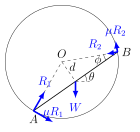
A hollow circular cylinder of internal radius $r$ is held fixed with its axis horizontal. A uniform rod of length $2a$ (where $a  < r$) rests in equilibrium inside the cylinder inclined at an angle of $\theta$ to the horizontal, where $\theta\ne0$. The vertical plane containing the rod is perpendicular to the axis of the cylinder. The coefficient of friction between the cylinder and each end of the rod is $\mu$, where $\mu > 0$.  Show that, if the rod is on the point of slipping, then the normal reactions $R_1$ and $R_2$ of the lower and higher ends of the rod, respectively, on the cylinder are related by
\[
\mu(R_1+R_2) = (R_1-R_2)\tan\phi
\]
where $\phi$ is the angle between the rod and the radius to an end of the rod.
Show further that
\[
\tan\theta = \frac {\mu r^2}{r^2 -a^2(1+\mu^2)}\,.
\]
Deduce that $\lambda <\phi $, where $\tan\lambda =\mu$.
Solution source
\begin{center}
    \begin{tikzpicture}
        \def\a{2};
        \coordinate (O) at (0,0);
        \coordinate (A) at ({\a*cos(10)},{\a*sin(10)});
        \coordinate (B) at ({\a*cos(240)},{\a*sin(240)});
        \coordinate (M) at ($(A)!0.5!(B)$);
        \coordinate (X) at ($(M) + (0.5, 0)$);

        % 1. Draw the circle and name it
        \draw (O) circle (\a);

        \node[right] at (A) {$B$};
        \node[below] at (B) {$A$};
        \node[above] at (O) {$O$};

        \draw[thick] (A) -- (B);

        \draw[dashed] (A) -- (O) -- (B);
        \draw[dashed] (M) -- (X);
        \draw[dashed] (O) -- (M) node[right, pos=0.25] {$d$};

        \draw[ultra thick, blue, -latex] (M) -- ++ (0,-0.6) node[below] {$W$};

        \draw[ultra thick, blue, -latex] (A) -- ($(A)!0.2!(O)$) node[above left] {$R_2$};
        \draw[ultra thick, blue, -latex] (B) -- ($(B)!0.4!(O)$) node[above] {$R_1$};
        \draw[ultra thick, blue, -latex] (A) -- ++({-0.4*sin(10)},{0.4*cos(10)}) node[above] {$\mu R_2$};
        \draw[ultra thick, blue, -latex] (B) -- ++({-0.8*sin(240)},{0.8*cos(240)}) node[above] {$\mu R_1$};

        \pic [draw, angle radius=.4cm, angle eccentricity=1.5, "$\theta$"] {angle = X--M--A};
        \pic [draw, angle radius=.5cm, angle eccentricity=1.5, "$\phi$"] {angle = O--A--B};

    \end{tikzpicture}
\end{center}

Let $M$ be the midpoint of $AB$, then

\begin{align*}
\overset{\curvearrowright}{M}: && R_1 \sin \phi-\mu R_1 \cos \phi &= R_2 \sin \phi+\mu R_2 \cos \phi \\
\Rightarrow && (R_1-R_2) \tan \phi &= \mu(R_1+R_2)
\end{align*}

As required.

\begin{align*}
&& \cos \phi = \frac{a}{r} &,\,\, \sin \phi = \frac{\sqrt{r^2-a^2}}{r} \\

\text{N2}(\rightarrow): && R_1\cos(\phi + \theta)+\mu R_1 \sin(\phi + \theta) &= R_2 \cos(\theta - \phi) + \mu R_2 \sin(\theta - \phi) \\
\Rightarrow && R_1(\cos \theta \cos \phi - \sin \theta \sin \phi)+ \mu R_1 (\sin \theta \cos \phi + \cos \theta \sin \phi) &= R_2 (\cos\theta \cos \phi + \sin \theta \sin \phi)+ \mu R_2 (\sin \theta \cos \phi - \cos \theta \sin \phi) \\
&& R_1 (1 - \tan \theta \tan \phi)+\mu R_1 (\tan \theta + \tan \phi) &= R_2(1 + \tan \theta \tan \phi) +\mu R_2 (\tan \theta - \tan \phi) \\
&& 0 &= (R_1-R_2)(1+\mu \tan \theta)+(R_1+R_2)(-\tan \theta \tan\phi+\mu \tan \phi) \\
\Rightarrow && \frac{R_1+R_2}{R_1-R_2} &= \frac{1+\mu \tan \theta}{\tan \phi (\tan \theta - \mu))} \\
\Rightarrow && \frac{\tan \phi}{\mu} &= \frac{1+\mu \tan \theta}{\tan \phi (\tan \theta - \mu))} \\
\Rightarrow && \tan^2 \phi &= \frac{\mu(1+\mu \tan \theta)}{\tan \theta - \mu} \\
\Rightarrow && \frac{r^2-a^2}{a^2} &= \frac{\mu(1+\mu \tan \theta)}{\tan \theta - \mu} \\
\Rightarrow && \tan \theta (r^2-a^2-a^2\mu^2) &= \mu a^2+\mu(r^2-a^2) \\
\Rightarrow && \tan \theta &= \frac{\mu r^2}{r^2-(1+\mu^2)a^2}
\end{align*}

Since $\mu r^2 > 0$ we must also have $r^2 > a^2(1+\mu^2)$ ie $\\sec^2 \phi > 1 + \mu^2 = \sec^2 \lambda$ and the result follows.
This was the least popular question on the paper, attracting the poorest efforts and having the weakest mean score (under 4 marks). Around half of attempts foundered at the very outset by failing to have "the vertical plane containing the rod ... perpendicular to the axis of the cylinder". Those candidates who resolved horizontally and vertically, instead of parallel and perpendicular to the rod, invariably ended up with a terrible mess that they simply couldn't sort; a few forget to take moments at all and were thus unable to make much progress towards the answers required.