2007 Paper 2 Q10
Year: 2007
Paper: 2
Question Number: 10
Course: UFM Mechanics
Section: Centre of Mass 2
Problem
Solution
Examiner's report
— 2007 STEP 2, Question 10Although the paper was by no means an easy one, it was generally found a more accessible paper than last year's, with most questions clearly offering candidates an attackable starting-point. The candidature represented the usual range of mathematical talents, with a pleasingly high number of truly outstanding students; many more who were able to demonstrate a thorough grasp of the material in at least three questions; and the few whose three-hour long experience was unlikely to have been a particularly pleasant one. However, even for these candidates, many were able to make some progress on at least two of the questions chosen. Really able candidates generally produced solid attempts at five or six questions, and quite a few produced outstanding efforts at up to eight questions. In general, it would be best if centres persuaded candidates not to spend valuable time needlessly in this way – it is a practice that is not to be encouraged, as it uses valuable examination time to little or no avail. Weaker brethren were often to be found scratching around at bits and pieces of several questions, with little of substance being produced on more than a couple. It is an important examination skill – now more so than ever, with most candidates now not having to employ such a skill on the modular papers which constitute the bulk of their examination experience – for candidates to spend a few minutes at some stage of the examination deciding upon their optimal selection of questions to attempt. As a rule, question 1 is intended to be accessible to all takers, with question 2 usually similarly constructed. In the event, at least one – and usually both – of these two questions were among candidates' chosen questions. These, along with questions 3 and 6, were by far the most popularly chosen questions to attempt. The majority of candidates only attempted questions in Section A (Pure Maths), and there were relatively few attempts at the Applied Maths questions in Sections B & C, with Mechanics proving the more popular of the two options. It struck me that, generally, the working produced on the scripts this year was rather better set-out, with a greater logical coherence to it, and this certainly helps the markers identify what each candidate thinks they are doing. Sadly, this general remark doesn't apply to the working produced on the Mechanics questions, such as they were. As last year, the presentation was usually appalling, with poorly labelled diagrams, often with forces missing from them altogether, and little or no attempt to state the principles that the candidates were attempting to apply.
Rating Information
Difficulty Rating: 1600.0
Difficulty Comparisons: 0
Banger Rating: 1500.0
Banger Comparisons: 0
Show LaTeX source
Problem source
A solid figure is composed of a uniform solid cylinder
of density $\rho$ and a uniform solid hemisphere of density $3\rho$.
The cylinder has  circular cross-section, with radius $r$, and height $3r$, and the  hemisphere has radius $r$. The flat face of the hemisphere is joined to one end of the cylinder, so that their centres coincide.
The figure  is held in equilibrium by a force $P$ so that one point of its flat base  is in contact with a rough horizontal plane and its base is  inclined at an angle $\alpha$ to the horizontal. The force $P$ is horizontal and  acts through the highest point of the base. The coefficient of friction between the solid and the plane is $\mu$.
Show that
\[\mu \ge \left\vert \tfrac98 -\tfrac12 \cot\alpha\right\vert\,.
\]
Solution source
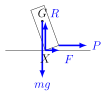
The centre of mass of the sphere will be at $(0, \frac{3}{2}r)$ and the centre of mass of the hemisphere will be at $(0, 3r + \frac38r)$, their masses will be $3\pi r^3 \cdot \rho $ and $\frac23 \pi r^3 \cdot 3\rho $, meaning the center of mass will be $\frac{\frac92r + \frac{27}{8} \cdot 2r}{3 + 2} = \frac{45/4}{5}r = \frac{9}{4}r$ above the center of the base.

\begin{center}
    \begin{tikzpicture}

        \def\s{20};

        \coordinate (G) at ({1.75*cos(\s)-1*sin(\s)}, {1.75*sin(\s)+1*cos(\s)});
        \coordinate (R) at ({2*cos(\s)}, {2*sin(\s)});
        \coordinate (N) at ({1.5*cos(\s)}, {1.5*sin(\s)});
        \draw (0,{1.5*sin(\s)}) -- (3,{1.5*sin(\s)});

        \draw ({1.5*cos(\s)}, {1.5*sin(\s)}) --
              ({2*cos(\s)}, {2*sin(\s)}) --
              ({2*cos(\s)-1.5*sin(\s)}, {2*sin(\s)+1.5*cos(\s)}) --
              ({1.5*cos(\s)-1.5*sin(\s)}, {1.5*sin(\s)+1.5*cos(\s)}) -- cycle;
              ;
        \filldraw (G) circle (1pt) node[above] {$G$};

        \draw[-latex, ultra thick, blue] (G) -- ++ (0, -2) node[below] {$mg$};
        \draw[-latex, ultra thick, blue] (R) -- ++ (1, 0) node[right] {$P$};
        \draw[-latex, ultra thick, blue] (N) -- ++ (0, 1) node[above right] {$R$};
        \draw[-latex, ultra thick, blue] (N) -- ++ (0.5, 0) node[below right] {$F$};
        \node[below] at (N) {$X$};
    \end{tikzpicture}
\end{center}


\begin{align*}
\text{N2}(\uparrow): && R -mg &= 0 \\
\overset{\curvearrowright}{X}: && P\cdot 2r \sin \alpha + mg (r \cos \alpha -\tfrac94 r\sin \alpha) &= 0 \\
\Rightarrow && P &= mg(\tfrac98 - \tfrac12 \cot \alpha) \\
\text{N2}(\rightarrow): && |F| &= |P| \\
(|F| \leq \mu R): && mg|\tfrac98 - \tfrac12 \cot \alpha| & \leq \mu mg \\
\Rightarrow && |\tfrac98 - \tfrac12 \cot \alpha| &\leq \mu

\end{align*}
This was the most popular of the three Mechanics questions, although most efforts failed to get very far into it. The routine opening part, finding the position of a centre of mass, probably accounts for its initial (relative) popularity, but progress beyond this point was pitifully weak in most cases. Resolving and taking moments frequently appeared, but often had to be searched-for in amidst a sea of other statements, many of which were incorrect, repetitive or just nonsensical. Very few candidates indeed grasped the fact that the horizontal force P could be in either direction, and the given answer was mostly fiddled, usually by simply placing modulus signs around the answer.