2013 Paper 1 Q11
Year: 2013
Paper: 1
Question Number: 11
Course: LFM Pure and Mechanics
Section: Friction
Problem
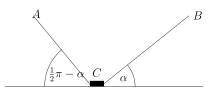
- In the case \(W> T\sin(\alpha+\beta)\), show that the block will remain at rest provided \[ W\sin\lambda \ge T\cos(\alpha+\beta- \lambda)\,, \] where \(\lambda\) is the acute angle such that \(\tan\lambda = \mu\).
- In the case \(W=T\tan\phi\), where \(2\phi =\alpha+\beta\), show that the block will start to move in a direction that makes an angle \(\phi\) with the horizontal.
Solution
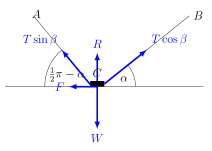
- Assuming the block is at rest we must have: \begin{align*} \text{N2}(\uparrow): && 0 &= T \sin \beta\cos \alpha + T \cos \beta \sin \alpha +R -W \\ \Rightarrow && W &> T \sin \beta\cos \alpha + T \cos \beta \sin \alpha \\ &&&= T\sin(\alpha+\beta) \\ \Rightarrow && R &= W-T\sin(\alpha+\beta)\\ \\ \text{N2}(\rightarrow): && 0 &= T \cos \beta \cos \alpha - T \sin \beta \sin \alpha - F \\ \Rightarrow && T \cos(\alpha+\beta) &= F \\ &&&\leq \mu (W-T\sin(\alpha+\beta)) \\ \Rightarrow && W \sin \lambda &\geq T \cos (\alpha+\beta)\cos \lambda +T \sin (\alpha+\beta) \sin \lambda \\ &&&= T\cos(\alpha+\beta-\lambda) \end{align*}
- If \(W = T\tan \phi\) where \(2\phi = \alpha + \beta\) then \begin{align*} \text{N2}(\uparrow): && ma_y &= T\sin(\alpha+\beta) - W \\ &&&= T \sin(\alpha+\beta) - T \tan \left ( \frac{\alpha+\beta}{2} \right ) \\ &&&= T \tan \left ( \frac{\alpha+\beta}{2} \right ) \left ( 2 \cos^2 \left ( \frac{\alpha+\beta}{2} \right ) -1\right) \\ &&&= T \tan \phi \cos \left ( \alpha+\beta\right ) \tag{notice this is positive so \(R=F=0\)} \\ \text{N2}(\rightarrow): && ma_x &= T \cos(\alpha+\beta) \\ \Rightarrow && \frac{a_y}{a_x} &= \tan \phi \end{align*} Therefore we are accelerating at an angle \(\phi\) to the horizontal
Examiner's report
— 2013 STEP 1, Question 11Around 1500 candidates sat this paper, a significant increase on last year. Overall, responses were good with candidates finding much to occupy them profitably during the three hours of the examination. In hindsight, two or three of the questions lacked sufficient 'punch' in their later parts, but at least most candidates showed sufficient skill to identify them and work on them as part of their chosen selection of questions. On the whole, nearly all candidates managed to attempt 4-6 questions – although there is always a significant minority who attempt 7, 8, 9, … bit and pieces of questions – and most scored well on at least two. Indeed, there were many scripts with 6 question-attempts, most or all of which were fantastically accomplished mathematically, and such excellence is very heart-warming.
Rating Information
Difficulty Rating: 1500.0
Difficulty Comparisons: 0
Banger Rating: 1500.0
Banger Comparisons: 0
Show LaTeX source
Problem source
$\,$
\begin{center}
\begin{tikzpicture}
    % Set the clipping area to match pspicture*
    \clip (-3.5,-0.23) rectangle (3.5,2.88);
    % The black filled rectangle (Pivot/Center)
    \fill[black] (-0.5,0) rectangle (0,0.2);


    \coordinate (B) at (3,2.5);
    \coordinate (Bs) at (0,0.1);
    \coordinate (X) at (10,0);
    \coordinate (Y) at (-.1,0);

    \coordinate (A) at (-2.5,2.5);
    \coordinate (As) at (-0.5,0.08);
    \coordinate (C) at (-10,0);
    \coordinate (D) at (-.4,0);

    % The ground lines (extending beyond the clip)
    \draw (-7,0) -- (5.5,0);
    % \draw (-0.5,0) -- (-7,0);
    % The angled lines (Rays)
    % Left Ray (Line to A)
    \draw (As) -- (A);
    % Right Ray (Line to B)
    \draw (Bs) -- (B);

    \pic [draw, angle radius=1.2cm, angle eccentricity=.7, "$\alpha$"] {angle = X--Y--B};
    \pic [draw, angle radius=1.7cm, angle eccentricity=.6, "$\frac12\pi-\alpha$"] {angle = A--D--C};
    \node[above] at (-.25,0.2) {$C$};
    \node[anchor=north west] at (-2.7,2.85) {$A$};
    \node[anchor=north west] at (3,2.8) {$B$};
\end{tikzpicture}
\end{center}
The diagram shows a small block $C$ of weight $W$ initially at rest on a rough horizontal surface. The coefficient of friction between the block and the surface is $\mu$. Two light strings, $AC$ and $BC$, are attached to the block, making angles $\frac12 \pi -\alpha$ and $\alpha$ to the horizontal, respectively. The tensions in $AC$ and $BC$ are $T\sin\beta$ and $T\cos\beta$ respectively, where $0< \alpha+\beta<\frac12\pi$.
\begin{questionparts}
\item In the case $W> T\sin(\alpha+\beta)$, show that the block will remain at rest provided
\[
W\sin\lambda \ge T\cos(\alpha+\beta- \lambda)\,,
\]
where $\lambda$ is the acute angle such that $\tan\lambda = \mu$.
\item
In the case $W=T\tan\phi$, where $2\phi =\alpha+\beta$, show that the block will start to move in a direction that makes an angle $\phi$ with the horizontal.
\end{questionparts}
Solution source
\begin{center}
\begin{tikzpicture}
    % Set the clipping area to match pspicture*
    \begin{scope}

    \clip (-3.5,-0.23) rectangle (3.5,2.88);

    % The black filled rectangle (Pivot/Center)
    \fill[black] (-0.5,0) rectangle (0,0.2);


    \coordinate (B) at (3,2.5);
    \coordinate (Bs) at (0,0.1);
    \coordinate (X) at (10,0);
    \coordinate (Y) at (-.1,0);


    \coordinate (A) at (-2.5,2.5);
    \coordinate (As) at (-0.5,0.08);
    \coordinate (C) at (-10,0);
    \coordinate (D) at (-.4,0);


    % The ground lines (extending beyond the clip)
    \draw (-7,0) -- (5.5,0);
    % \draw (-0.5,0) -- (-7,0);

    % The angled lines (Rays)
    % Left Ray (Line to A)
    \draw (As) -- (A);
    % Right Ray (Line to B)
    \draw (Bs) -- (B);


    \pic [draw, angle radius=1.2cm, angle eccentricity=.7, "$\alpha$"] {angle = X--Y--B};
    \pic [draw, angle radius=1.7cm, angle eccentricity=.6, "$\frac12\pi-\alpha$"] {angle = A--D--C};
    \end{scope}

    \node[above] at (-.25,0.2) {$C$};
    \node[anchor=north west] at (-2.7,2.85) {$A$};
    \node[anchor=north west] at (3,2.8) {$B$};

    \draw[-latex, ultra thick, blue] (As) -- ($(A)!0.5!(As)$) node[above left] {$T\sin \beta$};
    \draw[-latex, ultra thick, blue] (Bs) -- ($(B)!0.5!(Bs)$) node[above right] {$T\cos \beta$};

    \draw[-latex, ultra thick, blue] (-0.25, 0) -- ++(0, -1.5) node[below] {$W$};
    \draw[-latex, ultra thick, blue] (-0.25, 0) -- ++(-1, 0) node[left] {$F$};
    \draw[-latex, ultra thick, blue] (-0.25, 0.2) -- ++(0, 1) node[above] {$R$};

\end{tikzpicture}
\end{center}

\begin{questionparts}
    \item Assuming the block is at rest we must have:
    \begin{align*}
        \text{N2}(\uparrow): && 0 &= T \sin \beta\cos \alpha + T \cos \beta \sin \alpha +R -W \\
        \Rightarrow && W &> T \sin \beta\cos \alpha + T \cos \beta \sin \alpha \\
        &&&= T\sin(\alpha+\beta) \\
        \Rightarrow && R &= W-T\sin(\alpha+\beta)\\
        \\
        \text{N2}(\rightarrow): && 0 &= T \cos \beta \cos \alpha - T \sin \beta \sin \alpha - F \\
        \Rightarrow && T \cos(\alpha+\beta) &= F \\
        &&&\leq \mu (W-T\sin(\alpha+\beta)) \\
        \Rightarrow && W \sin \lambda &\geq T \cos (\alpha+\beta)\cos \lambda +T \sin (\alpha+\beta) \sin \lambda \\
        &&&= T\cos(\alpha+\beta-\lambda)
    \end{align*}

    \item If $W = T\tan \phi$ where $2\phi = \alpha + \beta$ then

    \begin{align*}
        \text{N2}(\uparrow): && ma_y &= T\sin(\alpha+\beta) - W \\
        &&&= T \sin(\alpha+\beta) - T \tan \left ( \frac{\alpha+\beta}{2} \right ) \\
        &&&= T \tan \left ( \frac{\alpha+\beta}{2} \right ) \left ( 2 \cos^2 \left ( \frac{\alpha+\beta}{2} \right ) -1\right) \\
        &&&= T \tan \phi  \cos \left ( \alpha+\beta\right ) \tag{notice this is positive so $R=F=0$}  \\
        \text{N2}(\rightarrow): && ma_x &= T \cos(\alpha+\beta) \\
        \Rightarrow && \frac{a_y}{a_x} &= \tan \phi
    \end{align*}
    Therefore we are accelerating at an angle $\phi$ to the horizontal
\end{questionparts}
A combination of some obviously tricky trigonometry and inequalities meant that this mechanics question was both unpopular and low-scoring, despite the given answer in (i). Only 300 candidates attempted it, and they averaged a score of 5/20, with most of the marks being scored at the beginning with correct statements regarding the resolution of forces vertically and horizontally. In (ii), it was important for candidates to realise (a fact clearly indicated by the question's wording) that the condition W > Tsin(α + λ) would no longer hold; those that recognised the change in the kinematics did not have too much trouble in working the problem through to its end. However, there were too few who had made it to the end of (i) intact, and these candidates had given up already without proceeding into part (ii).