2014 Paper 2 Q9
Year: 2014
Paper: 2
Question Number: 9
Course: UFM Mechanics
Section: Centre of Mass 1
Problem
- Show that, when the lamina is in limiting equilibrium with the frictional force acting upwards, \begin{equation} d\sin(\theta +\phi) = (\cos\theta +\mu \sin\theta)(a\cos\phi +b\sin\phi)\,. \tag{\(*\)} \end{equation}
- How should \((*)\) be modified if the lamina is in limiting equilibrium with the frictional force acting downwards?
- Find a condition on \(d\), in terms of \(a\), \(b\), \(\tan\theta\) and \(\tan\phi\), which is necessary and sufficient for the frictional force to act upwards. Show that this condition cannot be satisfied if \(b(2\tan\theta+ \tan \phi) < a\).
Solution
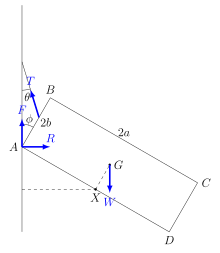
- \begin{align*} \text{N2}(\uparrow): && T \cos \theta + F -W &= 0 \\ && W &= T\cos \theta + \mu R \tag{1} \\ \text{N2}(\rightarrow): && R-T\sin \theta &= 0 \\ && R &= T \sin \theta \tag{2}\\ \\ (1)+(2): && W&=(\cos \theta + \mu \sin \theta)T \tag{3} \\ \overset{\curvearrowright}{A}: && 0 &= W(b\sin \phi + a \cos \phi) - Td\sin(\phi+\theta) \tag{4} \\ \\ (3)+(4): && 0 &= (\cos \theta + \mu \sin \theta)(b\sin \phi + a \cos \phi)-d\sin(\phi+\theta) \\ \Rightarrow && d\sin(\phi+\theta) &= (\cos \theta + \mu \sin \theta)(b\sin \phi + a \cos \phi) \end{align*} as required.
- If \(F\) is operating downwards, it's equivalent to \(-\mu\), ie: \[d\sin(\phi+\theta) = (\cos \theta - \mu \sin \theta)(b\sin \phi + a \cos \phi)\]
- For the frictional force to be acting upwards, we need \begin{align*} && d\sin(\phi+\theta) &\geq \cos \theta(b\sin \phi + a \cos \phi) \\ \Rightarrow && d &\geq \frac{\cos \theta(b\sin \phi + a \cos \phi)}{\sin(\phi + \theta)} \\ &&&= \frac{\cos \theta(b\sin \phi + a \cos \phi)}{\sin\phi \cos\theta+\cos\phi\sin \theta)}\\ &&&= \frac{(b\sin \phi + a \cos \phi)}{\sin\phi+\cos \phi \tan \theta)}\\ &&&= \frac{a+b\tan \phi}{\tan\theta+\tan\phi }\\ \end{align*} We know that \(d < 2b\), so \begin{align*} && 2b &>\frac{a+b\tan \phi}{\tan\theta+\tan\phi }\\ \Rightarrow && 2b \tan \theta + 2b \tan \phi &> a + b \tan \phi \\ \Rightarrow &&b(2 \tan \theta + \tan \phi) &> a\\ \end{align*} Therefore we will have problems if the inequality is reversed!
Examiner's report
— 2014 STEP 2, Question 9There were good solutions presented to all of the questions, although there was generally less success in those questions that required explanations of results or the use of diagrams and graphs to reach the solution. Algebraic manipulation was generally well done by many of the candidates although a range of common errors such as confusing differentiation and integration and simple arithmetic slips were evident. Candidates should also be advised to use the methods that are asked for in questions unless it is clear that other methods will be accepted (such as by the use of the phrase "or otherwise").
Rating Information
Difficulty Rating: 1600.0
Difficulty Comparisons: 0
Banger Rating: 1484.0
Banger Comparisons: 1
Show LaTeX source
Problem source
A uniform rectangular lamina $ABCD$ rests in equilibrium in a vertical plane with the $A$ in contact with a rough vertical wall. The plane of the lamina is perpendicular to the wall.
It is supported by a light inextensible string attached to the side $AB$ at a distance $d$ from $A$. The other end of the string is attached to a point on the wall above $A$ where it makes an acute angle  $\theta$ with the downwards vertical. The side $AB$ makes an acute angle $\phi$ with the upwards vertical at $A$. The sides $BC$ and $AB$ have lengths $2a$ and $2b$ respectively. The coefficient of friction between the lamina and the wall is $\mu$.
  \begin{questionparts}
  \item Show that, when the lamina is in limiting equilibrium with the frictional force acting upwards,
    \begin{equation}
      d\sin(\theta +\phi) = (\cos\theta +\mu \sin\theta)(a\cos\phi
      +b\sin\phi)\,.  \tag{$*$}
    \end{equation}
  \item How should $(*)$ be modified if the lamina is in limiting equilibrium with the frictional force acting downwards?
  \item Find a condition on $d$, in terms of $a$, $b$, $\tan\theta$ and $\tan\phi$, which is necessary and sufficient for the frictional force to act upwards. Show that this condition cannot be satisfied if $b(2\tan\theta+ \tan \phi) < a$.
  \end{questionparts}
Solution source
\begin{center}
\begin{tikzpicture}
        \begin{scope}[rotate=60]
            \coordinate (D) at (0,0);
            \coordinate (C) at (2,0);
            \coordinate (B) at (2,6);
            \coordinate (A) at (0,6);

            \coordinate (G) at (1,3);
            \coordinate (Gx) at (0,3);

            \coordinate (T) at (1.2,6);

        \end{scope}

        \coordinate (X) at (-1,0);
        \coordinate (Y) at ({6*cos(150)},6);

        \draw (D) -- (A) -- (B) -- (C) -- cycle;

        % \draw (-7, 0) -- (0.5,0);
        \draw ({6*cos(150)},0) -- ({6*cos(150)},8);

        \draw (T) -- (Y);

        \node[left] at (A) {$A$};
        \node[above] at (B) {$B$};
        \node[right] at (C) {$C$};
        \node[below] at (D) {$D$};

        \node[right] at ($(A)!0.5!(B)$) {$2b$};
        \node[above] at ($(B)!0.5!(C)$) {$2a$};

        \filldraw (G) circle (1pt) node [right] {$G$};
        \filldraw (Gx) circle (1pt) node[below] {$X$};
        \draw[dashed] (Gx) -- (G);
        \draw[dashed] ({6*cos(150)},{3*sin(150)}) -- (Gx);


        \pic [draw, angle radius=1cm, angle eccentricity=1.25, "$\theta$"] {angle = A--Y--T};
        \pic [draw, angle radius=0.8cm, angle eccentricity=1.25, "$\phi$"] {angle = T--A--Y};

        \draw[-latex, ultra thick, blue] (T) -- ($(Y)!0.5!(T)$) node[above] {$T$};
        \draw[-latex, ultra thick, blue] (A) -- ++(0,1) node[above] {$F$};
        \draw[-latex, ultra thick, blue] (A) -- ++(1,0) node[above] {$R$};
        % \draw[-latex, ultra thick, blue] (O) -- ++(-1,0) node[left] {$F_G$};
        % \draw[-latex, ultra thick, blue] (O) -- ++(0,1) node[above] {$R_G$};

        \draw[-latex, ultra thick, blue] (G) -- ++(0,-1) node[below] {$W$};

    \end{tikzpicture}
\end{center}

\begin{questionparts}
\item
\begin{align*}
\text{N2}(\uparrow): && T \cos \theta + F -W &= 0 \\
&& W &= T\cos \theta + \mu R \tag{1} \\
\text{N2}(\rightarrow): && R-T\sin \theta &= 0 \\
&& R &= T \sin \theta  \tag{2}\\
\\
(1)+(2): && W&=(\cos \theta + \mu \sin \theta)T \tag{3} \\
\overset{\curvearrowright}{A}: && 0 &= W(b\sin \phi + a \cos \phi) - Td\sin(\phi+\theta)  \tag{4} \\
\\
(3)+(4): && 0 &= (\cos \theta + \mu \sin \theta)(b\sin \phi + a \cos \phi)-d\sin(\phi+\theta) \\
\Rightarrow && d\sin(\phi+\theta) &= (\cos \theta + \mu \sin \theta)(b\sin \phi + a \cos \phi)
\end{align*}

as required.

\item If $F$ is operating downwards, it's equivalent to $-\mu$, ie:
\[d\sin(\phi+\theta) = (\cos \theta - \mu \sin \theta)(b\sin \phi + a \cos \phi)\]

\item For the frictional force to be acting upwards, we need
\begin{align*}
&& d\sin(\phi+\theta) &\geq  \cos \theta(b\sin \phi + a \cos \phi) \\
\Rightarrow && d &\geq \frac{\cos \theta(b\sin \phi + a \cos \phi)}{\sin(\phi + \theta)} \\
&&&= \frac{\cos \theta(b\sin \phi + a \cos \phi)}{\sin\phi \cos\theta+\cos\phi\sin \theta)}\\
&&&= \frac{(b\sin \phi + a \cos \phi)}{\sin\phi+\cos \phi \tan \theta)}\\
&&&= \frac{a+b\tan \phi}{\tan\theta+\tan\phi }\\
\end{align*}

We know that $d < 2b$, so

\begin{align*}
&& 2b &>\frac{a+b\tan \phi}{\tan\theta+\tan\phi }\\
\Rightarrow && 2b \tan \theta + 2b \tan \phi &> a + b \tan \phi \\
\Rightarrow &&b(2 \tan \theta +  \tan \phi) &> a\\
\end{align*}

Therefore we will have problems if the inequality is reversed!
\end{questionparts}
This question was not attempted by a very large number of candidates and the average score achieved was the lowest on the paper. While there were a number of attempts that did not proceed beyond drawing a diagram to represent the situation, the first part of the question was done well by a large number of candidates. Many were also able to adjust the result for the case when the frictional force acts downwards. Unfortunately, in the final part of the question many candidates continued to use F = μR, not realising that this only applies in the critical case and so there were very few correct solutions to this part of the question.