Problems
Filters
298 problems found
1993 Paper 3 Q8
A square pyramid has its base vertices at the points \(A\) \((a,0,0)\), \(B\) \((0,a,0)\), \(C\) \((-a,0,0)\) and \(D\) \((0,-a,0)\), and its vertex at \(E\) \((0,0,a)\). The point \(P\) lies on \(AE\) with \(x\)-coordinate \(\lambda a\), where \(0<\lambda<1\), and the point \(Q\) lies on \(CE\) with \(x\)-coordinate \(-\mu a\), where \(0<\mu<1\). The plane \(BPQ\) cuts \(DE\) at \(R\) and the \(y\)-coordinate of \(R\) is \(-\gamma a\). Prove that $$ \gamma = {\lambda \mu \over \lambda + \mu - \lambda \mu}. $$ Show that the quadrilateral \(BPRQ\) cannot be a parallelogram.
1993 Paper 3 Q9
For the real numbers \(a_1\), \(a_2\), \(a_3\), \(\ldots\),
- prove that \(a_1^2+a_2^2 \ge 2a_1a_2\),
- prove that \(a_1^2+a_2^2 +a_3^2 \ge a_2a_3 + a_3a_1 +a_1a_2\),
- prove that $3(a_1^2+a_2^2 +a_3^2 +a_4^2) \ge 2(a_1a_2+a_1a_3 + a_1a_4 +a_2a_3 + a_2a_4 +a_3a_4)\(,
- state and prove a generalisation of (iii) to the case of \)n$ real numbers,
- prove that
$$
\left(\sum_{i=1}^n a_i \right)^2 \ge {2n\over n-1} \sum_{i,j} a_ia_j,
$$
where the latter sum is taken over all pairs \((i,j)\) with $1\le i
1992 Paper 1 Q4
Sketch the following subsets of the complex plane using Argand diagrams. Give reasons for your answers.
- \(\{z:\mathrm{Re}((1+\mathrm{i})z)\geqslant0\}.\)
- \(\{z: |z^{2}| \leqslant2,\mathrm{Re}(z^{2})\geqslant0\}.\)
- \(\{z=z_{1}+z_{2}:\left|z_{1}\right|=2,\left|z_{2}\right|=1\}.\)
Solution:
- Multiplication by \(1+i\) rotates by \(45^{\circ}\) anticlockwise

- \(|z| \leq \sqrt{2}\), \(\textrm{Re}(z^2) \geq 0\) means \(\textrm{Re}{z} \geq \textrm{Im}{z}\)

- These are all points within \(1\) unit from a circle radius \(2\) units.

1992 Paper 1 Q11
Three light elastic strings \(AB,BC\) and \(CD\), each of natural length \(a\) and modulus of elasticity \(\lambda,\) are joined together as shown in the diagram. \noindent
1992 Paper 1 Q12
The diagram shows a crude step-ladder constructed by smoothly hinging-together two light ladders \(AB\) and \(AC,\) each of length \(l,\) at \(A\). A uniform rod of wood, of mass \(m\), is pin-jointed to \(X\) on \(AB\) and to \(Y\) on \(AC\), where \(AX=\frac{3}{4}l=AY.\) The angle \(\angle XAY\) is \(2\theta.\) \noindent
1992 Paper 2 Q11
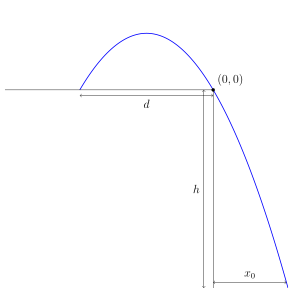
I am standing next to an ice-cream van at a distance \(d\) from the top of a vertical cliff of height \(h\). It is not safe for me to go any nearer to the top of the cliff. My niece Padma is on the broad level beach at the foot of the cliff. I have just discovered that I have left my wallet with her, so I cannot buy her an ice-cream unless she can throw the wallet up to me. She can throw it at speed \(V\), at any angle she chooses and from anywhere on the beach. Air resistance is negligible; so is Padma's height compared to that of the cliff. Show that she can throw the wallet to me if and only if \[ V^{2}\geqslant g(2h+d). \]
Solution:
1991 Paper 1 Q7
According to the Institute of Economic Modelling Sciences, the Slakan economy has alternate years of growth and decline, as in the following model. The number \(V\) of vloskan (the unit of currency) in the Slakan Treasury is assumed to behave as a continuous variable, as follows. In a year of growth it increases continuously at an annual rate \(aV_{0}\left(1+(V/V_{0})\right)^{2}.\) During a year of decline, as long as there is still money in the Treasury, the amount decreases continuously at an annual rate \(bV_{0}\left(1+(V/V_{0})\right)^{2};\) but if \(V\) becomes zero, it remains zero until the end of the year. Here \(a,b\) and \(V_{0}\) are positive constants. A year of growth has just begun and there are \(k_{0}V_{0}\) vloskan in the Treasury, where \(0\leqslant k_{0} < a^{-1}-1\). Explain the significance of these inequalities for the model to be remotely sensible. If \(k_{0}\) is as above and at the end of one year there are \(k_{1}V_{0}\) vloskan in the Treasury, where \(k_{1} > 0\), find the condition involving \(b\) which \(k_{1}\) must satisfy so that there will be some vloskan left after a further year. Under what condition (involving \(a,b\) and \(k_{0}\)) does the model predict that unlimited growth will take place in the third year (but not before)?
1991 Paper 1 Q9
- Suppose that the real number \(x\) satisfies the \(n\) inequalities \begin{alignat*}{2} 1<\ & x & & < 2\\ 2<\ & x^{2} & & < 3\\ 3<\ & x^{3} & & < 4\\ & \vdots\\ n<\ & x^{n} & & < n+1 \end{alignat*} Prove without the use of a calculator that \(n\leqslant4\).
- If \(n\) is an integer strictly greater than 1, by considering how many terms there are in \[ \frac{1}{n+1}+\frac{1}{n+2}+\cdots+\frac{1}{n^{2}}, \] or otherwise, show that \[ \frac{1}{n}+\frac{1}{n+1}+\cdots+\frac{1}{n^{2}}>1. \] Hence or otherwise find, with justification, an integer \(N\) such that \({\displaystyle {\displaystyle \sum_{n=1}^{N}\frac{1}{n}>10.}}\)
Solution:
- Suppose \(n > 4\) then the following inequalities are both true \begin{align*} 3 < x^3 < 4 & \Rightarrow 3^5 < x^{15} < 4^{5}\\ 5 < x^5 < 6 & \Rightarrow 5^{3} < x^{15} < 6^3 \end{align*} But \(3^5 = 243\) and \(6^3 = 216\) so \(243 < x^{15} < 216\) whichis a contradiction.
- This question is wrong. Consider \(n = 2\), then \(\frac{1}{2+1} + \frac{1}{2+2} = \frac13+\frac14 = \frac{7}{12} < 1\). The question should be about \(n \geq 4\). \begin{align*} \frac{1}{n+1}+\frac1{n+2}+\cdots + \frac{1}{2n} > \frac{n}{2n} &= \frac12 \\ \frac{1}{2n+1}+\frac1{2n+2}+\cdots + \frac{1}{3n} > \frac{n}{3n} &= \frac13 \\ \frac{1}{4n+1}+\frac1{4n+2}+\cdots + \frac{1}{4n} > \frac{n}{4n} &= \frac14 \\ \sum_{k=1}^{n^2-n} \frac{1}{n+k} > \frac{13}{12} &> 1 \end{align*} We have a stronger result, \(\frac1{n+1} + \cdots + \frac1{4n} > 1\) for \(n > 4\) so we can take \(N = 4^{10}\) since, since there will be \(9\) sequences from \(\frac{1}{4^{i}+1} \to \frac{1}{4^{i+1}}\) and we will have \(\frac1{1}\) at the start to give use the extra \(1\).
1991 Paper 1 Q12
\(\ \)\vspace{-1.5cm} \noindent
1991 Paper 2 Q6
Show by means of a sketch, or otherwise, that if \(0\leqslant\mathrm{f}(y)\leqslant\mathrm{g}(y)\) for \(0\leqslant y\leqslant x\) then \[ 0\leqslant\int_{0}^{x}\mathrm{f}(y)\,\mathrm{d}y\leqslant\int_{0}^{x}\mathrm{g}(y)\,\mathrm{d}y. \] Starting from the inequality \(0\leqslant\cos y\leqslant1,\) or otherwise, prove that if \(0\leqslant x\leqslant\frac{1}{2}\pi\) then \(0\leqslant\sin x\leqslant x\) and \(\cos x\geqslant1-\frac{1}{2}x^{2}.\) Deduce that \[ \frac{1}{1800}\leqslant\int_{0}^{\frac{1}{10}}\frac{x}{(2+\cos x)^{2}}\,\mathrm{d}x\leqslant\frac{1}{1797}. \] Show further that if \(0\leqslant x\leqslant\frac{1}{2}\pi\) then \(\sin x\geqslant x-\frac{1}{6}x^{3}.\) Hence prove that \[ \frac{1}{3000}\leqslant\int_{0}^{\frac{1}{10}}\frac{x^{2}}{(1-x+\sin x)^{2}}\,\mathrm{d}x\leqslant\frac{2}{5999}. \]
1991 Paper 2 Q12
A particle is attached to one end \(B\) of a light elastic string of unstretched length \(a\). Initially the other end \(A\) is at rest and the particle hangs at rest at a distance \(a+c\) vertically below \(A\). At time \(t=0\), the end \(A\) is forced to oscillate vertically, its downwards displacement at time \(t\) being \(b\sin pt\). Let \(x(t)\) be the downwards displacement of the particle at time \(t\) from its initial equilibrium position. Show that, while the string remains taut, \(x(t)\) satisfies \[ \frac{\mathrm{d}^{2}x}{\mathrm{d}t^{2}}=-n^{2}(x-b\sin pt), \] where \(n^{2}=g/c\), and that if \(0 < p < n\), \(x(t)\) is given by \[ x(t)=\frac{bn}{n^{2}-p^{2}}(n\sin pt-p\sin nt). \] Write down a necessary and sufficient condition that the string remains taut throughout the subsequent motion, and show that it is satisfied if \(pb < (n-p)c.\)
1991 Paper 3 Q11
1990 Paper 1 Q5
- Evaluate \[ \int_{1}^{3}\frac{1}{6x^{2}+19x+15}\,\mathrm{d}x\,. \]
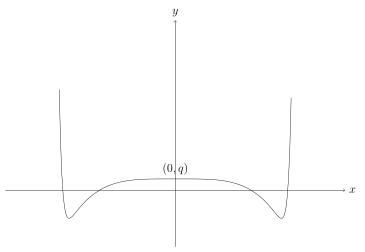
- Sketch the graph of the function \(\mathrm{f}\), where \(\mathrm{f}(x)=x^{1760}-x^{220}+q\), and \(q\) is a constant. Find the possible numbers of \textit{distinct }roots of the equation \(\mathrm{f}(x)=0\), and state the inequalities satisfied by \(q\).
Solution:
- \begin{align*} \int_{1}^{3}\frac{1}{6x^{2}+19x+15}\,\mathrm{d}x &= \int_1^3 \frac1{(2x+3)(3x+5)} \d x \\ &= \int_1^3 \l \frac{2}{2x+3} - \frac{3}{3x+5} \r \d x \\ &= \left [\ln(2x+3) - \ln(3x+5) \right ]_1^3 \\ &= \l \ln9 - \ln14 \r - \l \ln 5 - \ln 8 \r \\ &= \ln \frac{72}{70} \\ &= \ln \frac{36}{35} \end{align*}
- When \(q = 0\) the roots are \(-1, 0, 1\) There can be \(0, 2, 3, 4\) roots. There will be no roots if \(q > -\min (x^{1760} - x^{220})\) since the whole graph will be above the axis. There will be \(2\) roots if \(q = -\min (x^{1760} - x^{220})\) or \(q > 0\) There will be \(4\) roots if \(0 > q > -\min (x^{1760} - x^{220})\). There will be \(3\) roots if \(q =0\)
1990 Paper 1 Q9
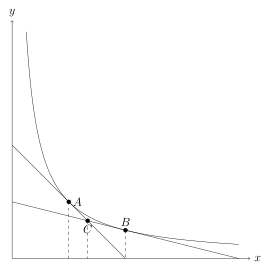
Let \(A\) and \(B\) be the points \((1,1)\) and \((b,1/b)\) respectively, where \(b>1\). The tangents at \(A\) and \(B\) to the curve \(y=1/x\) intersect at \(C\). Find the coordinates of \(C\). Let \(A',B'\) and \(C'\) denote the projections of \(A,B\) and \(C\), respectively, to the \(x\)-axis. Obtain an expression for the sum of the areas of the quadrilaterals \(ACC'A'\) and \(CBB'C'\). Hence or otherwise prove that, for \(z>0\), \[ \frac{2z}{2+z}\leqslant\ln\left(1+z\right)\leqslant z. \]
Solution:
1990 Paper 1 Q13
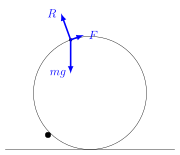
A rough circular cylinder of mass \(M\) and radius \(a\) rests on a rough horizontal plane. The curved surface of the cylinder is in contact with a smooth rail, parallel to the axis of the cylinder, which touches the cylinder at a height \(a/2\) above the plane. Initially the cylinder is held at rest. A particle of mass \(m\) rests in equilibrium on the cylinder, and the normal reaction of the cylinder on the particle makes an angle of \(\theta\) with the upward vertical. The particle is on the same side of the centre of the cylinder as the rail. The coefficient of friction between the cylinder and the particle and between the cylinder and the plane are both \(\mu\). Obtain the condition on \(\theta\) for the particle to rest in equilibrium. Show that, if the cylinder is released, equilibrium of both particle and cylinder is possible provided another inequality involving \(\mu\) and \(\theta\) (which should be found explicitly) is satisfied. Determine the largest possible value of \(\theta\) for equilibrium, if \(m=7M\) and \(\mu=0.75\).
Solution: