1990 Paper 1 Q13
Year: 1990
Paper: 1
Question Number: 13
Course: UFM Mechanics
Section: Moments
Difficulty: 1500.0
Banger: 1484.0
moments
friction
circular cylinder
equilibrium
inequality
rough surface
particle on cylinder
rigid body
Problem
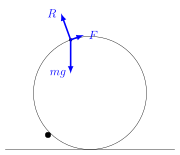
A rough circular cylinder of mass \(M\) and radius \(a\) rests on a rough horizontal plane. The curved surface of the cylinder is in contact with a smooth rail, parallel to the axis of the cylinder, which touches the cylinder at a height \(a/2\) above the plane. Initially the cylinder is held at rest. A particle of mass \(m\) rests in equilibrium on the cylinder, and the normal reaction of the cylinder on the particle makes an angle of \(\theta\) with the upward vertical. The particle is on the same side of the centre of the cylinder as the rail. The coefficient of friction between the cylinder and the particle and between the cylinder and the plane are both \(\mu\). Obtain the condition on \(\theta\) for the particle to rest in equilibrium. Show that, if the cylinder is released, equilibrium of both particle and cylinder is possible provided another inequality involving \(\mu\) and \(\theta\) (which should be found explicitly) is satisfied. Determine the largest possible value of \(\theta\) for equilibrium, if \(m=7M\) and \(\mu=0.75\).
Solution

Rating Information
Difficulty Rating: 1500.0
Difficulty Comparisons: 0
Banger Rating: 1484.0
Banger Comparisons: 1
Show LaTeX source
Problem source
A rough circular cylinder of mass $M$ and radius $a$ rests on a rough horizontal plane. The curved surface of the cylinder is in contact with a smooth rail, parallel to the axis of the cylinder, which touches the cylinder at a height $a/2$ above the plane. Initially the cylinder is held at rest. A particle of mass $m$ rests in equilibrium on the cylinder, and the normal reaction of the cylinder on the particle makes an angle of $\theta$ with the upward vertical. The particle is on the same side of the centre of the cylinder as the rail. The coefficient of friction between the cylinder and the particle and between the cylinder and the plane are both $\mu$. Obtain the condition on $\theta$ for the particle to rest in equilibrium. Show that, if the cylinder is released, equilibrium of both particle and cylinder is possible provided another inequality involving $\mu$ and $\theta$ (which should be found explicitly) is satisfied. Determine the largest possible value of $\theta$ for equilibrium, if $m=7M$ and $\mu=0.75$.Solution source
\begin{center}
    \begin{tikzpicture}
        \draw (-3, 0) -- (3, 0);
        \draw (0, 2) circle (2);
        \coordinate (P) at ({0 + 2*cos(110)}, {2+2*sin(110)});
        \coordinate (O) at (0,2);
        \filldraw ({-2.1/sqrt(2)},{2-2.1/sqrt(2)}) circle (0.1);

        \filldraw (P) circle (0.05);

        \draw[-latex, blue, ultra thick] (P) -- ($(P)!-0.5!(O)$) node[left] {$R$};
        \draw[-latex, blue, ultra thick] (P) -- ++(0, -1.2) node[left] {$mg$};
        \draw[-latex, blue, ultra thick] (P) -- ++({0.5*sin(110)}, {-0.5*cos(110)}) node[right] {$F$};
    \end{tikzpicture}
\end{center}

\begin{align*}
\text{N2}(\nwarrow): && R -mg \cos \theta &= 0 \\
\text{N2}(\rightarrow): && -R \sin \theta + F \cos \theta &= 0 \\
\\
\Rightarrow && F &= \tan \theta R \\
\\
&& F & \leq \mu R \\
\Rightarrow && \tan \theta R &\leq \mu R \\
\Rightarrow && \tan \theta &\leq \mu
\end{align*}

(Notice also $F = mg \sin \theta$)

Once everything is released, we have the following situation. (Red forces act on the cylinder, blue forces on the particle).

\begin{center}
    \begin{tikzpicture}
        \draw (-3, 0) -- (3, 0);
        \draw (0, 2) circle (2);
        \coordinate (P) at ({0 + 2*cos(110)}, {2+2*sin(110)});
        \coordinate (O) at (0,2);
        \coordinate (R) at ({-2.1/sqrt(2)},{2-2.1/sqrt(2)});
        \filldraw (R) circle (0.1);

        \filldraw (P) circle (0.05);

        \draw[-latex, blue, ultra thick] (P) -- ($(P)!-0.5!(O)$) node[left] {$R_p$};
        \draw[-latex, red, ultra thick] (P) -- ($(P)!0.5!(O)$) node[right] {$R_p$};
        \draw[-latex, blue, ultra thick] (P) -- ++(0, -1.2) node[left] {$mg$};
        \draw[-latex, blue, ultra thick] (P) -- ++({0.5*sin(110)}, {-0.5*cos(110)}) node[right] {$F_p$};
        \draw[-latex, red, ultra thick] (P) -- ++({-0.5*sin(110)}, {0.5*cos(110)}) node[left] {$F_p$};

        \draw[-latex, red, ultra thick] (R) -- ($(R)!0.5!(O)$) node[left] {$R_r$};

        \draw[-latex, red, ultra thick] (0,0) -- ++(0, 0.8) node[left] {$R_g$};
        \draw[-latex, red, ultra thick] (0,0) -- ++(-0.5, 0) node[left] {$F_g$};


        \draw[-latex, red, ultra thick] (O) -- ++(0, -0.8) node[right] {$Mg$};
    \end{tikzpicture}
\end{center}

\begin{align*}
\text{N2}(\uparrow): && 0 &= R_g - Mg - \underbrace{mg}_{R_p \text{ and } F_p} + \frac{1}{\sqrt{2}}R_r \\
\text{N2}(\rightarrow): && 0 &= \frac{1}{\sqrt{2}}R_r - F_g \\
\overset{\curvearrowleft}{O}: && 0 &= aF_p - aF_g \\
\Rightarrow && F_g &= mg \sin \theta \\
\Rightarrow && R_r &= \sqrt{2} mg \sin \theta \\
\Rightarrow && R_g &=(M+m)g + mg \sin \theta \\
\\
&& F_g &\leq \mu R_g \\
\Rightarrow && mg \sin \theta &\leq \mu (M+m(1+\sin \theta))g \\
\Rightarrow && \mu &\geq \frac{m \sin \theta}{M+m(1+\sin \theta)}
\end{align*}

If $m = 7M$ and $\mu  = \frac34$ we have:

\begin{align*}
&& \tan \theta &\leq \frac34 \\
&& 3(M+7M(1 + \sin \theta)) &\geq 4 \cdot 7 M \sin \theta \\
\Rightarrow && 10 + 7 \sin \theta & \geq 28 \sin \theta \\
\Rightarrow && 10 &\geq 21 \sin \theta \\
\Rightarrow && \sin \theta &\leq \frac{10}{21}
\end{align*}

If $\tan \theta = \frac{3}{4}, \sin \theta = \frac35 > \frac{10}{21}$, so the critical bound is $\sin \theta \leq \frac{10}{21}$, ie $ \theta \leq \sin^{-1} \frac{10}{21} \approx 30^{\circ}$