1992 Paper 2 Q11
Year: 1992
Paper: 2
Question Number: 11
Course: LFM Pure and Mechanics
Section: Projectiles
Difficulty: 1600.0
Banger: 1500.0
Problem
I am standing next to an ice-cream van at a distance \(d\) from the top of a vertical cliff of height \(h\). It is not safe for me to go any nearer to the top of the cliff. My niece Padma is on the broad level beach at the foot of the cliff. I have just discovered that I have left my wallet with her, so I cannot buy her an ice-cream unless she can throw the wallet up to me. She can throw it at speed \(V\), at any angle she chooses and from anywhere on the beach. Air resistance is negligible; so is Padma's height compared to that of the cliff. Show that she can throw the wallet to me if and only if
\[
V^{2}\geqslant g(2h+d).
\]
Solution
Rating Information
Difficulty Rating: 1600.0
Difficulty Comparisons: 0
Banger Rating: 1500.0
Banger Comparisons: 0
Show LaTeX source
Problem source
I am standing next to an ice-cream van at a distance $d$ from the top of a vertical cliff of height $h$. It is not safe for me to go any nearer to the top of the cliff. My niece Padma is on the broad level beach at the foot of the cliff. I have just discovered that I have left my wallet with her, so I cannot buy her an ice-cream unless she can throw the wallet up to me. She can throw it at speed $V$, at any angle she chooses and from anywhere on the beach. Air resistance is negligible; so is Padma's height compared to that of the cliff. Show that she can throw the wallet to me if and only if
\[
V^{2}\geqslant g(2h+d).
\]
Solution source
\begin{center}
    \begin{tikzpicture}
    \def\functionf(#1){2-(#1)^2};
    \def\xl{-3};
    \def\xu{3};
    \def\yl{-7};
    \def\yu{3};

    % Calculate scaling factors to make the plot square
    \pgfmathsetmacro{\xrange}{\xu-\xl}
    \pgfmathsetmacro{\yrange}{\yu-\yl}
    \pgfmathsetmacro{\xscale}{10/\xrange}
    \pgfmathsetmacro{\yscale}{10/\yrange}

    % Define the styles for the axes and grid
    \tikzset{
        axis/.style={very thick, ->},
        grid/.style={thin, gray!30},
        x=\xscale cm,
        y=\yscale cm
    }

    % Define the bounding region with clip
    \begin{scope}
        % You can modify these values to change your plotting region
        \clip (\xl,\yl) rectangle (\xu,\yu);

        % Draw a grid (optional)
        % \draw[grid] (-5,-3) grid (5,3);

        \draw[thick, blue, smooth, domain={-sqrt(2)}:\xu, samples=100]
            plot (\x, {\functionf(\x)});

        \draw (\xl, {0}) -- ({sqrt(2)}, {0}) -- ({sqrt(2)}, \yl);

        \draw[<->] ({-sqrt(2)}, {-.2}) -- ({sqrt(2)}, {-.2}) node[pos=0.5, below] {$d$};
        \draw[<->] ({-0.2 +sqrt(2)}, {0}) -- ({-0.2 + sqrt(2)}, \yl) node[pos=0.5, left] {$h$};

        \filldraw ({sqrt(2)}, {0}) circle (1.5pt) node[above right] {$(0,0)$};

        \draw[<->] ({sqrt(2)}, {\yl+.2}) -- ({sqrt(2-(\yl+.2))}, {\yl+.2}) node[pos=0.5, above] {$x_0$};


    \end{scope}
    \end{tikzpicture}
\end{center}

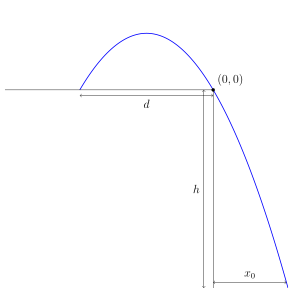
Rather than considering Padma's throw, imagine a throw in reverse from me. As we can see from the diagram, it will need to pass through $(0,0)$ to have minimal speed when it hits the ground, so possible throws are:

\begin{align*}
    && 0 &= u \sin \alpha t - \frac12 g t^2 \\
    \Rightarrow && T &= \frac{2u \sin \alpha}{g} \\
    && d &= u \cos \alpha T \\
    \Rightarrow && \frac{d}{u \cos \alpha} &=  \frac{2u \sin \alpha}{g} \\
    \Rightarrow && dg &= u^2 \sin 2 \alpha \\
    && v^2 &= u^2 + 2as \\
    \Rightarrow && V_y^2 &= u^2 \sin^2 \alpha + 2gh \\
    \Rightarrow && V^2 &=  u^2 \sin^2 \alpha + 2gh + u^2 \cos^2 \theta \\
    &&&= u^2 + 2gh \\
    &&&= 2gh + \frac{dg}{\sin 2 \alpha} \geq 2gh +dg = g(2h+d)
\end{align*}