1991 Paper 3 Q11
Year: 1991
Paper: 3
Question Number: 11
Course: UFM Mechanics
Section: Moments
Difficulty: 1700.0
Banger: 1484.0
moments
friction
inclined plane
cylinder
string
equilibrium
inequality
rough surface
circular motion
Problem
No solution available for this problem.
Rating Information
Difficulty Rating: 1700.0
Difficulty Comparisons: 0
Banger Rating: 1484.0
Banger Comparisons: 1
Show LaTeX source
Problem source
\begin{center}
\begin{tikzpicture}
    % Coordinate axes lines
    \coordinate (O) at (0,0);
    \coordinate (P) at (2.6,4.8);
    \coordinate (Z) at (5,0);
    \coordinate (Q) at (5.18, 2.96);

    \draw (O) -- (5,0);
    \draw (O) -- (7,4);

    \pic [draw, angle radius=1.5cm, "$\alpha$"] {angle = Z--O--Q};
    \pic [draw, angle radius=0.8cm, "$2\alpha$"] {angle = P--Q--O};

    % Circles centered at (2,4)
    \draw (2,4) circle (1);
    \draw (2,4) circle (2.49);

    % Line from P to Q
    \draw (P) -- (Q);

    % Labels
    \node at (Q) [right, below] {$Q$};
    \node at (P) [above] {$P$};
\end{tikzpicture}
\end{center}
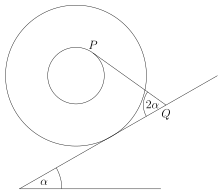
A uniform circular cylinder of radius $2a$ with a groove of radius $a$ cut in its central cross-section has mass $M$. It rests, as shown in the diagram, on a rough plane inclined at an acute angle $\alpha$ to the horizontal. It is supported by a light inextensible string would round the groove and attached to the cylinder at one end. The other end of the string is attached to the plane at $Q$, the free part of the string, $PQ,$ making an angle $2\alpha$ with the inclined plane. The coefficient of friction at the contact between the cylinder and the plane is $\mu.$ Show that $\mu\geqslant\frac{1}{3}\tan\alpha.$
The string $PQ$ is now detached from the plane and the end $Q$ is fastened to a particle of mass $3M$ which is placed on the plane, the position of the string remain unchanged. Given that $\tan\alpha=\frac{1}{2}$ and that the system remains in equilibrium, find the least value of the coefficient of friction between the particle and the plane.