1990 Paper 1 Q5
Year: 1990
Paper: 1
Question Number: 5
Course: LFM Pure
Section: Integration
Difficulty: 1500.0
Banger: 1500.0
integration
partial fractions
definite integral
quadratic factorisation
curve sketching
stationary points
roots of equations
polynomial
inequality
Problem
- Evaluate \[ \int_{1}^{3}\frac{1}{6x^{2}+19x+15}\,\mathrm{d}x\,. \]
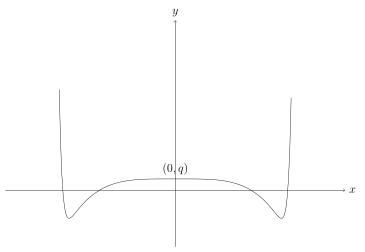
- Sketch the graph of the function \(\mathrm{f}\), where \(\mathrm{f}(x)=x^{1760}-x^{220}+q\), and \(q\) is a constant. Find the possible numbers of \textit{distinct }roots of the equation \(\mathrm{f}(x)=0\), and state the inequalities satisfied by \(q\).
Solution
- \begin{align*} \int_{1}^{3}\frac{1}{6x^{2}+19x+15}\,\mathrm{d}x &= \int_1^3 \frac1{(2x+3)(3x+5)} \d x \\ &= \int_1^3 \l \frac{2}{2x+3} - \frac{3}{3x+5} \r \d x \\ &= \left [\ln(2x+3) - \ln(3x+5) \right ]_1^3 \\ &= \l \ln9 - \ln14 \r - \l \ln 5 - \ln 8 \r \\ &= \ln \frac{72}{70} \\ &= \ln \frac{36}{35} \end{align*}
- When \(q = 0\) the roots are \(-1, 0, 1\) There can be \(0, 2, 3, 4\) roots. There will be no roots if \(q > -\min (x^{1760} - x^{220})\) since the whole graph will be above the axis. There will be \(2\) roots if \(q = -\min (x^{1760} - x^{220})\) or \(q > 0\) There will be \(4\) roots if \(0 > q > -\min (x^{1760} - x^{220})\). There will be \(3\) roots if \(q =0\)
Rating Information
Difficulty Rating: 1500.0
Difficulty Comparisons: 0
Banger Rating: 1500.0
Banger Comparisons: 0
Show LaTeX source
Problem source
\begin{questionparts}
\item Evaluate
\[
\int_{1}^{3}\frac{1}{6x^{2}+19x+15}\,\mathrm{d}x\,.
\]

\item Sketch the graph of the function $\mathrm{f}$, where $\mathrm{f}(x)=x^{1760}-x^{220}+q$,
and $q$ is a constant. Find the possible numbers of \textit{distinct
}roots of the equation $\mathrm{f}(x)=0$, and state the inequalities
satisfied by $q$.
 \end{questionparts}
Solution source
\begin{questionparts}
\item
\begin{align*}
\int_{1}^{3}\frac{1}{6x^{2}+19x+15}\,\mathrm{d}x &= \int_1^3 \frac1{(2x+3)(3x+5)} \d x \\
&= \int_1^3 \l \frac{2}{2x+3} - \frac{3}{3x+5} \r \d x \\
&= \left [\ln(2x+3) - \ln(3x+5) \right ]_1^3 \\
&= \l \ln9 - \ln14 \r - \l \ln 5 - \ln 8 \r \\
&= \ln \frac{72}{70} \\
&= \ln \frac{36}{35}
\end{align*}
\item


\begin{center}
\begin{tikzpicture}[scale=2]
    \draw[->] (-3, 0) -- (3, 0);
    \draw[->] (0,-1) -- (0,3);

    \node at (3,0) [right] {$x$};
    \node at (0,3) [above] {$y$};
    \node at (0,0.2) [above] {$(0,q)$};
    % \node at ({exp(1)/5},{2/exp(1)}) [above] {$(e, \frac1{e})$};
    % \node at ({1/5},0) [below, right] {$(1,0)$};
    \draw[domain = -1.025:1.025, samples=180, variable = \x]  plot ({2*\x},{pow(\x,40) - pow(\x, 4) + 0.2 });
\end{tikzpicture}
\end{center}

When $q = 0$ the roots are $-1, 0, 1$

There can be $0, 2, 3, 4$ roots.

There will be no roots if $q > -\min (x^{1760} - x^{220})$ since the whole graph will be above the axis.

There will be $2$ roots if $q = -\min (x^{1760} - x^{220})$ or $q > 0$

There will be $4$ roots if $0 > q > -\min (x^{1760} - x^{220})$.

There will be $3$ roots if $q =0$
\end{questionparts}