1990 Paper 1 Q9
Year: 1990
Paper: 1
Question Number: 9
Course: LFM Pure
Section: Integration
Difficulty: 1484.0
Banger: 1516.0
integration
inequality
curve sketching
rectangular hyperbola
tangent-normal
area under curve
logarithm
trapezium rule
optimisation
Problem
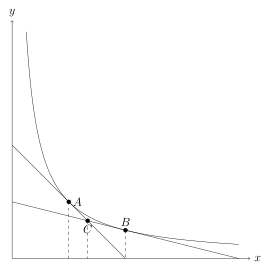
Let \(A\) and \(B\) be the points \((1,1)\) and \((b,1/b)\) respectively, where \(b>1\). The tangents at \(A\) and \(B\) to the curve \(y=1/x\) intersect at \(C\). Find the coordinates of \(C\).
Let \(A',B'\) and \(C'\) denote the projections of \(A,B\) and \(C\), respectively, to the \(x\)-axis. Obtain an expression for the sum of the areas of the quadrilaterals \(ACC'A'\) and \(CBB'C'\). Hence or otherwise prove that, for \(z>0\),
\[
\frac{2z}{2+z}\leqslant\ln\left(1+z\right)\leqslant z.
\]
Solution
Rating Information
Difficulty Rating: 1484.0
Difficulty Comparisons: 1
Banger Rating: 1516.0
Banger Comparisons: 1
Show LaTeX source
Problem source
Let $A$ and $B$ be the points $(1,1)$ and $(b,1/b)$ respectively, where $b>1$. The tangents at $A$ and $B$ to the curve $y=1/x$ intersect at $C$. Find the coordinates of $C$.
Let $A',B'$ and $C'$ denote the projections of $A,B$ and $C$, respectively, to the $x$-axis. Obtain an expression for the sum of the areas of the quadrilaterals $ACC'A'$ and $CBB'C'$. Hence or otherwise prove that, for $z>0$,
\[
\frac{2z}{2+z}\leqslant\ln\left(1+z\right)\leqslant z.
\]
Solution source
\begin{center}
    \begin{tikzpicture}[scale=2]
        \def\b{2};
        \coordinate (A) at (1,1);
        \coordinate (B) at (\b, {1/\b});
        \coordinate (C) at ({2*\b/(\b+1)}, {2/(\b+1)});

        \coordinate (Aa) at (1,0);
        \coordinate (Ba) at (\b,0);
        \coordinate (Ca) at ({2*\b/(\b+1)}, 0);

        \draw[domain = 0.25:4, samples=180, variable = \x]          plot ({\x},{1/\x});

        \draw[->] (0,0) -- (0, 4.2) node[above] {$y$};
        \draw[->] (0,0) -- (4.2, 0) node[right] {$x$};

        \draw (0,2) -- (2,0);
        \draw (0,{2/\b}) -- ({2*\b},0);

        \filldraw (A) circle (1pt) node [right] {$A$};
        \filldraw (B) circle (1pt) node [above] {$B$};
        \filldraw (C) circle (1pt) node [below] {$C$};

        \draw[dashed] (A) -- (Aa);
        \draw[dashed] (B) -- (Ba);
        \draw[dashed] (C) -- (Ca);

    \end{tikzpicture}
\end{center}

\begin{align*}
&& y &= 1/x \\
\Rightarrow && \frac{\d y}{\d x} &= -1/x^2
\end{align*}

Therefore the tangent at $(1,1)$ will be $\frac{y - 1}{x-1} = -1 \Rightarrow y = -x + 2$ and at $(b, 1/b)$ will be $\frac{y-1/b}{x-b} = -\frac{1}{b^2} \Rightarrow y = -\frac{x}{b^2} + \frac{2}{b}$

The intersection will be at
\begin{align*}
&& x + y & = 2 \\
&& x + b^2 y &= 2b \\
\Rightarrow && (b^2-1)y &= 2(b-1) \\
\Rightarrow && y &= \frac{2}{b+1} \\
&& x &= \frac{2b}{b+1}
\end{align*}

Therefore $\displaystyle C = \left (\frac{2b}{b+1}, \frac{2}{b+1} \right)$.

The areas of the two trapeziums will be:

\begin{align*}
[ACC'A'] &= \frac12 \left (1 + \frac{2}{b+1} \right) \left (\frac{2b}{b+1} - 1 \right) \\
&= \frac12  \cdot \frac{b+3}{b+1} \cdot \frac{2b - b - 1}{b+1} \\
&= \frac 12 \frac{(b+3)(b-1)}{(b+1)^2}
\end{align*}
\begin{align*}
[CBB'C'] &= \frac12 \left (\frac{2}{b+1} + \frac{1}{b} \right) \left (b-  \frac{2b}{b+1} \right) \\
&= \frac12  \cdot \frac{3b+1}{b(b+1)} \cdot \frac{b^2+b-2b}{b+1} \\
&= \frac 12 \frac{(3b+1)b(b-1)}{b(b+1)^2} \\
&= \frac12 \frac{(3b+1)(b-1)}{(b+1)^2}
\end{align*}

The area under the curve between $A$ and $B$ will be:

\begin{align*}
\int_1^b \frac{1}{x} \d x &= \left [\ln x \right]_1^b \\
&= \ln b
\end{align*}

The area of a rectangle of height $1$ from $A$ will clearly be above the curve and will have area $b-1$.

The area of $ACBB'C'A'$ will be:

\begin{align*}
[ACBB'C'A'] &= [ACC'A']+[CBB'C']  \\
&=\frac 12 \frac{(b+3)(b-1)}{(b+1)^2}+ \frac12 \frac{(3b+1)(b-1)}{(b+1)^2} \\
&= \frac12 \frac{(b-1)(4b+4)}{(b+1)^2} \\
&= \frac{2(b-1)}{b+1}
\end{align*}

By comparing areas, we must have: $\frac{2(b-1)}{b+1} \leq \ln b \leq b-1$ and since $b > 1$ we can write it as $1 + z$ for $z >0$, ie:

$\displaystyle \frac{2z}{2+z} \leq \ln (1 + z) \leq z$.

[By considering the area of $ABB'A'$ which is

\begin{align*}
[ABB'A'] &= \frac12 \left (1 + \frac{1}{b} \right) \left ( b- 1 \right) \\
&= \frac12 \frac{(b+1)(b-1)}{b}
\end{align*}
we can tighten the right hand bound to $\displaystyle \frac{(2+z)z}{2(z+1)} = \left (1 - \frac{z}{2z+2} \right)z$