Problems
Filters
27 problems found
2024 Paper 2 Q10
A triangular prism lies on a horizontal plane. One of the rectangular faces of the prism is vertical; the second is horizontal and in contact with the plane; the third, oblique rectangular face makes an angle \(\alpha\) with the horizontal. The two triangular faces of the prism are right angled triangles and are vertical. The prism has mass \(M\) and it can move without friction across the plane. A particle of mass \(m\) lies on the oblique surface of the prism. The contact between the particle and the plane is rough, with coefficient of friction \(\mu\).
- Show that if \(\mu < \tan\alpha\), then the system cannot be in equilibrium.
- Show that the magnitude, \(F\), of the frictional force between the particle and the prism is \[ F = \frac{m}{M+m}\left|(M+m)g\sin\alpha - P\cos\alpha\right|. \] Find a similar expression for the magnitude, \(N\), of the normal reaction between the particle and the prism.
- Hence show that the force \(P\) must satisfy \[ (M+m)g\tan(\alpha - \lambda) \leqslant P \leqslant (M+m)g\tan(\alpha + \lambda). \]
2024 Paper 3 Q10
A cube of uniform density \(\rho\) is placed on a horizontal plane and a second cube, also of uniform density \(\rho\), is placed on top of it. The lower cube has side length \(1\) and the upper cube has side length \(a\), with \(a \leqslant 1\). The centre of mass of the upper cube is vertically above the centre of mass of the lower cube and all the edges of the upper cube are parallel to the corresponding edges of the lower cube. The contacts between the two cubes, and between the lower cube and the plane, are rough, with the same coefficient of friction \(\mu < 1\) in each case. The midpoint of the base of the upper cube is \(X\) and the midpoint of the base of the lower cube is \(Y\). A horizontal force \(P\) is exerted, perpendicular to one of the vertical faces of the upper cube, at a point halfway between the two vertical edges of this face, and a distance \(h\), with \(h < a\), above the lower edge of this face.
- Show that, if the two cubes remain in equilibrium, the normal reaction of the plane on the lower cube acts at a point which is a distance \[\frac{P(1+h)}{(1+a^3)\rho g}\] from \(Y\), and find a similar expression for the distance from \(X\) of the point at which the normal reaction of the lower cube on the upper cube acts.
- Show that, if neither cube topples, equilibrium will be broken by the slipping of the upper cube on the lower cube, and not by the slipping of the lower cube on the ground.
- Show that, if \(a = 1\), then equilibrium will be broken by the slipping of the upper cube on the lower cube if \(\mu(1+h) < 1\) and by the toppling of the lower and upper cube together if \(\mu(1+h) > 1\).
- Show that, in a situation where \(a < 1\) and \(h\bigl(1 + a^3(1-a)\bigr) > a^4\), and no slipping occurs, equilibrium will be broken by the toppling of the upper cube.
- Show, by considering \(a = \frac{1}{2}\) and choosing suitable values of \(h\) and \(\mu\), that the situation described in (iv) can in fact occur.
2019 Paper 1 Q9
A box has the shape of a uniform solid cuboid of height \(h\) and with a square base of side \(b\), where \(h > b\). It rests on rough horizontal ground. A light ladder has its foot on the ground and rests against one of the upper horizontal edges of the box, making an acute angle of \(\alpha\) with the ground, where \(h = b \tan \alpha\). The weight of the box is \(W\). There is no friction at the contact between ladder and box. A painter of weight \(kW\) climbs the ladder slowly. Neither the base of the ladder nor the box slips, but the box starts to topple when the painter reaches height \(\lambda h\) above the ground, where \(\lambda < 1\). Show that:
- \(R = k\lambda W \cos \alpha\), where \(R\) is the magnitude of the force exerted by the box on the ladder;
- \(2k\lambda \cos 2\alpha + 1 = 0\);
- \(\mu \geq \frac{\sin 2\alpha}{1 - 3 \cos 2\alpha}\), where \(\mu\) is the coefficient of friction between the box and the ground.
Solution:

- \(\,\) \begin{align*} \overset{\curvearrowright}{X}:&& kW \cdot \lambda h\cos \alpha - R h &= 0 \\ \Rightarrow && R &= k\lambda W \cos \alpha \\ \end{align*}
- \(\,\) \begin{align*} \overset{\curvearrowright}{C}:&& R \sin \alpha \cdot h-R\cos \alpha \cdot b-W\frac{b}{2} &= 0 \\ && k\lambda W \cos \alpha \sin \alpha \cdot b \tan \alpha- k\lambda W \cos \alpha\cos \alpha \cdot h-W\frac{b}{2} &= 0 \\ && k \lambda (\cos^2 \alpha - \sin^2 \alpha) +\frac12 &= 0 \\ \Rightarrow && 2k \lambda \cos 2\alpha + 1 &= 0 \end{align*}
- \(\,\) \begin{align*} \text{N2}(\uparrow): && R_b -W-R\cos \alpha &= 0 \\ \Rightarrow && R_b &= W + k\lambda W \cos^2 \alpha\\ \text{N2}(\rightarrow): && R\sin \alpha - F_b &= 0 \\ \Rightarrow && F_b &= R \sin \alpha \\ \\ && F_b &\leq \mu R \\ \Rightarrow && k\lambda W \cos \alpha \sin \alpha &= \mu (W + k\lambda W \cos^2 \alpha) \\ \Rightarrow && \mu &\geq \frac{k\lambda \cos \alpha \sin \alpha}{1 + k\lambda \cos^2 \alpha} \\ &&&= \frac{k\lambda \sin 2\alpha}{2 + 2k\lambda cos^2 \alpha} \\ &&&= \frac{k\lambda \sin 2\alpha}{2 + k\lambda (\cos 2 \alpha+1)} \\ &&&= \frac{k\lambda \sin 2\alpha}{-4k\lambda \cos 2 \alpha + k\lambda (\cos 2 \alpha+1)} \\ &&&= \frac{\sin 2 \alpha}{1 -3 \cos 2\alpha} \end{align*}
2019 Paper 3 Q9
In this question, \(\mathbf{i}\) and \(\mathbf{j}\) are perpendicular unit vectors and \(\mathbf{j}\) is vertically upwards. A smooth hemisphere of mass \(M\) and radius \(a\) rests on a smooth horizontal table with its plane face in contact with the table. The point \(A\) is at the top of the hemisphere and the point \(O\) is at the centre of its plane face. Initially, a particle \(P\) of mass \(m\) rests at \(A\). It is then given a small displacement in the positive \(\mathbf{i}\) direction. At a later time \(t\), when the particle is still in contact with the hemisphere, the hemisphere has been displaced by \(-s\mathbf{i}\) and \(\angle AOP = \theta\).
- Let \(\mathbf{r}\) be the position vector of the particle at time \(t\) with respect to the initial position of \(O\). Write down an expression for \(\mathbf{r}\) in terms of \(a\), \(\theta\) and \(s\) and show that $$\dot{\mathbf{r}} = (a\dot{\theta} \cos \theta - \dot{s})\mathbf{i} - a\dot{\theta} \sin \theta \mathbf{j}.$$ Show also that $$\dot{s} = (1 - k)a\dot{\theta} \cos \theta,$$ where \(k = \frac{M}{m + M}\), and deduce that $$\dot{\mathbf{r}} = a\dot{\theta}(k \cos \theta \mathbf{i} - \sin \theta \mathbf{j}).$$
- Show that $$a\dot{\theta}^2 \left(k \cos^2 \theta + \sin^2 \theta\right) = 2g(1 - \cos \theta).$$
- At time \(T\), when \(\theta = \alpha\), the particle leaves the hemisphere. By considering the component of \(\ddot{\mathbf{r}}\) parallel to the vector \(\sin \theta \mathbf{i} + k \cos \theta \mathbf{j}\), or otherwise, show that at time \(T\) $$a\dot{\theta}^2 = g \cos \alpha.$$ Find a cubic equation for \(\cos \alpha\) and deduce that \(\cos \alpha > \frac{2}{3}\).
Solution:
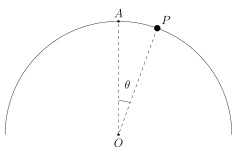
- \(\mathbf{r} = (a \sin \theta - s) \mathbf{i}+a\cos \theta\mathbf{j}\), so \begin{align*} && \dot{\mathbf{r}} &=(a \dot{\theta} \cos \theta - \dot{s}) \mathbf{i}- a\dot{\theta} \sin \theta \mathbf{j}\\ \\ \text{COM}(\rightarrow): && 0 &= M(-\dot{s}) + m(a \dot{\theta} \cos \theta - \dot{s}) \\ \Rightarrow && \dot{s} &= \frac{ma \dot{\theta} \cos \theta}{m+M} \\ &&&= \left ( 1- \frac{M}{m+M} \right) a\dot{\theta} \cos \theta \\ &&&= (1 - k) a\dot{\theta} \cos \theta \\ \\ \Rightarrow && \dot{\mathbf{r}} &=(a \dot{\theta} \cos \theta - \dot{s}) \mathbf{i}- a\dot{\theta} \sin \theta \mathbf{j} \\ &&&= (a \dot{\theta} \cos \theta - (1 - k) a\dot{\theta} \cos \theta) \mathbf{i}- a\dot{\theta} \sin \theta \mathbf{j} \\ &&&= a\dot{\theta} \left ( k \cos \theta \mathbf{i} - \sin \theta \mathbf{j} \right) \end{align*}
- \(\,\) \begin{align*} COE: &&\underbrace{0}_{\text{k.e.}}+ \underbrace{mga}_{\text{GPE}} &= \underbrace{\frac12 m \mathbf{\dot{r}}\cdot\mathbf{\dot{r}}}_{\text{k.e. }P} + \underbrace{mg a\cos \theta}_{\text{GPE}} + \underbrace{\frac12 M \dot{s}^2}_{\text{k.e. hemisphere}} \\ \Rightarrow && 2amg(1-\cos \theta) &= a^2m \dot{\theta}^2(k^2 \cos^2 \theta + \sin^2 \theta)+ M(1 - k)^2 a^2\dot{\theta}^2 \cos^2 \theta \\ \Rightarrow && 2mg(1-\cos \theta) &= a \dot{\theta}^2 \left (m\sin^2 \theta + (mk^2 + M(1-k)^2)\cos^2 \theta \right) \\ &&&= a \dot{\theta}^2 \left (m\sin^2 \theta + mk\cos^2 \theta \right) \\ \Rightarrow && 2g(1-\cos \theta) &= a \dot{\theta}^2 \left (\sin^2 \theta + k\cos^2 \theta \right) \\ \end{align*}
- The equation of motion is \(m \ddot{\mathbf{r}} = \mathbf{R} - mg\mathbf{j}\) and the particle will leave the surface when \(\mathbf{R} = 0\). If we take the component in the directions suggested: \begin{align*} && \ddot{\mathbf{r}} &= a\ddot{\theta}(k \cos \theta \mathbf{i}- \sin \theta \mathbf{j}) + a \dot{\theta}(-k\dot{\theta} \sin \theta \mathbf{i}- \dot{\theta} \cos \theta \mathbf{j}) \\ &&&= ak (\ddot{\theta} \cos \theta - \dot{\theta}^2 \sin \theta) \mathbf{i} -a(\ddot{\theta} \sin \theta + \dot{\theta}^2 \cos \theta) \mathbf{j} \\ \Rightarrow && \mathbf{\ddot{r}} \cdot (\sin \theta \mathbf{i} + k \cos \theta \mathbf{j}) &= ak (\ddot{\theta} \cos \theta - \dot{\theta}^2 \sin \theta) \sin \theta -ak(\ddot{\theta} \sin \theta + \dot{\theta}^2 \cos \theta)\cos \theta \\ &&&= - ak \dot{\theta}^2 \\ && (-g\mathbf{j}) \cdot (\sin \theta \mathbf{i} + k \cos \theta \mathbf{j}) &= -gk \cos \theta \\ \mathbf{R} = 0: && gk \cos \theta &= ak \dot{\theta}^2 \\ \Rightarrow && g \cos \theta &= a \dot{\theta}^2 \end{align*}
- \(\,\) \begin{align*} && 2g(1-\cos \theta) &= a \dot{\theta}^2(k \cos^2 \theta + \sin^2 \theta) \\ && a \dot{\theta}^2 &= g \cos \alpha \\ \Rightarrow && 2g(1-\cos \alpha) &= g \cos \alpha(k \cos^2 \alpha + (1-\cos^2 \alpha)) \\ \Rightarrow && 0 &= g(k-1)c^3+3gc-2g \\ \Rightarrow && 0 &= (k-1)c^3+3c - 2 \end{align*} When \(c =1, f(c) = k > 0\) when \(c = \frac23, f(c) = k-1 < 0\). Therefore there is a root with \(\cos \alpha > \frac23\)
2018 Paper 2 Q11
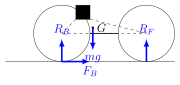
The axles of the wheels of a motorbike of mass \(m\) are a distance \(b\) apart. Its centre of mass is a horizontal distance of \(d\) from the front axle, where \(d < b\), and a vertical distance \(h\) above the road, which is horizontal and straight. The engine is connected to the rear wheel. The coefficient of friction between the ground and the rear wheel is \(\mu\), where \(\mu < b/h\), and the front wheel is smooth. You may assume that the sum of the moments of the forces acting on the motorbike about the centre of mass is zero. By taking moments about the centre of mass show that, as the acceleration of the motorbike increases from zero, the rear wheel will slip before the front wheel loses contact with the road if \[ \mu < \frac {b-d}h\,. \tag{*} \] If the inequality \((*)\) holds and the rear wheel does not slip, show that the maximum acceleration is \[ \frac{ \mu dg}{b-\mu h} \,. \] If the inequality \((*)\) does not hold, find the maximum acceleration given that the front wheel remains in contact with the road.
Solution:
2017 Paper 2 Q9
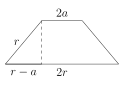
Two identical rough cylinders of radius \(r\) and weight \(W\) rest, not touching each other but a negligible distance apart, on a horizontal floor. A thin flat rough plank of width \(2a\), where \(a < r\), and weight \(kW\) rests symmetrically and horizontally on the cylinders, with its length parallel to the axes of the cylinders and its faces horizontal. A vertical cross-section is shown in the diagram below.
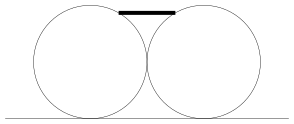
- Let \(F\) be the frictional force between one cylinder and the floor, and let \(R\) be the normal reaction between the plank and one cylinder. Show that \[ R\sin\theta = F(1+\cos\theta)\,, \] where \(\theta\) is the acute angle between the plank and the tangent to the cylinder at the point of contact. Deduce that \(2\sin\theta \le 1+\cos\theta\,\).
- Show that \[ N= \left( 1+\frac2 k\right)\left(\frac{1+\cos\theta}{\sin\theta} \right) F \,, \] where \(N\) is the normal reaction between the floor and one cylinder. Write down the condition that the cylinder does not slip on the floor and show that it is satisfied with no extra restrictions on \(\theta\).
- Show that \(\sin\theta\le\frac45\,\) and hence that \(r\le5a\,\).
Solution:
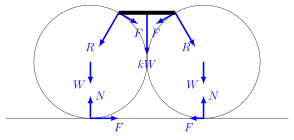
- \(\,\) \begin{align*} \text{N2}(\rightarrow, \text{ one cylinder}): && F\cos \theta + F - R \sin \theta &= 0 \\ \Rightarrow && F(1+\cos \theta) &= R \sin \theta \\ && F \leq \tfrac12 R \\ \Rightarrow && R \sin \theta &\leq \frac12 R(1+\cos \theta) \\ \Rightarrow && 2 \sin \theta &\leq 1 + \cos \theta \end{align*}
- \(\,\) \begin{align*} \text{N2}(\uparrow, \text{system}): && 2N-(k+2)W &= 0 \\ \Rightarrow && W &= \left ( \frac{2}{k+2} \right)N \\ \text{N2}(\uparrow, \text{one cylinder}): && N - W - R\cos \theta -F\sin \theta &= 0 \\ \Rightarrow && N - \left ( \frac{2}{k+2} \right)N - F \left ( \frac{1+\cos \theta}{\sin \theta} \right) \cos \theta - F \sin \theta &= 0 \\ \Rightarrow && \left ( \frac{k}{k+2} \right)N &= \left ( \frac{\cos \theta + \cos^2 \theta + \sin^2 \theta}{\sin \theta} \right) F\\ \Rightarrow && N &= \left ( 1 + \frac2{k} \right) \left ( \frac{\cos \theta + 1}{\sin \theta} \right) F \end{align*} The cylinder does not slip if \(F \leq \tfrac12 N\), ie \begin{align*} && N &\leq \left ( 1 + \frac2{k} \right) \left ( \frac{\cos \theta + 1}{\sin \theta} \right) \frac12 N \\ \Rightarrow && 2\sin \theta &\leq \left ( 1 + \frac2{k} \right) \left ( \cos \theta + 1 \right) \end{align*} but since \(2 \sin \theta \leq (1 + \cos \theta)\) and \((1+\frac2k) > 1\) this inequality is obviously satisfied.
- We can notice that \(2\sin \theta = 1 + \cos \theta\) is satisfied by a \(3-4-5\) triangle, where \(\sin \theta = 4/5, \cos \theta = 3/5\) and hence if \(\sin \theta \leq \frac45\) the condition must hold.
So \(\sin \theta = \frac{r-a}{r} \leq \frac45 \Rightarrow 5r-5a \leq 4r \Rightarrow r \leq 5a\)
2017 Paper 3 Q10
A uniform rod \(PQ\) of mass \(m\) and length \(3a\) is freely hinged at \(P\). The rod is held horizontally and a particle of mass \(m\) is placed on top of the rod at a distance~\(\ell\) from \(P\), where \(\ell <2a\). The coefficient of friction between the rod and the particle is \(\mu\). The rod is then released. Show that, while the particle does not slip along the rod, \[ (3a^2+\ell^2)\dot \theta^2 = g(3a+2\ell)\sin\theta \,, \] where \(\theta\) is the angle through which the rod has turned, and the dot denotes the time derivative. Hence, or otherwise, find an expression for \(\ddot \theta\) and show that the normal reaction of the rod on the particle is non-zero when~\(\theta\) is acute. Show further that, when the particle is on the point of slipping, \[ \tan\theta = \frac{\mu a (2a-\ell)}{2(\ell^2 + a\ell +a^2)} \,. \] What happens at the moment the rod is released if, instead, \(\ell>2a\)?
Solution:

| Inital | \@ \(\theta\) | |
| Rotational KE of rod | \(0\) | \(\frac{1}{2}I\dot{\theta}^2 = \frac{1}{2} \frac{1}{3} m (3a)^2 \dot{\theta}^2 = \frac32 m a^2 \dot{\theta}^2\) |
| KE of particle | \(0\) | \(\frac12 m \ell^2\dot{\theta}^2\) |
| GPE of rod | \(0\) | \(-\frac{3}{2}mga \sin \theta\) |
| GPE of particle | \(0\) | \(-mg \ell \sin \theta\) |
| Total | \(0\) | \(\frac12m \l \l 3a^2 + \ell^2\r \dot{\theta}^2 - \l 3a + 2\ell \r g \sin \theta \r\) |
2016 Paper 1 Q9
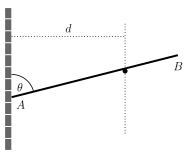
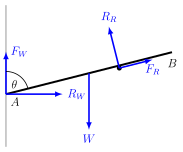
A horizontal rail is fixed parallel to a vertical wall and at a distance \(d\) from the wall. A uniform rod \(AB\) of length \(2a\) rests in equilibrium on the rail with the end \(A\) in contact with the wall. The rod lies in a vertical plane perpendicular to the wall. It is inclined at an angle \(\theta\) to the vertical (where \(0 < \theta < \frac12\pi\)) and \(a\sin\theta < d\), as shown in the diagram.
Solution:
2016 Paper 3 Q10
A smooth plane is inclined at an angle \(\alpha\) to the horizontal. A particle \(P\) of mass \(m\) is attached to a fixed point \(A\) above the plane by a light inextensible string of length \(a\). The particle rests in equilibrium on the plane, and the string makes an angle \(\beta\) with the plane. The particle is given a horizontal impulse parallel to the plane so that it has an initial speed of \(u\). Show that the particle will not immediately leave the plane if \(ag\cos(\alpha + \beta)> u^2 \tan\beta\). Show further that a necessary condition for the particle to perform a complete circle whilst in contact with the plane is \(6\tan\alpha \tan \beta < 1\).
2015 Paper 2 Q10
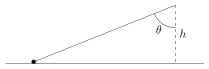
A particle of mass \(m\) is pulled along the floor of a room in a straight line by a light string which is pulled at constant speed \(V\) through a hole in the ceiling. The floor is smooth and horizontal, and the height of the room is \(h\). Find, in terms of \(V\) and \(\theta\), the speed of the particle when the string makes an angle of \(\theta\) with the vertical (and the particle is still in contact with the floor). Find also the acceleration, in terms of \(V\), \(h\) and \(\theta\). Find the tension in the string and hence show that the particle will leave the floor when \[ \tan^4\theta = \frac{V^2}{gh}\,. \]
Solution:
2013 Paper 2 Q9
The diagram shows three identical discs in equilibrium in a vertical plane. Two discs rest, not in contact with each other, on a horizontal surface and the third disc rests on the other two. The angle at the upper vertex of the triangle joining the centres of the discs is \(2\theta\).
- Show that the normal reaction between the horizontal surface and a disc in contact with the surface is \(\frac32 W\,\).
- Find the normal reaction between two discs in contact and show that the magnitude of the frictional force between two discs in contact is \(\dfrac{W\sin\theta}{2(1+\cos\theta)}\,\).
- Show that if \(\mu <2- \surd3\,\) there is no value of \(\theta\) for which equilibrium is possible.
2012 Paper 2 Q10
A hollow circular cylinder of internal radius \(r\) is held fixed with its axis horizontal. A uniform rod of length \(2a\) (where \(a < r\)) rests in equilibrium inside the cylinder inclined at an angle of \(\theta\) to the horizontal, where \(\theta\ne0\). The vertical plane containing the rod is perpendicular to the axis of the cylinder. The coefficient of friction between the cylinder and each end of the rod is \(\mu\), where \(\mu > 0\). Show that, if the rod is on the point of slipping, then the normal reactions \(R_1\) and \(R_2\) of the lower and higher ends of the rod, respectively, on the cylinder are related by \[ \mu(R_1+R_2) = (R_1-R_2)\tan\phi \] where \(\phi\) is the angle between the rod and the radius to an end of the rod. Show further that \[ \tan\theta = \frac {\mu r^2}{r^2 -a^2(1+\mu^2)}\,. \] Deduce that \(\lambda <\phi \), where \(\tan\lambda =\mu\).
Solution:
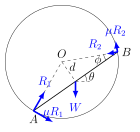
2012 Paper 3 Q10
A small ring of mass \(m\) is free to slide without friction on a hoop of radius \(a\). The hoop is fixed in a vertical plane. The ring is connected by a light elastic string of natural length \(a\) to the highest point of the hoop. The ring is initially at rest at the lowest point of the hoop and is then slightly displaced. In the subsequent motion the angle of the string to the downward vertical is \(\phi\). Given that the ring first comes to rest just as the string becomes slack, find an expression for the modulus of elasticity of the string in terms of \(m\) and \(g\). Show that, throughout the motion, the magnitude \(R\) of the reaction between the ring and the hoop is given by \[ R = ( 12\cos^2\phi -15\cos\phi +5) mg \] and that \(R\) is non-zero throughout the motion.
2011 Paper 3 Q9
Particles \(P\) and \(Q\) have masses \(3m\) and \(4m\), respectively. They lie on the outer curved surface of a~smooth circular cylinder of radius~\(a\) which is fixed with its axis horizontal. They are connected by a light inextensible string of length \(\frac12 \pi a\), which passes over the surface of the cylinder. The particles and the string all lie in a vertical plane perpendicular to the axis of the cylinder, and the axis intersects this plane at \(O\). Initially, the particles are in equilibrium. Equilibrium is slightly disturbed and \(Q\) begins to move downwards. Show that while the two particles are still in contact with the cylinder the angle \(\theta\) between \(OQ\) and the vertical satisfies \[ 7a\dot\theta^2 +8g \cos\theta + 6 g\sin\theta = 10g\,. \]
- Given that \(Q\) loses contact with the cylinder first, show that it does so when~\(\theta=\beta\), where \(\beta\) satisfies \[ 15\cos\beta +6\sin\beta =10. \]
- Show also that while \(P\) and \(Q\) are still in contact with the cylinder the tension in the string is $\frac {12}7 mg(\sin\theta +\cos\theta)\,$.
2010 Paper 3 Q9
\(\,\)