2016 Paper 1 Q9
Year: 2016
Paper: 1
Question Number: 9
Course: LFM Pure and Mechanics
Section: Friction
Problem
Solution
Examiner's report
— 2016 STEP 1, Question 9This year, more than 2000 candidates signed up to sit this paper, though just under 2000 actually sat it. This figure is about the same as the entry figure for 2015, though the number of candidates opting to sit STEP I has risen significantly over recent years; for instance, it was around 1500 in 2013. There is no doubt that the purpose of the STEPs is to learn which students can genuinely use their mathematical knowledge, skills and techniques in an arena that demands of them a level of performance that exceeds anything they will have encountered within the standard A-level (or equivalent) assessments. The ability to work at an extended piece of mathematical work, often with the minimum of specific guidance, allied to the need for both determination and the ability to "make connections" at speed and under considerable time pressure, are characteristics that only follow from careful preparation, and there is a great benefit to be had from an early encounter with, and subsequent prolonged exposure to, these kinds of questions. It is not always easy to say what level of preparation has been undertaken by candidates, but the minimum expected requirement is the ability to undertake routine A-level-standard tasks and procedures with speed and accuracy. At the top end of the scale, almost 100 candidates produced a three-figure score to the paper, which is a phenomenal achievement; and around 250 others scored a mark of 70+, which is also exceptionally impressive. At the other end of the scale, over 400 candidates failed to reach a total of 40 marks out of the 120 available. For STEP I, the most approachable questions are always set as Qs.1 & 2 on the paper, with Q1 in particular intended to afford every candidate the opportunity to get something done successfully. So it is perfectly reasonable for a candidate, upon opening the paper, to make an immediate start at the first and/or second question(s) before looking around to decide which of the remaining 10 or 11 questions they feel they can tackle. It is very important that candidates spend a few minutes – possibly at the beginning – reading through the questions to decide which six they intend to work, since they will ultimately only be credited with their best six question marks. Many students spend time attempting seven, eight, or more questions and find themselves giving up too easily on a question the moment the going gets tough, and this is a great pity, since they are not allowing themselves thinking time, either on the paper as a whole or on individual questions. The other side to the notion of strategy is that most candidates clearly believe that they need to attempt (at least) six questions when, in fact, four questions (almost) completely done would guarantee a Grade 1 (Distinction), especially if their score on these first four questions were then to be supplemented by a couple of early attempts at the starting parts of a couple more questions (for the first five or six marks); attempts which need not take longer than, say, ten minutes of their time. It is thus perfectly reasonable to suggest to candidates, in their preparations, that they can spend more than 30 minutes on a question, but only IF they think they are going to finish it off satisfactorily, although it might be best if they were advised to spend absolutely no more than 40-45 minutes on any single question; if they haven't finished by then, it really is time to move on. Curve-sketching skills are usually a common weakness, but were only tested on this paper in Q3. The other common area of weakness – algebra – was tested relatively frequently, and proved to be as testing as usual. Calculus skills were generally "okay" although the integration of first-order differential equations by the separation of variables, as appearing repeatedly in Q4, was found challenging by many of the candidates who attempted this question. The most noticeable deficiency, however, was in the widespread inability to construct an argument, particularly in Qs. 5, 7 & 8. Vectors are often poorly handled, and this year proved no exception.
Rating Information
Difficulty Rating: 1516.0
Difficulty Comparisons: 1
Banger Rating: 1469.4
Banger Comparisons: 2
Show LaTeX source
Problem source
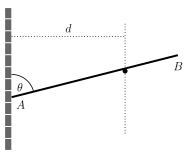
A horizontal rail is fixed parallel to a vertical wall and at a distance $d$ from the wall. A uniform rod $AB$ of length $2a$ rests in equilibrium on the rail with the end $A$ in contact with the wall. The rod lies in a vertical plane perpendicular to the wall. It is inclined at an angle $\theta$ to the vertical (where $0 < \theta < \frac12\pi$) and  $a\sin\theta < d$, as shown in the diagram.
\begin{center}
\begin{tikzpicture}
    % 1. Wall on the left
    % A thick line with a dash pattern replicates the grey segmented wall.
    % The right edge of this line naturally touches x=0 due to its thickness.
    \draw[line width=6.2pt, dash pattern=on 11pt off 1pt, black!60] (-0.12,0) -- (-0.12,5);
    % 2. Main rod from A to B
    \draw[line width=2pt] (0,1.86) -- (5.86,3.34);
    % 3. Vertical dotted line passing through the pivot
    \draw[thick, dotted] (4,0.58) -- (4,4.48);
    % 4. Horizontal dotted line representing distance d
    \draw[thick, dotted] (0,4) -- (4,4);
    % 5. Angle arc (theta)
    % The start angle is arctan((3.34-1.86) / 5.86) ≈ 14.17 degrees.
    % We use a scope shifted to point A (0, 1.86) to easily draw the arc.
    \begin{scope}[shift={(0,1.86)}]
        \draw[thick] (14.17:0.8) arc (14.17:90:0.8);
    \end{scope}
    % 6. Support / pivot dot
    % Original PSTricks size 5pt diameter translates to a 2.5pt radius in TikZ
    \fill (4,2.78) circle (2.5pt);
    % 7. Labels
    % Using anchors to mimic the original top-left (\rput[tl]) positioning
    \node[anchor=north west, inner sep=1pt] at (0.15,2.4) {$\theta$};
    \node[anchor=south] at (2,4) {$d$}; % Centered above the line for better typography
    \node[anchor=north west, inner sep=1pt] at (0.12,1.78) {$A$};
    \node[anchor=north west, inner sep=1pt] at (5.66,3.14) {$B$};
\end{tikzpicture}
\end{center}
The coefficient of friction between the rod and the wall  is $\mu$, and the coefficient of friction between the rod and the rail is $\lambda$.
Show that in limiting equilibrium, with the rod on the point of slipping at both the wall and the rail, the angle $\theta$ satisfies
\[
d\cosec^2\theta = a\big( (\lambda+\mu)\cos\theta + (1-\lambda \mu)\sin\theta
\big)
\,.
\]
Derive the corresponding result  if, instead, $ a\sin\theta > d $.
Solution source
\begin{center}
\begin{tikzpicture}

    % 1. Wall on the left
    % A thick line with a dash pattern replicates the grey segmented wall.
    % The right edge of this line naturally touches x=0 due to its thickness.
    \draw (-0,0) -- (-0,5);

    % 2. Main rod from A to B
    \draw[line width=2pt] (0,1.86) -- (5.86,3.34);

    \draw[-latex, blue, ultra thick] (0,1.86) -- ++(2, 0) node[right] {$R_W$};
    \draw[-latex, blue, ultra thick] (0,1.86) -- ++(0, 1.5) node[right] {$F_W$};

    % 5. Angle arc (theta)
    % The start angle is arctan((3.34-1.86) / 5.86) ≈ 14.17 degrees.
    % We use a scope shifted to point A (0, 1.86) to easily draw the arc.
    \begin{scope}[shift={(0,1.86)}]
        \draw[thick] (14.17:0.8) arc (14.17:90:0.8);
    \end{scope}

    % 6. Support / pivot dot
    % Original PSTricks size 5pt diameter translates to a 2.5pt radius in TikZ
    \fill (4,2.78) circle (2.5pt);

    \draw[-latex, blue, ultra thick] ({5.86/2}, {(3.34+1.86)/2}) -- ++(0,-2) node[below] {$W$};

    \draw[-latex, blue, ultra thick] (4,2.78) -- ++({5.86/5}, {(3.34-1.86)/5}) node[below] {$F_R$};
    \draw[-latex, blue, ultra thick] (4,2.78) -- ++({-(3.34-1.86)/4},{5.86/4}) node[above] {$R_R$};

    % 7. Labels
    % Using anchors to mimic the original top-left (\rput[tl]) positioning
    \node[anchor=north west, inner sep=1pt] at (0.15,2.4) {$\theta$};
    \node[anchor=north west, inner sep=1pt] at (0.12,1.78) {$A$};
    \node[anchor=north west, inner sep=1pt] at (5.66,3.14) {$B$};

\end{tikzpicture}
\end{center}

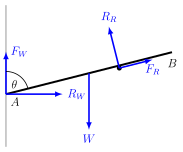
Notice everything is at limiting equilibrium, so $F_W = \mu R_W$ and $F_R = \lambda R_R$.

\begin{align*}
    \text{N2}(\nearrow): && \lambda R_R  - W \cos \theta+ R_W \sin \theta+\mu R_W \cos \theta &= 0 \\
    \text{N2}(\nwarrow): && R_R -W \sin \theta -R_W \cos \theta+\mu R_W \sin \theta &= 0 \\
    \overset{\curvearrowright}{A}: && a W \sin \theta -R_R \frac{d}{\sin \theta} &= 0 \\
    \overset{\curvearrowright}{\text{rod}}: && -W\left (d-a\sin \theta \right)+\mu R_W d-R_W d \cot \theta &= 0 \\
\end{align*}

So

\begin{align*}
    && R_W d(\mu - \cot \theta) &= W (d - a \sin \theta) \\
    && a W  &= R_Rd \textrm{cosec}^2 \theta \\
    \Rightarrow && d \textrm{cosec}^2 \theta &=\frac{aW}{R_R} \\
    && \lambda R_R &= W \cos \theta -R_W(\sin \theta + \mu \cos \theta) \\
    &&&= W\cos \theta - W \frac{d - a \sin \theta}{d(\mu - \cot \theta)} ( \sin \theta + \mu \cos \theta) \\
    &&&= W { \left ( \frac{d\mu \cos \theta - d\cos \theta \cot \theta - d \sin \theta - d \mu \cos \theta+a \sin^2 \theta + a \mu \sin \theta \cos \theta}{d(\mu - \cot \theta)} \right) }\\
    &&&=  W \left ( \frac{ - d \textrm{cosec} \theta +a \sin^2 \theta + a \mu \sin \theta \cos \theta}{d(\mu - \cot \theta)} \right) \\
    \Rightarrow && d \textrm{cosec}^2 \theta &=\frac{aW}{R_R} \\
    &&&= \frac{ad\lambda(\mu - \cot \theta)}{- d \textrm{cosec} \theta +a \sin^2 \theta + a \mu \sin \theta \cos \theta} \\
    &&&= \frac{ad\lambda(\mu \sin \theta  - \cos  \theta)}{-d + a \sin^2 \theta (\sin \theta + \mu \cos \theta)} \\
    \Rightarrow && -d^2 \textrm{cosec}^2 \theta &+ a(\sin \theta + \mu \cos \theta) = ad\lambda(\mu \sin \theta  - \cos  \theta) \\
    \Rightarrow && d \textrm{cosec}^2 \theta &= a(\sin \theta + \mu \cos \theta)-a\lambda(\mu \sin \theta  - \cos  \theta) \\
    &&&= a( (\mu+\lambda)\cos \theta + (1-\mu \lambda)\sin \theta)
\end{align*}

If the rod is before the midpoint, the directions of both frictions will be reversed, ie we should obtain the same result, but with $\mu \to -\mu, \lambda \to -\lambda$ ie $d \textrm{cosec}^2 \theta = a( -(\mu+\lambda)\cos \theta + (1-\mu \lambda)\sin \theta)$
In this question – a statics question – candidates were helped enormously by the given diagram, which allowed most takers the opportunity to get most of the preliminary "force" statements down correctly: resolving twice and taking moments (choosing sensible directions and a suitable axial point), along with the straightforward use of the "F = μR" friction law, meant that 7 marks could be obtained simply for noting all the correct ingredients. Suitable choices for eliminating terms would then lead to the printed answer with little difficulty beyond the algebraic. It is fair to say, however, that the prospect of doing it all again for the second configuration proved too much for many candidates, although it actually only involved the realisation that certain forces changed directions and could thus be replaced by their negatives.