2018 Paper 2 Q11
Year: 2018
Paper: 2
Question Number: 11
Course: UFM Mechanics
Section: Centre of Mass 1
Problem
Solution
Examiner's report
— 2018 STEP 2, Question 11The pure questions were again the most popular of the paper, with only two of those questions being attempted by fewer than half of the candidates (none of the other questions was attempted by more than half of the candidates). Good responses were seen to all of the questions, but in many cases, explanations lacked sufficient detail to be awarded full marks. Candidates should ensure that they are demonstrating that the results that they are attempting to apply are valid in the cases being considered. In several of the questions, later parts involve finding solutions to situations that are similar to earlier parts of the question. In general candidates struggled to recognise these similarities and therefore spent a lot of time repeating work that had already been done, rather than simply observing what the result must be.
Rating Information
Difficulty Rating: 1600.0
Difficulty Comparisons: 0
Banger Rating: 1500.0
Banger Comparisons: 0
Show LaTeX source
Problem source
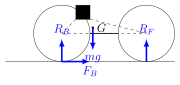
The axles of the wheels of a motorbike of mass $m$ are a distance $b$ apart.  Its centre of mass is a horizontal distance of $d$ from the front axle, where $d < b$, and a vertical distance $h$ above the road, which is horizontal and straight.
The engine is connected to the rear wheel.
The coefficient of friction between the ground and the rear wheel is $\mu$, where $\mu < b/h$, and the front wheel is smooth.
You may assume that the sum of the moments of the forces acting on the motorbike about the centre of mass is zero. By taking moments about the centre of mass show that, as the acceleration of the motorbike increases from zero, the rear wheel will slip before the front wheel loses contact with the road if
\[
\mu < \frac {b-d}h\,.
\tag{*}
\]
If the inequality $(*)$ holds and the rear wheel does not slip, show that the maximum acceleration is
\[
\frac{ \mu dg}{b-\mu h}
\,.
\]
If the inequality $(*)$ does not hold, find the maximum acceleration given that the front wheel remains in contact with the road.
Solution source
\begin{center}
    \begin{tikzpicture}

        \coordinate (G) at (2.1,0.2);

        \draw (1,0) circle (1);
        \draw (4,0) circle (1);
        \draw (-1, -1) -- (5, -1);
        \draw[dashed] (1,0) -- (4,0);
        \draw[thick] (2,0) -- (3,0);

        \filldraw (1.5,0.5) rectangle (2,1);
        \draw[dashed] (1.5, 0.5) -- (1,0);
        \draw[dashed] (2, 0.5) -- (4,0);

        \filldraw (G) circle (1pt) node[right] {$G$};

        \draw[-latex, ultra thick, blue] (G) -- ++(0, -0.8) node[below] {$mg$};
        \draw[-latex, ultra thick, blue] (4,-1) -- ++(0, 0.8) node[above] {$R_F$};
        \draw[-latex, ultra thick, blue] (1,-1) -- ++(0, 0.8) node[above] {$R_B$};
        \draw[-latex, ultra thick, blue] (1,-1) -- ++(1, 0) node[below] {$F_B$};

    \end{tikzpicture}
\end{center}

\begin{align*}
% \text{N2}(\uparrow): && R_B+ R_F &= mg \\
\overset{\curvearrowright}{G}: && -R_Fd - F_B h + R_B (b-d) &= 0 \\
\Rightarrow && -d R_F  - \mu h R_B +R_B(b-d) &= 0 \\
\Rightarrow && R_B(b-d-\mu h) &= d R_F \\
\underbrace{\Rightarrow}_{R_F > 0 \text{ if not leaving ground}} && R_B(b-d-\mu h) & > 0 \\
\Rightarrow && \frac{b-d}{h} > \mu
\end{align*}

The acceleration is $\frac{F_B}{m}$, so we wish to maximize $F_B$ which is the same as maximising $R_B$. Since the bike will slip before the front wheel lifts, we want the bike to be on the point of slipping, ie $$


\begin{align*}
&& R_B(b-d-\mu h) &= d R_F \\
\text{N2}(\uparrow): && R_B + R_F &= mg \\
\Rightarrow && R_B(b-d-\mu h) &= d(mg - R_B) \\
\Rightarrow && R_B(b-\mu h) &= dmg \\
\Rightarrow && R_B &= \frac{dmg}{b-\mu h} \\
\Rightarrow && a &= \frac{F_B}{m} \\
&&&= \frac{\mu R_B}{m} \\
&&&= \frac{\mu dg}{b-\mu h} \\
\end{align*}

If the inequality doesn't hold, we want to be at the point just before $R_F = 0$, since that gives us maximum friction at $F_B$, ie

\begin{align*}
&& R_B &= mg \\
\Rightarrow && a &= \frac{F_B}{m} \\
&&&= \frac{\mu mg}{m} \\
&&&= \mu g
\end{align*}
The most common mistake made in this question was to have the frictional force acting in the wrong direction, with many candidates assuming that the frictional force was pulling the motorbike backwards and a "driving force" from the engine acted to push it forwards. The great majority of candidates did attempt to find moments about the centre of mass as instructed, but there were some attempts to evaluate moments about one of the wheels.