2015 Paper 2 Q10
Year: 2015
Paper: 2
Question Number: 10
Course: LFM Pure and Mechanics
Section: Newton's laws and connected particles
Problem
Solution
Examiner's report
— 2015 STEP 2, Question 10As in previous years the Pure questions were the most popular of the paper with questions 1, 2 and 6 the most popular. The least popular questions on the paper were questions 8, 11 and 13 with fewer than 250 attempts for each of them. There were many examples of solutions in this paper that were insufficiently well explained given that the answer to be reached had been provided in the question.
Rating Information
Difficulty Rating: 1600.0
Difficulty Comparisons: 0
Banger Rating: 1516.0
Banger Comparisons: 1
Show LaTeX source
Problem source
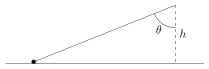
A particle of mass $m$ is pulled along the floor of a room in a straight line by a light string which is pulled at constant speed $V$ through a hole in the ceiling. The floor is smooth and horizontal, and the height of the room is $h$. Find, in terms of $V$ and $\theta$, the speed  of the particle when the string makes an angle of $\theta$ with the vertical (and the particle is still in contact with the floor). Find also the acceleration, in terms of $V$, $h$ and $\theta$.
Find the tension in the string and hence show that the particle will leave the floor when
\[
\tan^4\theta = \frac{V^2}{gh}\,.
\]
Solution source
\begin{center}
    \begin{tikzpicture}
        \coordinate (A) at (0,0);
        \coordinate (H) at (5, 2);
        \coordinate (E) at (5, 0);
        \draw (A) -- (H);
        \draw (-1, -0.07) -- (6, -0.07);

        \filldraw (A) circle (2pt);
        \draw[dashed] (H) -- ++(0,-2) node[pos=0.5, right] {$h$};
        \pic [draw, angle radius=.8cm, angle eccentricity=1.3, "$\theta$"] {angle = A--H--E};
    \end{tikzpicture}
\end{center}

The length of the string is $h/\cos \theta$, and it is decreasing at a rate $V$. The distance along the ground is decreasing at a rate of $V/\sin \theta$.

Note that $-V = \frac{\d}{\d t} \left ( \frac{h}{\cos \theta} \right) = \frac{h} {\cos^2 \theta} \sin \theta \cdot \dot{\theta} \Rightarrow \dot{\theta} = -\frac{V\cos^2\theta}{h \sin \theta}$.

Note that $a = \frac{\d}{\d t} \left ( \frac{V}{\sin \theta} \right) = -\frac{V}{\sin^2 \theta} \cos \theta \cdot \dot{\theta} = \frac{V^2 \cos^3 \theta}{h\sin^3 \theta}$.

Resolving horizontally we must have $T \sin \theta = ma \Rightarrow T = \frac{V^2m \cos^3 \theta}{h \sin^4 \theta}$.

Resolving vertically at the point where we are about to leave the ground, we must have $T\cos \theta = mg \Rightarrow \frac{V^2m \cos^4 \theta}{h \sin^4 \theta} = mg \Rightarrow \tan^4 \theta = \frac{V^2}{gh}$
This question received generally very poor attempts, including a large number of partial attempts. The majority of attempts failed to get the correct expression of the velocity in the first part and this limited the number of marks that could be awarded for the remainder of the question. A very small number of attempts were awarded full marks and there were a considerable number of attempts in which correct methods were attempted following an incorrect solution to the first part of the question.