Problems
Filters
46 problems found
2025 Paper 3 Q3
Let \(f(x)\) be defined and positive for \(x > 0\). Let \(a\) and \(b\) be real numbers with \(0 < a < b\) and define the points \(A = (a, f(a))\) and \(B = (b, -f(b))\). Let \(X = (m,0)\) be the point of intersection of line \(AB\) with the \(x\)-axis.
- Find an expression for \(m\) in terms of \(a\), \(b\), \(f(a)\) and \(f(b)\).
- Show that, if \(f(x) = \sqrt{x}\), then \(m = \sqrt{ab}\). Find, in terms of \(n\), \(a\) function \(f(x)\) such that \(m = \frac{a^{n+1} + b^{n+1}}{a^n + b^n}\).
- Let \(g_1(x)\) and \(g_2(x)\) be defined and positive for \(x > 0\). Let \(m = M_1\) when \(f(x) = g_1(x)\) and let \(m = M_2\) when \(f(x) = g_2(x)\). Show that if \(\frac{g_1(x)}{g_2(x)}\) is a decreasing function then \(M_1 > M_2\). Hence show that $$\frac{a+b}{2} > \sqrt{ab} > \frac{2ab}{a+b}$$
- Let \(p\) and \(c\) be chosen so that the curve \(y = p(c-x)^3\) passes through both \(A\) and \(B\). Show that $$\frac{c-a}{b-c} = \left(\frac{f(a)}{f(b)}\right)^{1/3}$$ and hence determine \(c\) in terms of \(a\), \(b\), \(f(a)\) and \(f(b)\). Show that if \(f\) is a decreasing function, then \(c < m\).
Solution:
- The line \(AB\) has equation: \begin{align*} && \frac{y+f(b)}{x-b} &= \frac{f(a)+f(b)}{a-b} \\ \Rightarrow && \frac{f(b)}{m-b} &= \frac{f(a)+f(b)}{a-b} \\ \Rightarrow && m &= \frac{a-b}{f(a)+f(b)}f(b) + b \\ &&&= \frac{af(b)+bf(a)}{f(a)+f(b)} \end{align*}
- Suppose \(f(x) = \sqrt{x}\) then \begin{align*} m &= \frac{a\sqrt{b}+b\sqrt{a}}{\sqrt{a}+\sqrt{b}} \\ &= \frac{\sqrt{ab}(\sqrt{a}+\sqrt{b})}{\sqrt{a}+\sqrt{b}} \\ &= \sqrt{ab} \end{align*} Suppose \(f(x) = x^{-n}\) then \begin{align*} m &= \frac{a b^{-n}+ba^{-n}}{a^{-n}+b^{-n}} \\ &= \frac{a^{n+1}+b^{n+1}}{b^n + a^n} \\ \end{align*}
- Without loss of generality, we can scale \(g_1(x)\) and \(g_2(x)\) so that \(g_1(a) = g_2(a)\) and \(m\) won't change for either of them. Then since \(\frac{g_1(b)}{g_2(b)} < 1\) (this function is decreasing) our line connecting \((a,g_i(a))\) and \((b,-g_i(b))\) must interect the axis first for \(g_2\), in particular \(M_1 > M_2\). Suppose \(g_1(x) =1, g_2(x) = \sqrt{x}, g_3(x) = x^{-1}\), the notice that \(\frac{g_1(x)}{g_2(x)} =\frac{g_2(x)}{g_3(x)}= x^{-1/2}\) are decreasing, therefore: \begin{align*} \frac{a+b}{1+1} &> \sqrt{ab} > \frac{1+1}{a^{-1}+b^{-1}} \\ \frac{a+b}{2} &> \sqrt{ab} > \frac{2ab}{a+b} \\ \end{align*}
- We must have: \begin{align*} && p(c-a)^3 &= f(a) \\ && p(c-b)^3 &= -f(b) \\ \Rightarrow &&\left ( \frac{c-a}{c-b} \right)^3 &= -\frac{f(a)}{f(b)} \\ \Rightarrow && \frac{c-a}{b-c} &= \left (\frac{f(a)}{f(b)} \right)^{\tfrac13} \\ \Rightarrow && c-a &= \left (\frac{f(a)}{f(b)} \right)^{\tfrac13}(b-c)\\ \Rightarrow && c \left (1 + \left (\frac{f(a)}{f(b)} \right)^{\tfrac13} \right) &= \left (\frac{f(a)}{f(b)} \right)^{\tfrac13}b + a \\ \Rightarrow && c &= \frac{\left (\frac{f(a)}{f(b)} \right)^{\tfrac13}b + a}{1 + \left (\frac{f(a)}{f(b)} \right)^{\tfrac13}} \\ &&&= \frac{b[f(a)]^\tfrac13+a[f(b)]^\tfrac13}{[f(a)]^\tfrac13+[f(b)]^\tfrac13} \end{align*} We have that \(\frac{c-a}{b-c} = \left (\frac{f(a)}{f(b)} \right)^{\tfrac13} \) and \(\frac{m-a}{b-c} = \frac{f(a)}{f(b)}\). Since \(f\) is decreasing, \(\frac{f(a)}{f(b)} > 1\) and so \(\left (\frac{f(a)}{f(b)} \right)^{\tfrac13} < \frac{f(a)}{f(b)}\), therefore \(m > c\).
2024 Paper 2 Q3
The unit circle is the circle with radius 1 and centre the origin, \(O\). \(N\) and \(P\) are distinct points on the unit circle. \(N\) has coordinates \((-1, 0)\), and \(P\) has coordinates \((\cos\theta, \sin\theta)\), where \(-\pi < \theta < \pi\). The line \(NP\) intersects the \(y\)-axis at \(Q\), which has coordinates \((0, q)\).
- Show that \(q = \tan\frac{1}{2}\theta\).
- In this part, \(q \neq 1\).
- Let \(\mathrm{f}_1(q) = \dfrac{1+q}{1-q}\). Show that \(\mathrm{f}_1(q) = \tan\frac{1}{2}\!\left(\theta + \frac{1}{2}\pi\right)\).
- Let \(Q_1\) be the point with coordinates \((0, \mathrm{f}_1(q))\) and \(P_1\) be the point of intersection (other than \(N\)) of the line \(NQ_1\) and the unit circle. Describe geometrically the relationship between \(P\) and \(P_1\).
- \(P_2\) is the image of \(P\) under an anti-clockwise rotation about \(O\) through angle \(\frac{1}{3}\pi\). The line \(NP_2\) intersects the \(y\)-axis at the point \(Q_2\) with co-ordinates \((0, \mathrm{f}_2(q))\). Find \(\mathrm{f}_2(q)\) in terms of \(q\), for \(q \neq \sqrt{3}\).
- In this part, \(q \neq -1\). Let \(\mathrm{f}_3(q) = \dfrac{1-q}{1+q}\), let \(Q_3\) be the point with coordinates \((0, \mathrm{f}_3(q))\) and let \(P_3\) be the point of intersection (other than \(N\)) of the line \(NQ_3\) and the unit circle. Describe geometrically the relationship between \(P\) and \(P_3\).
- In this part, \(0 < q < 1\). Let \(\mathrm{f}_4(q) = \mathrm{f}_2^{-1}\!\Big(\mathrm{f}_3\!\big(\mathrm{f}_2(q)\big)\Big)\), let \(Q_4\) be the point with coordinates \((0, \mathrm{f}_4(q))\) and let \(P_4\) be the point of intersection (other than \(N\)) of the line \(NQ_4\) and the unit circle. Describe geometrically the relationship between \(P\) and \(P_4\).
Solution:
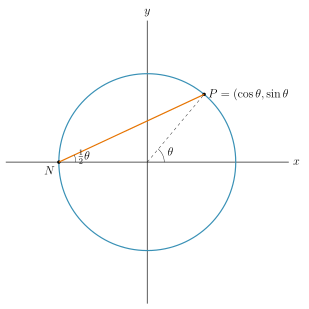
- \(\,\) \begin{align*} && \frac{y-0}{x-(-1)} &= \frac{\sin \theta }{\cos \theta + 1} \\ \Rightarrow && y_0 &= \frac{\sin \theta}{\cos \theta + 1} \\ &&&= \frac{\frac{2t}{1+t^2}}{\frac{1-t^2}{1+t^2}+1} \\ &&&= t = \tan \tfrac{\theta}{2} \end{align*} Alternatively, it is straightforward to see from the angles.
- \(f_1(q) = \frac{1+q}{1-q}\) so \begin{align*} && f_1(\tan\tfrac12\theta) &= \frac{1+\tan\tfrac12\theta}{1-\tan\tfrac12\theta} \\ &&&= \frac{\cos \tfrac12 \theta + \sin \tfrac12 \theta}{\cos \tfrac12 \theta - \sin \tfrac12 \theta} \\ &&&= \frac{\sin(\tfrac14 \pi + \tfrac12 \theta)}{\cos(\tfrac14 \pi + \tfrac12 \theta)} \\ &&&= \tan \tfrac12(\theta + \tfrac{\pi}{2}) \end{align*}
- \(Q_1\) is the point \((0, f_1(q))\) so \(P_1\) will be the point \((\cos (\theta + \tfrac{\pi}{2}), \sin (\theta + \tfrac{\pi}{2}))\) which is a rotation anticlockwise by \(\frac{\pi}{2}\)
- \(P_2 = (\cos(\theta + \tfrac{\pi}{3}), \sin( \theta + \tfrac{\pi}{3})\) and so \(f_2(q) = \tan (\tfrac12(\theta + \tfrac{\pi}{3}))\) so \begin{align*} && f_2(q) &= \tan (\tfrac12(\theta + \tfrac{\pi}{3})) \\ &&&= \frac{q + \tan \frac{\pi}{3}}{1 - \tan \frac{\pi}{3} \cdot q} \\ &&&= \frac{q + \frac{1}{\sqrt3}}{1 - \frac{q}{\sqrt{3}}} \\ &&&= \frac{\sqrt3 q + 1}{\sqrt3-q} \end{align*}
- Since \(q \to -q\) reflects \((0,q)\) in the \(x\)-axis, \(f_3(q) = f_1(-q)\) so \(P_3\) is the reflection of \(P_1\) so it's rotation by \(\frac{\pi}{2}\) followed by reflection in the \(x\)-axis, which is reflection in \(y=x\). [ie \(\theta \to -\theta + \frac{\pi}{2} \to \frac{\pi}{2}-\theta\)]
- We are rotating by \(\frac{\pi}{3}\) then reflecting in \(y=x\) and then rotating by \(-\frac{\pi}{3}\), ie \(\theta \to \theta + \frac{\pi}{3} \to \frac{\pi}{6}-\theta \to -\theta -\frac{\pi}{6} \)
2024 Paper 3 Q4
- Show that if the acute angle between straight lines with gradients \(m_1\) and \(m_2\) is \(45^\circ\), then \[\frac{m_1 - m_2}{1 + m_1 m_2} = \pm 1.\]
- If \(p \neq q\), show that the tangents to the curve \(C\) at the points with \(x\)-coordinates \(p\) and \(q\) meet at a point with \(x\)-coordinate \(\frac{1}{2}(p+q)\). Find the \(y\)-coordinate of this point in terms of \(p\) and \(q\). Show further that any two tangents to the curve \(C\) which are at \(45^\circ\) to each other meet on the curve \((y+3a)^2 = 8a^2 + x^2\).
- Show that the acute angle between any two tangents to the curve \(C\) which meet on the curve \((y+7a)^2 = 48a^2 + 3x^2\) is constant. Find this acute angle.
2024 Paper 3 Q8
- Explain why the equation \((y - x + 3)(y + x - 5) = 0\) represents a pair of straight lines with gradients \(1\) and \(-1\). Show further that the equation \[y^2 - x^2 + py + qx + r = 0\] represents a pair of straight lines with gradients \(1\) and \(-1\) if and only if \(p^2 - q^2 = 4r\).
- Explain why the coordinates of any point which lies on both of the curves \(C_1\) and \(C_2\) also satisfy the equation \[y^2 + 2sy + s(s+1) - x + k(y - x^2) = 0\] for any real number \(k\). Given that \(s\) is such that \(C_1\) and \(C_2\) intersect at four distinct points, show that choosing \(k = 1\) gives an equation representing a pair of straight lines, with gradients \(1\) and \(-1\), on which all four points of intersection lie.
- Show that if \(C_1\) and \(C_2\) intersect at four distinct points, then \(s < -\frac{3}{4}\).
- Show that if \(s < -\frac{3}{4}\), then \(C_1\) and \(C_2\) intersect at four distinct points.
2022 Paper 2 Q5
- Given that \(a > b > c > 0\) are constants, and that \(x\), \(y\), \(z\) are non-negative variables, show that \[ax + by + cz \leqslant a(x + y + z).\]
- Find \(\Delta\) in terms of \(a\), \(b\), \(c\), \(x\), \(y\) and \(z\).
- Find both the minimum value of the sum of the perpendicular distances from \(P\) to the three sides of the triangle and the values of \(x\), \(y\) and \(z\) which give this minimum sum, expressing your answers in terms of some or all of \(a\), \(b\), \(c\) and \(\Delta\).
- Show that, for all real \(a\), \(b\), \(c\), \(x\), \(y\) and \(z\), \[(a^2+b^2+c^2)(x^2+y^2+z^2) = (bx-ay)^2 + (cy-bz)^2 + (az-cx)^2 + (ax+by+cz)^2.\]
- Find both the minimum value of the sum of the squares of the perpendicular distances from \(P\) to the three sides of the triangle and the values of \(x\), \(y\) and \(z\) which give this minimum sum, expressing your answers in terms of some or all of \(a\), \(b\), \(c\) and \(\Delta\).
- Find both the maximum value of the sum of the squares of the perpendicular distances from \(P\) to the three sides of the triangle and the values of \(x\), \(y\) and \(z\) which give this maximum sum, expressing your answers in terms of some or all of \(a\), \(b\), \(c\) and \(\Delta\).
2022 Paper 2 Q10
- Show that, if a particle is projected at an angle \(\alpha\) above the horizontal with speed \(u\), it will reach height \(h\) at a horizontal distance \(s\) from the point of projection where \[h = s\tan\alpha - \frac{gs^2}{2u^2\cos^2\alpha}\,.\]
- Let a point \(P\) on the plane have coordinates \((x,\, y,\, y\tan\theta)\). Show that the condition for it to be possible for a projectile from the cannon to land at point \(P\) is \[x^2 + \left(y + \frac{u^2\tan\theta}{g}\right)^2 \leqslant \frac{u^4\sec^2\theta}{g^2}\,.\]
- Show that the furthest point directly up the plane that can be reached by a projectile from the cannon is a distance \[\frac{u^2}{g(1+\sin\theta)}\] from the cannon. How far from the cannon is the furthest point directly down the plane that can be reached by a projectile from it?
- Find the length of road which can be reached by projectiles from the cannon. The cannon is now moved to a point on the plane vertically above the \(y\)-axis, and a distance \(r\) from the road. Find the value of \(r\) which maximises the length of road which can be reached by projectiles from the cannon. What is this maximum length?
2021 Paper 2 Q6
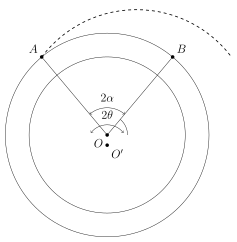
A plane circular road is bounded by two concentric circles with centres at point~\(O\). The inner circle has radius \(R\) and the outer circle has radius \(R + w\). The points \(A\) and \(B\) lie on the outer circle, as shown in the diagram, with \(\angle AOB = 2\alpha\), \(\tfrac{1}{3}\pi \leqslant \alpha \leqslant \tfrac{1}{2}\pi\) and \(0 < w < R\).
- Show that I cannot cycle from \(A\) to \(B\) in a straight line, while remaining on the road.
- I take a path from \(A\) to \(B\) that is an arc of a circle. This circle is tangent to the inner edge of the road, and has radius \(R + d\) (where \(d > w\)) and centre~\(O'\).
My path is represented by the dashed arc in the above diagram.
Let \(\angle AO'B = 2\theta\).
- Use the cosine rule to find \(d\) in terms of \(w\), \(R\) and \(\cos\alpha\).
- Find also an expression for \(\sin(\alpha - \theta)\) in terms of \(R\), \(d\) and \(\sin\alpha\).
- Show that \(\dfrac{d}{R}\) and \(\alpha - \theta\) are also both much less than \(1\).
- My friend cycles from \(A\) to \(B\) along the outer edge of the road. Let my path be shorter than my friend's path by distance~\(S\). Show that \[ S = 2(R+d)(\alpha - \theta) + 2\alpha(w - d). \] Hence show that \(S\) is approximately a fraction \[ \frac{\sin\alpha - \alpha\cos\alpha}{\alpha(1 - \cos\alpha)} \cdot \frac{w}{R} \] of the length of my friend's path.
2019 Paper 1 Q1
A straight line passes through the fixed point \((1 , k)\) and has gradient \(- \tan \theta\), where \(k > 0\) and \(0 < \theta < \frac{1}{2}\pi\). Find, in terms of \(\theta\) and \(k\), the coordinates of the points \(X\) and \(Y\) where the line meets the \(x\)-axis and the \(y\)-axis respectively.
- Find an expression for the area \(A\) of triangle \(OXY\) in terms of \(k\) and \(\theta\). (The point \(O\) is the origin.) You are given that, as \(\theta\) varies, \(A\) has a minimum value. Find an expression in terms of \(k\) for this minimum value.
- Show that the length \(L\) of the perimeter of triangle \(OXY\) is given by $$L = 1 + \tan \theta + \sec \theta + k(1 + \cot \theta + \cosec \theta).$$ You are given that, as \(\theta\) varies, \(L\) has a minimum value. Show that this minimum value occurs when \(\theta = \alpha\) where $$\frac{1 - \cos \alpha}{1 - \sin \alpha} = k.$$ Find and simplify an expression for the minimum value of \(L\) in terms of \(\alpha\).
Solution: \(y = (-\tan \theta)(x-1)+k\) so when \(x = 0\), \(y = k + \tan \theta\), so \(Y = (0, k+\tan \theta)\). When \(y = 0\), \(x = 1 + \frac{k}{\tan \theta}\)
- \(A = \frac12 (k+\tan \theta)\left ( 1 + \frac{k}{\tan \theta} \right) = k + \frac12 \left (\tan \theta + \frac{k^2}{\tan \theta} \right)\) Notice that \(x + \frac{k^2}{x} \geq 2 k\) by AM-GM, so the minimum is \(k + \frac12 \cdot 2k = 2k\)
- \(\,\) \begin{align*} L &= k + \tan \theta + 1 + k \cot \theta + \sqrt{(k + \tan \theta)^2 + \left (1 + \frac{k}{\tan \theta} \right)^2} \\ &= k + \tan \theta + 1 + k \cot \theta + \sqrt{k^2 + 2 k \tan \theta +\tan^2 \theta + 1 + 2k \cot \theta + k^2\cot^2 \theta} \\ &= k + \tan \theta + 1 + k \cot \theta + \sqrt{\sec^2 \theta+ 2k \sec\theta\cosec \theta + k^2\cosec^2 \theta} \\ &= k + \tan \theta + 1 + k \cot \theta +\sec \theta + k\cosec \theta\\ &= 1 + \tan \theta + \sec \theta + k (1 + \cot \theta + \cosec \theta) \end{align*} \begin{align*} && \frac{\d L}{\d \theta} &= \sec^2 \theta + \tan \theta \sec \theta + k(-\cosec^2 \theta - \cot \theta \cosec \theta ) \\ \Rightarrow && 0 &=\sec^2 \alpha+ \tan \theta \sec \alpha+ k(-\cosec^2 \alpha- \cot \alpha\cosec \alpha) \\ \Rightarrow && k &= \frac{\sec^2 \alpha+ \tan \alpha\sec \alpha}{\cosec^2 \alpha+ \cot \alpha\cosec \alpha} \\ &&&= \frac{\sin^2 \alpha(1 + \sin \alpha)}{\cos^2 \alpha (1+ \cos \alpha)} \\ &&&= \frac{(1-\cos^2 \alpha)(1 + \sin \alpha)}{(1-\sin^2 \alpha )(1+ \cos \alpha)} \\ &&&= \frac{1-\cos \alpha}{1-\sin \alpha} \\ \Rightarrow && L &= 1 + \tan \alpha + \sec \alpha + \frac{1-\cos \alpha}{1-\sin \alpha} \left (1 + \cot \alpha + \cosec \alpha \right) \\ &&&= \frac{1+\tan \alpha + \sec \alpha -\sin \alpha-\sin \alpha \tan \alpha-\tan \alpha}{1-\sin \alpha} + \\ &&&\quad \quad \frac{1+\cot \alpha + \cosec \alpha-\cos \alpha-\cos \alpha \cot \alpha -\cot \alpha}{1-\sin \alpha} \\ &&&= \frac{2+\sec \alpha(1-\sin^2 \alpha)-\sin \alpha + \cosec \alpha(1-\cos^2 \alpha)-\cos \alpha}{1-\sin \alpha} \\ &&&= \frac{2+\cos\alpha-\sin \alpha + \sin\alpha-\cos \alpha}{1-\sin \alpha} \\ &&&= \frac{2}{1-\sin \alpha} \end{align*}
2018 Paper 1 Q3
The points \(R\) and \(S\) have coordinates \((-a,\, 0)\) and \((2a,\, 0)\), respectively, where \(a > 0\,\). The point \(P\) has coordinates \((x,\, y)\) where \(y > 0\) and \(x < 2a\). Let \(\angle PRS = \alpha \) and \(\angle PSR = \beta\,\).
- Show that, if \(\beta = 2 \alpha\,\), then \(P\) lies on the curve \(y^2=3(x^2-a^2)\,\).
- Find the possible relationships between \(\alpha\) and \(\beta\) when \(0 < \alpha < \pi\,\) and \(P\) lies on the curve \(y^2=3(x^2-a^2)\,\).
Solution:

- \begin{align*} &&\tan \beta &= \frac{y}{2a - x} \\ &&\tan \alpha &= \frac{y}{x+a} \\ && \tan \beta &= \tan 2 \alpha \\ && &= \frac{\tan \alpha}{1 - \tan^2 (\alpha)} \\ \Leftrightarrow && \frac{y}{2a-x}&= \frac{\l \frac{y}{x+a} \r}{1 - \l \frac{y}{x+a} \r^2} \\ && &= \frac{2y(x+a)}{(x+a)^2 - y^2} \\ \Leftrightarrow && (x+a)^2 - y^2 &= 2(x+a)(2a-x) \tag{\(y \neq 0\)} \\ \Leftrightarrow && x^2 + 2ax + a^2 - y^2 &= -2x^2 + 2ax - 4a^2 \\ \Leftrightarrow && y^2 &= 3(x^2-a^2) \end{align*}
- Therefore if \(y^2 = 3(x^2-a^2)\) we know that \(\tan \beta = \tan 2\alpha\), so \(2\alpha = \beta + n \pi\). Since \(0 < \alpha + \beta < \pi\) (since they are angles in a triangle we must have that \(0 < \alpha + 2\alpha - n \pi = 3\alpha - n\pi < \pi\), so \(0 < \alpha - \frac{n\pi}{3} < \frac{\pi}3\), therefore we have \(3\) cases:
2017 Paper 1 Q3
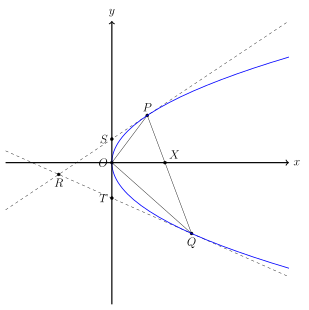
The points \(P(ap^2, 2ap)\) and \(Q(aq^2, 2aq)\), where \(p>0\) and \(q<0\), lie on the curve \(C\) with equation $$y^2= 4ax\,,$$ where \(a>0\,\). Show that the equation of the tangent to \(C\) at \(P\) is $$y= \frac 1 p \, x +ap\,.$$ The tangents to the curve at \(P\) and at \(Q \) meet at \(R\). These tangents meet the \(y\)-axis at \(S\) and \(T\) respectively, and \(O\) is the origin. Prove that the area of triangle \(OPQ\) is twice the area of triangle \(RST\).
Solution: \begin{align*} && 2yy' &= 4a \\ \Rightarrow && y' &= \frac{2a}{y} = \frac{2a}{2ap} = \frac1p \\ \Rightarrow && \frac{y-2ap}{x-ap^2} &= \frac1p \\ \Rightarrow && y &= \frac1p x +ap \end{align*} The other tangent will be \(y = \frac1qx+aq\) \begin{align*} &&& \begin{cases} py-x &= ap^2 \\ qy - x &= aq^2 \end{cases} \\ \Rightarrow && y(p-q) &= a(p^2-q^2) \\ \Rightarrow && y &= a(p+q) \\ && x &= apq \end{align*} Therefore \(R(apq, a(p+q)), S(0, ap), T(0, aq)\).
2016 Paper 1 Q5
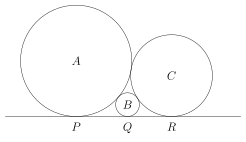
- The diagram shows three touching circles \(A\), \(B\) and \(C\), with a common tangent \(PQR\). The radii of the circles are \(a\), \(b\) and \(c\), respectively. Show that \[ \frac 1 {\sqrt b} = \frac 1 {\sqrt{a}} + \frac1{\sqrt{c}} \tag{\(*\)} \] and deduce that \[ 2\left(\frac1{a^2} + \frac1 {b^2} + \frac1 {c^2} \right) = \left(\frac1 a + \frac1 {b} + \frac1 {c} \right)^{\!2} . \tag{\(**\)} \]
- Instead, let \(a\), \(b\) and \(c\) be positive numbers, with \(b < c < a\), which satisfy \((**)\). Show that they also satisfy \((*)\).
Solution:
- \(\,\)
Notice that \begin{align*} && (a+b)^2 &= PQ^2 + (a-b)^2 \\ \Rightarrow && PQ^2 &= 4ab \\ && (b+c)^2 &= QR^2 + (c-b)^2 \\ \Rightarrow && QR^2 &= 4bc \\ && (a+c)^2 &= PR^2 + (a-c)^2 \\ \Rightarrow && PR^2 &= 4ac \\ \Rightarrow && 2\sqrt{ac} &= 2\sqrt{ab}+2\sqrt{bc} \\ \Rightarrow && \frac{1}{\sqrt{b}} &= \frac{1}{\sqrt{c}} + \frac1{\sqrt{a}} \\ \end{align*} Let \(x, y, z = \frac{1}{\sqrt{a}}, \frac1{\sqrt{b}}, \frac{1}{\sqrt{z}}\) so we would like to prove that \(2(x^4+y^4+z^4) = (x^2+y^2+z^2)^2\) or \(x^4+y^4+z^4 = 2x^2y^2+2y^2z^2+2z^2x^2\). We also have \begin{align*} && y &= x+z \\ \Rightarrow &&y^2 &= x^2+z^2+2xz \\ \Rightarrow && (y^2-x^2-z^2)^2 &= 4x^2z^2 \\ \Rightarrow && y^4+x^4+z^4 - 2x^2y^2-2y^2z^2+2x^2z^2 &= 4x^2z^2\\ \Rightarrow && y^4+x^4+z^4 &= 2x^2y^2+2y^2z^2+2z^2x^2 \end{align*}
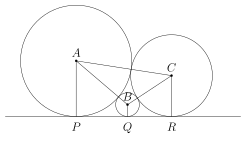
- Notice that subject to \(y > z > x\) all these steps are reversible, so we must have the equality we desire
2015 Paper 2 Q7
A circle \(C\) is said to be bisected by a curve \(X\) if \(X\) meets \(C\) in exactly two points and these points are diametrically opposite each other on \(C\).
- Let \(C\) be the circle of radius \(a\) in the \(x\)-\(y\) plane with centre at the origin. Show, by giving its equation, that it is possible to find a circle of given radius \(r\) that bisects \(C\) provided \(r > a\). Show that no circle of radius \(r\) bisects \(C\) if \(r\le a\,\).
- Let \(C_1\) and \(C_2\) be circles with centres at \((-d,0)\) and \((d,0)\) and radii \(a_1\) and \(a_2\), respectively, where \(d > a_1\) and \(d > a_2\). Let \(D\) be a circle of radius \(r\) that bisects both \(C_1\) and \(C_2\). Show that the \(x\)-coordinate of the centre of \(D\) is \(\dfrac{a_2^2 - a_1^2}{4d}\). Obtain an expression in terms of \(d\), \(r\), \(a_1\) and \(a_2\) for the \(y\)-coordinate of the centre of \(D\), and deduce that \(r\) must satisfy \[ 16r^2d^2 \ge \big (4d^2 +(a_2-a_1)^2\big) \, \big (4d^2 +(a_2+a_1)^2\big) \,. \]
Solution:
- \(C\) has the equation \(x^2 + y^2 = a^2\). One suitable circle would ideally pass through \((0,a)\) and \((0,-a)\) have a centre on the positive \(x\)-axis, so we would need \(a^2+c^2 = r^2\) so \(c = \sqrt{r^2-a^2}\) and the equation would be \((x-\sqrt{r^2-a^2})^2 + y^2 = r^2\). Clearly a circle with radius \(r < a\) cannot pass through two diametrically opposed points of a circle radius \(a\), since the furthest two points can be on a circle is \(2r\), and diametrically opposed points are \(2a\) apart. Similarly if they are exactly the same radii, then if they pass through diametrically opposed points they must be the same circle.
- Let the centre of \(D\) be at \((x,y)\), then it must be a distance of \(\sqrt{r^2-a_i}\) from each circle centre, ie \begin{align*} && (x-d)^2+y^2 &= r^2-a_2^2 \\ && (x+d)^2 + y^2 &= r^2-a_1^2 \\ \Rightarrow && 4dx &= a_2^2 - a_1^2 \\ \Rightarrow && x &= \frac{a_2^2-a_1^2}{4d} \\ \Rightarrow && y^2 &= r^2-a_1^2 - \left (\frac{a_2^2-a_1^2}{4d}+d \right)^2 \\ &&&= r^2 - a_1^2 - \frac{(a_2^2-a_1^2+4d^2)^2}{16d^2} \\ &&&= \frac{16d^2r^2-16d^2a_1^2 - a_2^4-a_1^4-16d^4+2a_1^2a_2^2+8a_1^2d^2-8a_2^2d^2}{16d^2} \\ &&&= \frac{16d^2r^2-8d^2a_1^2 - a_2^4-a_1^4-16d^4+2a_1^2a_2^2-8a_2^2d^2}{16d^2} \\ \Rightarrow && y &= \pm \sqrt{ \frac{16d^2r^2-8d^2a_1^2 - a_2^4-a_1^4-16d^4+2a_1^2a_2^2-8a_2^2d^2}{16d^2}} \end{align*} and we need \begin{align*} && 0 &\leq 16d^2r^2-8d^2a_1^2 - a_2^4-a_1^4-16d^4+2a_1^2a_2^2-8a_2^2d^2 \\ \Rightarrow && 16d^2 d^2 &\geq 8d^2a_1^2 + a_2^4+a_1^4+16d^4+2a_1^2a_2^2+8a_2^2d^2 \\ &&&= (4d^2+(a_2-a_1)^2)(4d^2+(a_2+a_1)^2) \end{align*}
2013 Paper 1 Q5
The point \(P\) has coordinates \((x,y)\) which satisfy \[ x^2+y^2 + kxy +3x +y =0\,. \]
- Sketch the locus of \(P\) in the case \(k=0\), giving the points of intersection with the coordinate axes.
- By factorising \(3x^2 +3y^2 +10xy\), or otherwise, sketch the locus of \(P\) in the case \(k=\frac{10}{3}\,\), giving the points of intersection with the coordinate axes.
- In the case \(k=2\), let \(Q\) be the point obtained by rotating \(P\) clockwise about the origin by an angle~\(\theta\), so that the coordinates \((X,Y)\) of \(Q\) are given by \[ X=x\cos\theta +y\sin\theta\,, \ \ \ \ Y= -x\sin\theta + y\cos\theta\,. \] Show that, for \(\theta =45^\circ\), the locus of \(Q\) is \( \sqrt2 Y= (\sqrt2 X+1 )^2 - 1 .\) Hence, or otherwise, sketch the locus of \(P\) in the case \(k=2\), giving the equation of the line of symmetry.
Solution:
- \(k = 0\), we have \(x^2 + y^2 + 3x + y = 0\), ie \((x+\tfrac32)^2+(y+\tfrac12)^2 = \frac{10}{4}\).

- \(3x^2 + 3y^2 +10xy = (3x+y)(x+3y)\) so \(x^2 + y^2 + \tfrac{10}3xy + 3x+y = (3x+y)(\frac{x+3y}{3}+1) = 0\) so we have the line pair \(3x +y =0\), \(x+3y + 3 = 0\)

- If \(k = 2\) then \((x+y)^2 + (x+y)+2x = 0\). If \(\theta = 45^\circ\) then \( X = \frac1{\sqrt{2}}(x+y), Y = \frac{1}{\sqrt{2}}(y-x)\), ie \(x+y = \sqrt{2}X\) and \(x = \frac{1}{\sqrt2}(X-Y)\), so our equation is:
\begin{align*}
0 &= 2X^2 + \sqrt{2}X + \sqrt{2}(X-Y) \\
&= (\sqrt{2}X + 1)^2 - 1 - \sqrt{2} Y
\end{align*}
which would be a parabola with line of symmetry \(X = -\frac{1}{\sqrt{2}}\).
However, we are actually looking at that parabola rotated by \(45^\circ\) anticlockwise.

2013 Paper 2 Q4
The line passing through the point \((a,0)\) with gradient \(b\) intersects the circle of unit radius centred at the origin at \(P\) and \(Q\), and \(M\) is the midpoint of the chord \(PQ\). Find the coordinates of \(M\) in terms of \(a\) and \(b\).
- Suppose \(b\) is fixed and positive. As \(a\) varies, \(M\) traces out a curve (the locus of \(M\)). Show that \(x=- by\) on this curve. Given that \(a\) varies with \(-1\le a \le 1\), show that the locus is a line segment of length \(2b/(1+b^2)^\frac12\). Give a sketch showing the locus and the unit circle.
- Find the locus of \(M\) in the following cases, giving in each case its cartesian equation, describing it geometrically and sketching it in relation to the unit circle:
- \(a\) is fixed with \(0 < a < 1\), and \(b\) varies with \(-\infty < b < \infty\);
- \(ab=1\), and \(b\) varies with \(0< b\le1\).
Solution: \begin{align*} && y &= bx-ba \\ && 1 &= x^2 + y^2 \\ \Rightarrow && 1 &= x^2 + b^2(x-a)^2 \\ \Rightarrow && 0 &= (1+b^2)x^2-2ab^2x+b^2a^2-1 \end{align*} This will have roots which sum to \(\frac{2ab^2}{1+b^2}\), therefore \(M = \left ( \frac{ab^2}{1+b^2}, \frac{ab^3}{1+b^2}-ba \right)=\left ( \frac{ab^2}{1+b^2}, \frac{-ba}{1+b^2} \right)\)
- Since \(b\) is fixed so is \(\frac{b}{1+b^2} = t\) and all the points are \((bta, -ta)\), ie \(x = -by\). If \(a \in [-1,1]\) we are ranging on the points \((bt, -t)\) to \((-bt, t)\) which is a distance of \begin{align*}
&& d &= \sqrt{(bt+bt)^2+(-2t)^2} \\
&&&= \sqrt{4(b^2+1)t^2} \\
&&&=2 \sqrt{(b^2+1)\frac{b^2}{(b^2+1)^2}} \\
&&&= \frac{2b}{\sqrt{b^2+1}}
\end{align*}

- If \(a\) is fixed we have \(\left ( \frac{ab^2}{1+b^2}, -\frac{ba}{1+b^2} \right)\)
\begin{align*}
&& \frac{x}{y} &= - b \\
\Rightarrow && y &= \frac{a\frac{x}{y}}{1 + \frac{x^2}{y^2}} \\
\Rightarrow && y^2 \left ( 1 + \frac{x^2}{y^2} \right) &= ax \\
\Rightarrow && x^2-ax + y^2 &= 0 \\
\Rightarrow && \left (x - \frac{a}{2} \right)^2 + y^2 &= \frac{a^2}{4}
\end{align*}
Therefore we will end up with a circle centre \((\tfrac{a}{2}, 0)\) going through the origin.

- If \(ab = 1\), we have \(\left ( \frac{b}{1+b^2}, -\frac{1}{1+b^2} \right)\)
\begin{align*}
&& \frac{x}{y} &= -b \\
\Rightarrow && y &= -\frac{1}{1+\frac{x^2}{y^2}} \\
\Rightarrow && y + \frac{x^2}{y} &= - 1 \\
\Rightarrow && y^2 +y+ x^2 &= 0 \\
\Rightarrow && \left ( y + \frac12 \right)^2 + x^2 &= \frac14
\end{align*}

- If \(a\) is fixed we have \(\left ( \frac{ab^2}{1+b^2}, -\frac{ba}{1+b^2} \right)\)
\begin{align*}
&& \frac{x}{y} &= - b \\
\Rightarrow && y &= \frac{a\frac{x}{y}}{1 + \frac{x^2}{y^2}} \\
\Rightarrow && y^2 \left ( 1 + \frac{x^2}{y^2} \right) &= ax \\
\Rightarrow && x^2-ax + y^2 &= 0 \\
\Rightarrow && \left (x - \frac{a}{2} \right)^2 + y^2 &= \frac{a^2}{4}
\end{align*}
Therefore we will end up with a circle centre \((\tfrac{a}{2}, 0)\) going through the origin.
2011 Paper 3 Q5
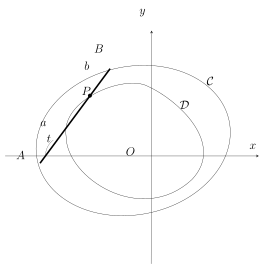
A movable point \(P\) has cartesian coordinates \((x,y)\), where \(x\) and \(y\) are functions of \(t\). The polar coordinates of \(P\) with respect to the origin \(O\) are \(r\) and \(\theta\). Starting with the expression \[ \tfrac12 \int r^2 \, \d \theta \] for the area swept out by \(OP\), obtain the equivalent expression \[ \tfrac12 \int \left( x\frac{\d y}{\d t} - y \frac{\d x}{\d t}\right)\d t \,. \tag{\(*\)} \] The ends of a thin straight rod \(AB\) lie on a closed convex curve \(\cal C\). The point \(P\) on the rod is a fixed distance \(a\) from \(A\) and a fixed distance \(b\) from \(B\). The angle between \(AB\) and the positive \(x\) direction is \(t\). As \(A\) and \(B\) move anticlockwise round \(\cal C\), the angle \(t\) increases from \(0\) to \(2\pi\) and \(P\) traces a closed convex curve \(\cal D\) inside \(\cal C\), with the origin \(O\) lying inside \(\cal D\), as shown in the diagram.
Solution: \begin{align*} && \tan \theta &= y/x \\ \Rightarrow && \sec^2 \theta \frac{\d \theta}{\d t} &= \frac{x \frac{\d y}{\d t} - y \frac{\d x}{\d t}}{x^2} \\ \Rightarrow && \frac{\d \theta}{\d t} &=\left (x \frac{\d y}{\d t} - y \frac{\d x}{\d t} \right) \frac{\cos^2 \theta}{x^2} \\ &&&=\left (x \frac{\d y}{\d t} - y \frac{\d x}{\d t} \right) \frac{\cos^2 \theta}{r^2 \cos^2 \theta } \\ &&&=\left (x \frac{\d y}{\d t} - y \frac{\d x}{\d t} \right) \frac{1}{r^2 } \\ && \tfrac12 \int r^2 \, \d \theta &= \tfrac12 \int \left (x \frac{\d y}{\d t} - y \frac{\d x}{\d t} \right) \d t \end{align*} \(A = (x - a \cos t, y - a \sin t), B = (x + b \cos t , y + b \sin t)\) \begin{align*} && [A] &= \tfrac12 \int_0^{2\pi} \left ((x-a \cos t) \frac{\d (y-a \sin t)}{\d t} - (y-a \sin t) \frac{\d (x-a \cos t)}{\d t} \right) \d t \\ &&&= \tfrac12 \int_0^{2\pi} \left ((x - a \cos t) \left ( \frac{\d y}{\d t} - a \cos t \right) - (y - a \sin t) \left ( \frac{\d x}{\d t} + a \sin t \right)\right) \d t \\ &&&= \tfrac12 \int_0^{2\pi} \left ( x \frac{\d y}{\d t} - y \frac{\d x}{\d t} - a \cos t \frac{\d y}{\d t}-ax \cos t +a^2 \cos^2 t + a \sin t \frac{\d x}{\d t}-y a \sin t + a^2 \sin^2 t \right) \d t \\ &&&= \tfrac12 \int_0^{2\pi} \left ( \underbrace{x \frac{\d y}{\d t} - y \frac{\d x}{\d t}}_{[P]}-a\left ((x + \frac{\d y}{\d x}) \cos t + (y - \frac{\d x}{\d t}) \sin t \right) + \underbrace{a^2}_{\pi a^2} \right) \d t \\ &&&= [P] + \pi a^2 - af \end{align*} \begin{align*} && [B] &= \tfrac12 \int_0^{2\pi} \left ((x+b \cos t) \frac{\d (y+b \sin t)}{\d t} - (y+b \sin t) \frac{\d (x+b \cos t)}{\d t} \right) \d t \\ &&&= \tfrac12 \int_0^{2\pi} \left ((x+b \cos t) (\frac{\d y}{\d t} + b \cos t) - (y+b \sin t)(\frac{\d x}{\d t} - b \sin t) \right) \d t \\ &&&= \tfrac12 \int_0^{2\pi} \left (x \frac{\d y}{\d t} - y \frac{\d x}{\d t} + b^2 + b(\cos t (x + \frac{\d y}{\d t}) +(y - \frac{\d x}{\d t})\sin t\right) \d t \\ &&&= [P] + \pi b^2 + b f \end{align*} Since \(A\) and \(B\) trace out the same area, we must have \(\pi a^2 - af = \pi b^2 + bf \Rightarrow \pi (a^2-b^2) = f(b+a) \Rightarrow f = \pi (a-b)\). In particular the area inbetween is \([A] - [P] = \pi a^2 - a \pi (a-b)\)